READING Key strategies include: Teacher directed guided reading - - PowerPoint PPT Presentation

reading
SMART_READER_LITE
LIVE PREVIEW

READING Key strategies include: Teacher directed guided reading - - PowerPoint PPT Presentation

WELCOME Year 3 Parent Partnership Afternoon CLASSROOM INSTRUCTION READING Key strategies include: Teacher directed guided reading lessons Explicit teaching Modelled, Shared, Independent, Collaborative, Reciprocal Reading Reading


slide-1
SLIDE 1

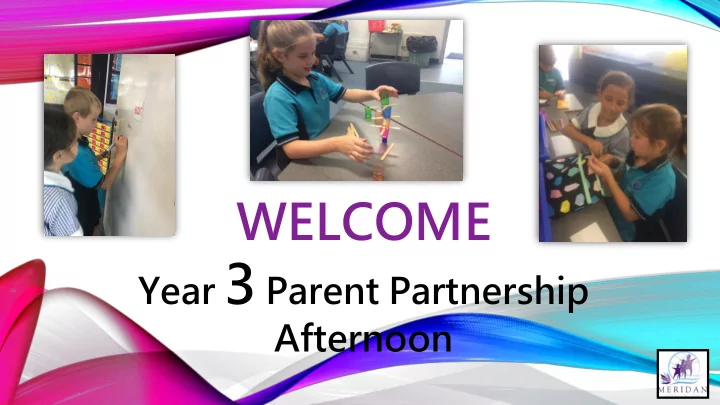
WELCOME

Year 3 Parent Partnership Afternoon

slide-2
SLIDE 2

Key strategies include:

  • Teacher directed guided reading lessons – Explicit teaching
  • Modelled, Shared, Independent, Collaborative, Reciprocal Reading
  • Reading Detective and Comprehension Strategies
  • Flexible grouping
  • Reading to children for enjoyment
  • Reading Stamina
  • Small groups formed for a specific purpose
  • Use of ICT devices to support literacy
  • Student/Teacher conferences
  • Setting goals and success criteria

CLASSROOM INSTRUCTION READING

slide-3
SLIDE 3

CLASSROOM INSTRUCTION READING

slide-4
SLIDE 4

Home reading is meant to be EASY and ENJOYABLE. Home reading books go home with homework and are be changed weekly The Reading Log on the Homework sheet needs to be filled in regularly and SIGNED. Children will be encouraged to become more independent as the year progresses with changing their books and monitoring what books they are reading.

HOME READING

slide-5
SLIDE 5

Maths Warm up Explicit teaching Focus Small group teaching/practising Reflection

WHAT DOES A NUMERACY BLOCK LOOK LIKE IN OUR CLASS?

Primary School Priorities P-3

slide-6
SLIDE 6

CLASSROOM INSTRUCTION NUMERACY

  • Maths Masters
  • Maths Boost
  • Fluency Focus
slide-7
SLIDE 7

LEARNING GOALS LITERACY AND NUMERACY

slide-8
SLIDE 8

Differentiation –Planning for Differentiation Feedback – To support learning Critical Thinking – Explicitly taught in all KLAs

Critical Thinking Frameworks are used across curriculum areas to frame thinking.

Critical thinking is at the core of most intellectual activity that involves students learning to recognise or develop an argument, use evidence in support of that argument, draw reasoned conclusions, and use information to solve problems. Creative thinking involves students learning to generate and apply new ideas in specific contexts, seeing existing situations in a new way, identifying alternative explanations, and seeing

  • r making new links that generate a positive outcome.

CRITICAL AND CREATIVE THINKING IN THE CLASSROOM

slide-9
SLIDE 9
  • 3. Student

udent Engagement gagement

Student Behaviour – Explicit Behaviour Lessons and Circle Time

STUDENT ENGAGEMENT AND WELLBEING

Circle Time Lessons Weekly Behaviour Lessons School wide behaviour rewards Recognising positive student achievements on assembly

slide-10
SLIDE 10

HOMEWORK

  • Consists of nightly reading, spelling and maths practice and a weekly task
  • Sent home Friday, back Thursday
  • Students will complete the weekly homework sheet and one weekly choice task
  • Each week two students will take a class scrapbook home focussing on a
  • Topic being studied in class
slide-11
SLIDE 11

SUPPORTING YOUR CHILD’S LEARNING

Any questions- see your child’s teacher Keep an eye out on school website for parent workshop times Working with students on homework- discuss new concepts, model and work together on both literacy and numeracy

slide-12
SLIDE 12

REMINDERS

3ET- Tuesday: Music, Drama Wednesday: PE Friday: Technology even weeks, Library 3JB- Tuesday: Music, Drama Wednesday: PE Thursday: Library Friday: Technology odd weeks PROTOCOLS

  • Students without a parent in the morning to go to Under Covered Area
  • If you arrive before 2:45pm to pick students up, please wait away from

windows as this can be very distracting to students when teaching is still being carried out

  • No playing on playgrounds before and after school
slide-13
SLIDE 13

EXCURSIONS AND EVENTS

Term 1

  • Setting expectations and routines
  • Parent Interviews
  • Reading Blitz

Term 2

  • NAPLAN Between12th – 22nd May
  • Written Reports
  • Market Day

Term 3

  • Parent Interviews
  • Learning Celebration- Multiplication

Game Fair

  • Incursion- Starlab
  • World Deaf Day Celebration

Term 4

  • Written reports
  • Excursion – Queensland Art Gallery in

Brisbane

  • Swimming program
  • Year 3 Art Celebration
slide-14
SLIDE 14

NAPLAN

NAPLAN Testing occurs for Year 3 between 12th – 22nd May

  • Reading
  • Writing
  • Language Conventions
  • Numeracy

If you have any concerns about your child’s participation in NAPLAN testing please discuss with the class teacher.

slide-15
SLIDE 15

Thank-you and welcome to your class community