Re duc ing Rur al Roadway De par tur e s E ve r y Day Counts - - PDF document

re duc ing rur al roadway de par tur e s
SMART_READER_LITE
LIVE PREVIEW

Re duc ing Rur al Roadway De par tur e s E ve r y Day Counts - - PDF document

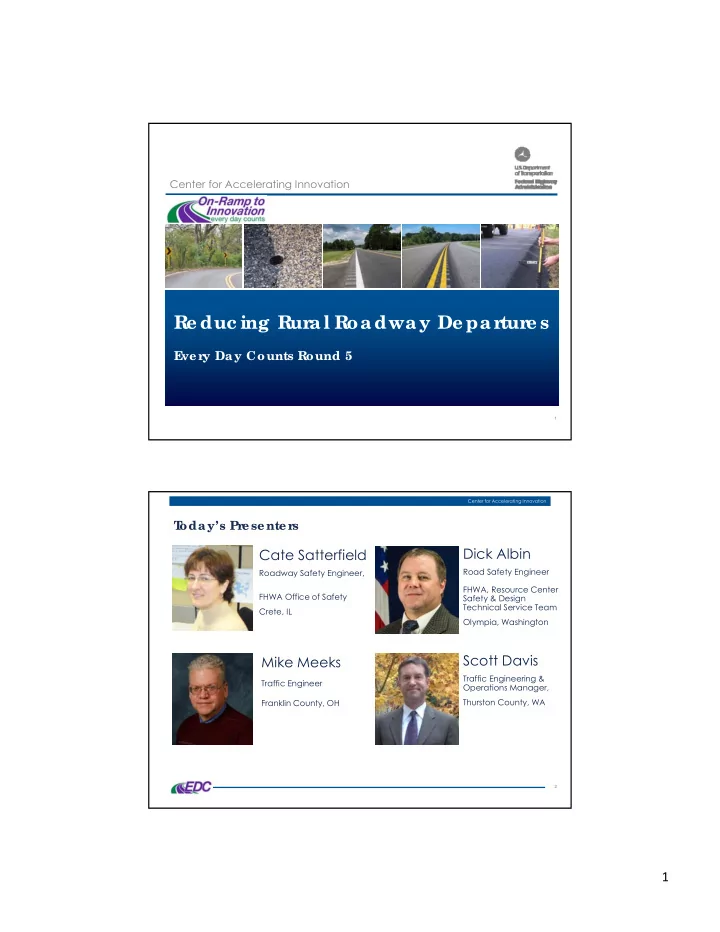
Center for Accelerating Innovation Re duc ing Rur al Roadway De par tur e s E ve r y Day Counts Round 5 1 Center for Accelerating Innovation T odays Pr e se nte r s Dick Albin Cate Satterfield Road Safety Engineer Roadway Safety


slide-1
SLIDE 1

1

Center for Accelerating Innovation

1

Re duc ing Rur al Roadway De par tur e s

E ve r y Day Counts Round 5

Center for Accelerating Innovation

T

  • day’s Pr

e se nte r s

2

Cate Satterfield

Roadway Safety Engineer, FHWA Office of Safety Crete, IL

Mike Meeks

Traffic Engineer Franklin County, OH

Dick Albin

Road Safety Engineer FHWA, Resource Center Safety & Design Technical Service Team Olympia, Washington

Scott Davis

Traffic Engineering & Operations Manager, Thurston County, WA

slide-2
SLIDE 2

2

Center for Accelerating Innovation

What is “Every Day Counts”(EDC)?

State-based model to identify and rapidly deploy proven but underutilized innovations to:

shorten the project delivery process enhance roadway safety reduce congestion improve environmental sustainability

  • EDC Rounds: two year cycles
  • Initiating 5th Round (2019-2020) - 10 innovations
  • To date: 4 Rounds, over 40 innovations

3

FAST Act, Sec.1444 For more information: https://www.fhwa.dot.gov/innovation/

Center for Accelerating Innovation

T he Mission

4

How? What? Why?

RRwD = 1/3 traffic deaths

Reduce the potential for serious injury and fatal roadway departure crashes on all public r

ur al r

  • ads by increasing the systemic deployment of

proven countermeasures.

slide-3
SLIDE 3

3

Center for Accelerating Innovation

Source: NHTSA FARS (2014 – 2016 Annual Average)

T he Rur al RwD Compone nt of F atalitie s

Rural RwD 11,874

34%

5 Center for Accelerating Innovation

What is a Roadway De par tur e (RwD)?

FHWA Definition: A crash in which a vehicle crosses an edge line, a center line, or otherwise leaves the traveled way.

6

Photo credit: FHWA Photo credit: Oregon State Police

slide-4
SLIDE 4

4

Center for Accelerating Innovation

Pe r c e nt Rur al RwD F atalitie s

7

53 63 37 44 (NH) 66 (VT) 69 63 32 54 51 65 36 52 40 46 45 5 (MA) 32 46 41 48 34 27 26 12 (CT) 43 22 37 31 21 10 (RI) 33 45 16 (MD) 60 31 (DE) 27 27 10 (NJ) 47 55 44 39 39 16 48 17 26 0 (DC) 36 54

> 50% average 35% - 50% average 20% - 34% average < 20% average

2014-2016 Annual Average of Rural Roadway Departures Source: FARS

Center for Accelerating Innovation

Rur al RwD F atalitie s

8

363 86 132 51 (NH) 36 (VT) 140 82 86 411 267 97 354 225 344 342 612 17 (MA) 1163 417 382 186 178 371 862 34 (CT) 284 197 446 334 67 5 (RI) 182 33 80 (MD) 130 38 (DE) 265 262 58 (NJ) 107 70 248 312 153 16 167 480 282 0 (DC) 267 145

> 500 fatalities 100-299 fatalities 25-99 fatalities < 25 fatalities 300-499 fatalities

2014-2016 Annual Average of Rural Roadway Departures Source: FARS

slide-5
SLIDE 5

5

Center for Accelerating Innovation

Why all public r

  • ads?

9

Local 16% Interstate 10% Other Principal Arterial 26% Minor Arterial 19% Major Collector 23% Minor Collector 6%

Roads typically maintained by states = 55% of Rural RwD fatalities Roads typically maintained by locals = 45% of Rural RwD fatalities

2014-2016 Annual Average of Rural Roadway Departures Source: FARS

Center for Accelerating Innovation

F Y2019 High Risk Rur al Roads Spe c ial Rule

Section 148(g)(1) of 23 U.S.C.

10

State Amount Montana $1,389,760 Nevada $1,487,814 New Mexico $1,887,424 Oregon $2,440,120 Pennsylvania $5,766,894 South Dakota $1,517,100 Utah $1,331,318 Virginia $4,459,774 Washington $3,144,572 State Amount Alabama $4,124,978 Alaska $900,000 Colorado $2,826,084 Georgia $6,299,452 Idaho $1,294,798 Illinois $6,048,546 Kentucky $2,879,986 Louisiana $3,085,174

slide-6
SLIDE 6

6

Center for Accelerating Innovation

Why do dr ive r s le ave the r

  • adway?

11

Roadway Condition Ve hic le Compone nt F ailur e Collision Avoidanc e

Dr ive r E r r

  • r

Polling Que stion

Photo credit: FHWA

Center for Accelerating Innovation

Cr ashe s Cause d by Var ious F ac tor s

12

Vehicle 12% Roadway 34% Driver 93% 27%

3%

1% 3% 57% 2% 6%

From: Lum & Reagan, Public Roads Magazine, Winter 1995, “Interactive Highway Safety Design Module”

Humans are the weakest link so we must design around human needs.

slide-7
SLIDE 7

7

Center for Accelerating Innovation 13 Center for Accelerating Innovation

How?

  • Systemic Analysis
  • Safety action plans
  • Deployment based
  • n risk factors

14

Systemic Deployment

Why? How? What?

RRwD = 1/3 traffic deaths

slide-8
SLIDE 8

8

Center for Accelerating Innovation

Whe r e would you inve st safe ty funds? 2012 2013 2014 2015 2016

Center for Accelerating Innovation

Most Har mful E ve nt

in Fatal Crashes

16

2012 2013 2014 2015 2016 Motor Vehicle In-Transport 289 249 267 388 373 Tree & Shrub (Standing Only) 158 149 155 153 163 Rollover/Overturn 132 136 142 159 161 Pedestrian 110 97 100 121 137 Embankment & Ditch 29 23 18 17 22 Utility Pole/Light & Sign Support 25 30 15 23 21 Traffic Barrier 16 7 18 16 14 Fire/Explosion 14 5 12 13 14 Pedalcyclist 13 15 14 16 25 Other Object (not fixed) 9 12 12 11 15 Culvert 8 5 8 10 7 Other Fixed Object 8 8 18 10 15 Parked Motor Vehicle 7 4 4 4 5 Live Animal 5 3 3 7 2 Curb 5 2 5 4 3

Source: FARS

slide-9
SLIDE 9

9

Center for Accelerating Innovation 17

Fatal crash locations

are

r andom

Source: Pexels

Center for Accelerating Innovation 18

Fatal crash types are

pr e dic table

Source: Pixabay

slide-10
SLIDE 10

10

Center for Accelerating Innovation

Syste mic Safe ty Impr

  • ve me nts

19

Syste mic

  • Based on Risk
  • Correlated with

particular severe crash types

An improvement that is widely implemented based on high-risk roadway features that are correlated with particular severe crash types.

http://safety.fhwa.dot.gov/systemic/index.htm

Center for Accelerating Innovation

Poll que stion

  • What are risk factors that you consider for roadway

departures?

20

slide-11
SLIDE 11

11

Center for Accelerating Innovation

Rur al Roadway De par tur e F atalitie s

by Most Har mful E ve nt

21

Head-On 3,354

28%

Rollover 3,609

30%

Trees 2,312

19%

2014-2016 Annual Average of Rural RwDs by MHE Source: FARS

Center for Accelerating Innovation

Highe r Spe e d is a Risk F ac tor

22

63% 84% 78%

0% 20% 40% 60% 80% 100% Tree Head-On Rollover Rur al RwD fatalitie s whe r e spe e d limit is > 50 MPH

2014-2016 Annual Average of Rural Roadway Departures Source: FARS

slide-12
SLIDE 12

12

Center for Accelerating Innovation

Cur ve s ar e a Risk F ac tor

23

50% 32% 44%

0% 10% 20% 30% 40% 50% 60% Tree Head-On Rollover Cur ve -r e late d Rur al RwD F atalitie s

2014-2016 Annual Average of Rural Roadway Departures Source: FARS

Center for Accelerating Innovation 24

State Str ate gic Highway Safe ty Plan (SHSP)

HSIP Other State Highway funds Local funding sources

SAF E T Y ACT ION PL ANS

  • Regional Plans
  • Tribal Plans
  • Local Plans
  • Other Plans

HSIP: 23USC 148(c), 23 CFR 924.7

slide-13
SLIDE 13

13

Center for Accelerating Innovation 25 Center for Accelerating Innovation

Minne sota E xample

26

State Trunk Highways 51% County Highways 36% Municipal Roads 7% Other Roads 6%

2015 Fatalities by Roadway in Minnesota

slide-14
SLIDE 14

14

Center for Accelerating Innovation

Minne sota Re sults

27

Source: Mark Vizecky, MnDOT

0.00 0.20 0.40 0.60 0.80 1.00 1.20 1.40 1.60 1.80 2.00 2003 2004 2005 2006 2007 2008 2009 2010 2011 2012 2013 2014

Fatality Rate* Year

County System State Highway System Interstate System

Begin Preparation of County Roadway Safety Plans Begin Widespread Deployment of Safety Strategies Along County System

Center for Accelerating Innovation

T ar ge t ze r

  • Washington State County Road Safety

28

slide-15
SLIDE 15

15

Center for Accelerating Innovation

Washington State Safe ty F ac ts

Counties maintain 47% of the road miles in Washington State

16% of the total vehicle miles traveled occur on County

roads The fatal crash rate is two times higher on county roads than on state highways.

29 Center for Accelerating Innovation

How doe s Washington State suppor t loc al r

  • ad safe ty?

Provides training Provides information Provides 70% HSIP funding to local agencies Over $200 million awarded to locals since 2009

30

State 30% County 30% City 40%

Percent Fatal & Serious Collisions

slide-16
SLIDE 16

16

Center for Accelerating Innovation

Cr ash Infor mation

 Provided by DOT  First Step in process  Easy to Use  Can quickly ID priorities

31 Center for Accelerating Innovation

County Road Safe ty Pr

  • gr

am Re sults

Over 80% of Washington State Counties have local road safety plans now

All the plans were completed by county staff

32

For more information contact Matthew Enders at EndersM@wsdot.wa.gov or visit

http://www.wsdot.wa.gov/LocalPrograms/Traffic/FedSafety.htm

slide-17
SLIDE 17

17

Center for Accelerating Innovation 33

L

  • c al Road Safe ty Plans

Center for Accelerating Innovation

Many Data Sour c e s

“Do what you can, with what you have, where you are.” – Theodore Roosevelt

34

Crash Maintenance Logs Road Safety Audits Enforcement

Safety Data

Roadway Traffic Volume

slide-18
SLIDE 18

18

Center for Accelerating Innovation

Quantitative Cr ash Analysis Me thods

35 Center for Accelerating Innovation

Qualitative Appr

  • ac h to Risk

Use qualitative ratings when needed:

  • Go o d, F

air, No t-S

  • -Go o d (c urve radius, ro adside ,

e tc .)

  • H

igh, Me dium, L

  • w (traffic vo lume s, pe de strian

vo lume s, c rash fre que nc y, e tc .) It is important to include the risk factors that are key to your roadway network

36

slide-19
SLIDE 19

19

Center for Accelerating Innovation

Poll que stion

  • Do you have a data-driven plan for your agency to

reduce rural roadway departures?

  • If so, has it been useful to get projects funded?

37

FRANKLIN COUNTY ENGINEER’S OFFICE Roadway Departure Programs

38

slide-20
SLIDE 20

20

Location Location Location

39

Incremental approach from simple to expensive. Based primarily on the human factor’s research of Ohio University researcher Helmut Zwhalen

Small hot spot Small systemic

Raised Pavement Markers 6” Center and Edge Lines Chevrons and Guardrail Reflectors

Signs on both sides/ Flashing Signs Signs on both sides/speed bars/chevrons

40

slide-21
SLIDE 21

21

Medium hot spot Medium systemic

Innovative/Active warning signs (w/Iowa State Research) Multi‐disciplinary Safety Audits

Crash curve rankings

41

Large hot spot

Realignment of curves Roundabout at intersection at curves

42

slide-22
SLIDE 22

22

43

Thurston County Public Works

THURSTON COUNTY

Local Road Safety Plan Case Example

44

slide-23
SLIDE 23

23

Thurston County Public Works

WHERE IS THURSTON COUNTY?

45

https://www.thurstoncountywa.gov/tchome/Pages/default.aspx Thurston County Public Works

THURSTON COUNTY SAFETY FACTS

Thurston County maintains over 1000 miles of roads

131 severe crashes were reported from

2012 to 2016 Over 70% of the severe crashes are reported to be lane departures

46

slide-24
SLIDE 24

24

Thurston County Public Works

CRASH DATA CHALLENGES

47

Thurston County Public Works

DATA ANALYSIS – SYSTEMIC SAFETY PROJECT SELECTION TOOL

48

https://safety.fhwa.dot.gov/systemic/

slide-25
SLIDE 25

25

Thurston County Public Works

EMPHASIS AREAS

49

2006‐2010 Collision Data

Fatal/Serious Injury Crashes Only All Roads All Counties Thurston County

Angle (left‐Turn) 16%

(2175)

13%

(468)

9%

(16)

Intersection‐Related 33%

(4557)

22%

(812)

19%

(34)

Horizontal Curve 26%

(3674)

39%

(1419)

45%

(80)

Thurston County Public Works

IMPLEMENTATION

50

1500 Signs 28 miles 65 miles 35 intersections 75,000 lineal feet 30,000 RPM’s 2 miles

Note: Improvements were completed over several HSIP funding programs and also through local forces

slide-26
SLIDE 26

26

Thurston County Public Works

RESULTS

51

35%

Reduction in target crashes

Used Proven Counter- measures L SRP by County staff

Thurston County Local Road Safety For more information regarding Scott Davis at davissa@co.thurston.wa.us or see case study at

https://safety.fhwa.dot.gov/systemic/tc.cfm

Center for Accelerating Innovation 52

slide-27
SLIDE 27

27

Center for Accelerating Innovation

Poll que stion

  • What data do you use?

53 Center for Accelerating Innovation

WHAT ?

  • Widespread, systemic

deployment of underutilized proven roadway departure countermeasures

54

Systemic Deployment Proven RRwD Countermeasures

Why? How? What?

RRwD = 1/3 traffic deaths

slide-28
SLIDE 28

28

Center for Accelerating Innovation

Roadway De par tur e Obje c tive s

55

1st - Keep vehicles on the road 2nd - Reduce the potential for crashes 3rd - Minimize the severity

Center for Accelerating Innovation

Str ate gie s inc lude :

Improved curve delineation Friction treatments in curves and

  • ther spot locations

Edge line, shoulder & center line rumble strips.

1st - Keep vehicles on the road

56

slide-29
SLIDE 29

29

Center for Accelerating Innovation

Impr

  • ve d Cur

ve De line ation

Source: CMF Clearinghouse, CMF IDs 2438 and 2439 Photo credit: Thurston County Photo credit: Thurston County

57

Che vr

  • n Signs:

25% Reduction in

nighttime crashes

16% Reduction in

non-intersection fatal and injury crashes

Center for Accelerating Innovation

High F r ic tion Sur fac e T r e atme nt (HF ST )

We t r

  • ad c r

ashe s r e duc e d 52% on Curves 86% on Ramps T

  • tal c r

ashe s r e duc e d 24% on Curves 35% on Ramps

http://www.fhwa.dot.gov/publications/research/safety/14065/14065.pdf Photo credit: FHWA Photo credit: FHWA

58

slide-30
SLIDE 30

30

Center for Accelerating Innovation

E dge & Ce nte r Rumble Str ips

Photo credit: FHWA Photo credit: FHWA Photo credit: FHWA

59

Ce nte r L ine Rumble Str ips

Head-on, opposite-direction, and sideswipe fatal and injury crashes reduced by

44- 64%

Shoulde r Rumble Str ips

Reduction in Single vehicle, run-off-road fatal and injury crashes reduced by

13- 51%

http://safety.fhwa.dot.gov/roadway_dept/pavement/rumble_strips/t504040/ http://safety.fhwa.dot.gov/roadway_dept/pavement/rumble_strips/t504039/

Center for Accelerating Innovation

Str ate gie s inc lude :

SafetyEdgeSM Maintained clear zones Traversable roadside slopes

2nd - Reduce the potential for crashes

60

slide-31
SLIDE 31

31

Center for Accelerating Innovation

Safe tyE dge SM

http://safety.fhwa.dot.gov/SafetyEdge/

With Safe tyE dge Without Safe tyE dge

Drop-off’s crashes 34% Head-on crashes 19% Run-off-Road crashes 21% Fatal and injury crashes 11%

Photo credit: FHWA Photo credit: FHWA

61

Cr ash Re duc tion F ac tor s

https://safety.fhwa.dot.gov/provencountermeasures/safety_edge/fhwasa17044/

Center for Accelerating Innovation

E stablish and Maintain Cle ar Zone s

AASHTO Definition — The unobstructed, traversable area provided beyond the edge of the through traveled way for the recovery of errant vehicles

Photo credit: FHWA

62

slide-32
SLIDE 32

32

Center for Accelerating Innovation

T r ave r sable Roadside Slope s

Slopes that are flatter than 3H:1V are traversable

  • 1V:2H to 1V:4 H → 10% reduction in SVROR
  • 1V:3H to 1V:6 H → 19% reduction in SVROR

Photo credit: FHWA Photo credit: FHWA

63

Source: AASHTO Highway Safety Manual

Center for Accelerating Innovation

Str ate gie s inc lude : Br e akaway F e atur e s

  • Signs and luminaire supports
  • Utility poles

Bar r ie r s to shie ld obstac le s inc luding:

  • Trees and shrubbery
  • Other fixed objects
  • Slopes

3rd - Minimize the severity

64

slide-33
SLIDE 33

33

Center for Accelerating Innovation

Polling Que stions on syste mic applic ation

  • Which of the following have you applied

systemically on rural roads?

  • For the ones you did not select, what are the

reasons?

65 Center for Accelerating Innovation

E DC-5 Offe r ings and Pr

  • duc ts

T e c hnic al Assistanc e

  • Local and Regional

Safety Action Plans

  • Systemic analysis
  • Peer exchanges
  • Focus groups on

implementation

66

T r aining

  • Webinars
  • Existing, revised, and

new training

  • Train-the-trainer
  • LTAP resource packet
slide-34
SLIDE 34

34

Center for Accelerating Innovation

Poll Que stion

  • How can we help you?

Please type your answers in the chat pod

67

Proven RwD countermeasures Systemic Deployment

Why? How? What?

RRwD are 34% of all fatalities

Center for Accelerating Innovation

EDC‐5 Funding Opportunities:

68

 State Transportation Innovation Council (STIC) Incentive

 Up to $100,000 per STIC per year to standardize an innovation  https://www.fhwa.dot.gov/innovation/stic/

 Accelerated Innovation Deployment (AID) Demonstration

 Up to $1 million available per year to deploy an innovation not routinely used  https://www.fhwa.dot.gov/innovation/grants/

slide-35
SLIDE 35

35

Center for Accelerating Innovation 69 Center for Accelerating Innovation

Innovation De ployme nt Ne ws

70

Weekly newsletter Bi-monthly magazine

T

  • Subsc r

ibe :

Email: https://www.fhwa.dot.gov/innovation/ Text: Send “F

HWA Innovation” to 468311