RBC Capital Markets Canadian Banks CEO Conference January 8, 2009 - - PDF document

rbc capital markets canadian banks ceo conference january
SMART_READER_LITE
LIVE PREVIEW

RBC Capital Markets Canadian Banks CEO Conference January 8, 2009 - - PDF document

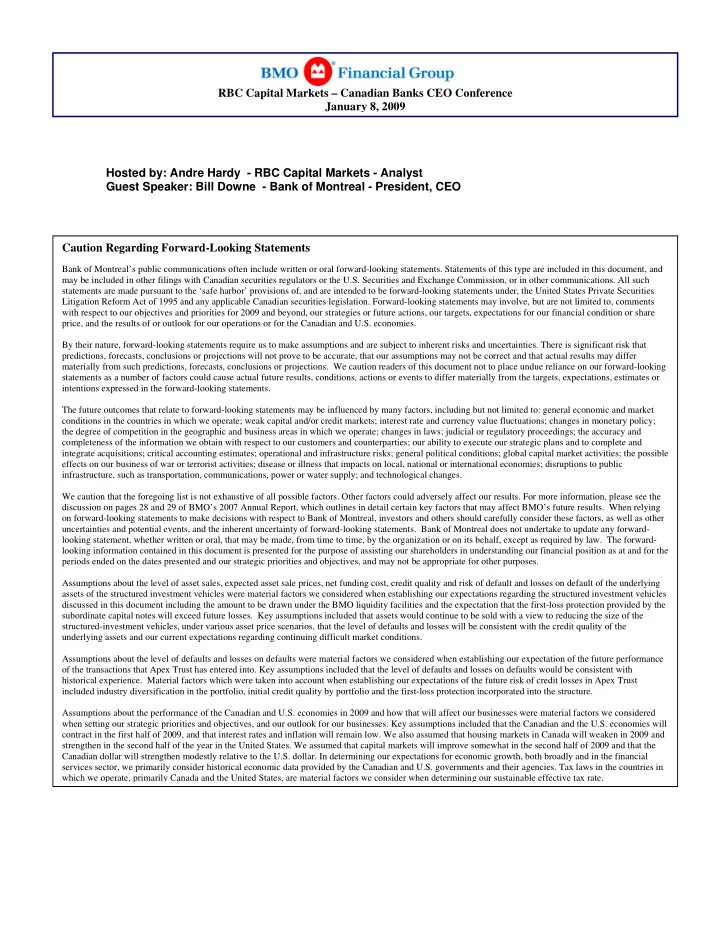
RBC Capital Markets Canadian Banks CEO Conference January 8, 2009 Hosted by: Andre Hardy - RBC Capital Markets - Analyst Guest Speaker: Bill Downe - Bank of Montreal - President, CEO Caution Regarding Forward-Looking Statements Bank of


slide-1
SLIDE 1

Hosted by: Andre Hardy - RBC Capital Markets - Analyst Guest Speaker: Bill Downe - Bank of Montreal - President, CEO RBC Capital Markets – Canadian Banks CEO Conference January 8, 2009 Caution Regarding Forward-Looking Statements

Bank of Montreal’s public communications often include written or oral forward-looking statements. Statements of this type are included in this document, and may be included in other filings with Canadian securities regulators or the U.S. Securities and Exchange Commission, or in other communications. All such statements are made pursuant to the ‘safe harbor’ provisions of, and are intended to be forward-looking statements under, the United States Private Securities Litigation Reform Act of 1995 and any applicable Canadian securities legislation. Forward-looking statements may involve, but are not limited to, comments with respect to our objectives and priorities for 2009 and beyond, our strategies or future actions, our targets, expectations for our financial condition or share price, and the results of or outlook for our operations or for the Canadian and U.S. economies. By their nature, forward-looking statements require us to make assumptions and are subject to inherent risks and uncertainties. There is significant risk that predictions, forecasts, conclusions or projections will not prove to be accurate, that our assumptions may not be correct and that actual results may differ materially from such predictions, forecasts, conclusions or projections. We caution readers of this document not to place undue reliance on our forward-looking statements as a number of factors could cause actual future results, conditions, actions or events to differ materially from the targets, expectations, estimates or intentions expressed in the forward-looking statements. The future outcomes that relate to forward-looking statements may be influenced by many factors, including but not limited to: general economic and market conditions in the countries in which we operate; weak capital and/or credit markets; interest rate and currency value fluctuations; changes in monetary policy; the degree of competition in the geographic and business areas in which we operate; changes in laws; judicial or regulatory proceedings; the accuracy and completeness of the information we obtain with respect to our customers and counterparties; our ability to execute our strategic plans and to complete and integrate acquisitions; critical accounting estimates; operational and infrastructure risks; general political conditions; global capital market activities; the possible effects on our business of war or terrorist activities; disease or illness that impacts on local, national or international economies; disruptions to public infrastructure, such as transportation, communications, power or water supply; and technological changes. We caution that the foregoing list is not exhaustive of all possible factors. Other factors could adversely affect our results. For more information, please see the discussion on pages 28 and 29 of BMO’s 2007 Annual Report, which outlines in detail certain key factors that may affect BMO’s future results. When relying

  • n forward-looking statements to make decisions with respect to Bank of Montreal, investors and others should carefully consider these factors, as well as other

uncertainties and potential events, and the inherent uncertainty of forward-looking statements. Bank of Montreal does not undertake to update any forward- looking statement, whether written or oral, that may be made, from time to time, by the organization or on its behalf, except as required by law. The forward- looking information contained in this document is presented for the purpose of assisting our shareholders in understanding our financial position as at and for the periods ended on the dates presented and our strategic priorities and objectives, and may not be appropriate for other purposes. Assumptions about the level of asset sales, expected asset sale prices, net funding cost, credit quality and risk of default and losses on default of the underlying assets of the structured investment vehicles were material factors we considered when establishing our expectations regarding the structured investment vehicles discussed in this document including the amount to be drawn under the BMO liquidity facilities and the expectation that the first-loss protection provided by the subordinate capital notes will exceed future losses. Key assumptions included that assets would continue to be sold with a view to reducing the size of the structured-investment vehicles, under various asset price scenarios, that the level of defaults and losses will be consistent with the credit quality of the underlying assets and our current expectations regarding continuing difficult market conditions. Assumptions about the level of defaults and losses on defaults were material factors we considered when establishing our expectation of the future performance

  • f the transactions that Apex Trust has entered into. Key assumptions included that the level of defaults and losses on defaults would be consistent with

historical experience. Material factors which were taken into account when establishing our expectations of the future risk of credit losses in Apex Trust included industry diversification in the portfolio, initial credit quality by portfolio and the first-loss protection incorporated into the structure. Assumptions about the performance of the Canadian and U.S. economies in 2009 and how that will affect our businesses were material factors we considered when setting our strategic priorities and objectives, and our outlook for our businesses. Key assumptions included that the Canadian and the U.S. economies will contract in the first half of 2009, and that interest rates and inflation will remain low. We also assumed that housing markets in Canada will weaken in 2009 and strengthen in the second half of the year in the United States. We assumed that capital markets will improve somewhat in the second half of 2009 and that the Canadian dollar will strengthen modestly relative to the U.S. dollar. In determining our expectations for economic growth, both broadly and in the financial services sector, we primarily consider historical economic data provided by the Canadian and U.S. governments and their agencies. Tax laws in the countries in which we operate, primarily Canada and the United States, are material factors we consider when determining our sustainable effective tax rate.

slide-2
SLIDE 2

Andre Hardy - RBC Capital Markets - Analyst

Thank you. So we’ll get started with our next session. Bill Downe, President and CEO of BMO Financial Group. We are happy to have you here. For those who don’t know Bill, Bill has been in his position since March 2007, but has been with the bank since the early ‘80’s. He spent a lot of time in the US, but also in Toronto through the years. Bill interestingly is also President of the Federal Reserve, Boards Federal Advisory Committee or Counsel, sorry, and spends a fair amount of time in the community including sitting on the Board of St. Michael’s Hospital here in Toronto. So Bill, on behalf of everyone in this room, thank you for participating. We have about 35-40 minutes and what we will do is you and I will chat in the beginning and then we will open it up for a few questions.

Bill Downe - Bank of Montreal - President, CEO

Sure, great.

Andre Hardy - RBC Capital Markets - Analyst

What we would like to start with is just a broad one, and if you look at the last 18 months, probably haven’t been very pleasant, but if you could help us understand how you feel at your bank, what it has done well, what it has done less well in those 18 months, and importantly how did those actions position you for the upcoming years.

Bill Downe - Bank of Montreal - President, CEO

Well, thanks Andre, it's great to be here and have a chance this early in the year to have a conversation and I think the format of this conference really lends itself to exploring issues. So thanks for the invitation, I appreciate being here. The last 18 months, probably even longer, I would say the last 24 months, clearly have been an amazingly challenging time for everybody in our industry, I don’t think there’s a person in this room, likely who has not felt enormously challenged. When I look at our bank and the 37,000 employees that we have, clearly they too have felt the

  • pressure. It's everyday, it's in the newspapers, it's on financial news. I think where I take the

greatest pride in our organization is that we’ve been able to keep the vast majority of the

  • rganization focused on moving the bank forward. And when I looked back last year, and the year

before and the year before, when I talked about what our strategic objectives were to dramatically strengthen the competitiveness of our personal and commercial bank in Canada and we’ve been successful in doing that. And it's across the whole broad range of things that I look for, our retail presence, the quality of our retail distribution points, the quality of the management in the business. Very significant changes in leadership roles, right through the organization. The quality of the front-line people from an attitude point of view that the approach that they take in dealing with customers. The visibility of the bank from a retail and commercial perspective, both in the sense of merchandizing and also the proactive calling that our people are doing in the marketplace and is showing up in improved market share numbers, improved customer loyalty numbers across every measure that we have and a visible shift in attitude within the system. So I would have to say that that was the most important assignment that we had or there has been a storm, that has been blowing over the financial services marketplace and we have been able to stay on the focus around the core strategy, I think it's really paid off. And notwithstanding the difficulties that have been experienced in valuation of assets, everywhere in the market, we have also been able to materially improve the bank’s position in that regard, continue to strengthen

slide-3
SLIDE 3

capital, continue to get off-balance sheet assets reduced and that gives me pretty good confidence that whether 2009 is a slow year and 2010 emerges or even if we have an extended recession that we will be able to continue to make progress.

Andre Hardy - RBC Capital Markets - Analyst

I want to start actually with your position on the advisory counsel and Feds Advisory Council. What kind of insights has that given you, which have changed or not changed, how you operate your bank in the US?

Bill Downe - Bank of Montreal - President, CEO

Well, the US system – I think one of the elements of the US system that I find very constructive is the level of engagement that takes place between business and government and I think one of the clear functions of the council is to have an active dialogue between effectively 12 bank CEO’s and the Governors of the Federal Reserve and in that kind of engagement and it takes place even beyond the Advisory Council because it takes place in each of the 12 Fed districts with the Governors is the opportunity to have an open dialogue amongst bankers about what's going on in the marketplace and we are all competitors, there is no question, but with respect to making certain that the market is well served then we understand what the – perhaps what the big macro events, what the impact of those are on our competitors, it's very helpful. So it's an active open dialogue, it gives us an insight. I think we are a very fortunate, Bank of Montreal is very fortunate because of the visibility and presence of Harris Bank to be participants and similarly it gives us, I think an opportunity to have some influence on public policy. Now we are starting to see some emergence of that in Canada as well, and I would have to say that the dialogue between the Department of Finance and the banking sector. This year has been dramatically higher than anything I have seen in my career.

Andre Hardy - RBC Capital Markets - Analyst

So sitting where you sit, if you look at the Canadian Banking or the North American Banking industry, credits were initiated in the US mostly so far, so what inning do you thing we are in the US?

Bill Downe - Bank of Montreal - President, CEO

In the US, I think we might be further through the restructuring of the banking industries and people fully appreciate. What we haven’t started to see is consolidation. I think I had anticipated that in the last four or five months, we would have seen quite a bit more consolidation and I think that the TARP equity injections in some sense delayed that, we would have expected them to be a little more, I want to use the right word and I want to be careful here, I think that there was a broad distribution of capital and we would have expected it to be more tilted to quality. And I think that would have accelerated the consolidation process. So, I think that’s been a little bit – that’s been a little bit delayed. But I think in 2009, you would see a lot of bank combinations that will in the consequences that would be to take excess capacity out

  • f the system. I think that would be very progressive. And I think that the fixed income market is

going to come back to life in 2009. I think the fixed income investors will start to come into the market with new issuance and I think you saw yesterday, the beginning of new issuance and when that process works it's way through, I think you will see 2009 will be a clear the decks year in the US and in 2010 hopefully positive economic growth.

slide-4
SLIDE 4

Andre Hardy - RBC Capital Markets - Analyst

The banks often talked about making further acquisitions in the US. Now this is an environment where things might be as cheap as they will ever be. We don’t know for sure, but might. So your approach, is that to say, the environment is cloudy, but then they are really cheap, it's time to do things, or there is going to be so much consolidation that waiting for a year doesn’t really matter because there will be more banks for sale in a year.

Bill Downe - Bank of Montreal - President, CEO

We’ve been very cautious in the last 18 months with respect to making acquisitions in the US and I still think it's early times and I think you can be quite patient to the extent that there are properties that are liquidated through the Federal Deposit Insurance Corporation. Those would be small

  • transactions. I think they present great opportunities to buy branches and deposits, to buy

somebody else’s loan book and have to work it out, not a very attractive proposition. Particularly because the concentration of real estate in regional and community US banks – commercial real estate is above 50%, our portfolio is below 25% and we would just shift the concentration if we made an acquisition at this particular time. Now both assets are written down in the course of 2009, great visibility into those balance sheets and that would be the time to think of the acquisition.

Andre Hardy - RBC Capital Markets - Analyst

But two Canadian Banks have had credit issues so far, yours and the one I work for. Partly it was positioning – whether a deconstruction real estate, which is where the initial problems were. When you look at the next leg of the US credit cycle, it looks like commercial real estate and traditional business lending is where the pain will be felt. Could you talk about how you might be better or worse positioned than you were in the early leg of the credit cycle?

Bill Downe - Bank of Montreal - President, CEO

Well, we are pretty well positioned in the early leg of the current cycle. If you look at the mortgage business in the United States, our delinquency rates are running still about 25% of the delinquency rate average of the peer banks in the United States. So on the mortgage side, we have done extremely well on home equity. We are about 10 or 15% below the delinquency rates, home equity

  • bviously has been elevated. The builder-developer portion of the market, that’s the one that you
  • referenced. It's working its way through. Clearly no developers are going to be able to generate

new revenues from building homes, because there is potentially no homes being built. And so I think that’s probably – it will work its way through the remainder of the year, so your question goes to what happens to commercial real estate and the broader corporate market. We have seen very, very little escalation of problems, in those areas to date. I think the commercial real estate market in the United States at the high end is really protected by the fact that there's very high occupancy and lease rates and very solid capital structures behind a lot of those – a lot of those developments. We go back to the early ‘90’s, a lot of big construction development was sitting on bank balance sheets. And today it isn't. So we are watchful around mid-market commercial in the US and that’s probably where you will see stress, but as I said, the proportion of our exposure in that area is relatively small on a peer to US

  • basis. And that, I think that’s where we have to look at the US peers and say, how we did it from a

qualitative point of view. And the reason that’s important is we are going to come out the other side

  • f this at some point and the banks that have relatively clean balance sheets in that market will be
slide-5
SLIDE 5

able to grow their business and very profitably because I expect that will have a lot less competition down at the ground level in 2009 and ‘10.

Andre Hardy - RBC Capital Markets - Analyst

And so on the topic of credit, as we move north, you eluded to very strong retail growth relative to peers, and I want to come back on the positive side of that. But I want to address the negative side as well. It's late in the cycle. You are picking up a lot of market share. Can you give us – and I think it's important for people here to realize traditionally you’ve had lower loan losses in retail in the industry; should we expect that to continue? Has something changed on the underwriting side that’s allowing you pick up that market share?

Bill Downe - Bank of Montreal - President, CEO

  • No. I don’t think it's on the underwriting side. It really goes back to our presence in the market, the

biggest adjustment that we have made is in the approach to customers, the accessibility of our front line people, the training that they have and the Canadian market will clearly experience some of the things that have taken place in the US market. I am not one of the people who is at all optimistic that what's taken place in the rest of the world, Canada is going to avoid. I think we are two years behind the United States and I would expect to see the same things occur in Canada as have

  • ccurred in the United States although to a lesser degree.

And one of the reasons is that the structure of the Canadian industry is fundamentally different. If you look at the mortgage business, a vast proportion of the originated mortgages, reside on Canadian bank balance sheets and a large proportion of those mortgages are government insured. And I think that provides a great deal of more stability and that even goes to the higher ratio loans and even the most problematic, I think in terms of the next six to twelve months, the long maturity and the forty year maturity loans and they carry very high proportions of government insurance. So I think structurally, the Canadian market will be protected somewhat. But we are going to see a slow down, there is no question and looking at the next year I don’t think we will see the same level

  • f loan growth in Canada at our bank for certain and I am speaking in context of the whole industry,

because borrower demand is falling, we can see it falling. From a quality standpoint, I do expect to see deterioration, but to date we have not seen it in the delinquency numbers in cards or in home equity or in mortgage. I think the last time you and I talked, the only thing I could put my finger on was the visibility of fraud losses, not gigantic fraud

  • losses. But those are usually the front edge of a stressed environment.

Andre Hardy - RBC Capital Markets - Analyst

And as we look at the economy, it certainly looks like it's going to be at least like the early ‘90’s. Not like the early 2000’s. It's your thoughts I am interested in. But I am also interested in how is your bank’s loan portfolio different today versus what it was in the early ‘90’s, because we are all sitting here trying to figure out how bad credit is going to get so that would be very helpful.

Bill Downe - Bank of Montreal - President, CEO

We have all done the same exercises. In order to understand the implications of rising provisions, we look back and say, “What happened in previous cycles?” One of the things that was different, no question in the early ‘90’s is the levels of concentration in single names in the portfolios. When I started in banking, and I did start my career with a US bank, lending more than 10% of your capital to a single name was against the law and in Canada, those concentrations in single names going into the downturn of the early ‘90’s were one or one and a half times individual bank capital.

slide-6
SLIDE 6

So I think one of the big differences in – we are not exactly sure how this is going to play out, but the single name concentration should – my expectation is should imply a lower peak than in 1990. Now that’s all – that’s all the depth of the recession dependent. If you replay the depth of the recession, then I would expect to see lower proportionate peaks. But reflect back on those days and the unemployment rate in Canada was close to 12% and we had – we had big, big deficits in the Federal and Provincial Governments and we had inflation. So, it's a different environment.

Andre Hardy - RBC Capital Markets - Analyst

And that’s by a good segway into capital. The bank raised capital in December in two different forms or might – it might have been three different forms; Why, the timing and is this to take advantage of what's going on or has the economy has deteriorated to a degree where the bank should have that kind of capital?

Bill Downe - Bank of Montreal - President, CEO

Well, from our point of view, when we looked, when we got into December, in to the latter half of December, and that’s when these events took place, looked into 2009, there was an enormous amount of uncertainty as to how available the capital was going to be. I think that in my mind was the biggest question, because there's been a lot of it of concern expressed over the refunding of maturing term debt in the US marketplace and there is a large bulge coming through the market as I said yesterday, the fact that GECC managed to get a 30-year issue done and quite handily, probably means that we were more pessimistic in our view of what 2009 could bring. But we knew that the first quarter was going to be a test of the market and the equity market had not been really showing any signs of life prior to the last two weeks in December, and it was really investor receptivity that changed their mind. And we saw the opportunity to issue some innovative tier one, we had some maturing pref. so we issued some pref. shares and with respect to common equity, it's either a case of there was going to be some significant opportunities to do good business in 2009, it was going to be important to have a high level of confidence in the capitalization or the risk of a fundamentally more difficult environment in the first quarter. And in either way, there was no visibility about capital raising and we made the decision that we would take advantage of that availability and go home for the turn of the year, with a much higher level, a piece of mind that I think any of us have had in the last couple of years. And I think that really was the reason. I think it has given us confidence that we have flexibility this year that we can continue to grow the businesses that we are focusing on. We might be able to take advantage of some smaller opportunities that would fit in nicely and most importantly if it had turned out that the beginning of the year was really a very, very negative environment, the door would have closed and the capital wouldn’t have been there.

Andre Hardy - RBC Capital Markets - Analyst

And conceptually, is capital there to be, and drawn on is not the right word, to be bled into a credit cycle and that we should expect it to go down, or you look at it the other way around, which is the more uncertain the environment is, the better capitalized you would want it to be?

Bill Downe - Bank of Montreal - President, CEO

I think in a time like this, being extremely well capitalized and being very liquid, give you the ultimate flexibility and the confidence that you can move your bank forward and that’s really where we are and I don’t think it's any anticipation that elevated provisions will drive down the

  • capitalization. I mean if you look at the last two years, the amount of loss that has been absorbed in

the portfolio, both much higher provisions for credit losses than we have seen in a decade and in

slide-7
SLIDE 7

valuations and we’ve been able to generate about $2 billion of after tax and net income, I think the earning power of the bank can absorb the provisions as they come through. Having strong capital, means that you don’t have to stay focused on the next 30 days, you can start to look ahead and say now, where is the bank going to be able to take advantage of opportunities.

Andre Hardy - RBC Capital Markets - Analyst

And with capital, we can't avoid the topic of dividends and the bank has a higher pay out ratio than

  • most. So I guess the way we ask the question is – is how patient is the board with the higher than

target pay out ratio?

Bill Downe - Bank of Montreal - President, CEO

Patient and it's interesting at the fourth quarter conference call, I made a very clear statement about the confidence I have in the earning power of the bank and the dividend and then in think it was you that asked me a question that took us down a long circular path around, could you devise a circumstance in which you wouldn’t feel the same way about the dividend. We are very patient with respect to the earning power of the bank. I believe that the core business is – as the cycle improves, have the capacity to generate much higher levels of net income and I think the pay out ratio will come back into line. So I am patient and I don’t want to speak for the – I don’t want to speak for the board, but in my interaction and communication with the board, there has been no difference of opinion at all.

Andre Hardy - RBC Capital Markets - Analyst

We’ll talk about capital markets a bit. There have been issues for all banks; there have been issues for your bank. How has that effected your thoughts on how much capital should be in that business and perhaps you could talk to us relative to two or three years ago, and what that ultimately means for earning power?

Bill Downe - Bank of Montreal - President, CEO

If I go back two or three years ago, and you asked me, how did I visualize our capital markets business going forward, I was pretty clear that I saw us as a mid-market investment bank. I think that – and this is the consequence of 30 years in banking with a big portion of it in the wholesale business, that when you center your business around clients and those are both at the issuing and investing clients. But when you center your business around clients and around the advisory part of the business, what you build is a strong and sustainable franchise and you are actually building equity in the firm in those relationships and that’s where BMO Capital markets, BMO Nesbitt Burns and the Bank of Montreal have done the best work over the longest period of time. Now in the last 24 months, there has been an escalation of the amount of capital in those businesses just because of the expansion of risk. The combination of risk migration and what's gone on in the trading business is actually push your allocation of capital on the same amount of business up. My own view is that around a third of the capital or less of the bank is properly deployed in the capital markets business and when you talk to the people – the professionals who work in that business, they understand, that doesn’t mean, we are going to withdraw from the

  • marketplace. In fact, we are probably going to put more emphasis on customer presence, less

emphasis on trading businesses that don’t have a direct customer input.

slide-8
SLIDE 8

Andre Hardy - RBC Capital Markets - Analyst

That being said, the banks trading revenues, if you exclude write-downs, they are doing quite good. So it looks like if you forget about write down’s, we will come back to those, the numbers are still coming in?

Bill Downe - Bank of Montreal - President, CEO

But if you look at the strongest parts of the trading revenue in the last few quarters, take the foreign exchange business, very, very strong contributor. I think our foreign exchange business stands out globally and that it's a high service business. The people who work in that business are really focused on mid-market customers and we’ve built tremendous utility, self serve utility, online utility for commercial clients and it's really paying off. So that’s trading activity that’s actually tied the customer business and it's very profitable. The other area that’s making a big contribution right now Andre, is the interest rate business and there is no question that that would be the case, because if you just look at the yield curve in the United States, it is positioned and stably positioned to provide a very positive return in the interest rate businesses and I expect that would continue for some time. That’s different I think than the trading businesses that we are pushing the frontier on new product, which we talked about endlessly and the impact that those had on the business and they were contributed in the past, but I can go back to 2004, 2005, look at the core earnings in investment and corporate banking and say that going beyond this cycle, I expect that we will be able to generate a third or a little bit more of the earnings of the bank from capital markets.

Andre Hardy - RBC Capital Markets - Analyst

And as you manage this through these exposures, is the bank able to take advantage of what's out there, whether there would be wider credit spreads, wider lending spreads, and could you give us examples of how that is playing out.

Bill Downe - Bank of Montreal - President, CEO

I think we are. One of the things that you have to do when you are making transition through a difficult period, is just remind yourself where you were 12 months ago and where you were 24 months ago. And where we were 24 months ago was a much more difficult situation given what was coming in the markets and where we are today, and we made significant reductions in those areas of concern in the last, certainly in the last 12 months, but in a period before that. And I think 2009 is the year in which the remainder of those concerns are going to come down again to a material level. The combination of strong capital – what we’ve done with our front line people with the strength of the marketing presence of the bank in the market, I think we absolutely have our position to take advantage. I was going to make a comment about the personal and commercial banking business in Chicago because one of the things that I am expecting in the next year or so is that the rationalization in that market which has been underway I think is going to create much better business opportunities than we’ve seen in quite some time. Going back four or five years ago, there was a big influx of

  • competitors. Many of them have been wiped out. They are withdrawing from the market closing –

they are closing branches. Our visibility in the market as the hometown bank, as the go-to bank with that very high service levels, is very high right now. And we are winning new customers, we are bringing in new deposit business, and on a cash net income basis, excluding the integration costs

slide-9
SLIDE 9
  • f the branches that we’ve been buying, you can see sequential growth in net income. So I think

there is a big opportunity there even without making acquisitions to grow earnings.

Andre Hardy - RBC Capital Markets - Analyst

We will come back to P&C, I want to ask about structured investment vehicles and APEX where we are clearly at a situation where the current market value is much lower than the theoretical value of

  • maturity. So I guess my question is accounting related. So today in a way, the bank is accounting

for these issues based on value at maturity. What needs to change for the gap between the current value and what these things are valued at to narrow or for the backed half to take a write down? Is actual defaults or is it?

Bill Downe - Bank of Montreal - President, CEO

It's actual defaults. We haven’t seen default levels in the SIV’s that are causing us concern. So the SIV’s we have reduced dramatically, $27 billion down to I think there is about $7 billion today. And in 2009, I think it's between 50 and $100 million a month just in maturities and these, as the assets mature, then the balance gets paid down. The year beyond, we end up with a fairly big pick up in natural reduction. And the average life of the assets is around 3.5 years. We have not seen credit deterioration and so the difference between the theoretical value and the expected value, is still

  • there. We watch it all the time. But in the absence of actual default, I think we are exactly where we
  • ught to be.

And it will narrow, time will actually cause it to narrow, because as you approach maturity then those valuations – market valuations – in the external market will come in.

Andre Hardy - RBC Capital Markets - Analyst

So as outsiders default is what we will need to watch?

Bill Downe - Bank of Montreal - President, CEO

Yes.

Andre Hardy - RBC Capital Markets - Analyst

Same for APEX?

Bill Downe - Bank of Montreal - President, CEO

Yes on APEX Tom Flynn did a very good job I think, of laying out the tranche structure in the last quarter and I am not going to go into the details of that but there is one tranche, a very small tranche at the top where I think defaults will be – will have an impact and that will give visibility to that and talk about it, the others I don’t think there is going to be an initiative.

Andre Hardy - RBC Capital Markets - Analyst

Back to P&C, and Canadian P&C. So we’ve had an increase in market share, you have eluded to an increase in customer loyalty. How much runway do you feel you have, i.e. you’ve done a lot of things for centralized expenses, put more money on the front lines so that that big kind of a

  • restructuring. How far along into it and how much of the pay off have you seen?
slide-10
SLIDE 10

Bill Downe - Bank of Montreal - President, CEO

Well, we are only this far into a very long journey with respect to reclaiming a much larger piece of the Canadian personal and commercial market. As far as managing expenses, it is true that we have been investing in the business, but we are also still growing revenues faster than expenses. And I think that the changes of management are largely complete, that we’ve done a good job across the country of putting new leaders in markets that are critically important. The branch building and branch renovation process, I think that there was a peak in 2006, 2007, 2008 and while we are going to continue to be investing, it's going to be at a lower level in 2009 and 2010. And slower economy means that those kinds of investments need to be constrained a little bit. But with respect to the promise we’ve made to our customers, it's really built on a combination of service and identification of needs. And I can run through five or six areas where we have made product changes in the last twelve months and Frank Techar who is the president of the business has committed to every three or four months, a new offer in the marketplace. The most recent one, which I don’t know whether you have seen, but we just introduced a program in December for new

  • homebuyers. And I think it's unique in the Canadian marketplace and that it was a soft entry. We

put it on the websites first. It's only available online. But it basically consists of a new home buyer’s

  • kit. It has every element that a home buyer would need to address in order to buy a house. They

would say, well this is kind of an interesting idea. How does it work? Well, the customer pays for it. They pay $25 for it and we sold thousands of them. It's quite surprising and once they take the package home and start to work their way through it, it actually brings them into a direct dialogue with our bankers around various elements. All of the things that you need to think about buying a home. Well, we think that there was a correction in the house price market. These kinds of tools are going to be very important to consumers and we plan to have new offerings on that kind of time table and this can go on for a very long time and I think it will stimulate more and more interest in BMO.

Andre Hardy - RBC Capital Markets - Analyst

And as you measure your customer loyalty scores, presumably, you measure the competition and are you --?

Bill Downe - Bank of Montreal - President, CEO

Every month.

Andre Hardy - RBC Capital Markets - Analyst

And are you catching up to where they are, or is everybody rising?

Bill Downe - Bank of Montreal - President, CEO

  • No. Well everybody was rising. I think we were in a dual for a fifth place two or three years ago and

we moved up into fourth place and we are now clearly in third place with respect to customer loyalty in the country. That’s the kind of progress I want to see. It's not going to be overnight on your way to number one, but when I look at NPS, Net Promoter Score, which is the measure that we’ve used most extensively in the US and have introduced to our bank branches in Canada. When the numbers are down in the 20’s that means you basically have very unhappy customers, because this is happy customer minus unhappy customers. Once we get across the country in every district the number is above 30 which is where we are now, and I have a much higher level of confidence in our relationship with our customers. And we want to push those numbers from where they are up into the 40’s.

slide-11
SLIDE 11

Andre Hardy - RBC Capital Markets - Analyst

What about funding that business that you are getting? During the 2000’s, loan growth was much greater than deposit growth, core deposit growth. Will we see a more balanced approach or result going forward given what's happened in wholesale funding markets?

Bill Downe - Bank of Montreal - President, CEO

There's no question the loan book was growing faster than the deposit book. In the last few months, we’ve actually seen, and I think it has something to do with product introduction that we’ve done. We’ve actually seen a strengthening of deposit growth. We had one period where we actually had a nice up tick. The month of December, I don’t think it was as strong, but what we’ve seen is on all of

  • ur new deposit product introductions, we’ve seen very high levels of acceptance.

So I am expecting one of the most significant phenomenons that we are going to see, is that as consumers start to save, there's actually going to be a movement of deposits up and we are projecting lower loan, demand then higher deposit growth for 2009.

Andre Hardy - RBC Capital Markets - Analyst

On the topic of margins, we all know your funding costs are up, they are up for all the banks. Where are you re-pricing customers and is it happening quicker than funding costs have gone up?

Bill Downe - Bank of Montreal - President, CEO

  • No. I think it's about the same pace. Where we are re-pricing customers revolves primarily around

risk premiums, so re-pricing of customers in the higher risk categories and that’s to avoid adverse selection if you want in the loan growth. So we are putting a lot of emphasis on identifying lower quality customers and renegotiating or sitting down and having conversations about price on those. I mean in some areas we are being very competitive. We have the best five-year fixed mortgage rate in Canada right now. And we are getting good growth in that particular area. So I think the team is really focused on the areas of the highest quality and where we can get some competitive profiles.

Andre Hardy - RBC Capital Markets - Analyst

And before we open the floor to questions, I will ask you one last one. If you have your crystal ball and it's clear, how would BMO going to be different three years versus two years ago?

Bill Downe - Bank of Montreal - President, CEO

It's going to be an extension of the elements and the strategy that I’ve talked about. We have a very clear plan of where we are going. We are going to stay on that plan and it's going to be in the area

  • f customer service and the aggressiveness with which we manage the company. So it's customer

service in the management of performance.

Andre Hardy - RBC Capital Markets - Analyst

And maybe to make that answer even more useful for a crowd that cares about the bottom line, the capitalization change, the margins, will that look different, the risk profile?

slide-12
SLIDE 12

Bill Downe - Bank of Montreal - President, CEO

Well, the business mix will change, so you are going to see a faster rate of growth in personal and commercial banking than in the wholesale business. There is no question about, that changes the margin of the bank in its entirety. I think tier one capital at the 10% and above level in the short run is a good idea. We have a floor of 8% on our tier one capital and I think that the capitalization of banks as we move through the cycle will probably come into an area where people think that nine- plus tier one capital on a long-term basis is appropriate and sustainable. Our tangible common to equity to risk assets is above 7%. I think that’s a level that’s clearly

  • important. With respect to return on equity, it's in our medium term targets. We want to see the

return on equity about 17%, so 17 to 20% in the long run. I think we can get back to 10% earnings per share growth. So that gives you the view where we set up a pretty clear sense of that. And there are still good opportunities to improve the expense to revenue ratio in the company and that means that we have to be growing revenues about 2% faster than expenses in the long run. So if you put all of those things together, what it says is we expect a pretty strong bank as we look beyond the credit cycle.

Andre Hardy - RBC Capital Markets - Analyst

Okay, thanks. So with that we will open the floor up for questions and again, please wait until you have the mike before asking the question.

Q&A

Audience Member

Last year, Deutsch Bank in Europe, chose not to call fixed floater structure and caused some upset in market. There is predominance to that kind of structure in the Canadian market. I just wanted you to make some general comments on your thoughts behind Deutsch Bank decision and how you see that type of funding in Canada going forward?

Bill Downe - Bank of Montreal - President, CEO

I can't comment on what caused that decision. I would say that I thought it was surprising and I am really unsure what led them to that decision and I think maintaining a good relationship with your fixed income investors long-term is a critical thing to do. Surprising investors is not a good thing to do, and my own anticipations we will see a pretty orderly refinancing market in 2009 and I don’t think you will see examples of that in the Canadian marketplace. And I would love to ask you what you think of it, but it's probably not appropriate with the time remaining. I probably – I can probably guess what you think of it.

Audience Member

It's nice to see you. If I read between all of the lines, it sounds to me like you guys – which is a little different than what I have been hearing, and you feel that rates on the personal lending and personal incorporate lending side, especially are quite high and you would like to grow your book in that area, quickly before interest rates come down, because the fixed income market is going to be really hot this year. Clearly that we suggested the – that some of the higher risk spreads are – at least you expect some of those to come down, which would make the – any business you can pick up quite profitable in the meantime. Is that sort of right?

slide-13
SLIDE 13

Bill Downe - Bank of Montreal - President, CEO

Well, looking through the past cycles, the 18 months after the peak in provisioning, the risk reward for lending has been appropriate for the capital that’s deployed. Outside of that period, the return on lending is generally around the cost of capital and the reason why you do it is because your advisory businesses are tied to that business. So I think lending spreads have widened out to a level that clearly has a very good risk award and to the extent that we are able to do well-structured business, we are going to do it and we are not going to hold back from writing good business at a time like this, because you are right, the spreads are very good. But more importantly, I think the business has to look beyond when those spreads come in and make certain that investing if you want time and energy and relationships that are going to be broad enough that the return is sustainable beyond that 18-month period. So if you have a relationship where the loan return is 8 or 9% but the relationship return is 17 or 18%, you are in a happy place. If you do a loan that has a return of 15 or 16% today, but there's no other revenue attached to it, it's certain that your relationship is going to go below your cost of capital. But I think there is a little bit of art in that decision-making. But making good loans with the appropriate risk return spread, is best on right now and as I say, it's about an 18-month window.

Audience Member

I know that you mentioned APEX and SITKA, but I was wondering if you could just comment on the securitization sector industry. I know that BMO has been a major player and I just want to see your comments on how do you see that going forward.

Bill Downe - Bank of Montreal - President, CEO

  • Sure. Asset securitization in multi-contributor conduits have declined in size of the proportion of the

financing market dramatically and the same thing has happened in the case of our own involvement in the market. Most of the programs have been reducing in size, programs that have come up for renewal are not getting redone and it has everything to do with investor demand. There really is a strong investor demand for asset back commercial paper in Canada. It's relatively small universe of

  • investors. It shrunk. And I think until an alternative to the existing structures comes into place, you

are just going to see an eventual run off of those businesses. I do think there is going to be – there will be other structures that will develop and they will probably – they will probably revolve around

  • syndication. The structure is not single bank sponsored structures but multi-bank sponsored

structures, but it's really unclear what form they will take and as of yet, I am not certain that there's enough money in those structures to pay people for the liquidity risk that’s attached to them. So I think there will be more pressure on corporate borrowers to term their liabilities which in my own view they ought to have a little better match of duration on their assets and their liabilities

  • anywhere. Less reliance on short-term markets to fund longer-term assets on the balance sheet

and in our case, we are working very hard to try to develop alternatives to the existing structures recognizing that the existing structures are very unlikely to survive. I think they will all mature out. And I think within two years, the path we on will essentially be gone.

Andre Hardy - RBC Capital Markets - Analyst

Thank you Bill.

Bill Downe - Bank of Montreal - President, CEO

Thanks very much. It's great to have a chance to be here, and good luck with the rest of your conference.