
SLIDE 1
Rapid Prototyping of Eclipse RCP Applications
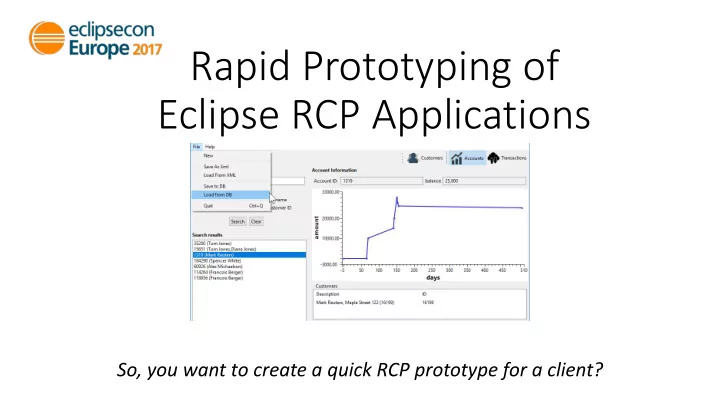
So, you want to create a quick RCP prototype for a client?
Rapid Prototyping of Eclipse RCP Applications So, you want to - - PowerPoint PPT Presentation
Rapid Prototyping of Eclipse RCP Applications So, you want to create a quick RCP prototype for a client? About us Speaker Patrik Suzzi, www.itemis.ch Software Engineer Eclipse Platform Committer Audience Are you familiar with
So, you want to create a quick RCP prototype for a client?
Software Engineer Eclipse Platform Committer
+ Nebula Widgets (to use XY Graph)
http://download.eclipse.org/nebula/releases/latest
+ WindowBuilder (if not already installed in Eclipse IDE for RCP..)
http://download.eclipse.org/windowbuilder/WB/integration/4.8/
+ EclipseLink (JPA and JAXB)
https://www.eclipse.org/eclipselink/downloads/ + Database (Derby) https://db.apache.org/derby/
listeners!
*
transactions
*
customers
*
transactions
*
accounts
*
customers
*
accounts recipientAccount sourceAccount
Account Deposit Charge Bank
Customer Transfer Withdrawal
#amount: double #confirmed: boolean #processed: boolean
Transaction
Bank bank = new Bank(); // create customers Customer c1 = new Customer("Tom", "Jones", "Garden Street 8"); Customer c2 = new Customer("Diana", "Jones", "Garden Street 8"); Customer c3 = new Customer("Mark", "Reuters", "Maple Street 122"); Customer c4 = new Customer("Spencer", "White", "Avenue Pontida 1"); Customer c5 = new Customer("Alex", "Michaelson", "Red Square 14b"); Customer c6 = new Customer("Francois", "Berger", "Frederickstrasse 87"); bank.addCustomers(c1,c2,c3,c4,c5,c6); // add accounts and link to customers Account a1 = new Account().link(c1); Account a2 = new Account().link(c1, c2); Account a3 = new Account().link(c3); Account a4 = new Account().link(c4); Account a5 = new Account().link(c5); Account a6 = new Account().link(c6); Account a7 = new Account().link(c6); bank.addAccounts(a1,a2,a3,a4,a5,a6,a7); // add transactions Transaction t1 = new Deposit().create(5000, a1).confirm("2016-02-20").process(); Transaction t2 = new Charge().create(250, a1).confirm("2016-03-10").process(); Transaction t3 = new Transfer().create(1000, a1, a2).confirm("2016-04-05").process(); Transaction t4 = new Deposit().create(10000, a3).confirm("2016-04-06").process(); Transaction t5 = new Deposit().create(5000, a3).confirm("2016-04-10").process(); Transaction t6 = new Deposit().create(5000, a3).confirm("2016-06-21").process(); Transaction t7 = new Deposit().create(10000, a3).confirm("2016-06-23").process(); Transaction t8 = new Withdrawal().create(2500, a3).confirm("2016-07-01").process(); Transaction t9 = new Charge().create(1500, a3).confirm("2016-07-03").process(); Transaction t10 = new Transfer().create(1000, a3, a2).confirm("2016-07-05").process(); bank.addTransactions(t1,t2,t3,t4,t5,t6,t7,t8,t9,t10); // test mock data assertEquals("Nr. of Customers", 6, bank.getCustomers().size()); assertEquals("Nr. of Accounts", 7, bank.getAccounts().size()); assertEquals("Nr. of Transactions", 10, bank.getTransactions().size()); // test containment assertThat("Account's customer", a1.getCustomers().contains(c1)); assertThat("Customer's account", c1.getAccounts().contains(a1)); assertThat("Transaction's account", t1.getSourceAccount().equals(a1));
@XmlRootElement public class Bank {...} @XmlAttribute @XmlID public String getId() {...} @XmlList @XmlIDREF public List<Account> getAccounts() { ... }
referencing entities
superclass
@XmlSeeAlso({Deposit.class, Charge.class, Withdrawal.class, Transfer.class}) @XmlRootElement public abstract class Transaction {...}
public static void persistXml(File xmlFile, Bank bank) { JAXBContext jaxbContext = JAXBContext.newInstance(Bank.class); Marshaller marshaller = jaxbContext.createMarshaller(); marshaller.setProperty(Marshaller.JAXB_FORMATTED_OUTPUT, true); marshaller.marshal(bank, xmlFile); } public static Bank loadXml(File xmlFile) { JAXBContext jaxbContext = JAXBContext.newInstance(Bank.class); Unmarshaller unmarshaller = jaxbContext.createUnmarshaller(); Bank bank = (Bank) unmarshaller.unmarshal(xmlFile); return bank; }
Usage: TestPersistence.java
<bank id="59340"> <customers id="2711"> <accounts>143365 170217</accounts> <address>Garden Street 8</address> <firstName>Tom</firstName> <lastName>Jones</lastName> </customers> <accounts id="143365"> <balance>3750.0</balance> <creationDate>2016-02-01T00:00:00+01:00</creationDate> <customers>2711</customers> <transactions>110290 79075 91111</transactions> </accounts> <transactions xmlns:xsi="http://www.w3.org/2001/XMLSchema- instance" xsi:type="deposit" id="110290"> <amount>5000.0</amount> <confirmed>true</confirmed> <confirmedDate>2016-02-20T00:00:00+01:00</confirmedDate> <processed>true</processed> <processedDate>2016-02-20T00:00:00+01:00</processedDate> <sourceAccount>143365</sourceAccount> </transactions> </bank>
Aggregation ID list ID attribute Subclass
discriminating column
@MappedSuperclass public class BaseModel {...} @Entity public class Bank extends BaseModel{...} @OneToMany @JoinColumn(name="BANK_ID") public List<Customer> getCustomers() {...} @Entity @Inheritance(strategy = InheritanceType.SINGLE_TABLE) @Table(name="T_TRANSACTION") @DiscriminatorColumn(name="T_TYPE") public abstract class Transaction {...} @Entity @DiscriminatorValue("D") public class Deposit extends Transaction {...}
public static void persistDB(Bank bank){ EntityManager em = instance().getEntityManager(); em.getTransaction().begin(); em.merge(bank); em.flush(); em.getTransaction().commit(); } public static Bank loadDB() throws JAXBException { EntityManager em = instance().getEntityManager(); em.getTransaction().begin(); TypedQuery<Bank> query = em.createQuery(SELECT_BANK, Bank.class); Bank bank = query.getSingleResult(); return bank; }
Usage: TestPersistence.java
@Execute public void execute(MApplication app, IEventBroker eventBroker) { Bank bank = new Bank(); app.getContext().set(Bank.class, bank); eventBroker.send(EventConstants.TOPIC_MODEL_MODIFIED, bank); } @Inject @Optional private void modelModified(@UIEventTopic( EventConstants.TOPIC_MODEL_MODIFIED) Bank model) { setModel(model); }
Handlers Commands MenuItems Perspectives Sash Containers View Parts Controls
Filter/search select edit
public void setModel(Bank model) { if(model==null) return; disposeBindings(m_bindingContext); super.setModel(model); if(listViewer==null) return; m_bindingContext = initDataBindings(); update(); } @Inject @Optional private void modelModified(@UIEventTopic( EventConstants.TOPIC_MODEL_MODIFIED) Account account) { update(); }
listViewer.addSelectionChangedListener((e)->{ selectionService.setSelection( listViewer.getStructuredSelection().getFirstElement()); }); @Inject protected ESelectionService selectionService; btnSearch.addSelectionListener(new SelectionAdapter() { public void widgetSelected(SelectionEvent e) { update(); } });
private void update() { tableViewer.refresh(); tableViewer_1.refresh(); resizeColumns(table); resizeColumns(table_1); ChartHelper.generateGraph(lws, getModel()); }
// don't instantiate the lightweigt twice. // it won't refresh the chart on Mac lws = new LightweightSystem(canvas); void generateGraph(LightweightSystem lws, Account account) { XYGraph xyGraph = new XYGraph(); lws.setContents(xyGraph); xyGraph.setTitle("Balance chart"); // create the trace CircularBufferDataProvider provider = ... Trace trace = new Trace("Trace1", xyGraph.getPrimaryXAxis(), xyGraph.getPrimaryYAxis(), provider); // add the trace to xyGraph xyGraph.addTrace(trace); }
Filter/search
ece2017/com.itemis.e4.banking
Th Than ank yo you fo for yo your at atten entio ion!
itemis AG | Am Brambusch 15-24 | D-44536 Lünen | www.itemis.de