SLIDE 1
Randome Variables and Expectation
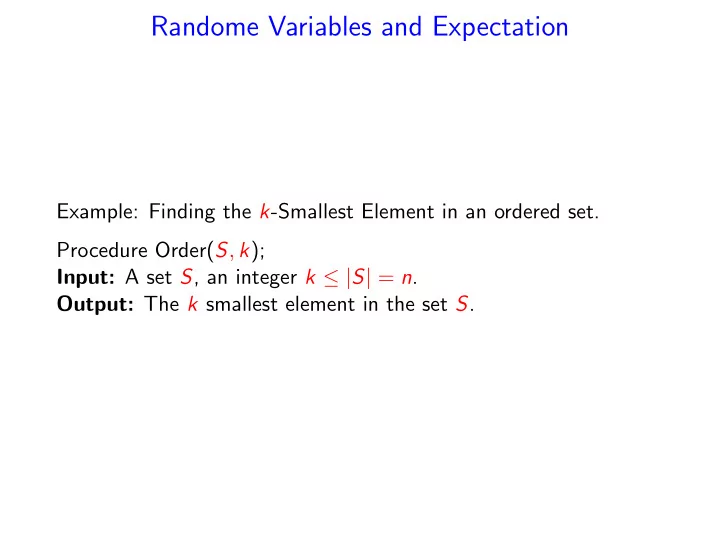
Example: Finding the k-Smallest Element in an ordered set. Procedure Order(S, k); Input: A set S, an integer k ≤ |S| = n. Output: The k smallest element in the set S.
SLIDE 2
Example: Finding the k-Smallest Element
Procedure Order(S, k); Input: A set S, an integer k ≤ |S| = n. Output: The k smallest element in the set S.
1 If |S| = k = 1 return S. 2 Choose a random element y uniformly from S. 3 Compare all elements of S to y. Let S1 = {x ∈ S | x ≤ y}
and S2 = {x ∈ S | x > y}.
4 If k ≤ |S1| return Order(S1, k) else return Order(S2, k − |S1|).
Theorem
1 The algorithm always returns the k-smallest element in S 2 The algorithm performs O(n) comparisons in expectation.
SLIDE 3 Random Variable
Definition A random variable X on a sample space Ω is a real-valued function on Ω; that is, X : Ω → R. A discrete random variable is a random variable that takes on only a finite or countably infinite number of values. Discrete random variable X and real value a: the event “X = a” represents the set {s ∈ Ω : X(s) = a}. Pr(X = a) =
Pr(s)
SLIDE 4 Independence
Definition Two random variables X and Y are independent if and only if Pr((X = x) ∩ (Y = y)) = Pr(X = x) · Pr(Y = y) for all values x and y. Similarly, random variables X1, X2, . . . Xk are mutually independent if and only if for any subset I ⊆ [1, k] and any values xi,i ∈ I, Pr
Xi = xi
Pr(Xi = xi).
SLIDE 5 Expectation
Definition The expectation of a discrete random variable X, denoted by E[X], is given by E[X] =
i Pr(X = i), where the summation is over all values in the range of X. The expectation is finite if
i |i| Pr(X = i) converges; otherwise, the
expectation is unbounded. The expectation (or mean or average) is a weighted sum over all possible values of the random variable.
SLIDE 6
Median
Definition The median of a random variable X is a value m such Pr(X < m) ≤ 1/2 and Pr(X > m) < 1/2.
SLIDE 7
Linearity of Expectation
Theorem For any two random variables X and Y E[X + Y ] = E[X] + E[Y ]. Lemma For any constant c and discrete random variable X, E[cX] = cE[X].
SLIDE 8
Example: Finding the k-Smallest Element
Procedure Order(S, k); Input: A set S, an integer k ≤ |S| = n. Output: The k smallest element in the set S.
1 If |S| = k = 1 return S. 2 Choose a random element y uniformly from S. 3 Compare all elements of S to y. Let S1 = {x ∈ S | x ≤ y}
and S2 = {x ∈ S | x > y}.
4 If k ≤ |S1| return Order(S1, k) else return Order(S2, k − |S1|).
Theorem
1 The algorithm always returns the k-smallest element in S 2 The algorithm performs O(n) comparisons in expectation.
SLIDE 9 Proof
- We say that a call to Order(S, k) was successful if the random
element was in the middle 1/3 of the set S. A call is successful with probability 1/3.
- After the i-th successful call the size of the set S is bounded
by n(2/3)i. Thus, need at most log3/2 n successful calls.
- Let X be the total number of comparisons. Let Ti be the
number of iterations between the i-th successful call (included) and the i + 1-th (excluded): E[X] ≤ log3/2 n
i=0
n(2/3)iE[Ti].
- Ti has a geometric distribution G(1/3).
SLIDE 10
The Geometric Distribution
Definition A geometric random variable X with parameter p is given by the following probability distribution on n = 1, 2, . . .. Pr(X = n) = (1 − p)n−1p. Example: repeatedly draw independent Bernoulli random variables with parameter p > 0 until we get a 1. Let X be number of trials up to and including the first 1. Then X is a geometric random variable with parameter p.
SLIDE 11 Lemma Let X be a discrete random variable that takes on only non-negative integer values. Then E[X] =
∞
Pr(X ≥ i). Proof.
∞
Pr(X ≥ i) =
∞
∞
Pr(X = j) =
∞
j
Pr(X = j) =
∞
j Pr(X = j) = E[X].
SLIDE 12 For a geometric random variable X with parameter p, Pr(X ≥ i) =
∞
(1 − p)n−1p = (1 − p)i−1. E[X] =
∞
Pr(X ≥ i) =
∞
(1 − p)i−1 = 1 1 − (1 − p) = 1 p
SLIDE 13 Proof
- Let X be the total number of comparisons.
- Let Ti be the number of iterations between the i-th successful
call (included) and the i + 1-th (excluded):
i=0
n(2/3)iE[Ti].
- Ti ∼ G(1/3), therefore E[Ti] = 3.
- Expected number of comparisons:
E[X] ≤
log3/2 n
3n 2 3 j ≤ 9n. Theorem
1 The algorithm always returns the k-smallest element in S 2 The algorithm performs O(n) comparisons in expectation.
What is the probability space?
SLIDE 14
Finding the k-Smallest Element with no Randomization
Procedure Det-Order(S, k); Input: An array S, an integer k ≤ |S| = n. Output: The k smallest element in the set S.
1 If |S| = k = 1 return S. 2 Let y be the first element is S. 3 Compare all elements of S to y. Let S1 = {x ∈ S | x ≤ y}
and S2 = {x ∈ S | x > y}.
4 If k ≤ |S1| return Det-Order(S1, k) else return
Det-Order(S2, k − |S1|). Theorem The algorithm returns the k-smallest element in S and performs O(n) comparisons in expectation over all possible input permutations.
SLIDE 15 Randomized Algorithms:
- Analysis is true for any input.
- The sample space is the space of random choices made by the
algorithm.
- Repeated runs are independent.
Probabilistic Analysis:
- The sample space is the space of all possible inputs.
- If the algorithm is deterministic repeated runs give the same
- utput.
SLIDE 16
Algorithm classification
A Monte Carlo Algorithm is a randomized algorithm that may produce an incorrect solution. For decision problems: A one-side error Monte Carlo algorithm errs only one one possible output, otherwise it is a two-side error algorithm. A Las Vegas algorithm is a randomized algorithm that always produces the correct output. In both types of algorithms the run-time is a random variable.