
Computer Graphics (Spring 2008) Computer Graphics (Spring 2008)
COMS 4160, Lecture 23: Radiosity
http://www.cs.columbia.edu/~cs4160
Radiosity Radiosity
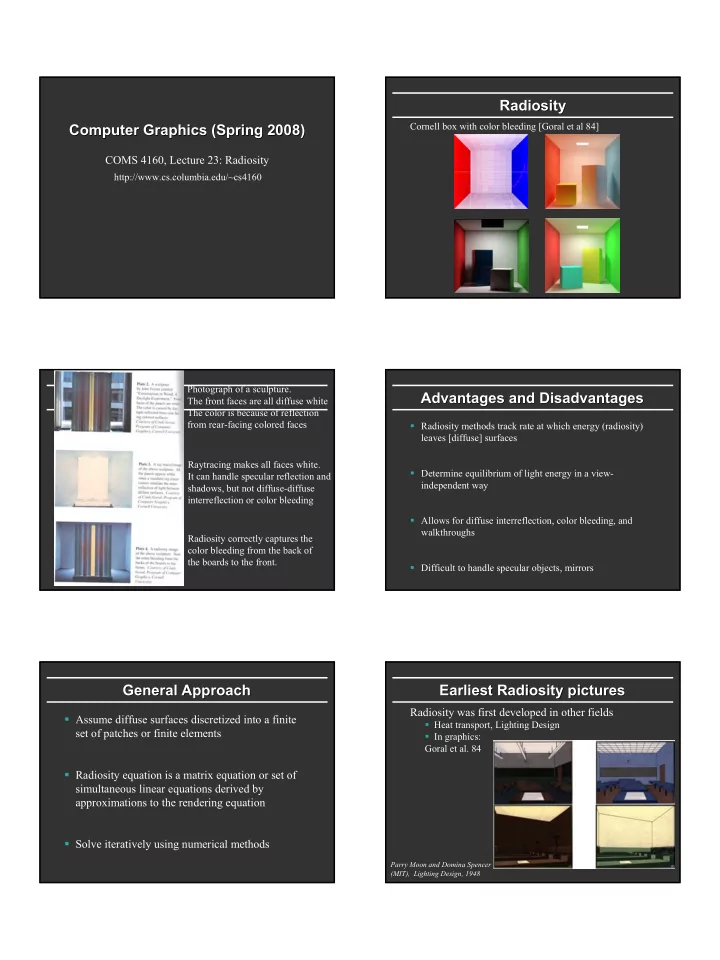
Cornell box with color bleeding [Goral et al 84] Photograph of a sculpture. The front faces are all diffuse white The color is because of reflection from rear-facing colored faces Raytracing makes all faces white. It can handle specular reflection and shadows, but not diffuse-diffuse interreflection or color bleeding Radiosity correctly captures the color bleeding from the back of the boards to the front.
Advantages and Disadvantages Advantages and Disadvantages
Radiosity methods track rate at which energy (radiosity) leaves [diffuse] surfaces Determine equilibrium of light energy in a view- independent way Allows for diffuse interreflection, color bleeding, and walkthroughs Difficult to handle specular objects, mirrors
General Approach General Approach
Assume diffuse surfaces discretized into a finite set of patches or finite elements Radiosity equation is a matrix equation or set of simultaneous linear equations derived by approximations to the rendering equation Solve iteratively using numerical methods
Earliest Earliest Radiosity Radiosity pictures pictures
Radiosity was first developed in other fields
Heat transport, Lighting Design In graphics: Goral et al. 84
Parry Moon and Domina Spencer (MIT), Lighting Design, 1948