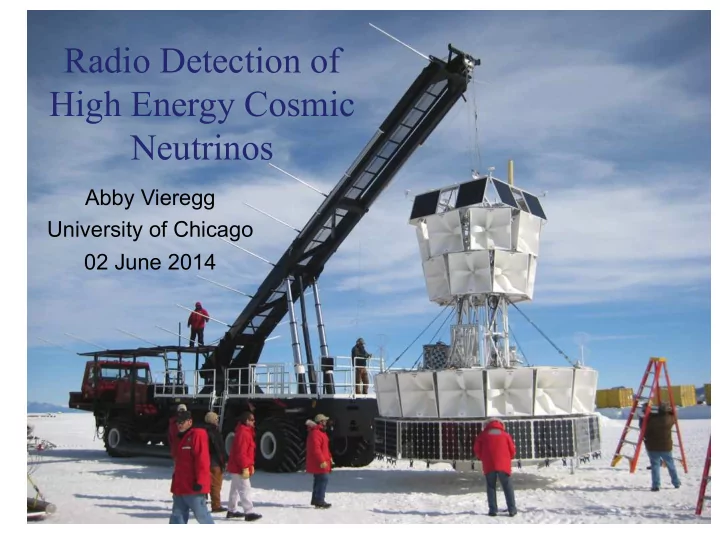
Radio Detection of High Energy Cosmic Neutrinos Abby Vieregg - - PowerPoint PPT Presentation

radio detection of high energy cosmic neutrinos
SMART_READER_LITE
LIVE PREVIEW

Radio Detection of High Energy Cosmic Neutrinos Abby Vieregg - - PowerPoint PPT Presentation

Radio Detection of High Energy Cosmic Neutrinos Abby Vieregg University of Chicago 02 June 2014 The Ultra-High Energy Universe UHE Cosmic Ray Flux We know there are sources up to 10 20 eV (1 Joule)!! How are these particles


slide-1
SLIDE 1

Abby Vieregg University of Chicago 02 June 2014

Radio Detection of High Energy Cosmic Neutrinos

slide-2
SLIDE 2
  • We know there are sources up to 1020 eV (1 Joule)!!
  • How are these particles accelerated?
  • Active Galactic Nucleii (black holes accreting mass)?
  • Blazars (Jets emitted in our direction by AGN)?
  • Gamma Ray Bursts (most luminous events in the universe)?

2

UHE Cosmic Ray Flux

  • A. G. Vieregg

The Ultra-High Energy Universe

(Reminder: IceCube <1015 eV)

slide-3
SLIDE 3

Possible Messenger Particles:

  • Photons lost above 100 TeV (pair production on CMB & IR)
  • Protons and Nuclei deflect in magnetic fields
  • Neutrons decay
  • Neutrinos: point back to sources, travel unimpeded through universe
  • A. G. Vieregg

3

Neutrinos: The Ideal UHE Messenger

UHE Neutrino Detectors:

  • Open a unique window into the universe
  • Highest energy observation of extragalactic

sources

  • Very distant sources
  • Deep into opaque sources
  • How does the high energy universe evolve?
slide-4
SLIDE 4

Earth

Neutrino Production: The GZK Process

GZK process: Cosmic ray protons (E> 1019.5 eV) interact with CMB photons

+

cosmic rays CMB

= Neutrino Beam!

Discover the origin of high energy cosmic rays through neutrinos? What is the high energy cutoff of our universe?

slide-5
SLIDE 5

5

  • ECM is ~200 TeV (LHC “only” 14 TeV)

– Measure neutrino-nucleon cross section in a new regime

  • Lint ~ 300 km: use Earth-shielding

as cross-section analyzer (count events with different path lengths through the earth)

  • Probe exotic models

Large extra dimensions

  • Std. model

Anchordoqui et al. Astro-ph/0307228

GZK nu

  • A. G. Vieregg

Why is UHE Neutrino Astronomy Interesting? A Particle Physics Case

Probe particle physics interactions at energies not achievable on earth

slide-6
SLIDE 6

6

Detection Principle: The Askaryan Effect

  • EM shower in dielectric (ice)  moving negative charge excess
  • Coherent radio Cherenkov radiation (P ~ E2) if λ > Moliere radius

Askaryan Effect Observed at SLAC

ANITA Coll., PRL (2007)

  • G. Askaryan
  • A. G. Vieregg

e+,e-,γ

Typical Dimensions: L ~ 10 m Rmoliere ~ 10 cm

 Radio Emission is much stronger than

  • ptical for UHE showers
slide-7
SLIDE 7

Models & Current Constraints

  • Best current limits:

– >1018 eV: Radio Detection, ANITA – <1018 eV: Optical Detection, IceCube

  • Starting to constrain some

models (source evolution and cosmic ray composition)

  • How do we get a factor of

~100 to dig into the interesting region and make a real UHE neutrino

  • bservatory?
  • Why bother? Not a fishing

expedition! There is a floor

  • n the expectation.
  • A. G. Vieregg

7

  • P. Gorham
slide-8
SLIDE 8

8

ANITA-I & ANITA-II: Best Limit > 1019 eV

NASA Long Duration Balloon, launched from Antarctica ANITA-I: 35 day flight 2006-07 ANITA-I: 30 day flight 2008-09 Instrument Overview:

  • 40 horn antennas, 200-1200 MHz
  • Direction calculated from timing delay

between antennas

  • In-flight calibration from ground
  • Threshold limited by thermal noise
  • A. G. Vieregg

8

ANITA-I ANITA-II Neutrino Candidate Events 1 1 Expected Background 1.1 0.97 +/- 0.42

UHE Neutrino Search Results:

slide-9
SLIDE 9

9

UHE Neutrino Radio Detector Requirements

  • ~1-10 GZK neutrinos/km2/year
  • Lint ~ 300 km

 ~ 0.01 neutrinos/km3/year

  • Need a huge (>> 100 km3),

radio-transparent detector

  • 3 media: salt, sand, and ice
  • Long radio attenuation lengths

in south pole ice

– 1 km for RF (vs. ~100 m for optical signals used by IceCube)

 Ice is good for radio detection

  • f UHE neutrinos!

1 km

  • A. G. Vieregg
slide-10
SLIDE 10

ANITA-III: 2014-2015

  • Flight scheduled this year
  • More antennas
  • Digitize longer traces
  • New: interferometric trigger
  • Lower noise front-end RF system

 Factor of 5 improvement in neutrino sensitivity compared to ANITA-II

  • A. G. Vieregg

10

slide-11
SLIDE 11

Beyond ANITA: Going to the Ground

Why go to the ground?

– Much more livetime – Understandable man-made background – Lower energy threshold – Use more antennas than on a balloon – But: smaller instrumented volume

  • A. G. Vieregg

11

slide-12
SLIDE 12

ARIANNA

  • Idea: Ground-based array of antennas
  • n the surface of the Ross Ice Shelf
  • Currently: 3 stations operating well, 4

more coming in December

  • Plan: proposal submitted for full array

(1000 detectors)

  • Solar Power: stations have operated

through 58% of the year on solar power alone

12

ARIANNA Coll. See arXiv:1207.3846

slide-13
SLIDE 13

ARA: Askaryan Radio Array

H Pol Antennas V Pol Antennas

  • Idea: 37-station array of

antennas buried 200m below the surface at the South Pole

  • Currently: 3 stations + testbed

deployed and working

  • Plan: Proposal pending for

next stage of deployment (10 stations)

ARA Collaboration. Astropart. Phys. (2012)

slide-14
SLIDE 14

ARA Testbed Data Analysis

  • 2011 and 2012 testbed station data
  • Three independent blind analyses, look at 10% sample

14

  • Cut-based analysis:

– Reconstruction cuts  reject thermal noise background – Impulsiveness cuts  reject continuous wave background – Directionality cuts  reject man-made background

  • Future: much more volume

instrumented, trigger and analysis improvements for full 37-station array

ARA Collaboration: arXiv:1404.5285

slide-15
SLIDE 15

Greenland Neutrino Observatory

15

Kansas Univ. CRESIS

NSF Summit Station & Isi Station Site

  • Idea: array of 100 near-surface

stations at Summit Station, Greenland

  • 3 km thick ice
  • Year-round NSF operated station

with LC-130 access and annual

  • verland traverse
  • Northern Sky Coverage
  • Use power from Summit Station,

could use solar (10 mo/year) for large array

  • Plans for a new station with

expanded capacity, construction begins 2014

Greenland Ice Thickness

slide-16
SLIDE 16

Summit Site Characterization June 2013

  • A. G. Vieregg

16

  • Measured the attenuation length of the ice: 997 +/-150m for top

1.5 km of ice at 300 MHz

– Comparable to South Pole, better than other sites

  • Measured firn properties: shallower surface layer than South Pole
  • First-pass measurement of RF backgrounds
  • Plan: deploy first neutrino-hunting station in 2015
slide-17
SLIDE 17

EVA: ExaVolt Antenna

  • Idea: Turn an entire NASA super

pressure balloon into the antenna

  • Currently: 3 year NASA grant for

developing 1/5 scale engineering test, full RF + float test

  • Full Balloon: similar sensitivity to full,

3-year of ground-based arrays

17

reflector feed array @ focus Gorham et al. (2011)  Feed design: dual-polarization, broadband, sinuous antennas on inner membrane

slide-18
SLIDE 18

EVA Scale Model Test Results

  • Microwave scale model testbed
  • 1/35 and 1/26 scale models
  • Measured directivity ~22dB
  • A. G. Vieregg

18

Gorham et al. (2011)

slide-19
SLIDE 19

Projected UHE Neutrino Sensitivity

  • A. G. Vieregg

19

ARA Coll. arXiv:1105.2854

What the sensitivity of a next-generation UHE neutrino detector looks like:  With tens of events per year, we’ll have a real high-energy neutrino

  • bservatory for particle

physics and astrophysics

slide-20
SLIDE 20

Summary

  • It is an exciting time in the search

for UHE neutrinos!

  • Probing lots of fundamental particle

physics and astrophysics

  • Radio technique has been proven,

current results constrain models

  • ANITA-III 2014, IceCube ongoing
  • Large forward-looking efforts in

initial stages: ARIANNA, ARA, GNO, EVA

  • In 5-10 years, we hope to have a

real UHE neutrino observatory and to observe for many years

  • A. G. Vieregg

20