H U M A N I T I E S C E N T E R 2 7 J a n u a r y 2 0 16 M A R S H A L . R I CH M O N D A S S O C I A T E P R O F E S S O R D E P A R T M E N T O F H I S T O R Y
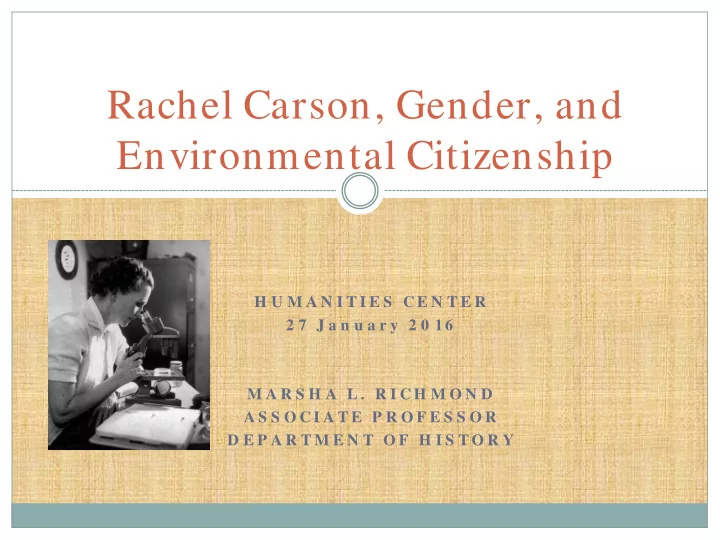
Rachel Carson, Gender, and Environmental Citizenship H U M A N I T - - PowerPoint PPT Presentation
Rachel Carson, Gender, and Environmental Citizenship H U M A N I T I E S C E N T E R 2 7 J a n u a r y 2 0 16 M A R S H A L . R I CH M O N D A S S O C I A T E P R O F E S S O R D E P A R T M E N T O F H I S T O R Y Background
Background
Before World War II, scientists were regarded as
“experts” whose knowledge guided society and benefitted the state
With the coming of the atomic age, this
relationship began to break down, especially over the issue of nuclear fallout
During the Cold War, a climate of distrust arose
- ver the possible threats posed by nuclear fallout,
with scientists themselves (especially geneticists) disagreeing about the danger
Argument
The discord among scientists provided a particular opening
for women scientists, who as “outsiders” could gain the public trust, as individuals who were not just “authorities” but also had the public’s best interest at heart
Rachel Carson, as a trained biologist, accepted the duty to
speak out publicly with knowledge and conviction about an issue she believed was critical, and in so doing challenged vested interests in government and industry
I argue that gender played a significant role in the persona
she adopted, the public reception of her message, and her campaign to create a new kind of “environmental” citizenship
The U.S. Government’s Postwar Advocacy of Atomic Energy
The Atomic
Energy Commission consistently emphasized the promise of nuclear energy, downplaying the harm posed by radioactivity
(See Angela Creager, Life Atom ic)
Albert Q. Maisel, “Medical Dividends,” Collier’s Weekly, 3 May 1947
WWII and the Environment
- At the same time, the
federal government in the immediate postwar period promoted the ubiquitous use of DDT, not just in agriculture but also cities
- This initiative was couched
in terms of fighting a “war against insects” and especially directed at housewives
Dated March 1947
Chemical Industry
The American chemical industry rushed to market
household pesticides to housewives as well
Department of Agriculture
Not only was DDT used on crops, but it was freely
sprayed in cities, not just to kill insects but also as a preventative measure
Neighborhoods and children were especially targeted
Rachel Carson
Carson was born near Pittsburgh and
graduated from the Pennsylvania College for Women (now Chatham University) with a duel major in biology and English
She did graduate work in genetics and
marine biology at Johns Hopkins, aiming for a Ph.D. but leaving with a master’s owing to the Depression
In 1936, she was appointed to the
U.S. Bureau of Fisheries, only the second woman hired fulltime as an aquatic biologist
Rachel Carson (1907-1964)
Women in Science, 1920-1960
All the major players in postwar scientific debates were
males—not surprising given that science in the 1950s was completely male-dominated
Carson was a member of the third generation of women to
receive university training in science, and among the new cohort holding advanced degrees
Carson the Scientist
During her time with the Fish and Wildlife Bureau,
Carson, much of her work focused on problems in Chesapeake Bay: overfishing, pollution, destruction of habitat
She wrote regular features for the Baltim ore Sun and
sometimes in the Atlantic Monthly
Carson the Popular Writer
Carson published her
first popular book about the seashore during the war
In 1951, she was
awarded a Guggenheim Fellowship which allowed her to quit her job and devote herself fulltime to writing
In 1952, she won a
National Book Award for her second book
1941 1951 1955
Silent Spring
In 1958, she began a new book, with the theme, as
she told her friend Dorothy Freeman, similar to that of her previous works: “Life and the relations
- f Life to the physical environment,” though now
she had to face the troubling realization that man had “the power to change drastically – or even destroy – the physical world”
Prompted by reports of a die-off of birds in a
nature preserve recently sprayed with DDT, Carson began to think deeply about the impact not just postwar radiation but also chemicals were having
- n humans and other organisms
After researching the book for four years, it
appeared in September 1962, preceded by an abridged The New Yorker series in June and July
“More valuable than individual life is our genetic heritage”
Carson had been trained in genetics in college and
graduate school, but since then the science had advanced: DNA was established as the material of heredity in 1953
In researching Silent Spring, she began to scour all the
evidence she could find about the danger of pesticides for ecosystems, individuals, and human heredity (thus, future generations)
In the absence of direct evidence, Carson frequently
invoked scientific data on the harm of radioactive fallout and chemical mutagenesis to build her case against the indiscriminate use of DDT
Human Exposure to “Dangerous Chemicals”
As she wrote in Silent Spring, “For
the first time in the history of the world, every human being is now subjected to contact with dangerous chemicals from the moment of conception until death. . . . these chemicals are now stored in the bodies of the vast majority of human beings, regardless of age. They occur in the mother’s milk, and probably in the tissues of the unborn child.” (p. 15)
Preliminary results of the “baby tooth survey” of the Greater
- St. Louis Citizens'
Committee for Nuclear Information was published in 1961, indicating the presence of strontium 90 in children’s teeth
The “Authoritarian” versus the “People”
“Who has made the decision that sets in
motion these chains of poisonings, this ever- widening wave of death that spreads out, like ripples when a pebble is dropped into a still pond? . . . Who has decided—who has the rig ht to decide—for the countless legions of people who were not consulted that the suprem e value is a world without insects, … The decision is that of the authoritarian temporarily entrusted with power; he has made it during a moment of inattention by millions to whom beauty and the ordered world of nature still have a meaning that is deep and imperative.” (127)
The Controversy
In April 1963, CBS Reports aired
“The Silent Spring of Rachel Carson,” hosted by Eric Severeid
Carson explained her assumption of
“the balance of nature”
Robert White-Stevens (Rutgers
chemist and Assistant Director of Agricultural Research at American Cyanimid, the leading manufacturer
- f agricultural chemicals) spoke for
“modern science”
CBS Reports, “The Silent Spring of Rachel Carson,” with Eric Severeid
Spreading Her Message
Immediately after Silent Spring appeared in September
1962, Carson began spreading her message in a series of talks she gave, primarily on the East Coast
The majority of these speeches were given to women’s
groups
National Council of Women (10 October 1962) Women’s National Press Club (5 December 1962) Federation of Homemakers, November 1962
John M. Lee, New York Tim es, 22 July 1962
All-Women Conference, October 1962
National Council of Women on the United States:
“It is truly inspiring to see so many of
you assembled here to discuss the matter of conscience. It is perhaps particularly appropriate for wom en to consider this them e, for wom en are traditionally the custodians of fam ily welfare, the guardians of the health and happiness of their children. . . . To my mind the word conscience implies not only an evaluation of what we are doing in the present --it reaches out into the future to embrace the generations of the unborn.”
Federation of Homemakers, November 1962
One woman journalist reported
Carson’s remarks:
“` I am quite sure that democracy still
works if we will allow it to,’ she said in a soft mild voice that belies her strength and determination. Pesticides poison
- ur soil, kill our wildlife and threaten to
deform future generations, she
- continued. ` But it is a threat that
Am erican wom en can help to stop.’ Miss Carson suggested that the ladies write letters to congressmen, senators, state and local government agencies and newspaper editors.”
Federation of Homemakers in Bethesda, Maryland, November 1962
Congress and the President’s Science Advisory Committee
Carson was asked to testify before
President Kennedy’s Science Advisory Committee
“Carson’s appearance was a historical
milestone for PSAC, which had by then been largely a world without wom en. It was no accident that the first major PSAC report on a topic other than the masculine military technology, space, and science policy, was instigated by a wom an scientist and science writer, belonging to a m arginal group in the hierarchical scientific com m unity.”
(Zuoyue Wang, In Sputnik’s Shadow )
Carson (far left) speaking at a meeting of the President’s Scientific Advisory Committee. In 1963 the committee recommended banning DDT
Creating Scientifically Informed Public Activism
“In the end,” Wang concludes, “it
took incisive political leadership, enlightened technological rationality, and scientifically inform ed public activism to turn the pesticide debate into the beginning of a modern environmental movement.”
Carson cultivated “scientifically
informed public activism,” particularly targeting women
Carson testified before a Senate subcommittee on pesticides, 1963
Conclusions
Carson used her scientific expertise to educate and inform the
public about an issue she believed was of utmost social concern
She put her case for restricting the use of pesticides directly
“to the people,” encouraging citizens (and especially educated middle-class women) to become scientifically informed and work to influence government policies
Her efforts helped shift the status quo and give “countless legions of
people” rather than nameless “authoritarians” the “right to decide”
Carson, in short, promoted a new kind of action among the