
SLIDE 1
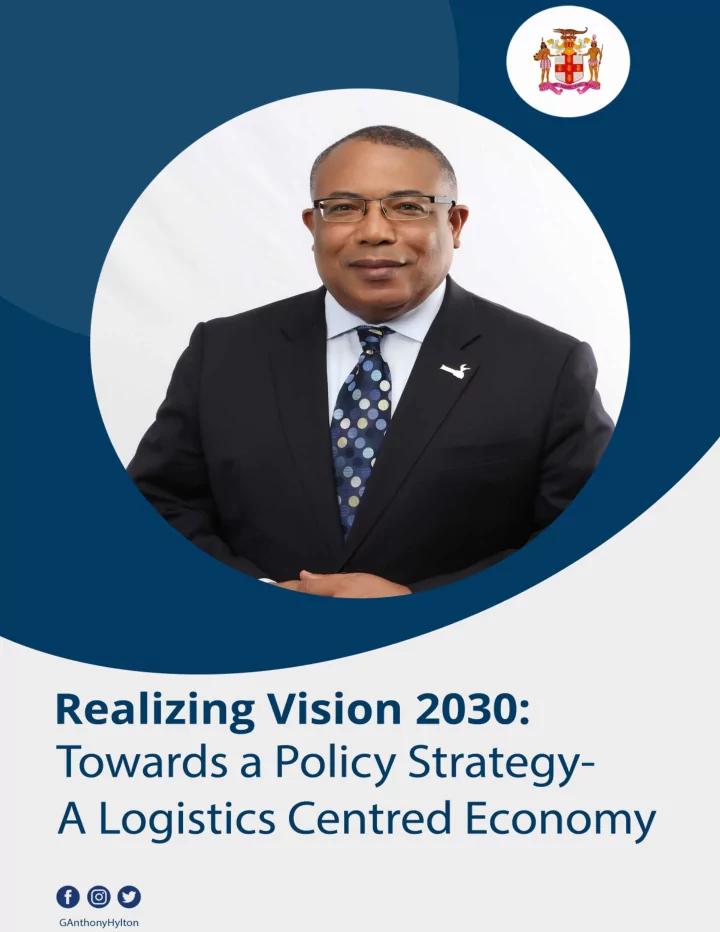
R ealizing V ision 2030: T owaRds a P olicy s TRaTegy - a l ogisTics - - PDF document
CONTRIBUTION TO SECTORAL DEBATE GORDON HOUSE July 9, 2019 R ealizing V ision 2030: T owaRds a P olicy s TRaTegy - a l ogisTics c enTRed e conomy G. ANTHONY HYLTON, MP O p p o s i t i o n S p o k e s m a n o n D e v e l o p m e n t , N a t
2
O p p o s i t i o n S p o k e s m a n o n D e v e l o p m e n t , N a t i o n a l P h y s i c a l P l a n n n i n g , a n d t h e N a t i o n a l H o u s i n g Tr u s t
3
All praises to the Almighty for contjnuing health and strength. As usual, I have several persons to thank for their contjnuing support.
constjtuency secretary as well as my security and driver.
support me and the People’s Natjonal Party. They have never failed to support the PNP at the polls at every electjon and they are ready for the next one, whenever it is called.
present here today.
their support in good and bad tjmes.
leadership and commitment to the Party and Jamaican people in good and bad tjmes.
portjon of wisdom as you guide the work of this chamber.
4
Plan outlined in Vision 2030 represents the Policy Framework for moving Jamaica to developed country status in the next eleven (11) years. Is this a “pie in the sky” or will we be able to achieve our stated
The answer to this questjon Mr. Speaker, lies primarily with the administratjon of the day, but from my vantage point as the shadow minister for Natjonal Development and Physical Planning with oversight responsibility of the UDC, Special Economic Zones (SEZ) and the Natjonal Housing Trust (NHT), I say that we are in the best positjon we have ever been to achieve or come close to achieving our target. It is a fact that our economy is realizing its longest period of growth in decades and its highest growth rate in several years though stjll less than needed. We have achieved low levels of interest rates, infmatjon and unemployment not seen in several decades.
5
Government debt/GDP ratjo is the lowest in decades with improved credit ratjngs for our country and instjtutjons. We have managed to achieve this “Holy Grail” through the hard work and sacrifjces of our several stakeholders, including the mass of the Jamaican people, the private sector, Civil Society organisatjons, internatjonal partners and, last but not least, successive administratjons formed by both the PNP and JLP.
World Bank and IADB in enforcing fjscal discipline, while helping to design and implement the structural reforms, cannot and should not be
diminutjon of the leadership roles played by our various Prime Ministers, Finance Ministers and their Cabinet colleagues in driving the various policies, plans and programmes across administratjons.
6
party affjliatjon must be concerned about the antj-social behaviour refmected in our crime statjstjcs and in the several acts of corruptjon currently being investjgated by law enforcement, the auditor general or the oversight role of the Parliamentary Commituees. This should serve as a reminder to all of us Mr. Speaker, that the maintenance
requiring visionary leadership at all levels of the politjcal, social and economic
Speaker, I observe that this administratjon in antjcipatjon of the ending of the Stand By Programme with the IMF, and wantjng to engender contjnuing confjdence in its economic policy of fjscal responsibility and independent
its proposal to replace the EPOC with a new Fiscal Council.
economic Plans and Programmes going forward and has taken prudent measures to mitjgate those risks, especially in the absence of an IMF Programme with only its Artjcle IV monitoring and oversight.
7
Natjonal Spatjal Plan represents a serious threat to Jamaica achieving its Vision 2030 goal.
among other professional grouping and the constructjon industry, that the spatjal plans of both the Norman Manley and Edward Seaga era of the 1950’s and the 70’s are outdated and in urgent need of updatjng. This is so Mr. Speaker, even if the Manley Plan of the 1950’s contjnues to drive the debate around the development of the Natjonal Heroes Park and the locatjon of the proposed new Parliament building and the Government Campus currently being pursued by the administratjon. The current efgorts in the Ministry of Economic Growth and Job Creatjon to develop a Natjonal Spatjal Plan, leaves much to be desired. Both in its design and development, the exercise is defjcient and, if achieved, will be wholly inefgectual and irrelevant to the task at hand, i.e. realizing Vision 2030.
8
This is so for several reasons Mr. Speaker. Firstly, the exercise repeats the inherent weaknesses of the fjrst two natjonal plans, in that they both lack a clear natjonal policy strategy to inform the natjonal prioritjes in both the design and implementatjon of these
from sectjonal and private interests could not be easily determined and led, at least in part, to the less than optjmal achievement of their stated objectjves. Because, Mr. Speaker, depending on the wishes
ignored by the various planning authoritjes or interpreted to suit the administratjons objectjves in planning outcomes. This, Mr. Speaker, has resulted in weak or no enforcement primarily at the local level, giving rise to a plethora of land use issues and confmicts leading to changed neighbourhoods and with it the undermining of property values. This characterises many communitjes in the corporate area and other urban areas and towns across Jamaica. Secondly, the absence of an architecture to govern the Natjonal Physical or Spatjal Planning process has resulted in sub-optjmal plans and invited confmicts between the various authoritjes at difgerent levels.
9
The efgorts over the years to bring forward replacement legislatjon in place of the existjng Town & Country Planning legislatjon evidences some of these confmicts. Thirdly, the current efgort at evolving a Natjonal Spatjal Plan, through the development of seven academic papers, is not likely to
data sets and not on current primary data. Additjonally, the lack of proper consultatjon with key stakeholders, including the Oppositjon is not likely to improve these major defjcits identjfjed herein.
1 0
now!! To the fjrst of the three (3) defjcits inherent in the current exercise at Natjonal Spatjal Planning, I pointed out earlier in the presentatjon, I
(a) Architecture - My proposal Mr. Speaker, is that consideratjon be given to the role and functjon of the Urban Development Corporatjon (UDC) in the year of the passing of its chief architect, Rt. Hon. Edward Seaga, who envisaged a critjcal, if limited, role for the UDC in the implementatjon of the 1970 Natjonal Spatjal Plan. Fifuy years afuer its establishment Mr. Speaker, I believe the tjme has come to review and revise the role of UDC and to re-purpose it for its mission in changing
should be reviewed, revised and re-purposed in light of current realitjes.
be the subject of a thorough-going review with the objectjve of merging
1 1
aspects of these two agencies to form the Natjonal Physical Planning Authority which, along with the planning functjon currently being done by NEPA under the Town & Country Planning Act, be subsumed by this new Planning Authority. In furtherance of this objectjve, I am proposing that a Review Commission be established (similar to that which reviewed the NHT Act) to examine this proposal and the Oppositjon stands ready to assist in the drawing up of the necessary terms of reference. My proposal, Mr. Speaker, is not fully aligned with the Hon. Prime Minister’s own observatjon in his Budget Presentatjon just ended, that: “We are able to do all of what we are doing and all of what we plan to do [regarding infrastructure development programme outlined] because we are under one Ministry. The Ministry of Economic Growth and Job Creatjon, where all agencies necessary to achieve the objectjve of physical and economic development reside” Prime Minister, I only have to observe that in the same presentatjon you appropriately “apologise(d) to those who have been inconvenienced by these works. As I said earlier, there is much room for improvement... we ask for your contjnued support and understanding.” We in the Oppositjon, of course, disagree that the debacle in the implementatjon of the major works in the corporate area is simply an
1 2
“inconvenience”. The truth is that signifjcant damage has been done to several businesses in the afgected areas. There has been tremendous loss of man-hours, reductjon in productjon and productjvity, and all this, ironically, at a tjme when we need to increase the country’s GDP and accelerate economic growth. We believe Mr. Speaker, and it has been stated by the Leader of Oppositjon, that potentjal claims against the Government lie as a result of siloed planning and patently poor implementatjon. Nor do we agree Mr. Speaker, that the serious congestjon and other problems experienced by several communitjes and businesses caused by the simultaneous implementatjon of multjple projects in major corridors of the corporate area, results simply from previously signed contracts with China related instjtutjons by the PNP Administratjon, as stated by the Prime Minister.
1 3
Prime Minister, it is simply not our experience as to how one friendly sovereign government deals with another cooperatjng sovereign natjon, especially afuer a change of administratjon through the democratjc process, that necessary adjustments to obligatjons undertaken by the previous administratjon in offjce could, or would not, be entertained or responded to upon request and negotjatjon. (b) Policy Strategy - Mr. Speaker, the second solutjon to the defjcits identjfjed in the current Natjonal Spatjal Planning efgort is the clear need for a Policy Strategy to guide the new proposed Physical Planning Authority in order to achieve the goals of Vision 2030. Where we do agree with the Prime Minister, Mr. Speaker is the contjnuing need for a third Infrastructure Development Programme as “successor to the soon concluded major Infrastructure Development Programme or MIDP II as the programme has come to be called. While there is not now alignment on the details of such a programme, we do note from the Prime Minister’s recent Budget presentatjon that the programme broadly outlined, carries forward the concept
Initjatjve launched by the previous PNP Administratjon and supported by the Logistjcs Hub Master Plan: Industry Analysis.
though not debated here or elsewhere, and was subsequently declared a Natjonal Priority by the administratjon.
1 4
In this context, we take note of the Prime Minister’s admission that “this second phase of major infrastructure development is based on technical recommendatjons,
Master Drainage Plan.” Further, Mr. Speaker there is broad alignment with the need to incorporate the “upgraded/restoratjon works to bring light railway solutjons to passenger operatjons as an economical optjon to multj-modal transport within and between urban centres.” Mr. Speaker, I would suggest that not only the passenger aspects of any light railway project be considered, but that the railway cargo as well as the aviatjon cargo infrastructure be considered as well. Again, this approach speaks to the recognitjon of the logistjcs centred economy as a key policy strategy for the realisatjon of Vision 2030. So, Mr. Speaker, the focus
is broadly supportable by the Oppositjon.
1 5
However, Mr. Speaker, in the interest of good governance and in the absence
existjng planning instjtutjons and regulatjons, the Oppositjon strongly recommends an appropriate consultatjon process to underpin the development of the natjonal prioritjes under the proposed next phase of MIDP II, to be called the Greater Infrastructure Development Programme being developed.
that the policy strategy best suited for achieving Vision 2030, is the logistjcs centred approach to planning. This approach is further supported by the long and successful experience of Singapore and other major logistjcs hubs present in Dubai and Rotuerdam, even in
More recently, Mr. Speaker, is the 2019/20 Budget presented to the Indian Parliament by the new Minister of Finance in her maiden presentatjon, in which several informed commentators in reviewing the highlights of the budget stated: “Good news was in store for the transport, logistjcs and shipping industries as the minister proposed a massive push to all forms of physical connectjvity. Industrial corridors, dedicated freight corridors, state road networks to be developed in second phase of the project, were among the highlights that will benefjt the industries.”
1 6
The commentary contjnued: “The ambitjous programme would help develop natjonal road corridors and highways, while enhancing port connectjvity, through
the cost of transportatjon and increasing the competjtjveness of domestjcally produced goods”.
a logistjcs centred economy is similarly aimed at increasing competjtjveness, connectjvity and productjvity. Importantly, it also addressed the increased trade defjcit currently being experienced by our country and which represents a threat to economic growth. (c) The Imperatjve of Data - Mr. Speaker, the third area of weakness of the current Natjonal Spatjal Planning process, is the chronic data problem which has dogged the proper planning of our economic development. The absence of appropriate data sets, has served to undermine medium to long term planning and efgectjve decision making at all levels of government and the private sector regarding our economic, cultural, social and environmental developments. Key to the solutjon to this problem, Mr. Speaker, are decisions regarding pending legislatjon on data privacy, as well as the creatjon of a digital economy
1 7
which will allow for the greater use of technology such as sensors, artjfjcial intelligence (AI), Internet of Things (IOT), Big Data, block chain and Analytjcs. These key technologies will not only transform the supply chain and logistjcs industry, but will also have a positjve impact on Jamaica’s logistjcs and transportatjon industry both from a business and connectjvity perspectjve.
digital economy and the integratjon of new technologies, will yield the data necessary to support the reform of the planning process and the Logistjcs Centred Economy as a key policy strategy for achieving the desired outcomes
Initjatjve: Market Analysis and Master Plan.
calls for some Twenty-Eight Billion United States Dollars (USD$ 28 Billion)
employment of over 80,000 persons directly and more than 400,000.00 indirect jobs and utjlizing some 4,000 hectares or 9884.22 acres of lands spread throughout the island. Many of these investments will be located in Special Economic Zones (SEZ) in response to the signifjcant fjscal and
as defjned in the SEZ legislatjon and regulatjons.
1 8
Jamaican people”, the number of cases evidencing success in the implementatjon
agreement with CMA/CGM;
PAJ;
greater efgorts must be made to develop this consensus project along with the supportjve infrastructure such as a town centre. Indeed, Mr. Speaker, I believe that Vernamfjeld represents a greater priority than the misadventure at Bernard Lodge);
further expansion in the local cofgee industry and manufacturing sector;
enhance domestjc logistjcs and supply chains.
Project in Seaview Gardens to aturact major investments in an SEZ planned for
1 9
Seaview Gardens, on lands near to the existjng Port of Kingston.
German and Jamaican business interest to provide ship repair operatjons in the Kingston Harbour. 10.Caymans SEZ- Is very advanced in its planning to develop a commercial residentjal and university campus and a logistjcs park on several hundred acres of lands adjoining the improved Mandela Highway and in proximity to the North South Highway. A dedicated access route to the Port of Kingston is recommended by the Logistjcs Hub Master Plan. An announcement by the Government as to its development partner is being awaited.
development that seek to implement the logistjcs operatjons. Other reforms of the bureaucracy aiding the Logistjcs centred economy are as follows: The contjnuing implementatjon of a Port Community System to increase effjciency at the Port and to betuer coordinate stakeholder functjoning at the Port, together with the Asycuda system being implemented by Customs, forms the backbone of a Single Electronic Window platgorm aimed at integratjng the several ICT operatjons at the Port to enhance effjciency and productjvity.
2 0
steps needed to conduct efgectjve trading with Jamaica. The portal was recently launched and is housed at the Trade Board, which has the responsibility of updatjng the system.
sittjng, should have broad implicatjons for facilitatjng the ease and speed of doing export and import business at the Port.
to help in the public partjcipatjon in and knowledge of the operatjons
agreement between the European Union (EU) and Mercosur trading
EU should enhance frictjonless trade between these two major trading blocs with Jamaica being able to play a key role in the supply chain and logistjcs operatjons between these two large trading blocs.
being created to bring about the development of Jamaica as a logistjcs hub or the Gateway to the Americas and beyond, is indeed not a “hoax”
2 1
the adoptjon of the Logistjcs Centred Economy as the policy strategy for implementjng and achieving Vision 2030.
2 2
2 3
2 4
tjmes, but is under the constant threat of sea level rise due to the advancing climate change and its implicatjons for the residents of Seaview Gardens, Riverton, Callaloo Mews and New Haven.
that the gullies and drains located in these communitjes are constantly being blocked by debris moving largely from the upper reaches of St. Andrew and deposited in these communitjes. The failure of successive administratjons to fund a proper maintenance/repair programme to clean/ upgrade these drains and gullies has placed these communitjes at risk of businesses being fmood, especially those along Spanish town Road in the vicinity of Six Miles moving eastward to Three Miles, homes and schools in these communitjes are not spared. Additjonally, the heightened risk of water borne diseases together with mosquito borne outbreaks of viruses, present a constant danger to the populatjon in these communitjes. We are therefore, Mr. Speaker, quite pleased to hear the Budget announcement by the Most Honourable Prime Minister, that a Master Drainage Plan is being considered or developed. I use this opportunity
2 5
to urge the administratjon to fast track the planning and funding of this badly needed project to alleviate the risks faced on a daily basis by these community residents. Of partjcular concern, Mr. Speaker, is the current state of the Sandy Gully, which has remained (as shown in this slide (pics) for some several years, depictjng the overgrowth of trees and the mountain of debris trapped between the trees, despite my efgorts to have this and other gullies cleaned and repaired. There is a clear and present danger faced by the populatjon in Seaview Gardens and
medium, as other efgorts to have these drains and gullies cleaned and repaired
2 6
has not been addressed. Most recently, the constjtuency was allocated One Million ($ 1Million) to carry out mitjgatjon works, the same amount as or less than the other constjtuencies in the corporate area with far less gullies and drains than exists in Western St. Andrew. This is iniquitous Mr. Minister.
Drainage Plan, I request that additjonal funds be identjfjed to mitjgate the risks to these communitjes on a priority basis. Additjonally, Mr. Speaker the implicatjons for the Port of Kingston and the Hunts Bay (currently being considered for a major industrial and logistjcs park) of these vast quantjtjes of trees and garbage fmowing from the Duhaney River and the Sandy Gully, plus other smaller gullies, into the Hunts Bay and eventually the Kingston Harbour, are additjonal reasons for urgent actjon.
Haven, a Local Area Development Plan (LADP) is about to get underway for the involvement of the Community Development Commituee (CDC), the University of Technology, other planning professionals and overseas charity
2 7
make these communitjes less vulnerable to the vagaries of man and nature. The stakeholders intend to engage the government in its current efgorts to privatjse the Riverton Dump, to ensure that their interests are taken into account and protected before a deal for the dump is fjnalised. Ultjmately, a LADP will address the matuer of land tenure for most of the families residing in Riverton City and New Haven.
many, if not most, of these communitjes are relieved to see the strong show
have experienced for extended periods of tjme in their communitjes. They
2 8
are as clear as I am, that if the opportunity is not taken to begin to address the conditjons giving rise to this situatjon in the fjrst place, then it’s only a matuer of tjme before we/they are at the mercy of the youth gangs again. It is for this reason, Mr. Speaker, that as Member of Parliament for some of the communitjes now under the State of Public Emergency, I declare that I have mixed feeling today. Happy for those feeling the sense of respite from the shootjngs and murders in their communitjes, but anxious at the same tjme that more than the police and military presence, other actjons necessary to support these measures need to be taken simultaneously and urgently. I have spoken to a few of these today in this presentatjon, but tjme does not allow for a fuller briefjng of more of the pressing issues. For these, I will be seeking audience with my neighbour and colleague, the Most Honourable Prime Minister.
2 9
acknowledgment of the clear progress that has been made on the economic
To avoid the failure to which I have alluded Mr. Speaker, we collectjvely, must make the best use of these most favourable conditjons for achieving the goals outlined in the Natjonal Development Plan or Vision 2030, together with the UN Sustainable Development Goals 2030. While the Planning Instjtute of Jamaica (PIOJ) has built the capacity for sound economic planning and forecast, no similar instjtutjon exists on the physical planning side of the development equatjon. There is broad consensus among planning professionals that the architecture for physical planning is fractured and in need of urgent reform or replacement. Beyond the instjtutjonal capacity for developing an integrated physical plan for Jamaica in this period, or to update/replace the previous two (2) Natjonal Physical or Spatjal Plans of the 1950’s and 70’s, there is the urgent need for a clear policy strategy to inform the implementatjon of Vision 2030, if we are to even come close to achieving its goals within the eleven
3 0
(11) year period remain untjl 2030. The Oppositjon puts forward for consideratjon a review of the role and functjon of the UDC and/or the FCJ by an appropriate high level body (not unlike the review of the NHT), with a view to creatjng a Natjonal Physical Planning Authority, comprised of the requisite professional representatjon with the necessary policy oversight and appropriate governance structure. Additjonally, Mr. Speaker, the Oppositjon puts forward for consideratjon the adoptjon of the Logistjcs Centred Economy as the policy strategy to inform the development of a new Natjonal Spatjal Plan aimed at driving economic growth rates beyond the 2% average experienced over the last several decades. The experience of Singapore and the other global logistjc hubs in atuaining sustained growth rates resultjng in their transformatjon to achieve develop country status has been truly inspiring. More recently, India’s 2019/20 Budget focusing on the development of its logistjcs infrastructure, including highways, ports, airports, bridges, warehouses and the adoptjon of smart technologies integratjng ICT, is presented as further evidence of the credibility of this strategy. More importantly, Mr. Speaker, are the results of the World Bank funded the Jamaica Logistjcs Hub Initjatjve: Market Analysis and Master Plan commissioned
3 1
in 2014 and presented in 2017. The Master Plan embraces the Logistjcs Centred Economy as a central strategy and recommends the implementatjon
growing consensus on the central role of logistjcs in driving a proposed new The Greater Infrastructure Development Programme, by the Government.
Special Economic Zone Authority (SEZA) as the implementjng agency for the SEZ Legislatjon and Regulatjon, is further evidence of a growing consensus towards a growth strategy built around logistjcs.
growth, will see the acceleratjon of growth in the economy in the remaining eleven (11) years suffjcient to get us to, or close enough to realising Vision 2030 with Jamaica, as the place of choice to live, work, do business and to raise families. MAY GOD BLESS JAMAICA, LAND WE LOVE!!
3 2
D E S I G N E D B Y C O N C E P T B N K ( 8 7 6 ) 7 8 8 - 8 1 0 6 K I N G S T O N , J A M A I C A J U LY 2 0 1 9