
110734 Bibliotheca Alexandrina Compiled by Salsabeel Kassem
Wole Soyinka
(Born July 13th, 1934)
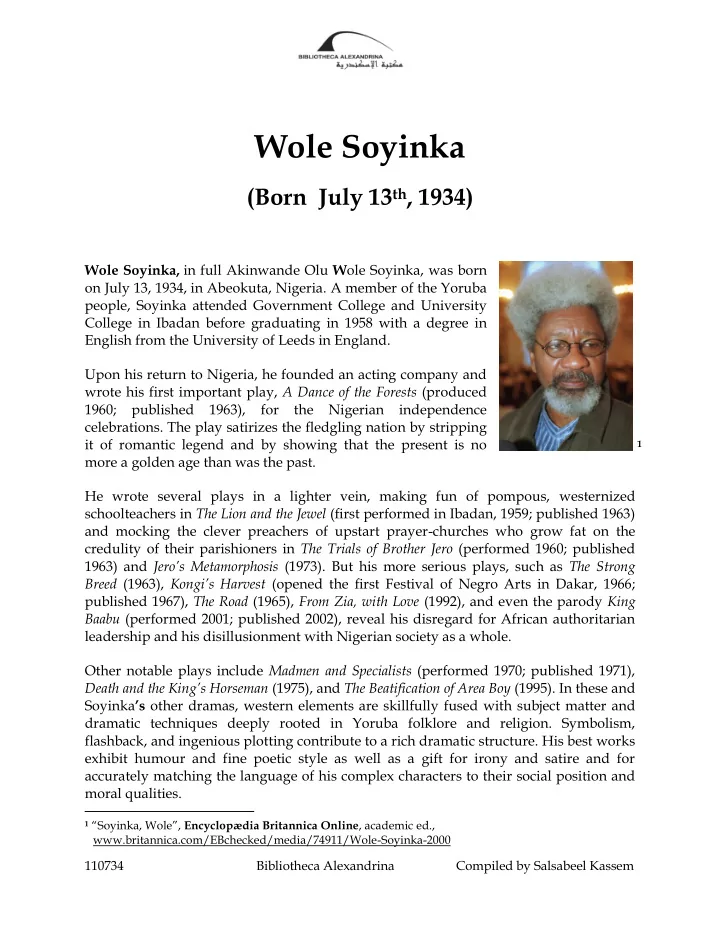
Wole Soyinka, in full Akinwande Olu Wole Soyinka, was born
- n July 13, 1934, in Abeokuta, Nigeria. A member of the Yoruba
people, Soyinka attended Government College and University College in Ibadan before graduating in 1958 with a degree in English from the University of Leeds in England. Upon his return to Nigeria, he founded an acting company and wrote his first important play, A Dance of the Forests (produced 1960; published 1963), for the Nigerian independence
- celebrations. The play satirizes the fledgling nation by stripping
it of romantic legend and by showing that the present is no more a golden age than was the past.
1
He wrote several plays in a lighter vein, making fun of pompous, westernized schoolteachers in The Lion and the Jewel (first performed in Ibadan, 1959; published 1963) and mocking the clever preachers of upstart prayer-churches who grow fat on the credulity of their parishioners in The Trials of Brother Jero (performed 1960; published 1963) and Jero’s Metamorphosis (1973). But his more serious plays, such as The Strong Breed (1963), Kongi’s Harvest (opened the first Festival of Negro Arts in Dakar, 1966; published 1967), The Road (1965), From Zia, with Love (1992), and even the parody King Baabu (performed 2001; published 2002), reveal his disregard for African authoritarian leadership and his disillusionment with Nigerian society as a whole. Other notable plays include Madmen and Specialists (performed 1970; published 1971), Death and the King’s Horseman (1975), and The Beatification of Area Boy (1995). In these and Soyinka’s other dramas, western elements are skillfully fused with subject matter and dramatic techniques deeply rooted in Yoruba folklore and religion. Symbolism, flashback, and ingenious plotting contribute to a rich dramatic structure. His best works exhibit humour and fine poetic style as well as a gift for irony and satire and for accurately matching the language of his complex characters to their social position and moral qualities.
1 “Soyinka, Wole”, Encyclopædia Britannica Online, academic ed.,
www.britannica.com/EBchecked/media/74911/Wole-Soyinka-2000