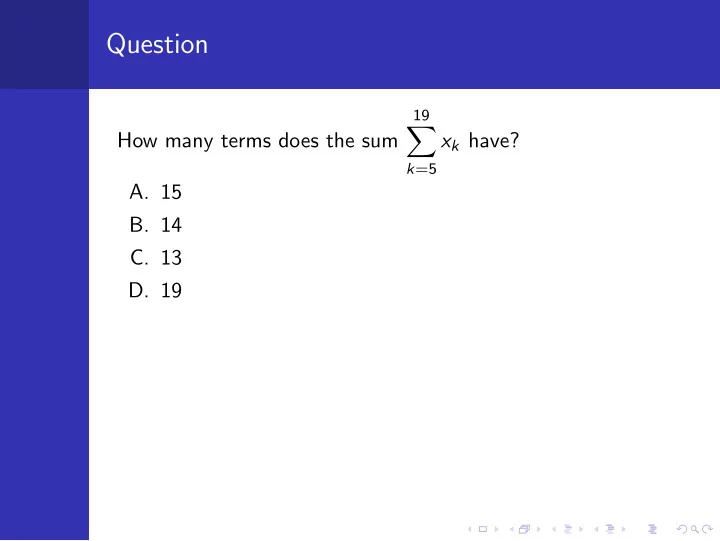
Question 19 How many terms does the sum x k have? k =5 A. 15 B. - - PowerPoint PPT Presentation

question
SMART_READER_LITE
LIVE PREVIEW

Question 19 How many terms does the sum x k have? k =5 A. 15 B. - - PowerPoint PPT Presentation

Question 19 How many terms does the sum x k have? k =5 A. 15 B. 14 C. 13 D. 19 Question 8 8 Suppose that a i = 5 and a i = 2. What is a 1 + a 2 ? i =1 i =3 A. 2 B. 3 C. 4 D. 5 Question 7 3 j ? Which of the below


slide-1
SLIDE 1

Question

How many terms does the sum

19

  • k=5

xk have?

  • A. 15
  • B. 14
  • C. 13
  • D. 19
slide-2
SLIDE 2

Question

Suppose that

8

  • i=1

ai = 5 and

8

  • i=3

ai = 2. What is a1 + a2?

  • A. 2
  • B. 3
  • C. 4
  • D. 5
slide-3
SLIDE 3

Question

Which of the below expressions is equal to

7

  • j=3

3j? A.

7

  • j=0

3j+3 B.

5

  • j=1

3j+3 C.

4

  • j=0

3j+3

  • D. 1

3

8

  • j=4

3j

slide-4
SLIDE 4

Question

Suppose that an investment with simple interest doubles every time period. What is its interest rate?

  • A. r = 1
  • B. r = 2
  • C. r = 100
  • D. r = 200
slide-5
SLIDE 5

Question

Paula deposits N dollars into an account earning an APR of r compounded monthly, while on the same day Srishti deposits 2N dollars into another account earning interest under the same terms. After two years they each withdraw the balance. Which of the following statements are true?

  • A. Srishti has exactly twice the amount that Paula has.
  • B. Srishti has more than twice the amount that Paula has.
  • C. Srishti has less than twice the amount that Paula has.
  • D. The answer depends on N or r.
slide-6
SLIDE 6

Question

Suppose that you have two investments of P dollars. The first investment R1 has simple compound interest at rate r applied every month. The second investment R2 has interest rate 2r applied on even months (t = 2, 4, 6 etc.). How are the investments related after six months?

  • A. The answer depends on P or r.
  • B. R1 < R2.
  • C. R1 = R2.
  • D. R1 > R2.
slide-7
SLIDE 7

Question

Suppose that account A and B have the same interest rate r. If A compounds monthly and B compounds weekly, how do their effect annual rates compare?

  • A. rA > rB.
  • B. rB > rA.
  • C. rA = rB.
  • D. The answer depends on r.
slide-8
SLIDE 8

Question

A savings account has an APR of r and interest is compounded quarterly (every three months). How much would you need to deposit on January 1st, 2020 so that you have a total of $1000

  • n July 31st, 2021?
  • A. 1000
  • 1 + r

4 −6

  • B. 1000 (1 + r)−6
  • C. 1000
  • 1 + r

4 −19/3

  • D. 1000
  • 1 + r

4 −19

slide-9
SLIDE 9

Question

Suppose that you invest $1000 in an account A that compounds 1% monthly for six months, and then 3% monthly for six months, and $1000 in an account B that compounds 2% for twelve months. Which account has more money at the end

  • f the year?
  • A. A > B.
  • B. B > A.
  • C. A = B.
slide-10
SLIDE 10

Question

Suppose that your account has $8, and then a week later $12, and two weeks later $27. At what rate is the interest rate r of your account?

  • A. r = 0.5
  • B. r = 1.5
  • C. r = 2

3

  • D. There is not enough information to determine r.
slide-11
SLIDE 11

Question

Suppose you invest $1000 at an APR of 3% compounding every five days. What is the value of the account after 75 days?

  • A. 1000
  • 1 + 0.03

73

15

  • B. 1000
  • 1 + 0.03

365

75

  • C. 1000
  • 1 + 0.03

12

15

  • D. 1000
  • 1 + 0.03

365

2.5

slide-12
SLIDE 12

Question

Suppose an investment pays out at a rate r at the end of the first week, and a rate 2r at the end of the second week. Thereafter, the interest repeats this cycle. If a principal P is invested on the first day of the week, what is the value of the account after five weeks?

  • A. P(1 + r)3(1 + 2r)2
  • B. P(1 + r)5
  • C. P(1 + r)5(1 + 2r)5
  • D. P(1 + r)(1 + 2r)(1 + 3r)(1 + 4r)(1 + 5r)