
SLIDE 1
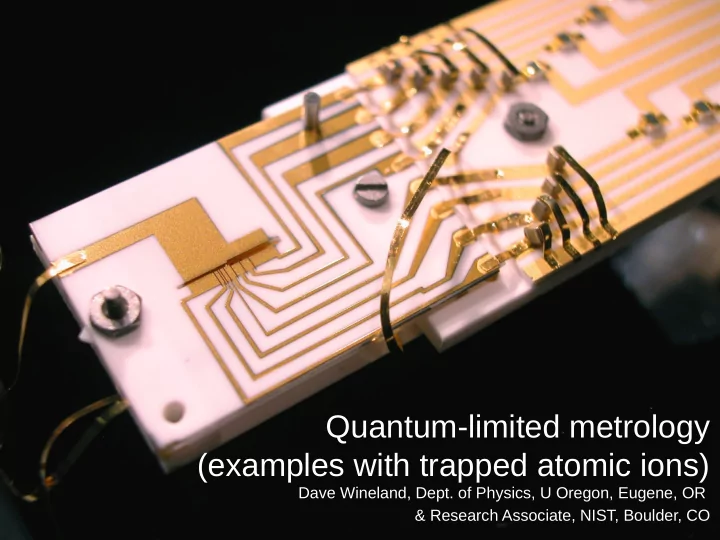
Quantum-limited metrology (examples with trapped atomic ions)
Dave Wineland, Dept. of Physics, U Oregon, Eugene, OR & Research Associate, NIST, Boulder, CO
Quantum-limited metrology (examples with trapped atomic ions) Dave - - PowerPoint PPT Presentation
Quantum-limited metrology (examples with trapped atomic ions) Dave Wineland, Dept. of Physics, U Oregon, Eugene, OR & Research Associate, NIST, Boulder, CO Summary: Ramsey interferometer, angular momentum picture * application to
Dave Wineland, Dept. of Physics, U Oregon, Eugene, OR & Research Associate, NIST, Boulder, CO
* application to spectroscopy/clocks
* spin squeezing * spin “Schrödinger cat” states
* application to spectroscopy/clocks
Dave Wineland, Dept. of Physics, U Oregon, Eugene, OR & Research Associate, NIST, Boulder, CO
50/50 beam splitters 1 2
detect photon in path 1 or 2 incoming photon
Mach-Zehnder interferometer:
Carl Caves, … review: V. Giovannetti, Science 306, 1330 (2004).
Ligo uses large coherent states & different geometry
Ramsey interferometry with qubits (states |↓〉 and |↑〉, E↑ - E↓ = ћω0)
π/2 pulse π/2 pulse
T
M↑
measure
π/2 N “Signal” Noise signal to noise independent of φ (“projection noise”)
applied radiation (“π/2 pulses”) frequency ω near ω0
π/2 pulses like 50/50 beam splitters in Mach-Zehnder interferometer ∆Õ ≡ (〈(Õ - 〈Õ〉)2〉)1/2 for each qubit:
J = N/2, mJ = -N/2 (“coherent spin state”) (in rotating frame of applied field (frequency ω): 〈J(0)〉 Brf/2 Bz = B0 (ωo - ω)/ωo (Brf >> Bz) (ωo - ω)T = π/2 First Ramsey pulse Free precession Second Ramsey pulse 〈Ñ↑(tf)〉 = N/2(1 + cos(ωo - ω)T) 〈Ñ↑(tf)〉 π/2
ϕ = (ωo - ω)T →
N
J = ΣSi (Si = ½, equivalent to ensemble of two-level systems)
Õ = Ñ↑(tf) = Ĵz + JÎ
Ramsey interferometer, angular momentum picture
x y z e.g., Hi = ћ γSzB0 (tf = T)
Uncertainty relation for operators: For operators Õ1, Õ2, Schwartz inequality (1) ∆Õ1 ∆Õ2 ≥ ½|〈[Õ1,Õ2]〉| (measurement fluctuations on identically prepared
systems)
for Õ1 = x, Õ2 = p, Eq. (1) gives position/momentum uncertainty relation
Measurement uncertainty relations:
For operator Õ(ξ) (ξ = parameter) ∆Õ ≅ |d〈Õ〉/dξ〉|∆ξ, ⇒ ∆ξ ≅ ∆Õ /|d〈Õ〉/dξ〉| In (1), let Õ1 = Õ, Õ2 = H (Hamiltonian) ⇒ ∆Õ∆H ≥ ½| 〈[Õ,H]〉| But, ћ dÕ/dt = i[H,Õ] + ћ ∂Õ/∂t ⇒ ∆Õ ∆H ≥ ½ ћ |d〈Õ〉/dt| (for ∂Õ/∂t = 0) ∆Õ = |d〈Õ〉/dt| ∆t, ⇒ ∆H ∆t ≥ ½ ћ Time/Energy uncertaintly relation: Uncertainty relations for parameters and operators
Quantum limits to (angular momentum) rotation angle measurement
Uncertainty relation: Jz = - N/2 For J(0) = J, -J〉 (“coherent” spin state) x y
phase sensitivity ∆φ = N-½ independent of φ
“projection noise”
π/2 N angle sensitivity = N-1/2
z 2 1 y x 2 1 y x
J J , J ΔJ ΔJ
N J/2 ) ( J ) ( J , ) ( J
2 1 y x z
〈J(0)〉 〈J(T)〉 〈J(0)〉
coherent spin state “spin-squeezed” state
WANT:
〈J(T)〉
PRA33, 4033 (1986)
∆Jz Angle sensitivity = 〈J(T)〉 ∆J⊥ angle sensitivity = N-1/2
ϕ = (ωo - ω)T
Generate spin squeezing with HI = χJz
2, ⇒ U = exp(-iχtJz 2)
HI = ( χJz) Jz
κ = signal-to-noise improvement |〈J〉| ∆J⊥√2J
κ =
1/√2J |〈J〉| ∆J⊥/ test by first rotating state to
(nonlinear beam splitter for photons)
(potentially realized by Coulomb interaction in electron interferometers)
Note: |〈J〉| shrinks with squeezing J / ΔJ 2J 1/ d) Δθ(squeeze t) Δθ(coheren
apply HI ∝ Jx
ξ BRF 〈 J(0)〉
|↓〉|↓〉 → cos(α)|↓〉|↓〉 + i sin(α) |↑〉|↑〉
0.9 0.8 0.7 0.6 0.5 0.4
After π/2 pulse about BRF ξ → ∆Jz π/2
Standard quantum limit
anti-squeezing squeezing α = π/6
θ
|〈J〉| ∆J⊥√2J
κ =
J 〈Jz(tf)〉 π ϕ = (ωo - ω)T →
coherent state
J 〈Jz(tf)〉 π ϕ →
squeezed state
κ ≅ 1.07, N = 2
for Ψ perfect
Science 352, 1297 (2016)
κ = 2.5 (2), N = 85 HI = ( χJz) Jz
measure Jz (via cavity frequency pulling) project to squeezed state κ = 7.7 (3) κexp = 2.3 (3)
87Rb, |↓〉 = |F=2, mF = 2〉, |↑〉 = |3,3〉
N = 4 x 10⁵ squeezing reduced by noise in feedback
87Rb, |↓〉 = |F=2, mF = 0〉, |↑〉 = |3,0〉
Nature 529, 505 (2016) z
κ = 10.1(2)
N = 5 x 10⁵ Measure Jz via frequency shift of coupled cavity z
After second Ramsey pulse, measure parity operator:
(J. Bollinger et al., Phys. Rev. A54, R4649 (1996)) (two values possible: 1, -1)
T
M
measure
entangling pulse conventional Ramsey pulse R1,2,…N(π/2)
Ramsey interferometry of 〈J〉 = 0 states:
|〈J〉| = 0 !
spin “Schrödinger cat” states ⇒ Heisenberg limit
Õ = N↑ - N↓ (nonentangled) Õ = parity (entangled)
6 2
2π (ω - ω0)T → 〈Õ〉 (single measurement)
∆ϕ = 1/N, independent of (ω - ω0)T
〈Õ〉 →
“Heisenberg limit”
entangling “π/2” pulse
t →
T entangling “π/2” pulse
M
measure
all ions fluoresce no ions fluoresce
Ramsey interferometry with two entangling pulses
(D. Leibfried et al. Science ’04, Nature ‘05)
Entangled state interferometry:
N = 3 N = 4 N = 5 N = 6 N = 1 “Signal” Noise
C
S/N = C “win” if C > C = 0.84(1) > 3-1/2 = 0.58 κ = 1.45(2) C = 0.419(4) > 6-1/2 = 0..408 κ = 1.03(1)
PRL 106, 130506 (2011) κ > 1 for N = 14 (D. Leibfried et al. Science 2004, Nature 2005)
Entangled state interferometry:
N = 3 N = 4 N = 5 N = 6 N = 1 “Signal” Noise
C
S/N = C “win” if C > C = 0.84(1) > 3-1/2 = 0.58 κ = 1.45(2) C = 0.419(4) > 6-1/2 = 0..408 κ = 1.03(1)
PRL 106, 130506 (2011) κ > 1 for N = 14 (D. Leibfried et al. Science 2004, Nature 2005)
But! assumptions above: perfect probe oscillators, noise = projection noise
PRL 79, 3865 (1997) (phase decoherence of atoms)
(phase decoherence of source radiation)
Efficient detection with ancilla qubits
(Al+ optical clock experiment, NIST, Boulder)
Coulomb interaction
2P3/2 2S1/2
(F=1, mF = -1) (F=2, mF = -2)
Be+
hyperfine qubit
qubit
λ = 267 nm
1S0 3P0 1P1
λ = 167 nm
transfer information to 9Be+
Coulomb interaction
3P1 1S0 3P0 2 1 0 n 2P3/2
Cool ions to ground state with Be+: |↓〉Be |n=0〉
Efficient detection with ancilla qubits
(Al+ optical clock experiment, NIST, Boulder)
Coulomb interaction
3P1 1S0 3P0 2 1 0 n 2P3/2
If Ψ = |3P0〉|↓〉Be|n=0〉
Efficient detection with ancilla qubits
(Al+ optical clock experiment, NIST, Boulder)
Coulomb interaction
3P1 1S0 3P0 2 1 0 n 2P3/2
Is “QND” measurement; can repeat to increase Fidelity F = 0.85 → 0.9994
Efficient detection with ancilla qubits
(Al+ optical clock experiment, NIST, Boulder)
Now, extensions to molecules: C.–W. Chou et al., Nature 545, 203 (2017).
Sensitive mechanical motion detection e.g. single harmonic motion
αi D(αi) ≡ exp[αia - αi*a] with α = (∆x + i∆p/mωx)/(2x0)) ground state (n =0) wavefunction
here, κ ∝ αI / ground-state wave packet spread
Sensitive mechanical motion detection e.g. single harmonic motion
(D(α) ≡ exp[αa - α*a] with α = (∆x + i∆p/mωx)/(2x0))
generated with parametric drive trap potential modulated at 2ωx
κ ≅ 7.3
. Colombe et al., Optics Express, 22, 19783 (2014) recipe: http://www.nist.gov/pml/div688/grp10/index.cfm
MoSi
Surface metrology:
“Stylus” trap for ion-heating studies
1 mm test surface
Ion heating: try to reduce with surface science techniques:
collaboration with D. Hite, K. McKay, D. Pappas (NIST, Boulder)
Ar+ beam cleaning side view, surface-electrode trap
x 100 heating reduction
~ 2 kV, 500 C/m2, p(Ar) ~ 4 x 10⁻⁵ Torr Johnson noise too small
Cryo cooling helps too:
Shewmon, and I. L. Chuang, Phys. Rev. Lett. 101, 180602 (2008).
……
Ion heating review:
RMP 87, 1419 (2015)