Frequency Division Multiplexing Allows for mulFple devices - - PDF document

frequency division multiplexing
SMART_READER_LITE
LIVE PREVIEW

Frequency Division Multiplexing Allows for mulFple devices - - PDF document

10/1/15 Clearing the RF Smog: Making 802.11 Robust to Cross- Technology Interference Author(s): Gollakota et al. Sigcomm 2011 Presenter: Sean Sanders


slide-1
SLIDE 1

10/1/15 ¡ 1 ¡

Clearing ¡the ¡RF ¡Smog: ¡Making ¡ 802.11 ¡Robust ¡to ¡Cross-­‑ Technology ¡Interference ¡

Author(s): ¡Gollakota ¡et ¡al. ¡Sigcomm ¡2011 ¡ Presenter: ¡Sean ¡Sanders ¡ Date: ¡September ¡24, ¡2015 ¡

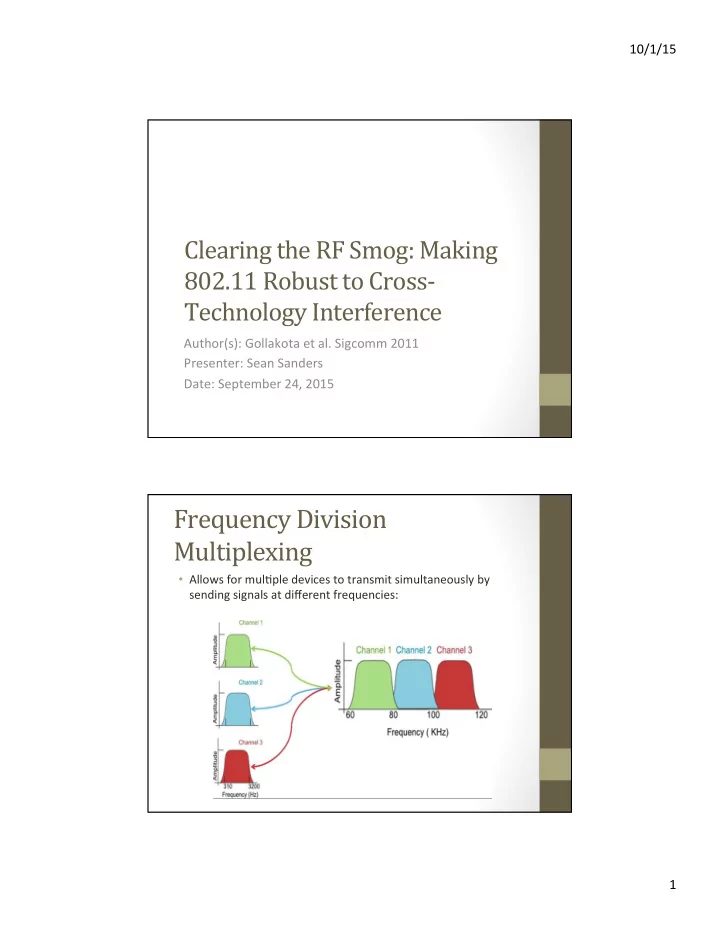
Frequency ¡Division ¡ Multiplexing ¡

  • Allows ¡for ¡mulFple ¡devices ¡to ¡transmit ¡simultaneously ¡by ¡

sending ¡signals ¡at ¡different ¡frequencies: ¡

slide-2
SLIDE 2

10/1/15 ¡ 2 ¡

Frequency ¡Reuse: ¡Radio ¡ Frequency ¡Reuse: ¡Television ¡

slide-3
SLIDE 3

10/1/15 ¡ 3 ¡

Problems ¡with ¡Frequency ¡ Spectrum ¡Reuse ¡in ¡the ¡Home ¡

  • Many ¡home ¡uFlize ¡mulFple ¡wireless ¡technologies ¡that ¡may ¡
  • verlap ¡with ¡the ¡same ¡frequency ¡spectrum ¡
  • Cordless ¡phone ¡
  • Microwave ¡oven ¡
  • Bluetooth ¡devices ¡
  • Baby ¡Monitor ¡
  • WiFi ¡
  • Industrial, ¡scienFfic, ¡and ¡medical ¡radio ¡bands ¡(ISM) ¡– ¡

2.4-­‑5.0GHz ¡

  • Consequences ¡
  • Interference ¡between ¡different ¡technologies ¡
  • Failures ¡in ¡TDM, ¡FDM, ¡and ¡SDM ¡
  • Devices ¡do ¡not ¡work ¡well ¡together ¡

Contribution ¡of ¡this ¡paper ¡

  • Scenario: ¡802.11n ¡is ¡subject ¡to ¡cross-­‑technology ¡interference ¡

within ¡the ¡home. ¡Complete ¡loss ¡of ¡communica0on. ¡

  • Baby ¡Monitors ¡
  • Cordless ¡phones ¡
  • Microwave ¡oven ¡
  • Bluetooth ¡CommunicaFon ¡
  • Propose ¡TIMO: ¡Method ¡to ¡allow ¡802.11n ¡devices ¡to ¡transmit ¡

in ¡the ¡presence ¡of ¡interference. ¡

  • Result: ¡Increase ¡802.11n ¡throughput ¡substanFally ¡(from ¡

nothing ¡to ¡normal) ¡while ¡coexisFng ¡with ¡other ¡technology. ¡

slide-4
SLIDE 4

10/1/15 ¡ 4 ¡

Outline ¡

  • 802.11 ¡Overview ¡
  • MoFvaFon: ¡Empirical ¡Evidence ¡of ¡Interference ¡
  • TIMO ¡
  • Math/Theory ¡
  • System ¡Overview ¡
  • Performance ¡EvaluaFon ¡
  • Conclusion/Discussion ¡

802.11 ¡Overview ¡

  • Physical ¡and ¡Link ¡Layer ¡specificaFons ¡for ¡Wireless ¡LAN ¡

communicaFons ¡(WiFi) ¡

  • Half ¡duplex ¡wireless ¡transmission ¡over ¡the ¡air ¡
  • Mul>ple ¡versions: ¡
  • 802.11b, ¡and ¡802.11g ¡operate ¡on ¡2.4GHz ¡band: ¡20MHz ¡Channel ¡
  • 802.11n ¡(focus ¡of ¡this ¡paper): ¡2.4/5GHz ¡band ¡that ¡uses ¡MulFple ¡

Input ¡MulFple ¡Output(MIMO) ¡technology ¡

  • MulFple ¡Antennas ¡(Space ¡division ¡mulFplexing ¡(SDM) ¡to ¡increase ¡

bandwidth) ¡

¡

slide-5
SLIDE 5

10/1/15 ¡ 5 ¡

Severity ¡of ¡Cross-­‑Technology ¡ Interference ¡

  • Experimental ¡Setup ¡(cordless ¡phone, ¡baby ¡monitor, ¡

microwave ¡oven, ¡bluetooth) ¡

  • A ¡(802.11n ¡transmi_er) ¡
  • B ¡(802.11n ¡receiver) ¡
  • Numbers ¡(Interferer ¡LocaFon) ¡

Severity ¡of ¡Cross-­‑Technology ¡ Interference ¡– ¡Cordless ¡Phone ¡

¡

Complete ¡loss ¡of ¡ transmission ¡by ¡ 802.11n ¡ ¡ NO ¡THROUGHPUT!! ¡ Cordless ¡phone ¡use ¡ Fme ¡division ¡ mulFplexing ¡at ¡high ¡ power! ¡

slide-6
SLIDE 6

10/1/15 ¡ 6 ¡

Severity ¡of ¡Cross-­‑Technology ¡ Interference ¡– ¡Baby ¡Monitor ¡

¡

NO ¡THROUGHPUT!! ¡ Baby ¡ ¡monitor ¡ transmits ¡video ¡in ¡a ¡ single ¡direcFon ¡ consistently ¡at ¡high ¡ power! ¡

Severity ¡of ¡Cross-­‑Technology ¡ Interference ¡– ¡Microwave ¡

¡

Reduced ¡ Throughput!! ¡ Microwaves ¡cyclic ¡ power/energy ¡ cycles ¡allows ¡for ¡ more ¡some ¡ communicaFon ¡by ¡ 802.11 ¡nodes ¡

slide-7
SLIDE 7

10/1/15 ¡ 7 ¡

Severity ¡of ¡Cross-­‑Technology ¡ Interference ¡– ¡Bluetooth ¡

¡ ¡ ¡

Negligible ¡Interference ¡ ¡with ¡802.11!! ¡ Likely ¡the ¡result ¡of ¡ using ¡low ¡power ¡ transmission ¡and ¡ Frequency ¡hopping ¡

Decoding ¡in ¡2-­‑by-­‑2 ¡MIMO ¡ System ¡

si ¡signal ¡sent ¡ from ¡antenna ¡i ¡ yi ¡signal ¡ received ¡from ¡ antenna ¡i ¡

hij ¡channel ¡ coefficients ¡on ¡ path ¡from ¡antenna ¡ i ¡to ¡j ¡ ¡

If ¡you ¡know ¡hij(PHY ¡layer) ¡you ¡can ¡decode ¡s1 ¡and ¡s2 ¡ ¡

slide-8
SLIDE 8

10/1/15 ¡ 8 ¡

TIMO: ¡The ¡Math ¡

S(t): ¡signal ¡of ¡ interest ¡ Y(t): ¡received ¡ signal ¡ Hi: ¡Interference ¡channel ¡

Purpose: ¡Decode ¡S(t) ¡at ¡the ¡receiver ¡

I(t): ¡ interference ¡ signal ¡ Hs: ¡Signal ¡of ¡interest ¡channel ¡

Wide-­‑band ¡signals ¡requires ¡ ConvoluFon, ¡not ¡mulFplicaFon ¡

TIMO: ¡The ¡Math ¡(Compute ¡Bj) ¡

Purpose: ¡Decode ¡S(t) ¡at ¡the ¡receiver ¡

MulFply ¡by ¡known ¡signal ¡raFo ¡and ¡subtract ¡received ¡signals ¡

slide-9
SLIDE 9

10/1/15 ¡ 9 ¡

TIMO: ¡The ¡Math ¡(Compute ¡Bj) ¡

MulFply ¡by ¡conjugate ¡of ¡received ¡signal ¡on ¡antenna ¡2 ¡and ¡ ¡ take ¡ExpectaFon ¡

TIMO: ¡The ¡Math ¡(Compute ¡Bj) ¡

Calculate ¡Power ¡of ¡interference ¡signal ¡ Merge ¡EquaFons ¡to ¡compute ¡Bj ¡

slide-10
SLIDE 10

10/1/15 ¡ 10 ¡

Must ¡Deal ¡with ¡Inter-­‑Symbol ¡ Interference ¡(ISI) ¡ ¡

Inter-­‑symbol ¡Interference ¡results ¡from ¡mulFpath ¡effects ¡ (signal ¡travels ¡from ¡sender ¡to ¡receiver ¡along ¡mulFple ¡paths) ¡ ¡ ¡ Basically, ¡the ¡interference ¡signal ¡will ¡experience ¡ISI ¡in ¡the ¡ frequency ¡domain. ¡AddiFonal ¡noise ¡hurts ¡SNR ¡and ¡impacts ¡

  • throughput. ¡

¡ ¡ ¡ ¡ ¡ Eliminate ¡i(t) ¡altogether ¡

Iterating ¡to ¡Increase ¡Accuracy ¡

  • Problem: ¡CompuFng ¡expectaFons ¡by ¡taking ¡averages ¡over ¡

mulFple ¡OFDM ¡symbols ¡to ¡help ¡esFmate ¡Channel ¡RaFo, ¡Bj ¡

  • May ¡not ¡be ¡able ¡to ¡obtain ¡many ¡OFDM ¡symbols ¡
  • Need ¡to ¡sFll ¡compute ¡accurate ¡Bj ¡

¡

  • Step ¡1: ¡Compute ¡Bj ¡as ¡you ¡normally ¡would ¡and ¡decode ¡s(t) ¡
  • Step ¡2: ¡Remodulate ¡s(t) ¡to ¡obtain ¡new ¡signal ¡s^(t) ¡
  • Repeat ¡
  • Use ¡new ¡Bj ¡
slide-11
SLIDE 11

10/1/15 ¡ 11 ¡

Summary: ¡TIMO ¡

  • Purpose: ¡Eliminate ¡Interference ¡noise ¡
  • 802.11n ¡takes ¡received ¡signal ¡to ¡frequency ¡domain ¡to ¡

compute ¡interference ¡channel ¡raFos ¡

  • Transforms ¡interference ¡channel ¡raFo ¡to ¡Fme ¡domain ¡filter ¡

using ¡Inverse ¡Fast ¡Fourier ¡Transform ¡(IFFT) ¡

  • Use ¡Fme ¡domain ¡filter ¡to ¡remove ¡interference ¡
  • Receiver ¡can ¡now ¡decode ¡the ¡signal ¡of ¡interest ¡
  • Use ¡Interference ¡nulling ¡to ¡allow ¡compeFng ¡technology ¡to ¡

communicate ¡(similar ¡idea ¡as ¡above) ¡

  • Implementa>on: ¡Built ¡prototype ¡of ¡TIMO ¡using ¡USRP2 ¡radio ¡

plaiorm ¡and ¡the ¡GNURadio ¡sojware ¡package. ¡

Detecting ¡Interference ¡

¡

  • Only ¡need ¡to ¡compute ¡channel ¡raFo ¡when ¡there ¡is ¡

interference ¡ ¡

  • Use ¡presence ¡of ¡soj ¡errors ¡at ¡Physical(PHY) ¡layer ¡for ¡this ¡

¡ ¡

slide-12
SLIDE 12

10/1/15 ¡ 12 ¡

Performance ¡Evaluation ¡

  • Same ¡experimental ¡environment ¡as ¡moFvaFon ¡
  • Source ¡of ¡Interference ¡(Cordless ¡phone, ¡Baby ¡monitor, ¡

Microwave ¡oven, ¡Bluetooth) ¡

  • Evaluate ¡
  • Throughput ¡of ¡802.11n ¡with ¡and ¡without ¡TIMO ¡
  • Impact ¡of ¡TIMO ¡on ¡the ¡source ¡of ¡interference ¡(coexist ¡with ¡

different ¡technology) ¡

  • Carrier ¡sense ¡disabled ¡ ¡

Performance ¡Evaluation-­‑ ¡ Cordless ¡Phone ¡

¡ ¡ ¡ ¡

TIMO ¡achieves ¡high ¡ throughput ¡with ¡ cordless ¡phone. ¡ ¡ Cordless ¡phone ¡has ¡ low ¡loss ¡rate. ¡

slide-13
SLIDE 13

10/1/15 ¡ 13 ¡

Performance ¡Evaluation ¡-­‑ ¡Baby ¡ Monitor ¡

¡ ¡ ¡ ¡

TIMO ¡achieves ¡high ¡ throughput ¡with ¡ baby ¡monitor. ¡ ¡ Baby ¡monitor ¡can ¡ also ¡receive ¡signals ¡ that ¡are ¡watchable ¡ (PSNR>20) ¡

Performance ¡Evaluation ¡– ¡ Multiple ¡Technologies ¡

¡ ¡ ¡ ¡

3 ¡technologies ¡ transmilng ¡all ¡ perform ¡be_er ¡with ¡ TIMO ¡enabled ¡

slide-14
SLIDE 14

10/1/15 ¡ 14 ¡

Summary ¡

  • ISM ¡radio ¡bands ¡are ¡overcrowded ¡– ¡results ¡in ¡cross ¡

technology ¡interference ¡

  • Propose ¡interference ¡cancellaFon ¡approach, ¡TIMO, ¡to ¡deal ¡

with ¡these ¡issues ¡for ¡802.11n ¡technology ¡

  • TIMO ¡increases ¡the ¡throughput ¡of ¡802.11n ¡without ¡

significantly ¡impacFng ¡other ¡wireless ¡technology ¡