Exceptions and Processes (cont) time multiplexing: operating system - - PowerPoint PPT Presentation

exceptions and processes con t
SMART_READER_LITE
LIVE PREVIEW

Exceptions and Processes (cont) time multiplexing: operating system - - PowerPoint PPT Presentation

Exceptions and Processes (cont) time multiplexing: operating system alternates which mechanism for operating system to run: exceptions thread runs on the processor time multiplexing: operating system alternates which CPU: ssh.exe loop.exe


slide-1
SLIDE 1

Exceptions and Processes (con’t)

1

Recall: Process

illusion of dedicated machine thread + address space thread = illusion of dedicated processor address space = illusion of dedicated memory

2

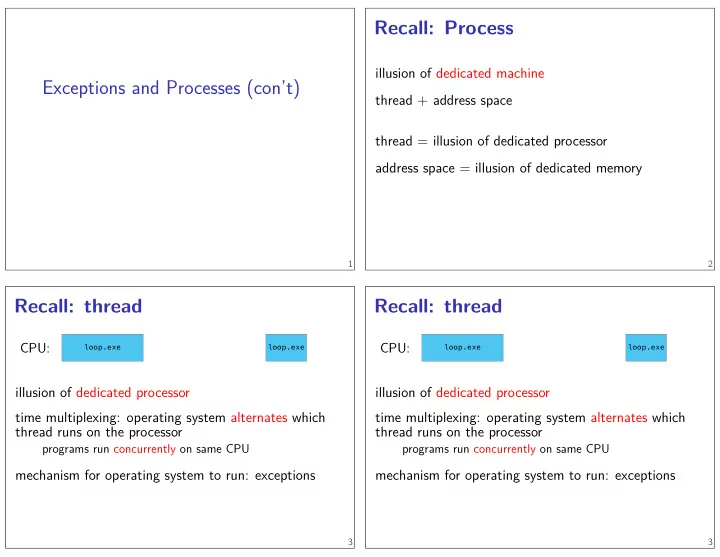
Recall: thread

loop.exe ssh.exe firefox.exe loop.exe ssh.exe

CPU:

illusion of dedicated processor time multiplexing: operating system alternates which thread runs on the processor

programs run concurrently on same CPU

mechanism for operating system to run: exceptions

3

Recall: thread

loop.exe ssh.exe firefox.exe loop.exe ssh.exe

CPU:

illusion of dedicated processor time multiplexing: operating system alternates which thread runs on the processor

programs run concurrently on same CPU

mechanism for operating system to run: exceptions

3

slide-2
SLIDE 2

Recall: thread

loop.exe ssh.exe firefox.exe loop.exe ssh.exe

CPU:

illusion of dedicated processor time multiplexing: operating system alternates which thread runs on the processor

programs run concurrently on same CPU

mechanism for operating system to run: exceptions

3

Recall: address space

illuision of dedicated memory

Program A addresses Program B addresses mapping (set by OS) mapping (set by OS) Program A code Program B code Program A data Program B data OS data … real memory trigger error = kernel-mode only

4

Recall: protection

processes can’t interfere with other processes processes can’t interfere with operating system … except as allowed by OS mechanism 1: kernel mode and privileged instructions mechanism 2: address spaces mechanism 3: exceptions for controlled access

5

protection and sudo

programs always run in user mode extra permissions from OS do not change this

sudo, superuser, root, SYSTEM, …

  • perating system may remember extra privileges

6

slide-3
SLIDE 3

OS process information

context: registers, condition codes, address space OS tracks extra information, too:

process ID — identify process in system calls user ID — who is running the process? what fjles can it access? current directory

  • pen fjles

…and more

CPU doesn’t know about this extra information

7

Recall: Linux x86-64 hello world

.globl _start .data hello_str: .asciz "Hello, ␣ World!\n" .text _start: movq $1, %rax # 1 = "write" movq $1, %rdi # file descriptor 1 = stdout movq $hello_str, %rsi movq $15, %rdx # 15 = strlen("Hello, World!\n") syscall movq $60, %rax # 60 = exit movq $0, %rdi syscall

8

types of exceptions

interrupts — externally-triggered

timer — keep program from hogging CPU I/O devices — key presses, hard drives, networks, …

faults — errors/events in programs

memory not in address space (“Segmentation fault”) divide by zero invalid instruction

traps — intentionally triggered exceptions

system calls — ask OS to do something

aborts

9

types of exceptions

interrupts — externally-triggered

timer — keep program from hogging CPU I/O devices — key presses, hard drives, networks, …

faults — errors/events in programs

memory not in address space (“Segmentation fault”) divide by zero invalid instruction

traps — intentionally triggered exceptions

system calls — ask OS to do something

aborts

9

slide-4
SLIDE 4

aborts

something is wrong with the hardware example: memory chip failed, has junk value tell OS so it can do something do what??? reboot?

10

exceptions in exceptions

handle_timer_interrupt: save_old_pc save_pc movq %rax, save_rax /* key press here */ movq %rbx, save_rbx ... handle_keyboard_interrupt: save_old_pc save_pc movq %rax, save_rax movq %rbx, save_rbx movq %rcx, save_rcx ...

solution: disallow this!

11

exceptions in exceptions

handle_timer_interrupt: save_old_pc save_pc movq %rax, save_rax /* key press here */ movq %rbx, save_rbx ... handle_keyboard_interrupt: save_old_pc save_pc movq %rax, save_rax movq %rbx, save_rbx movq %rcx, save_rcx ...

solution: disallow this!

11

exceptions in exceptions

handle_timer_interrupt: save_old_pc save_pc movq %rax, save_rax /* key press here */ movq %rbx, save_rbx ... handle_keyboard_interrupt: save_old_pc save_pc movq %rax, save_rax movq %rbx, save_rbx movq %rcx, save_rcx ...

solution: disallow this!

11

slide-5
SLIDE 5

interrupt disabling

CPU supports disabling (most) interrupts interrupts will wait until it is reenabled CPU has extra state:

interrupts enabled? keyboard interrupt pending? timer interrupt pending?

. . .

exception logic

12

exceptions in exceptions

handle_timer_interrupt: /* interrupts automatically disabled here */ save_old_pc save_pc movq %rax, save_rax /* key press here */ movq %rsp, save_rsp ... call move_saved_state enable_interrupts /* interrupt happens here! */ ... handle_keyboard_interrupt: save_old_pc save_pc ... call move_saved_state

13

exceptions in exceptions

handle_timer_interrupt: /* interrupts automatically disabled here */ save_old_pc save_pc movq %rax, save_rax /* key press here */ movq %rsp, save_rsp ... call move_saved_state enable_interrupts /* interrupt happens here! */ ... handle_keyboard_interrupt: save_old_pc save_pc ... call move_saved_state

13

exceptions in exceptions

handle_timer_interrupt: /* interrupts automatically disabled here */ save_old_pc save_pc movq %rax, save_rax /* key press here */ movq %rsp, save_rsp ... call move_saved_state enable_interrupts /* interrupt happens here! */ ... handle_keyboard_interrupt: save_old_pc save_pc ... call move_saved_state

13

slide-6
SLIDE 6

disabling interrupts

automatically disabled when exception handler starts also done with privileged instruction:

change_keyboard_parameters: disable_interrupts ... /* change things used by handle_keyboard_interrupt here */ ... enable_interrupts

14

a note on terminology (1)

real world: inconsistent terms for exceptions we will follow textbook’s terms in this course the real world won’t you might see:

‘interrupt’ meaning what we call ‘exception’ (x86) ‘exception’ meaning what we call ‘fault’ ‘hard fault’ meaning what we call ‘abort’ ‘trap’ meaning what we call ‘fault’ … and more

15

a note on terminology (2)

we use the term “kernel mode” some additional terms:

supervisor mode privileged mode ring 0

some systems have multiple levels of privilege

difgerent sets of priviliged operations work

16

  • n virtual machines

process can be called a ‘virtual machine’ programmed like a complete computer… but weird interface for I/O, memory — system calls can we make that closer to the real machine?

17

slide-7
SLIDE 7
  • n virtual machines

process can be called a ‘virtual machine’ programmed like a complete computer… but weird interface for I/O, memory — system calls can we make that closer to the real machine?

17

trap-and-emulate

privileged instructions trigger a protection fault we assume operating system crashes what if OS pretends the privileged instruction works?

18

trap-and-emulate: write-to-screen

struct Process { AddressSpace address_space; SavedRegisters registers; }; void handle_protection_fault(Process *process) { // normal: would crash if (was_write_to_screen()) { do_write_system_call(process); process−>registers−>pc += WRITE_TO_SCREEN_LENGTH; } else { ... } }

19

trap-and-emulate: write-to-screen

struct Process { AddressSpace address_space; SavedRegisters registers; }; void handle_protection_fault(Process *process) { // normal: would crash if (was_write_to_screen()) { do_write_system_call(process); process−>registers−>pc += WRITE_TO_SCREEN_LENGTH; } else { ... } }

19

slide-8
SLIDE 8

was_write_to_screen()

how does OS know what caused protection fault?

  • ption 1: hardware “type” register
  • ption 2: check instruction:

int opcode = (*process−>registers−>pc & 0xF0) >> 4; if (opcode == WRITE_TO_SCREEN_OPCODE) ...

20

trap-and-emulate: write-to-screen

struct Process { AddressSpace address_space; SavedRegisters registers; }; void handle_protection_fault(Process *process) { // normal: would crash if (was_write_to_screen()) { do_write_system_call(process); process−>registers−>pc += WRITE_TO_SCREEN_LENGTH; } else { ... } }

21

trap-and-emulate: write-to-screen

struct Process { AddressSpace address_space; SavedRegisters registers; }; void handle_protection_fault(Process *process) { // normal: would crash if (was_write_to_screen()) { do_write_system_call(process); process−>registers−>pc += WRITE_TO_SCREEN_LENGTH; } else { ... } }

21

system virtual machines

turn faults into system calls emulate machine that looks more like ‘real’ machine what software like VirtualBox, VMWare, etc. does more complicated than this:

  • n x86, some privileged instructions don’t cause faults

dealing with address spaces is a lot of extra work

22

slide-9
SLIDE 9

process VM versus system VM

Linux process feature real machine feature fjles, sockets I/O devices threads CPU cores mmap/brk ??? signals exceptions

23

signals

Unix-like operating system feature like interrupts for processes: can be triggered by external process

kill command/system call

can be triggered by special events

pressing control-C faults

can invoke signal handler (like exception handler)

24

signal API

sigaction — register handler for signal kill — send signal to process pause — put process to sleep until signal received sigprocmask — temporarily block some signals from being received … and much more

25

example signal program

void handle_sigint(int signum) { write(1, "Got ␣ signal!\n", sizeof("Got ␣ signal!\n")); _exit(0); } int main(void) { struct sigaction act; act.sa_handler = &handle_sigint; sigemptyset(&act.sa_mask); act.sa_flags = 0; sigaction(SIGINT, &act, NULL); char buf[1024]; while (fgets(buf, sizeof buf, stdin)) { printf("read ␣ %s", buf); } }

26

slide-10
SLIDE 10

example signal program

void handle_sigint(int signum) { write(1, "Got ␣ signal!\n", sizeof("Got ␣ signal!\n")); _exit(0); } int main(void) { struct sigaction act; act.sa_handler = &handle_sigint; sigemptyset(&act.sa_mask); act.sa_flags = 0; sigaction(SIGINT, &act, NULL); char buf[1024]; while (fgets(buf, sizeof buf, stdin)) { printf("read ␣ %s", buf); } }

26

example signal program

void handle_sigint(int signum) { write(1, "Got ␣ signal!\n", sizeof("Got ␣ signal!\n")); _exit(0); } int main(void) { struct sigaction act; act.sa_handler = &handle_sigint; sigemptyset(&act.sa_mask); act.sa_flags = 0; sigaction(SIGINT, &act, NULL); char buf[1024]; while (fgets(buf, sizeof buf, stdin)) { printf("read ␣ %s", buf); } }

26

x86-64 Linux signal delivery (1)

suppose: signal happens while foo() is running OS saves registers to user stack OS modifjes user registers, PC to call signal handler

address of __restore_rt saved registers PC when signal happened local variables for foo … the stack stack pointer before signal delivered stack pointer when signal handler started

27

x86-64 Linux signal delivery (2)

handle_sigint: ... ret ... __restore_rt: // 15 = "sigreturn" system call movq $15, %rax syscall

__restore_rt is return address for signal handler sigreturn syscall restores pre-signal state

needed to handle caller-saved registers also might unblock signals (like un-disabling interrupts)

28

slide-11
SLIDE 11

signal handler unsafety (0)

void foo() { /* SIGINT might happen while foo() is running */ char *p = malloc(1024); ... } /* signal handler for SIGINT (registered elsewhere with sigaction() */ void handle_sigint() { printf("You ␣ pressed ␣ control−C.\n"); }

29

signal handler unsafety (1)

void foo() { /* This malloc() call interrupted */ char *p = malloc(1024); ... } void *malloc(size_t size) { ... to_return = next_to_return; /* SIGNAL HAPPENS HERE */ next_to_return += size; return to_return; } void handle_sigint() { printf("You ␣ pressed ␣ control−C.\n"); }

30

signal handler unsafety (1)

void foo() { /* This malloc() call interrupted */ char *p = malloc(1024); ... } void *malloc(size_t size) { ... to_return = next_to_return; /* SIGNAL HAPPENS HERE */ next_to_return += size; return to_return; } void handle_sigint() { printf("You ␣ pressed ␣ control−C.\n"); }

30

signal handler unsafety (2)

void handle_sigint() { printf("You ␣ pressed ␣ control−C.\n"); } int printf(...) { static char *buf; ... buf = malloc() ... }

31

slide-12
SLIDE 12

signal handler unsafety: timeline

foo starts malloc: to_return = next_to_return; handle_sigint printf malloc: to_return = next_to_return; malloc: next_to_return += ...; printf: store/use returned buf foo: malloc returns pointer printf is using!

32

signal handler unsafety (3)

foo() { char *p = malloc(1024)... { to_return = next_to_return; handle_sigint() { /* signal delivered here */ printf("You ␣ pressed ␣ control-C.\n") { buf = malloc(...) { to_return = next_to_return; next_to_return += size; return to_return; } ... } } next_to_return += size; return to_return; } /* now p points to buf used by printf! */ } 33

signal handler unsafety (3)

foo() { char *p = malloc(1024)... { to_return = next_to_return; handle_sigint() { /* signal delivered here */ printf("You ␣ pressed ␣ control-C.\n") { buf = malloc(...) { to_return = next_to_return; next_to_return += size; return to_return; } ... } } next_to_return += size; return to_return; } /* now p points to buf used by printf! */ } 33

signal handler safety

POSIX (standard that Linux follows) defjnes “async-signal-safe” functions these must work correctly in signal handlers no matter what they interrupt includes: write, _exit does not include: printf, malloc, exit

34

slide-13
SLIDE 13

blocking signals

avoid having signal handlers anywhere: can instead block signals sigprocmask system call signal will become “pending” instead OS will not deliver unless unblocked analagous to disabling interrupts

35

alternatives to signal handlers

fjrst, block a signal then use system calls to inspect pending signals

example: sigwait

  • r unblock signals only when waiting for I/O

example: pselect system call

36

synchronous signal handling

int main(void) { sigset_t set; sigemptyset(&set); sigaddset(&set, SIGINT); sigprocmask(SIG_BLOCK, SIGINT); printf("Waiting ␣ for ␣ SIGINT ␣ (control−C)\n"); if (sigwait(&set, NULL) == 0) { printf("Got ␣ SIGINT\n"); } }

37

example signals

signal default action description SIGINT terminate control-C SIGHUP terminate terminal closed SIGTERM terminate request termination SIGTSTP stop control-Z SIGSEGV terminate Segmentation fault SIGILL terminate Illegal instruction

38

slide-14
SLIDE 14

example signals

signal default action description SIGINT terminate control-C SIGHUP terminate terminal closed SIGTERM terminate request termination SIGTSTP stop control-Z SIGSEGV terminate Segmentation fault SIGILL terminate Illegal instruction

38

example signals

signal default action description SIGINT terminate control-C SIGHUP terminate terminal closed SIGTERM terminate request termination SIGTSTP stop control-Z SIGSEGV terminate Segmentation fault SIGILL terminate Illegal instruction

38

refmecting exceptions

Linux turns faults into signals allows process’s signal handler to try running, e.g.: save a debug log when crashing emulate a missing instruction

39

special signals

SIGKILL — always terminates a process SIGSTOP — always stops a process both cannot have a signal handler

might register one, but will never be called

40

slide-15
SLIDE 15

setjmp/longjmp

jmp_buf env; main() { if (setjmp(env) == 0) { // like try { ... read_file() ... } else { // like catch printf("some ␣ error ␣ happened\n"); } } read_file() { ... if (open failed) { longjmp(env, 1) // like throw } ... }

41

implementing setjmp/longjmp

setjmp:

copy all registers to jmp_buf … including stack pointer

longjmp

copy registers from jmp_buf … but change %rax (return value)

42

setjmp psuedocode

setjmp: looks like fjrst half of context switch

setjmp: movq %rcx, env−>rcx movq %rdx, env−>rdx movq %rsp + 8, env−>rsp // +8: skip return value ... save_condition_codes env−>ccs movq 0(%rsp), env−>pc movq $0, %rax // always return 0 ret

43

longjmp psuedocode

longjmp: looks like second half of context switch

longjmp: movq %rdi, %rax // return a different value movq env−>rcx, %rcx movq env−>rdx, %rdx ... restore_condition_codes env−>ccs movq env−>rsp, %rsp jmp env−>pc

44

slide-16
SLIDE 16

setjmp weirdness — local variables

Undefjned behavior:

int x = 0; if (setjmp(env) == 0) { ... x += 1; longjmp(env, 1); } else { printf("%d\n", x); }

45

setjmp weirdness — fjx

Defjned behavior:

volatile int x = 0; if (setjmp(env) == 0) { ... x += 1; longjmp(env, 1); } else { printf("%d\n", x); }

46

  • n implementing try/catch

could do something like setjmp()/longjmp() but setjmp is slow

47

low-overhead try/catch (1)

main() { printf("about ␣ to ␣ read ␣ file\n"); try { read_file(); } catch(...) { printf("some ␣ error ␣ happened\n"); } } read_file() { ... if (open failed) { throw IOException(); } ... }

48

slide-17
SLIDE 17

low-overhead try/catch (2)

main: ... call printf start_try: call read_file end_try: ret main_catch: movq $str, %rdi call printf jmp end_try read_file: pushq %r12 ... call do_throw ... end_read: popq %r12 ret

program counter range action recurse? start_try to end_try jmp main_catch no read_file to end_read popq %r12, ret yes anything else error — lookup table not actual x86 code to run track a “virtual PC” while looking for catch block

49
low-overhead try/catch (2)

main: ... call printf start_try: call read_file end_try: ret main_catch: movq $str, %rdi call printf jmp end_try read_file: pushq %r12 ... call do_throw ... end_read: popq %r12 ret

program counter range action recurse? start_try to end_try jmp main_catch no read_file to end_read popq %r12, ret yes anything else error — lookup table not actual x86 code to run track a “virtual PC” while looking for catch block

49

low-overhead try/catch (2)

main: ... call printf start_try: call read_file end_try: ret main_catch: movq $str, %rdi call printf jmp end_try read_file: pushq %r12 ... call do_throw ... end_read: popq %r12 ret

program counter range action recurse? start_try to end_try jmp main_catch no read_file to end_read popq %r12, ret yes anything else error — lookup table not actual x86 code to run track a “virtual PC” while looking for catch block

49

low-overhead try/catch (2)

main: ... call printf start_try: call read_file end_try: ret main_catch: movq $str, %rdi call printf jmp end_try read_file: pushq %r12 ... call do_throw ... end_read: popq %r12 ret

program counter range action recurse? start_try to end_try jmp main_catch no read_file to end_read popq %r12, ret yes anything else error — lookup table not actual x86 code to run track a “virtual PC” while looking for catch block

49

slide-18
SLIDE 18

lookup table tradeofgs

no overhead if throw not used handles local variables on registers/stack, but… larger executables (probably) extra complexity for compiler

50

summary

exceptions — mechanism to for OS to run

to help out user programs in response to external events in repsonse to errors

process — “virtual machine” illusion

thread + address space

signals — process analogy to exceptions setjmp/longjmp —

try/catch-like C feature

51

next time: address space

illuision of dedicated memory

Program A addresses Program B addresses mapping (set by OS) mapping (set by OS) Program A code Program B code Program A data Program B data OS data … real memory trigger error = kernel-mode only

52