Quantum jump processes for decoherence Maxime Hauray Aix-Marseille - - PowerPoint PPT Presentation

quantum jump processes for decoherence
SMART_READER_LITE
LIVE PREVIEW

Quantum jump processes for decoherence Maxime Hauray Aix-Marseille - - PowerPoint PPT Presentation

Quantum jump processes for decoherence Maxime Hauray Aix-Marseille University Nice, December 2017, PSPDE VI MH (UMA) Jump processes and decoherence Nice, December 2017, PSPDE VI 1 / 1 Content MH (UMA) Jump processes and decoherence Nice,
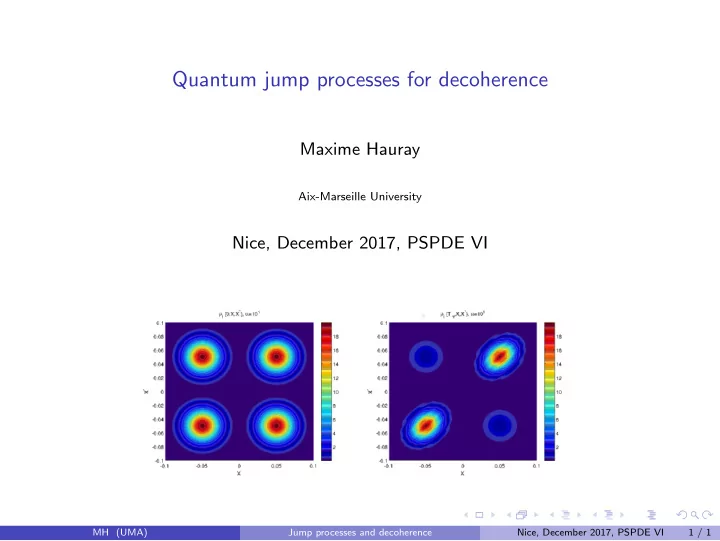

slide-1
SLIDE 1

Quantum jump processes for decoherence

Maxime Hauray

Aix-Marseille University

Nice, December 2017, PSPDE VI

MH (UMA) Jump processes and decoherence Nice, December 2017, PSPDE VI 1 / 1

slide-2
SLIDE 2

Content

MH (UMA) Jump processes and decoherence Nice, December 2017, PSPDE VI 2 / 1

slide-3
SLIDE 3

Section 1 Three physical experiments

MH (UMA) Jump processes and decoherence Nice, December 2017, PSPDE VI 3 / 1

slide-4
SLIDE 4

Wilson’s cloud chamber

Photography of Wilson’s cloud chamber (PRLS ’12), and Mott’s original paper. Question : Why the spherical wave function of an α particles gives straight ionization line in the cloud chamber? [Darwin (grandson), Heisenberg et Mott]

MH (UMA) Jump processes and decoherence Nice, December 2017, PSPDE VI 3 / 1

slide-5
SLIDE 5

Wilson’s cloud chamber

Photography of Wilson’s cloud chamber (PRLS ’12), and Mott’s original paper. Question : Why the spherical wave function of an α particles gives straight ionization line in the cloud chamber? [Darwin (grandson), Heisenberg et Mott] Answer given by Mott [Mott, PRLS ’29]. Recently re-examined mathematically [Dell’Antonio, Figari & Teta, JMP ’08] and [Teta, EJP ’10] and [Carlone, Figari & Negulescu ,preprint]

MH (UMA) Jump processes and decoherence Nice, December 2017, PSPDE VI 3 / 1

slide-6
SLIDE 6

The two slit experiment of Young revisited

The decrease of interference fringes is observed experimentally in a two slit experiment near vacuum: [Hornberger & coll., PRL ’03] A scheme of the experimental protocol and the results of Hornberger & all.

MH (UMA) Jump processes and decoherence Nice, December 2017, PSPDE VI 4 / 1

slide-7
SLIDE 7

The quantum measurement problem

The postulate of Quantum mechanics (P1) The phase space is a Hilbert space H = L2(D) (for us D = Rd), (P2) A quantum observable is a self-adjoint operator on H: A =

  • i∈N

λiφi ⊗ φi =

  • i∈N

λi|φiφi|, (P3-4) For a system in the state ψ, the measurement of A gives λi avec proba pi :=

  • φi|ψ
  • 2,

(P5) Wave packet collapse. After a measurement which result is λi, the system is in the state ψ+ = φi

  • u

ψ+ = 1 Piψ−Piψi, The free evolution of a quantum system is driven by a Schr¨

  • dinger equation :

i∂tψt = Hψt.

MH (UMA) Jump processes and decoherence Nice, December 2017, PSPDE VI 5 / 1

slide-8
SLIDE 8

The quantum measurement problem

The postulate of Quantum mechanics (P1) The phase space is a Hilbert space H = L2(D) (for us D = Rd), (P2) A quantum observable is a self-adjoint operator on H: A =

  • i∈N

λiφi ⊗ φi =

  • i∈N

λi|φiφi|, (P3-4) For a system in the state ψ, the measurement of A gives λi avec proba pi :=

  • φi|ψ
  • 2,

(P5) Wave packet collapse. After a measurement which result is λi, the system is in the state ψ+ = φi

  • u

ψ+ = 1 Piψ−Piψi, The free evolution of a quantum system is driven by a Schr¨

  • dinger equation :

i∂tψt = Hψt. Recurrent question: Why a postulate to describe a measurement ?

MH (UMA) Jump processes and decoherence Nice, December 2017, PSPDE VI 5 / 1

slide-9
SLIDE 9

Haroche experiment: Following experiment along time

Experimental set-up of Haroche & all. [Nature ’07].

MH (UMA) Jump processes and decoherence Nice, December 2017, PSPDE VI 6 / 1

slide-10
SLIDE 10

Haroche experiment: Following experiment along time

Experimental results by Haroche & all. [Nature ’07]. Uses non-demolishing measurement: only the wave-packet of the probe collapse. The wave packet collapse of the photons follows, but only after (many) repeated interactions. Mathematical explanation given by Bauer and Bernard [Phys. Rev. A 84, 2011] with a interesting Markov process.

MH (UMA) Jump processes and decoherence Nice, December 2017, PSPDE VI 7 / 1

slide-11
SLIDE 11

Section 2 Super-operator describing quantum collisions

MH (UMA) Jump processes and decoherence Nice, December 2017, PSPDE VI 8 / 1

slide-12
SLIDE 12

Classical collisions

!allows to deals with instantaneous collisions : (x, v)

coll

− − → (x, v′) avec v′ = g(v, θ)

MH (UMA) Jump processes and decoherence Nice, December 2017, PSPDE VI 8 / 1

slide-13
SLIDE 13

Describing a quantum collision

Using the quantum scattering operator SV (V interaction potential) SV := lim

t→+∞ eitH0e−2itHV eitH0,

with H0 = −1 2∆, HV = −1 2∆ + V Quantum scattering with a massive particle The two particle wave-function ψ(t, X, x) evolves according to the Schr¨

  • dinger eq.:

i∂tψ = − 1 2m ∆xψ − 1 2M ∆Xψ + V (x − X)ψ

MH (UMA) Jump processes and decoherence Nice, December 2017, PSPDE VI 9 / 1

slide-14
SLIDE 14

Describing a quantum collision

Using the quantum scattering operator SV (V interaction potential) SV := lim

t→+∞ eitH0e−2itHV eitH0,

with H0 = −1 2∆, HV = −1 2∆ + V Quantum scattering with a massive particle The two particle wave-function ψ(t, X, x) evolves according to the Schr¨

  • dinger eq.:

i∂tψ = − 1 2m ∆xψ −✟✟✟

1 2M ∆Xψ + V (x − X)ψ

MH (UMA) Jump processes and decoherence Nice, December 2017, PSPDE VI 9 / 1

slide-15
SLIDE 15

Describing a quantum collision

Using the quantum scattering operator SV (V interaction potential) SV := lim

t→+∞ eitH0e−2itHV eitH0,

with H0 = −1 2∆, HV = −1 2∆ + V Quantum scattering with a massive particle The two particle wave-function ψ(t, X, x) evolves according to the Schr¨

  • dinger eq.:

i∂tψ = − 1 2m ∆xψ + V (x − X)ψ

An instantaneous quantum collision

ψin = φ ⊗ χ

Collision

− − − − → ψout ≃ φ(X)

  • SXχ
  • (x),

where SX is the scattering operator of the light particle with a center in X. Obtained rigorously in [Adami, H., Negulescu, CMS 2016]

MH (UMA) Jump processes and decoherence Nice, December 2017, PSPDE VI 9 / 1

slide-16
SLIDE 16

Describing a quantum collision

Using the quantum scattering operator SV (V interaction potential) SV := lim

t→+∞ eitH0e−2itHV eitH0,

with H0 = −1 2∆, HV = −1 2∆ + V Quantum scattering with a massive particle The two particle wave-function ψ(t, X, x) evolves according to the Schr¨

  • dinger eq.:

i∂tψ = − 1 2m ∆xψ + V (x − X)ψ

An instantaneous quantum collision

ψin = φ ⊗ χ

Collision

− − − − → ψout ≃ φ(X)

  • SXχ
  • (x),

where SX is the scattering operator of the light particle with a center in X. Obtained rigorously in [Adami, H., Negulescu, CMS 2016] Problem : After the collision, the two particles are entangled: no wave function for

  • ne particle anymore.

Partial answer : The density matrix formalism introduced by von Neumann.

MH (UMA) Jump processes and decoherence Nice, December 2017, PSPDE VI 9 / 1

slide-17
SLIDE 17

Density matrix or operator

Quantum systems now described by compact self-adjoint positive operators with unit trace on H = L2(Rd). Pure states: If a state has a wave function : ρ = |ψψ| (= ψ ⊗ ψ) Mixed state: The general case, after diagonalization ρ =

  • i

λi|ψiψi| The partial trace : allows to average on “degrees of freedom”. ρL(X, X ′) =

  • ρ(X, x, X ′, x) dx

MH (UMA) Jump processes and decoherence Nice, December 2017, PSPDE VI 10 / 1

slide-18
SLIDE 18

A super-operator describing instantaneous collisions

According to [Joos-Zeh, Z. Phys. B ’85], the effect of one interaction on the massive particle is describe by a super-operator S+

1 ⊂ B

  • L2(Rd)
  • :

S+

1 :=

  • ρ sym. positive, Tr ρ < +∞
  • Definition (Instantaneous collision operator)

defined on S+

1 with I χ V (X, X ′) :=

  • SXχ, SX ′χ
  • ρ

V

− − → Iχ

V [ρ]

with kernel ρ(X, X ′) → ρ(X, X ′)I χ

V (X, X ′),

MH (UMA) Jump processes and decoherence Nice, December 2017, PSPDE VI 11 / 1

slide-19
SLIDE 19

A super-operator describing instantaneous collisions

According to [Joos-Zeh, Z. Phys. B ’85], the effect of one interaction on the massive particle is describe by a super-operator S+

1 ⊂ B

  • L2(Rd)
  • :

S+

1 :=

  • ρ sym. positive, Tr ρ < +∞
  • Definition (Instantaneous collision operator)

defined on S+

1 with I χ V (X, X ′) :=

  • SXχ, SX ′χ
  • ρ

V

− − → Iχ

V [ρ]

with kernel ρ(X, X ′) → ρ(X, X ′)I χ

V (X, X ′),

General properties

Contractive: |I χ

V (X, X ′)| ≤ 1,

Trace preserving: I χ

V (X, X ′) = 1,

Completely positive (see the Stinespring dilatation theorem). References: Davies CMP 78, Dios´ ı, Europhys. Lett. ’95 ; AltenM¨ uller, M¨ uller, Schenzle,

  • Phys. Rev. A ’97 ; Dodd, Halliwell, Phys. Rev. D ’03 ; Hornberger, Sipe, Phys. Rev. A

’03 ; Adler, J. Phys. A ’06, Attal & Joye, JSP 07.

MH (UMA) Jump processes and decoherence Nice, December 2017, PSPDE VI 11 / 1

slide-20
SLIDE 20

A simpler form in 1D

The scattering theory in 1D is simpler: S

  • eikx

= tkeikx + rke−ikx, et SX eikx = tkeikx + e2ikXrke−ikx

Particular case : Collision super-operator in 1D.

I χ

V (X, X ′) = 1 − Θχ V (X − X ′) + i Γχ V (X) − i Γχ V (X ′)

with Θχ

V ∈ C and Γχ V ∈ R defined with the help of reflexion and transmission amplitudes

(rk, tk) Θχ

V (Y ) :=

  • R
  • 1 − e2ikY

|rk|2| χ(k)|2 dk, Γχ

V (X) := −i

  • R

e2ikX rkt−k χ(k) χ(−k) dk. Θχ

V est la partie “d´

ecoherente”, et Γχ

V ∈ [−1, 1] la partie “potentielle”.

MH (UMA) Jump processes and decoherence Nice, December 2017, PSPDE VI 12 / 1

slide-21
SLIDE 21

The general decomposition

A similar decomposition exists in larger dimension, when S = I + iT.

General form of the collision super-operator

I χ

V (X, X ′) = 1 − Θχ V (X, X ′) + i Γχ V (X) − i Γχ V (X ′)

with Θχ

V ∈ C, et Γχ V ∈ R, defined T by

Θχ

V (X, X ′) := ℑχ, T Xχ + ℑχ, T X ′χ − T Xχ, T X ′χ

Γχ

V (X) := ℜχ, T Xχ.

Θχ

V is the “decoherent” part, while Γχ V ∈ [−1, 1] is “the potential” one.

Remark: The optical theorem ensures that Θχ

V (X, X) = 0.

MH (UMA) Jump processes and decoherence Nice, December 2017, PSPDE VI 13 / 1

slide-22
SLIDE 22

Simplifications in 1D: GWP et “quasi”-scattering

If χ is a Gaussian Wave Packet (GWP) with parameters (①, ♣, σ) χ(x) = 1 (2πσ2)1/4 e− (x−①)2

4σ2

+i♣x;

“Freeze” the reflection and transmission amplitude rk = α ∈ [0, 1] and tk = ±i

  • 1 − |α|2.

Important: This approximation preserves all the important properties : unitarity of the scattering, complete positivity, commutation with the free evolution...

♣ ♣ ♣ ♣ ♣ ♣ ♣ ♣

MH (UMA) Jump processes and decoherence Nice, December 2017, PSPDE VI 14 / 1

slide-23
SLIDE 23

Simplifications in 1D: GWP et “quasi”-scattering

If χ is a Gaussian Wave Packet (GWP) with parameters (①, ♣, σ) χ(x) = 1 (2πσ2)1/4 e− (x−①)2

4σ2

+i♣x;

“Freeze” the reflection and transmission amplitude rk = α ∈ [0, 1] and tk = ±i

  • 1 − |α|2.

Important: This approximation preserves all the important properties : unitarity of the scattering, complete positivity, commutation with the free evolution...

A simple explicit approximation.

I ♣,σ

α

(X, X ′) = 1 − Θ♣,σ

α (X − X ′) + i Γ♣,σ α (X − x) − i Γ♣,σ α i(X ′ − x),

with Θ♣,σ

α (Y ) = α2

  • 1 − e2iσ♣ Y

σ − Y 2 2σ2

  • ,

Γ♣,σ

α (X) = ±α

  • 1 − |α|2e−2σ2♣2− X2

2σ2 MH (UMA) Jump processes and decoherence Nice, December 2017, PSPDE VI 14 / 1

slide-24
SLIDE 24

A simulation.

Initially, a massive particle in a superposed state φ(0) = 1 √ 2

  • |φ− + |φ+
  • :=

1 √ 2

  • GWP
  • −❳, P, Σ
  • + 1

√ 2

  • GWP
  • ❳, −P, Σ
  • ρM(0) = |φ(0)φ(0)|

Density operator ρM(0) (modulus of the kernel) before and after collision. From [Adami, H., Negulescu, CMS 2016].

MH (UMA) Jump processes and decoherence Nice, December 2017, PSPDE VI 15 / 1

slide-25
SLIDE 25

Simulation of the effect of the interaction on the interference fringes.

Without interaction: the two bumps superposes at a time T ∗ with interference fringes. with interaction, the density is ρM

a (T ∗, X, X):

−0.1 −0.08 −0.06 −0.04 −0.02 0.02 0.04 0.06 0.08 0.1 0.05 0.1 0.15 0.2 0.25 0.3 0.35 0.4 0.45 Decoherence effect, PL=−1.5*102 X ρH(t*,X) α=102 α=5*102 α=103

−0.1 −0.08 −0.06 −0.04 −0.02 0.02 0.04 0.06 0.08 0.1 0.1 0.2 0.3 0.4 0.5 0.6 0.7 Decoherence effect, PL=−2.5*102 X ρH(t*,X) α=102 α=5*102 α=103 α=2*103

Density profil ρM(T ∗, X, X) for different interaction strength α, and velocity ♣. Observation :

◮ Damped interference fringes,

linked to the transmission of the light particle,

◮ A bump on the right without fringes,

linked to the r´ eflexion of the light particle. ⇒ Moment exchange.

MH (UMA) Jump processes and decoherence Nice, December 2017, PSPDE VI 16 / 1

slide-26
SLIDE 26

Section 3 Generators of quantum semi-groups: Lindblad super-operators

MH (UMA) Jump processes and decoherence Nice, December 2017, PSPDE VI 17 / 1

slide-27
SLIDE 27

Lindblad equations and super-operators

Importance of the complete positivity, see [Kossakowsky, RMP 72] and [Lindblad, CMP 76].

Definition (Lindblad super-operator)

It is the generator of a quantum semi-group, that preserves complete positivity. ∂tρ = L∗ρ :=

  • i
  • ViρV ∗

i − 1

2

  • V ∗

i Viρ + ρV ∗ i Vi

  • MH (UMA)

Jump processes and decoherence Nice, December 2017, PSPDE VI 17 / 1

slide-28
SLIDE 28

Lindblad equations and super-operators

Importance of the complete positivity, see [Kossakowsky, RMP 72] and [Lindblad, CMP 76].

Definition (Lindblad super-operator)

It is the generator of a quantum semi-group, that preserves complete positivity. ∂tρ = L∗ρ :=

  • i
  • ViρV ∗

i − 1

2

  • V ∗

i Viρ + ρV ∗ i Vi

  • Poisson semi-group with unitary Vi:

∂tρ =

  • i

αiViρV ∗

i −

  • αi
  • ρ

Gaussian semi-group with self-adjoint Vi ∂tρ =

  • i
  • ViρVi − 1

2

  • V 2

i ρ + ρV 2 i

  • = −
  • i
  • Vi,
  • Vi, ρ
  • MH (UMA)

Jump processes and decoherence Nice, December 2017, PSPDE VI 17 / 1

slide-29
SLIDE 29

Classical and quantum Poisson semi-group.

Wigner transform

It is “almost” a position velocity distribution, associated to ρ : f (x, v) :=

  • ρ
  • x − k

2 , x + k 2

  • eikv dk,

Probl` eme : f ∈ R but not necessarily f ≥ 0. But Husimi transform ˜ f = e

1 4 ∆x,v f ≥ 0. MH (UMA) Jump processes and decoherence Nice, December 2017, PSPDE VI 18 / 1

slide-30
SLIDE 30

Classical and quantum Poisson semi-group.

Wigner transform

It is “almost” a position velocity distribution, associated to ρ : f (x, v) :=

  • ρ
  • x − k

2 , x + k 2

  • eikv dk,

Probl` eme : f ∈ R but not necessarily f ≥ 0. But Husimi transform ˜ f = e

1 4 ∆x,v f ≥ 0.

quantum Poisson semi-group (θ probability on R) : ∂tρ =

  • R
  • eikxρe−ikx − ρ
  • θ(dk).

After Wigner transform ∂tf (x, v) =

  • R
  • f (x, v − k) − f (x, v)
  • θ(dk),

it is the Fokker-Planck equation for a jump process on the velocities.

MH (UMA) Jump processes and decoherence Nice, December 2017, PSPDE VI 18 / 1

slide-31
SLIDE 31

classical quantum Gaussian semi-groups

Quantum Gaussian semi-group: ∂tρ = XρX − 1 2

  • X 2ρ + ρX 2

After Wigner transform ∂tf (x, v) = 1 2∆vf (x, v), which is the Fokker-Planck equation for a Langevin process(Brownian motion on velocities).

MH (UMA) Jump processes and decoherence Nice, December 2017, PSPDE VI 19 / 1

slide-32
SLIDE 32

classical quantum Gaussian semi-groups

Quantum Gaussian semi-group: ∂tρ = XρX − 1 2

  • X 2ρ + ρX 2

After Wigner transform ∂tf (x, v) = 1 2∆vf (x, v), which is the Fokker-Planck equation for a Langevin process(Brownian motion on velocities). And for the Gaussian quantum semi-group : ∂tρ = (i∂)ρ(i∂) − 1 2

  • (i∂)2ρ + ρ(i∂)2

After Wigner ∂tf (x, v) = 1 2∆xf (x, v).

MH (UMA) Jump processes and decoherence Nice, December 2017, PSPDE VI 19 / 1

slide-33
SLIDE 33

Section 4 The “weak coupling” limit.

MH (UMA) Jump processes and decoherence Nice, December 2017, PSPDE VI 20 / 1

slide-34
SLIDE 34

An environment modeled by a thermal bath.

With N interaction par time unit

At random time Ti, the massive particle interact with GWP of parameter (①i, σi = 1, ♣i) where (Ti, ①i, ♣i) are given by a Poisson Random Measure of intensity N 1 2RN dt ⊗ 1 2RN 1[−RN,RN]d① ⊗ 1 √ 2π¯ σ e−

1 2 ¯ σ2 p2d♣.

This is a thermic bath at temperature T = 1 + ¯ σ2. ① ♣

MH (UMA) Jump processes and decoherence Nice, December 2017, PSPDE VI 20 / 1

slide-35
SLIDE 35

An environment modeled by a thermal bath.

With N interaction par time unit

At random time Ti, the massive particle interact with GWP of parameter (①i, σi = 1, ♣i) where (Ti, ①i, ♣i) are given by a Poisson Random Measure of intensity N 1 2RN dt ⊗ 1 2RN 1[−RN,RN]d① ⊗ 1 √ 2π¯ σ e−

1 2 ¯ σ2 p2d♣.

This is a thermic bath at temperature T = 1 + ¯ σ2. RN is a truncature parameter, necessary in 1D. (Ti+1 − Ti) are i.i.d. with exponential law E(1/2N). ①i are i.i.d. with uniform law U

  • [−RN, RN]
  • .

♣i are i.i.d normal law N(0, ¯ σ2). everything is independent of everything.

MH (UMA) Jump processes and decoherence Nice, December 2017, PSPDE VI 20 / 1

slide-36
SLIDE 36

An environment modeled by a thermal bath.

With N interaction par time unit

At random time Ti, the massive particle interact with GWP of parameter (①i, σi = 1, ♣i) where (Ti, ①i, ♣i) are given by a Poisson Random Measure of intensity N 1 2RN dt ⊗ 1 2RN 1[−RN,RN]d① ⊗ 1 √ 2π¯ σ e−

1 2 ¯ σ2 p2d♣.

This is a thermic bath at temperature T = 1 + ¯ σ2. RN is a truncature parameter, necessary in 1D. (Ti+1 − Ti) are i.i.d. with exponential law E(1/2N). ①i are i.i.d. with uniform law U

  • [−RN, RN]
  • .

♣i are i.i.d normal law N(0, ¯ σ2). everything is independent of everything. Question: N interactions by time unit: ⇒ How to scale the interaction force to get a finite effect in the limit?

MH (UMA) Jump processes and decoherence Nice, December 2017, PSPDE VI 20 / 1

slide-37
SLIDE 37

The appropriate scaling for the interaction strentgh

The super-operator Ip,x

α

multiply the kernel by I ♣,①

α (X, X ′) = 1 − α2

1 − e2i♣Y − 1

2 Y 2

±iα

  • 1 − α2e−2♣2

e− 1

2 (X−①)2 − e− 1 2 (X ′−①)2

♣ ① ♣ ♣ ① ①

MH (UMA) Jump processes and decoherence Nice, December 2017, PSPDE VI 21 / 1

slide-38
SLIDE 38

The appropriate scaling for the interaction strentgh

The super-operator Ip,x

α

multiply the kernel by I ♣,①

α (X, X ′) = 1 − α2

1 − e2i♣Y − 1

2 Y 2

±iα

  • 1 − α2e−2♣2

e− 1

2 (X−①)2 − e− 1 2 (X ′−①)2

Replacing α by α √ N . I ♣,①

α,N(X, X ′) = 1 − α2

N

  • 1 − e2i♣(X−X ′)− 1

2 (X−X ′)2

±i α √ N

  • 1 − α2

N e−2♣2 e− 1

2 (X−①)2 − e− 1 2 (X ′−①)2 MH (UMA) Jump processes and decoherence Nice, December 2017, PSPDE VI 21 / 1

slide-39
SLIDE 39

The appropriate scaling for the interaction strentgh

The super-operator Ip,x

α

multiply the kernel by I ♣,①

α (X, X ′) = 1 − α2

1 − e2i♣Y − 1

2 Y 2

±iα

  • 1 − α2e−2♣2

e− 1

2 (X−①)2 − e− 1 2 (X ′−①)2

Replacing α by α √ N . I ♣,①

α,N(X, X ′) = 1 − α2

N

  • 1 − e2i♣(X−X ′)− 1

2 (X−X ′)2

±i α √ N

  • 1 − α2

N e−2♣2 e− 1

2 (X−①)2 − e− 1 2 (X ′−①)2

The “decoherent” term with α2/N has a bounded expectation by time unit. The “potential” term with α/ √ N has uniform expectation, and bounded fluctuations.

MH (UMA) Jump processes and decoherence Nice, December 2017, PSPDE VI 21 / 1

slide-40
SLIDE 40

A quantum jump process

The “weak coupling” model

i∂tρN

t =

  • H0, ρN

t

  • n [Ti, Ti+1),

avec H0 = −1 2∆ ρN

Ti = I♣i ,①i α,N ρN T −

i MH (UMA) Jump processes and decoherence Nice, December 2017, PSPDE VI 22 / 1

slide-41
SLIDE 41

A quantum jump process

The “weak coupling” model

i∂tρN

t =

  • H0, ρN

t

  • n [Ti, Ti+1),

avec H0 = −1 2∆ ρN

Ti = I♣i ,①i α,N ρN T −

i

Written with the PRM denoted PN, ρN

t

= ρN − i t

  • H0, ρN

s

  • ds + i

t

  • Ip,x

α,NρN s

− ρN

s

  • PN(ds, dx, dp),

MH (UMA) Jump processes and decoherence Nice, December 2017, PSPDE VI 22 / 1

slide-42
SLIDE 42

A quantum jump process

The “weak coupling” model

i∂tρN

t =

  • H0, ρN

t

  • n [Ti, Ti+1),

avec H0 = −1 2∆ ρN

Ti = I♣i ,①i α,N ρN T −

i

Written with the PRM denoted PN, ρN

t

= ρN − i t

  • H0, ρN

s

  • ds + i

t

  • Ip,x

α,NρN s

− ρN

s

  • PN(ds, dx, dp),

Or with the compensated PRM ˜ PN, θ∞(Y ) = e− 2

T Y 2:

ρN

t = ρN 0 − i

t

  • H0 + γN, ρN

s

  • ds + α2

t

  • θ∞
  • ρN

s

  • − ρN

s

  • ds

+ i t

  • Ip,x

α,NρN s − ρN s

  • ˜

PN(ds, dx, dp).

MH (UMA) Jump processes and decoherence Nice, December 2017, PSPDE VI 22 / 1

slide-43
SLIDE 43

A convergence result: low density environement

Theorem (Gomez & H., arXiv 2016, rough version)

If the cut-off parameter RN → ∞, then the solution converges in Sp (p > 1) towards the unique solution of the Lindblad equation i∂tρ∞

t

=

  • H0, ρ∞

t

  • + iα2

θ∞

  • ρ∞

t

  • − ρ∞

t

  • ,

MH (UMA) Jump processes and decoherence Nice, December 2017, PSPDE VI 23 / 1

slide-44
SLIDE 44

A convergence result: low density environement

Theorem (Gomez & H., arXiv 2016, rough version)

If the cut-off parameter RN → ∞, then the solution converges in Sp (p > 1) towards the unique solution of the Lindblad equation i∂tρ∞

t

=

  • H0, ρ∞

t

  • + iα2

θ∞

  • ρ∞

t

  • − ρ∞

t

  • ,

Theorem (Gomez & H., arXiv 2016, rough version)

If RN ≤ N, then fluctuations Z N

t = √RN(ρN t − ρ∞ t ) converge in law in S2 towards the

unique solution of i dZ ∞

t

=

  • H0 dt, Z ∞

t

  • + iα2

θ∞

  • Z ∞

t

  • − Z ∞

t

  • dt + α2

dWt, ρ∞

t

  • ,

where Wt is a cylindrical BM with covariance E

  • Wt(X)Ws(X ′)
  • = c(s ∧ t)α2e− 1

4 (X−X ′)2. MH (UMA) Jump processes and decoherence Nice, December 2017, PSPDE VI 23 / 1

slide-45
SLIDE 45

A convergence result: dense environnement

Theorem (Gomez & H., arXiv 2016, rough version)

If RN = R, then ρN converges in law in Sp (pour p > 1) towards the unique solution of a stochastic Lindblad equation i dρ∞

t

=

  • H0 dt + dWt, ρ∞

t

  • + iα2

θ∞

  • ρ∞

t

  • − ρ∞

t

  • dt,

where Wt is a cylindrical BM with covariance E

  • Wt(X)Ws(X ′)
  • = c(s ∧ t)α2

R e− 1

4 (X−X ′)2gR(X, X ′).

where gR(X, X ′) ≃ 1 when |X|, |X ′| << R.

MH (UMA) Jump processes and decoherence Nice, December 2017, PSPDE VI 24 / 1

slide-46
SLIDE 46

A convergence result: dense environnement

Theorem (Gomez & H., arXiv 2016, rough version)

If RN = R, then ρN converges in law in Sp (pour p > 1) towards the unique solution of a stochastic Lindblad equation i dρ∞

t

=

  • H0 dt + dWt, ρ∞

t

  • + iα2

θ∞

  • ρ∞

t

  • − ρ∞

t

  • dt,

where Wt is a cylindrical BM with covariance E

  • Wt(X)Ws(X ′)
  • = c(s ∧ t)α2

R e− 1

4 (X−X ′)2gR(X, X ′).

where gR(X, X ′) ≃ 1 when |X|, |X ′| << R.

  • r in Stratonovitch formulation

i dρ∞

t

=

  • H0 dt + dWt◦, ρ∞

t

  • + iα2

θ∞

  • ρ∞

t

  • − ρ∞

t

  • dt

+ ic R

−R

  • γ(· − x),
  • γ(· − x), ρ∞

t

  • dxdt

MH (UMA) Jump processes and decoherence Nice, December 2017, PSPDE VI 24 / 1

slide-47
SLIDE 47

Effect of the stochastic potential on the decoherence

Stratonovich formulation separates the dynamics in: A reversible part: i dρ∞

t

=

  • H0 dt + dWt◦, ρ∞

t

  • A dissipative part:

i dρ∞

t

= iα2 θ∞

  • ρ∞

t

  • − ρ∞

t

  • dt + ic

R

−R

  • γ(· − x),
  • γ(· − x), ρ∞

t

  • dxdt

Remark: The brown term decreases decoherence.

MH (UMA) Jump processes and decoherence Nice, December 2017, PSPDE VI 25 / 1

slide-48
SLIDE 48

Effect of the stochastic potential on the decoherence

Stratonovich formulation separates the dynamics in: A reversible part: i dρ∞

t

=

  • H0 dt + dWt◦, ρ∞

t

  • A dissipative part:

i dρ∞

t

= iα2 θ∞

  • ρ∞

t

  • − ρ∞

t

  • dt + ic

R

−R

  • γ(· − x),
  • γ(· − x), ρ∞

t

  • dxdt

Remark: The brown term decreases decoherence.

Remarque

The Heisenberg-Ito equation i∂tρ =

  • H0dt + dWt, ρt
  • increases coherence, because in Stratonovich formulation

i∂tρt =

  • H0dt + dWt, ρt
  • + 2i
  • g(0) − g(X − X ′)
  • ρt

where g is the correlation function of the BM W .

MH (UMA) Jump processes and decoherence Nice, December 2017, PSPDE VI 25 / 1