Quantum gas microscopy of the Fermi-Hubbard model in new regimes - - PowerPoint PPT Presentation

quantum gas microscopy of the fermi hubbard model in new
SMART_READER_LITE
LIVE PREVIEW

Quantum gas microscopy of the Fermi-Hubbard model in new regimes - - PowerPoint PPT Presentation

Quantum gas microscopy of the Fermi-Hubbard model in new regimes Peter Schauss, Princeton University Debayan Mitra, Peter Brown, Elmer Guardado-Sanchez, Stanimir Kondov, Trithep Devakul, David Huse, Waseem Bakr Ehsan Khatami, Thereza Paiva,


slide-1
SLIDE 1

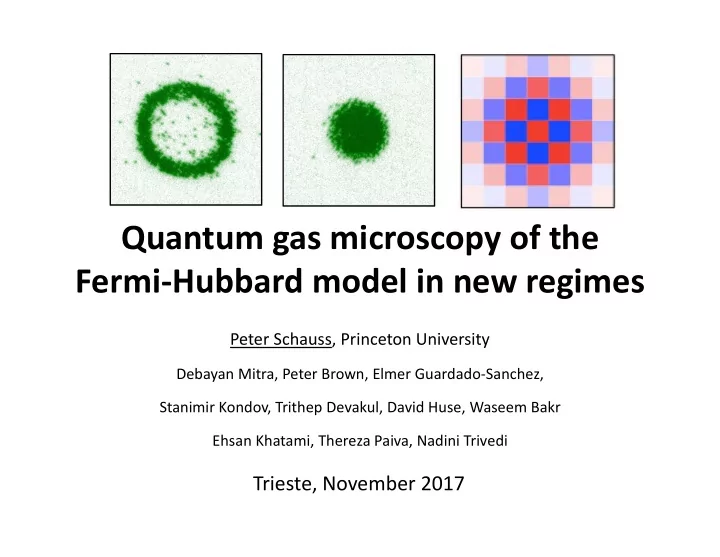
Quantum gas microscopy of the Fermi-Hubbard model in new regimes

Peter Schauss, Princeton University

Debayan Mitra, Peter Brown, Elmer Guardado-Sanchez, Stanimir Kondov, Trithep Devakul, David Huse, Waseem Bakr Ehsan Khatami, Thereza Paiva, Nadini Trivedi

Trieste, November 2017

slide-2
SLIDE 2

The Fermi-Hubbard model

  • Two species of fermions in a 2D lattice.
  • Nearest neighbor tunneling t.
  • Onsite interactions U.
  • Realized naturally with cold atoms in optical lattices

with fully tunable parameters.

Jaksch, PRL 81, 3108 (1998)

slide-3
SLIDE 3

The parameter space

Interactions Repulsive Attractive Temperature

U

Mott insulator

t2/U

Antiferromagnet

Mott insulator: Munich, ETH

Doping

?

Spin-imbalance

Antiferromagnet: ETH, Rice, Harvard, MIT, Munich, Bonn d-wave SF?

slide-4
SLIDE 4

Quantum gas microscopy

  • Boson microscopes
  • Fermion microscopes

Harvard MPQ Strathclyde MIT Toronto Princeton Harvard MPQ Kyoto Tokyo

slide-5
SLIDE 5

Antiferromagnetic correlations

Greiner group T/t = 0.45 (2D) Science 353, 1253 (2016) Zwierlein group T/t = 0.89 (2D) Science 353, 1260 (2016) Bloch/Gross group 1D Science 353, 1257 (2016) Köhl group (2D) PRL 118, 170401 (2017) Esslinger group Science 340, 1307 (2013) Hulet group Nature 519, 211 (2015)

slide-6
SLIDE 6

A simplified Fermi gas microscope

  • Single beam optical lattice @ 1064 nm simplifies microscopy:

4-fold interference enhances depth + larger lattice spacing. Lithium allows for large lattice spacing: – Light – “good” Feshbach resonances – NA = 0.5 is sufficient for single-site

Vertical polarization: 752 nm Horizontal polarization: 532 nm

6Li

slide-7
SLIDE 7

Repulsive Hubbard model: Mott insulators and band insulators

Mott insulator Band insulator (in presence of light assisted collisions)

Brown et. al., Science 357, 1385 (2017)

Detect 1000 photons/atom in 1.2s via Raman sideband cooling Hopping: 0.4%, loss: 1.6%

slide-8
SLIDE 8

Outline

  • 1. Spin-imbalance in

repulsive Hubbard model

  • 2. Attractive Hubbard model
slide-9
SLIDE 9
  • 1. Spin-imbalance in a 2D Fermi-Hubbard system

Brown et. al., Science 357, 1385 (2017)

slide-10
SLIDE 10

Spin imbalance

Condensed matter system: Spin imbalance by applied magnetic field (Zeeman effect) Cold atoms: Spin-imbalance prepared before loading to lattice by evaporation in spin-dependent potential. No spin-relaxation. Spin-polarization Zeeman field

slide-11
SLIDE 11

Spin canting – classical model

Classical antiferromagnetic Heisenberg model

 Main signature: Asymmetry in SzSz vs SxSx correlation

↑ ↓ ↑ ↓

  • Increasing

magnetic field h Polarization:

slide-12
SLIDE 12

Spin Canting: 2D Hubbard Phase Diagram at half-filling

  • Superexchange energy

scale , BKT phase transition

  • Field breaks SU(2)

symmetry

  • AFM correlations build

up preferably in XY plane

Phase Diagram: PRB 69, 184501 (2004) PRA 81, 023628 (2010) Isotropic AF with QGM: Science 353, 1253 (2016) Science 353, 1257 (2016) Science 353, 1260 (2016)

slide-13
SLIDE 13

Spin-imbalanced Mott insulators

Mott physics is not affected by imbalance Polarization is constant in Mott insulator region Singles density Radius (sites) Total Majority Minority U/t = 8

slide-14
SLIDE 14

Interesting interesting behavior in density at larger interaction (U/t = 15)

h = 0.2t

↑ ↓ ↑ ↓

slide-15
SLIDE 15

Spin-Susceptibility

AF region Metallic region non-degenerate gas

Hubbard reproduces peak in cuprate susceptibility at about 20% doping.

PRB 40, 8872 (1989) PRL 62, 957 (1989) PRB 40, 2254 (1989) h = 0.2t

  • (linear regime)
  • Brown et. al. Science 357, 1385 (2017)
slide-16
SLIDE 16

Probing spin-imbalanced lattice gases

Sx Sz

  • 1-3 mixture of lithium
  • Evaporate in gradient
  • Load into lattice at U/t = 8

Vary:

Brown et. al. Science 357, 1385 (2017)

slide-17
SLIDE 17

Spin Canting

  • Good agreement with

NLCE & DQMC

  • T/t increases from 0.40

to 0.57

DQMC by Thereza Paiva and Nandini Trivedi NLCE by Ehsan Khatami

Brown et. al. Science 357, 1385 (2017)

along field

  • rthogonal to field

Nearest neighbor spin-correlator

slide-18
SLIDE 18
  • Spin Canting
  • Good agreement with

NLCE & DQMC

  • T/t increases from 0.40

to 0.57

DQMC by Thereza Paiva and Nandini Trivedi NLCE by Ehsan Khatami

Brown et. al. Science 357, 1385 (2017)

slide-19
SLIDE 19
  • Why negative NNN?

𝑞 = 0.77

Spin Canting

  • Good agreement with

NLCE & DQMC

  • T/t increases from 0.40

to 0.57

DQMC by Thereza Paiva and Nandini Trivedi NLCE by Ehsan Khatami

Brown et. al. Science 357, 1385 (2017)

slide-20
SLIDE 20

Unpolarized gas: isotropic spin correlations [SU(2) symmetry] Polarized gas: AFM correlations preferred in the plane

Increasing polarization

Correlations at larger distances

slide-21
SLIDE 21
  • 2. Quantum gas microscopy of an

attractive Fermi-Hubbard system

Mitra et. al, Nature Physics, 10.1038/nphys4297 (2017)

slide-22
SLIDE 22

Spin-balanced attractive Hubbard model

Preformed pairs: U Superfluidity: 4t2/U

pseudogap pseudogap band insulator vacuum

Mitra et. al, Nat. Phys., 10.1038/nphys4297 (2017)

slide-23
SLIDE 23

Site-resolved doublon detection

Band insulator

90 % fidelity

Mitra et. al, Nat. Phys., 10.1038/nphys4297 (2017)

slide-24
SLIDE 24

Density profile of attractive lattice gas

Singles fraction suppressed at large |U|/t due to fermion pairing Expect s-wave pairing correlations near n = 1 Experimental data with DQMC fit T/t = 0.45 U/t = -5.7 Reasonably large region of cloud near half filling At trap frequency w = 2p 200 Hz Total density Density in doublons

Mitra et. al, Nat. Phys., 10.1038/nphys4297 (2017)

slide-25
SLIDE 25

Thermometry in attractive Hubbard system

  • Singles fraction increases as

gas heats up during hold time

  • Singles fraction for

thermometry only for T/t > 1

  • Correlation thermometry at

T/t < 1

Single fraction Doublon fraction Doublon-doublon correlator Mitra et. al, Nat. Phys., 10.1038/nphys4297 (2017)

slide-26
SLIDE 26

Doublon-doublon correlators

Doublon-doubloon correlator Nearest neighbor Diagonal neighbor Haven’t we heard this story before? Diagonal correlator goes negative at large doping? Density

U/t = -5.7

Correlations Up to d = 2

slide-27
SLIDE 27

Mapping between the models

Repulsive U > 0 Attractive U < 0

Mott insulator Preformed pairs Antiferromagnet Charge density wave

  • Phys. Rev. A 79, 033620 (2009)

1. 2.

↓ ↓

slide-28
SLIDE 28

Correlator symmetry

Attractive Hubbard Repulsive Hubbard

slide-29
SLIDE 29

Correlator symmetry

Attractive Hubbard Repulsive Hubbard Doublon-doublon correlations are lower bound for s-wave pairing correlations

slide-30
SLIDE 30

Conclusions and outlook

  • Observation of canted antiferromagnetic correlations in spin-

imbalanced repulsive gases.

  • Observation of charge density wave correlations in attractive lattice

gases.

  • Outlook:

– Lower temperatures (e.g. entropy redistribution) – Beyond single band Hubbard on attractive branch – Spin-imbalanced attractive gases in 1D-2D crossover (FFLO) – Dynamics – LDOS measurements on topological defects – Dipolar interactions through Rydberg dressing

slide-31
SLIDE 31

Lithium Rydberg excitation

  • Direct excitation at 230nm
  • Detection via loss
  • Rabi frequency: up to 6 MHz
  • Towards Rydberg dressing of Fermions

Pair correlation: Rabi oscillation

Guardado-Sanchez et. al. arXiv:1711.00887 (2017)

Quench dynamics in an antiferromagnetic 2D Ising Hamiltonian

slide-32
SLIDE 32

Outlook: Hubbard dynamics

Strange metal phase is within reach of current Fermi-Hubbard experiments. Defined by “strange” transport behavior (dynamics) Ongoing: charge hydrodynamics (sound, diffusion in doped Hubbard model.

slide-33
SLIDE 33

Outlook: Hubbard dynamics

Strange metal phase is within reach of current Fermi-Hubbard experiments. Defined by “strange” transport behavior (dynamics) Ongoing: charge hydrodynamics (sound, diffusion in doped Hubbard model.

slide-34
SLIDE 34

Theory: David Huse and Trithep Devakul, Princeton University Nandini Trivedi, Ohio State University Thereza Paiva, Universidade Federal do Rio de Janeiro Ehsan Khatami, San José State University Funding:

Debayan Mitra Stanimir Kondov (now Columbia) Peter Schauss Elmer Guardado-Sanchez PI: Waseem Bakr Peter Brown