Quantitative Laser Spectroscopy for SI-Traceable Measurements of - - PowerPoint PPT Presentation

quantitative laser spectroscopy for si traceable
SMART_READER_LITE
LIVE PREVIEW

Quantitative Laser Spectroscopy for SI-Traceable Measurements of - - PowerPoint PPT Presentation

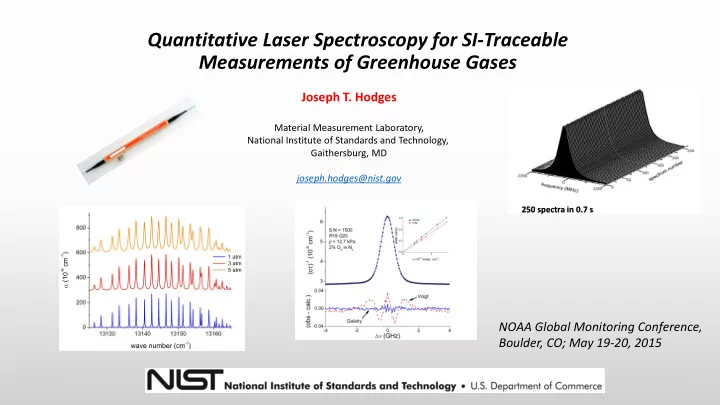
Quantitative Laser Spectroscopy for SI-Traceable Measurements of Greenhouse Gases Joseph T. Hodges Material Measurement Laboratory, National Institute of Standards and Technology, Gaithersburg, MD joseph.hodges@nist.gov 250 spectra in 0.7 s


slide-1
SLIDE 1

Quantitative Laser Spectroscopy for SI-Traceable Measurements of Greenhouse Gases

Joseph T. Hodges

Material Measurement Laboratory, National Institute of Standards and Technology, Gaithersburg, MD joseph.hodges@nist.gov

250 spectra in 0.7 s

NOAA Global Monitoring Conference, Boulder, CO; May 19-20, 2015

slide-2
SLIDE 2

Outline

Line intensities as intrinsic standards for measurement of concentration Frequency-stabilized cavity ring-down spectroscopy (FS-CRDS) Comparison of measured and ab initio intensities for CO2 Line shape effects Development of mid-IR laser spectrometer for measuring 16O14C16O at natural abundance

slide-3
SLIDE 3

Measurement of Line Intensity (S) and Absorber Concentration (n) S = ∫ α(ν)dν /{ n ∫g(ν)dν} = A/n

line profile (unity area) fitted spectrum area measured absorption coefficient

Once the intrinsic property S is known, then

n = A/S

slide-4
SLIDE 4

Transition dipole

S12 = fn(T)*|µ12|2

Calculation of S12 requires wave functions that are computed from potential energy surface (PES) and dipole moment surface (DMS)

Quantum (ab initio) calculation of line intensity, S12

H2O: 10-electron system CO2 22-electron system

  • O. Polyansky & J. Tennyson, University College of London
slide-5
SLIDE 5

Frequency-stabilized cavity ring-down spectroscopy (FS-CRDS)

frequency-stabilized reference laser cw probe laser cavity stabilization servo pzt

  • ptical resonator

decay signal time

stabilized comb of resonant frequencies νFSR = 200 MHz absorption spectrum

frequency

Enables high-fidelity and high-sensitivity measurements of transition areas, widths & shapes, positions and pressure shifts

1/(c τ) = α0 + α(ν)

I = I0 exp-(t/τ) + const

slide-6
SLIDE 6

Primary Standards

High-precision comparator

Primary Mixture 400 ppm CO2

  • rel. unc. = 0.07 %
  • rel. unc. = 0.02 %

Secondary Mixture

insulated box

pressure controller pump ring-down spectrometer

p

exhaust

T

CO2-in-air sample preparation

Need steady flow of sample gas to mitigate wall effects

slide-7
SLIDE 7

fit + residual area etalon T, p, mole fraction Total (quadrature sum) isotopic composition

Accuracy of CO2 intensity measurements: 1.6 um region

uncertainties

Polyansky et al.

(30013)-(00001) band

Polyansky et al., High accuracy CO2 line intensities from theory and experiment, (under review)

slide-8
SLIDE 8

Correspondence between pCqSDHCP and pCqSDNGP parameters

Partially correlated quadratic-speed-dependent Nelkin-Ghatak Profile (aka “Hartmann-Tran” profile)

Quadratic approximation to speed dependence Complex, normalized narrowing frequency Complex profile Mechanisms: 1) collisional narrowing (hard-collision model), 2) speed-dependent broadening and shifting, 3) partial correlations between velocity-changing and dephasing collisions

slide-9
SLIDE 9

7892.3021 cm -1 S = 1.89x10- 25 cm molec.-1 (002)- (000) (15 5 6) – (9 2 7): Q’ – Q’’ 7799.9970 cm -1 S = 2.58x10- 25 cm molec.-1 (002) - (000) (10 4 6) – (9 3 7): Q’ – Q’’

H2O line shape study

0.53 kPa

single-spectrum fit multi-spectrum fit

pCqSDNGP

Need to include:

  • 1. collisional narrowing
  • 2. speed dependent effects
  • 3. partial correlation between

velocity-changing and dephasing collisions

slide-10
SLIDE 10

14C: A tool for identifying the origins of feedstocks and emissions

14C

Partitioning GHG sources Biobased product verification Biofuel feedstock identification Pollutant source identification

slide-11
SLIDE 11

Current method: Accelerator mass spectrometry (AMS)

  • Measurements of 14C are extremely difficult due to low natural

abundance (~1 ppt)

  • AMS uses an accelerator to mass separate the analyte
  • Then analyzed using mass spectrometry
  • Disadvantages:
  • Expensive ($6M/facility)
  • Requires a large facility and highly

trained staff

  • Only 10 facilities in the U.S.

Figure from LLNL

15-30 day lead time

slide-12
SLIDE 12

Optical measurements of 14CO2

  • 14CO2 transitions are shifted relative to 12CO2
  • Allows for spectroscopic measurements of 14CO2 in the mid-infrared

Because of the ultralow abundance of 14CO2 (1.2 ppt) optical detection has only recently been demonstrated in the laboratory [Galli et al. PRL v107, 270802 (2011)] using a spectrometer at 195 K.

12CO2 14CO2 14CO2

Zoom in 60,000,000,000X

slide-13
SLIDE 13

Mid-IR spectrometer for measuring 14C at natural abundance

NEP = 70 fW Hz-1/2 L = 150 cm, R = 0.99994 Finesse = 50,000 λ =4.5267 µm

slide-14
SLIDE 14

Quantum-noise-limited residuals in fitted decay signals

Ultra-high sensitivity in mid-IR region

NIST value Galli et al.

slide-15
SLIDE 15

16O14C16O transition

at λ = 4526.7137 nm 1.2 parts-per-trillion

Calculated Absorption Spectra of Radiocarbon

pair of “hot band” 16O13C16O transitions p = 7.5 Torr Short-term precision of 0.0012 ppm will give peak SNR of ∼30:1

slide-16
SLIDE 16

16O14C16O transition

at λ = 4526.7137 nm 1.2 parts-per-trillion

Calculated Absorption Spectra of Radiocarbon

pair of “hot band” 16O13C16O transitions p = 7.5 Torr N2O desorption from walls is another interferent 5 ppb of N2O

slide-17
SLIDE 17

SI-traceable measurements of concentration at (∼0.2 % uncertainty level) over a range of p, T and mixture composition can be realized provided that both the x and y axes of absorption spectra are acquired with high fidelity, and the absorber intensity is known from experiment or calculation. This intrinsic standard approach is attractive for trace and reactive species as well as for rare isotopologues and for measurements of isotopic ratios. Mid-IR QC laser, cavity-enhanced spectroscopy for the measurement of 14CO2 provides a promising alternative to AMS-based methods.

Conclusions

slide-18
SLIDE 18

Thanks to

  • R. van Zee, D Long, A. Fleisher, Z. Reed

Guest Researchers

  • K. Bielska,* H. Lin, V. Sironneau, Q. Liu,
  • M. Ghysels, S. Wojtewicz,* A. Cygan*
  • J. Tennyson, O. Polyansky

University College of London

  • D. Lisak, R. Ciurylo

*University of Nicolaus Copernicus, Torun, Poland

  • M. Okumura, T. Bui

California Institute of Tehnology

Funding: NIST Greenhouse Gas Measurements and Climate Research Program NASA OCO-2 Science Team