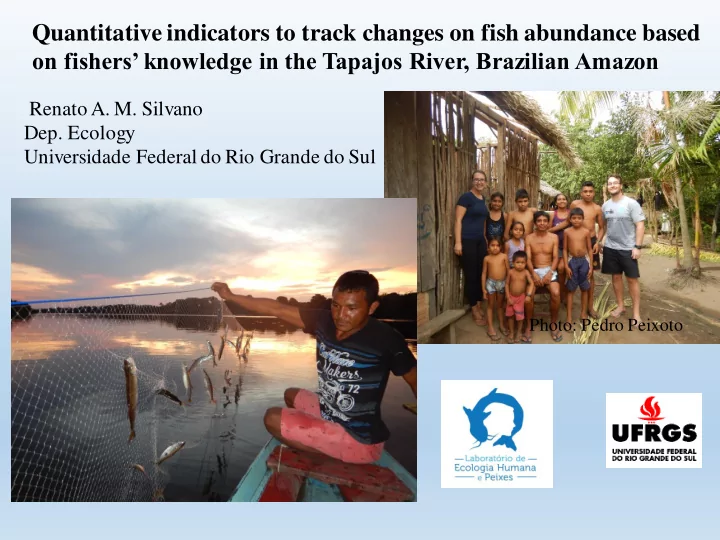
SLIDE 1 Quantitative indicators to track changes on fish abundance based
- n fishers’ knowledge in the Tapajos River, Brazilian Amazon
Renato A. M. Silvano
Universidade Federal do Rio Grande do Sul
Photo: Pedro Peixoto
SLIDE 2
Research Project: Linking sustainability of small-scale fisheries, fishers’ knowledge, conservation and co-management of biodiversity in large rivers of the Brazilian Amazon
PEER Cycle 4 Grant Award Number: AID-OAA-A-11
SLIDE 3
Mekong Mackenzie Tapajos
SLIDE 4
Tapajós River ➢ 8 fishing communities, 4 inside X 4 outside (red squares) Extractive Reserve (RESEX): comparison
Communities River Lake
RESEX Tapajos-Arapiuns 1998
SLIDE 5
Main goal: 5 quantitative indicators to track changes on fish availability from fishers’ knowledge (interviews) 1) Fish size: indicated in a tape 2)Temporal trends on fish abundance: increased, same or decreased ✓ 3) Composition of catches: species of fish cited (already presented) 4) Biomass of fish caught (kg) 5) Catch per unit of effort (CPUE) of fish caught: kg/h x n of fishers
SLIDE 6
✓ Interviews with fishers: standard questionnaire with 31 questions addresing fishing practices, socioeconomic issues, local knowledge, management ✓ Snow-ball sampling: 161 fishers interviewed, 10 to 20 fishers in each studied community Methods
SLIDE 7
Questions about fish: 1) Which are the most caught fish species (list 5)? 2) Which is the average size of these fish (show in a metric tape)? 3) Do you think that the abundance of these fish has increased, decreased or remained the same over the las 20 years? 4) How much fish (kg) do you regularly catch? 5) How many hours you take to cath this amount of fish and with how many people? 2006 2016 1996
RESEX Tapajós-Arapiuns
Past (20 years ago) Actual
SLIDE 8 1) Fish size: citations of size estimates for 12 commercial fish species (or groups of species) in both time periods
Aracu Caratinga Dourada Filhote Jaraqui Mapara Pacu Pescada Pirarucu Surubim Tambaqui Tucunare
Fish 50 100 150 200 250 300 350 F i s h s i z e ( c m ) Past (20 years) Actual PERIOD
SLIDE 9
Outside RESEX Region
30 60 90 120 150 180 210 240 270 300
F i s h s i z e ( c m ) 20 years ago Actual Period
Larger fish in the past, no difference between RESEX and outside
SLIDE 10 A r a c u B a r a r u r á B
ó B r a n q u i n h a C a r a t i n g a C h a p e r e m a C h a r u t
r a d a F i l h
e F u r a
a l ç a J a r a q u i M a p a r á P a c u P e s c a d a P i a u P i r a r u c u S a r d a S u r u b i m T a m b a q u i T u c u n a r é
Fish species
0.2 0.6 1.0 A b u n d a n c e t r e n d
RESEX REGION
2) Comparison of abundancetrends, for each fish species: Increased= +1, Same = 0, Decreased = -1 (X proportion of fishers) All fish decreasedin abundance, except a small, less valuablefish insideRESEX
SLIDE 11
4) Biomass of fish caught (kg): more fish in the past, no difference between RESEX and outside (OUT X)
OUT X RESEX Region 1 2 3 4 Log10 (Fish Biomass kg) 20 years ago Actual Period
SLIDE 12 5) CPUE: higher CPUE in the past, no difference between RESEX and outside (“Fora”)
Fora RESEX Region 1 2 3 L
1 C P U E f i s h 20 years ago Actual Period
SLIDE 13
Indicators Temporal change? Influence of RESEX? Fish composition of catches No No Temporal abundance trends Yes No Fish size Yes No Biomass of fish caught Yes No CPUE of fish caught Yes No
Biomass, CPUE and temporal trends indicated same patterns Temporal change, few effects of RESEX
SLIDE 14
We made 16 meetings with fishers in all fishing communities to discuss some of the results of the research.
Photo: Daiana Scneider
SLIDE 15
Acknowledgments ➢ To fishers for their cooperation ➢ To USAID for funding the research ➢ The research team ➢ To Tracking Change Project and SSHRCC ➢ To you by your attention
Questions??