Quality Assurance: Test Development & Execution Implementing - - PDF document

quality assurance test development execution
SMART_READER_LITE
LIVE PREVIEW

Quality Assurance: Test Development & Execution Implementing - - PDF document

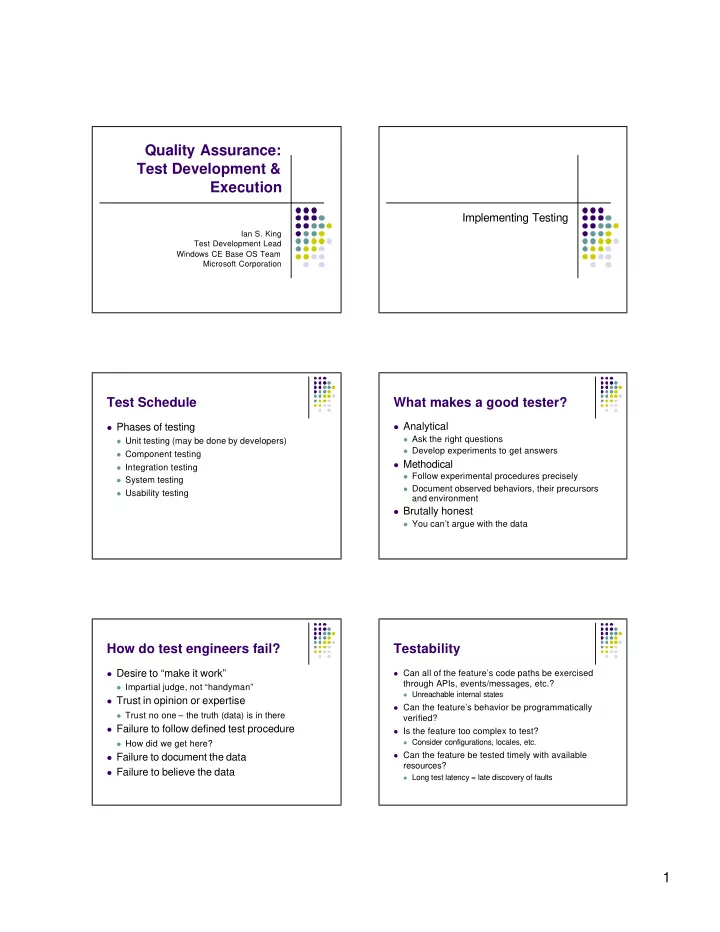
Quality Assurance: Test Development & Execution Implementing Testing Ian S. King Test Development Lead Windows CE Base OS Team Microsoft Corporation Test Schedule What makes a good tester? Analytical Phases of testing Ask


slide-1
SLIDE 1

1

Quality Assurance: Test Development & Execution

Ian S. King Test Development Lead Windows CE Base OS Team Microsoft Corporation

Implementing Testing

Test Schedule

Phases of testing

Unit testing (may be done by developers) Component testing Integration testing System testing Usability testing

What makes a good tester?

Analytical

Ask the right questions Develop experiments to get answers

Methodical

Follow experimental procedures precisely Document observed behaviors, their precursors

and environment

Brutally honest

You can’t argue with the data

How do test engineers fail?

Desire to “make it work”

Impartial judge, not “handyman”

Trust in opinion or expertise

Trust no one – the truth (data) is in there

Failure to follow defined test procedure

How did we get here?

Failure to document the data Failure to believe the data

Testability

Can all of the feature’s code paths be exercised

through APIs, events/messages, etc.?

Unreachable internal states

Can the feature’s behavior be programmatically

verified?

Is the feature too complex to test?

Consider configurations, locales, etc.

Can the feature be tested timely with available

resources?

Long test latency = late discovery of faults

slide-2
SLIDE 2

2

What color is your box?

Black box testing

Treats the SUT as atomic Study the gazinta’s and gozouta’s Best simulates the customer experience

White box testing

Examine the SUT internals Trace data flow directly (in the debugger) Bug report contains more detail on source of defect May obscure timing problems (race conditions)

Designing Good Tests

Well-defined inputs and outputs

Consider environment as inputs Consider ‘side effects’ as outputs

Clearly defined initial conditions Clearly described expected behavior Specific – small granularity provides greater

precision in analysis

Test must be at least as verifiable as SUT

Types of Test Cases

Valid cases

What should work?

Invalid cases

Ariane V – data conversion error

(http://www.cs.york.ac.uk/hise/safety-critical- archive/1996/0055.html)

Boundary conditions

Fails in September? Null input

Error conditions

Distinct from invalid input

Manual Testing

Definition: test that requires direct human

intervention with SUT

Necessary when:

GUI is present Behavior is premised on physical activity (e.g.

card insertion)

Advisable when:

Automation is more complex than SUT SUT is changing rapidly (early development)

Automated Testing

Good: replaces manual testing Better: performs tests difficult for manual

testing (e.g. timing related issues)

Best: enables other types of testing

(regression, perf, stress, lifetime)

Risks:

Time investment to write automated tests Tests may need to change when features change

Types of Automation Tools: Record/Playback

Record “proper” run through test procedure

(inputs and outputs)

Play back inputs, compare outputs with

recorded values

Advantage: requires little expertise Disadvantage: little flexibility - easily

invalidated by product change

Disadvantage: update requires manual

involvement

slide-3
SLIDE 3

3

Types of Automation Tools: Scripted Record/Playback

Fundamentally same as simple

record/playback

Record of inputs/outputs during manual test

input is converted to script

Advantage: existing tests can be maintained

as programs

Disadvantage: requires more expertise Disadvantage: fundamental changes can

ripple through MANY scripts

Types of Automation Tools: Script Harness

Tests are programmed as modules, then run

by harness

Harness provides control and reporting Advantage: tests can be very flexible Disadvantage: requires considerable

expertise and abstract process

Types of Automation Tools: Verb-Based Scripting

Module is programmed to invoke product

behavior at low level – associated with ‘verb’

Tests are designed using defined set of verbs Advantage: great flexibility Advantage: changes are usually localized to

a given verb

Disadvantage: requires considerable

expertise and abstract process

Test Corpus

Body of data that generates known results Can be obtained from

Real world – demonstrates customer experience Test generator – more deterministic

Caveats

Bias in data generation Don’t share test corpus with developers!

Instrumented Code: Test Hooks

Code that enables non-invasive testing Code remains in shipping product May be enabled through

Special API Special argument or argument value Registry value or environment variable

Example: Windows CE IOCTLs Risk: silly customers….

Instrumented Code: Diagnostic Compilers

Creates ‘instrumented’ SUT for testing

Profiling – where does the time go? Code coverage – what code was touched?

Really evaluates testing, NOT code quality

Syntax/coding style – discover bad coding

lint, the original syntax checker

Complexity

Very esoteric, often disputed (religiously) Example: function point counting

slide-4
SLIDE 4

4

Instrumented platforms

Example: App Verifier

Supports ‘shims’ to instrument standard system

calls such as memory allocation

Tracks all activity, reports errors such as

unreclaimed allocations, multiple frees, use of freed memory, etc.

Win32 includes ‘hooks’ for platform

instrumentation

Environment Management Tools

Predictably simulate real-world situations MemHog DiskHog Data Channel Simulator

Test Monkeys

Generate random input, watch for crash or

hang

Typically, ‘hooks’ UI through message queue Primarily to catch “local minima” in state

space (logic “dead ends”)

Useless unless state at time of failure is well

preserved!

Finding and Managing Bugs

What is a bug?

Formally, a “software defect” SUT fails to perform to spec SUT causes something else to fail SUT functions, but does not satisfy usability

criteria

If the SUT works to spec and someone wants

it changed, that’s a feature request

What are the contents of a bug report?

Repro steps – how did you cause the failure? Observed result – what did it do? Expected result – what should it have done? Any collateral information: return

values/output, debugger, etc.

Environment

Test platforms must be reproducible “It doesn’t do it on my machine”

slide-5
SLIDE 5

5

Ranking bugs

Severity

Sev 1: crash, hang, data

loss

Sev 2: blocks feature, no

workaround

Sev 3: blocks feature,

workaround available

Sev 4: trivial (e.g.

cosmetic)

Priority

Pri 1: Fix immediately Pri 2: Fix before next

release outside team

Pri 3: Fix before ship Pri 4: Fix if nothing better

to do ☺

A Bug’s Life Regression Testing

Good: rerun the test that failed

Or write a test for what you missed

Better: rerun related tests (e.g. component

level)

Best: rerun all product tests

Automation can make this feasible!

Tracking Bugs

Raw bug count

Slope is useful predictor

Ratio by ranking

How bad are the bugs we’re finding?

Find rate vs. fix rate

One step forward, two back?

Management choices

Load balancing Review of development quality

When can I ship?

Test coverage sufficient Bug slope, find vs. fix lead to convergence Severity mix is primarily low-sev Priority mix is primarily low-pri

To beta, or not to beta

Quality bar for beta release: features mostly

work if you use them right

Pro:

Get early customer feedback on design Real-world workflows find many important bugs

Con:

Do you have time to incorporate beta feedback? A beta release takes time and resources

slide-6
SLIDE 6

6

Developer Preview

Different quality bar than beta Goals

Review of feature set Review of API set by technical consumers

Customer experience

Known conflicts with previous version Known defects, even crashing bugs Setup/uninstall not completed