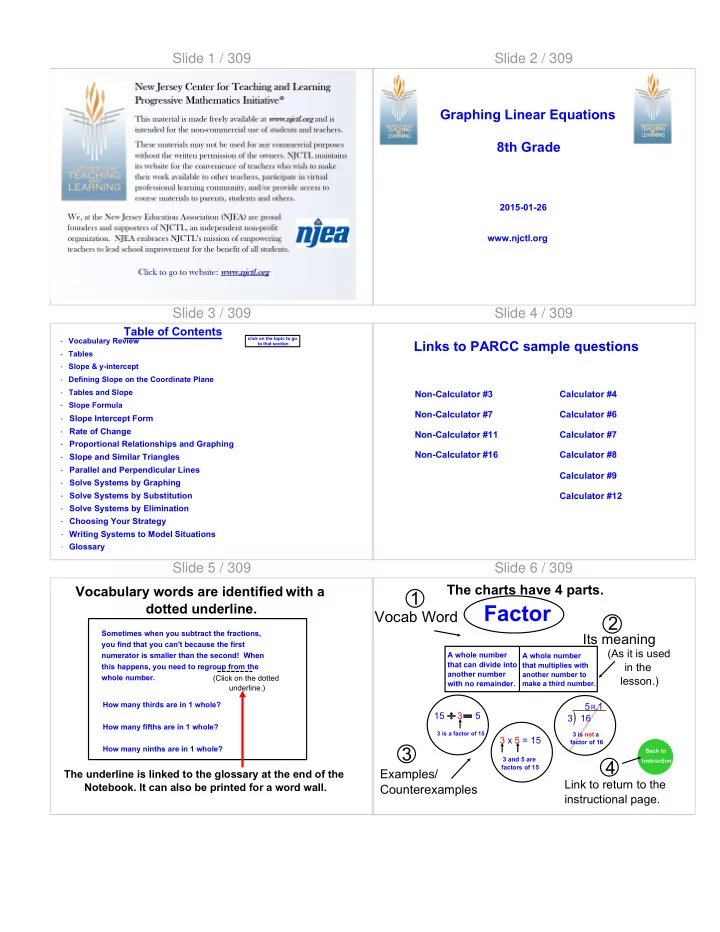
Factor Vocab Word 2 Sometimes when you subtract the fractions, - - PDF document

factor
SMART_READER_LITE
LIVE PREVIEW

Factor Vocab Word 2 Sometimes when you subtract the fractions, - - PDF document

Slide 1 / 309 Slide 2 / 309 Graphing Linear Equations 8th Grade 2015-01-26 www.njctl.org Slide 3 / 309 Slide 4 / 309 Table of Contents click on the topic to go Vocabulary Review Links to PARCC sample questions to that section Tables


slide-1
SLIDE 1

Slide 1 / 309 Slide 2 / 309 Graphing Linear Equations 8th Grade

www.njctl.org 2015-01-26

Slide 3 / 309

click on the topic to go to that section

Table of Contents

· Vocabulary Review · Defining Slope on the Coordinate Plane · Tables and Slope · Tables · Slope Formula · Slope & y-intercept

· Slope Intercept Form · Rate of Change · Proportional Relationships and Graphing · Slope and Similar Triangles · Parallel and Perpendicular Lines · Solve Systems by Graphing · Solve Systems by Substitution · Solve Systems by Elimination · Choosing Your Strategy · Writing Systems to Model Situations · Glossary

Slide 4 / 309 Links to PARCC sample questions

Calculator #6 Calculator #7 Calculator #9 Non-Calculator #3 Calculator #4 Non-Calculator #11 Non-Calculator #16 Non-Calculator #7 Calculator #8 Calculator #12

Slide 5 / 309

Sometimes when you subtract the fractions, you find that you can't because the first numerator is smaller than the second! When this happens, you need to regroup from the whole number. How many thirds are in 1 whole? How many fifths are in 1 whole? How many ninths are in 1 whole?

Vocabulary words are identified with a dotted underline.

The underline is linked to the glossary at the end of the

  • Notebook. It can also be printed for a word wall.

(Click on the dotted underline.)

Slide 6 / 309

Back to Instruction

Factor

A whole number that can divide into another number with no remainder.

15 3 5

3 is a factor of 15

3 x 5 = 15

3 and 5 are factors of 15

16 3 5 .1

R 3 is not a factor of 16

A whole number that multiplies with another number to make a third number.

The charts have 4 parts.

Vocab Word

1

Its meaning

2

Examples/ Counterexamples

3

Link to return to the instructional page.

4

(As it is used in the lesson.)

slide-2
SLIDE 2

Slide 7 / 309

y-axis: vertical number line that extends indefinitely in both directions from zero. (Up- positive Down- negative) x-axis: horizontal number line that extends indefinitely in both directions from zero. (Right- positive Left- negative) Origin: the point where zero on the x-axis intersects zero on the y-axis. The coordinates of the origin are (0,0).

II I III IV

Vocabulary Review

Coordinate Plane: the two dimensional plane or flat surface that is created when the x-axis intersects with the y-axis. Also known as a coordinate graph and the Cartesian plane. Quadrant: any of the four regions created when the x-axis intersects the y-axis. They are usually numbered with Roman numerals.

Slide 8 / 309

To graph an ordered pair, such as ( 4, 8), you start at the

  • rigin (0, 0)and then go left or right on the x-axis

depending on the first number and then up or down from there parallel to the y-axis.

2 4 6 8 10

  • 2
  • 4
  • 6
  • 8
  • 10

2 4 6 8 10

  • 2
  • 4
  • 6
  • 8
  • 10

Slide 9 / 309

2 4 6 8 10

  • 2
  • 4
  • 6
  • 8
  • 10

2 4 6 8 10

  • 2
  • 4
  • 6
  • 8
  • 10

(4,8) So to graph (4,8), we would go 4 to the right and up 8 from there.

Slide 10 / 309

Linear Equation: Any equation whose graph is represented by a straight line. One way to check this is to create a table of values.

Slide 11 / 309

Tables

Return to Table

  • f Contents

Slide 12 / 309

Geometry Theorem: Through any two points in a plane there can be drawn only one line.

slide-3
SLIDE 3

Slide 13 / 309

2 4 6 8 10

  • 2
  • 4
  • 6
  • 8
  • 10

2 4 6 8 10

  • 2
  • 4
  • 6
  • 8
  • 10

Given y=3x+2, we want to graph

  • ur equation to show all of the
  • rdered pairs that make it true.

So according to this theorem from Geometry, we need to find 2 points.

Slide 14 / 309

2 4 6 8 10

  • 2
  • 4
  • 6
  • 8
  • 10

2 4 6 8 10

  • 2
  • 4
  • 6
  • 8
  • 10

One way is to create a table of values. Let's consider the equation y= 3x + 2. We need to find pairs of x and y numbers that make equation true.

Slide 15 / 309

2 4 6 8 10

  • 2
  • 4
  • 6
  • 8
  • 10

2 4 6 8 10

  • 2
  • 4
  • 6
  • 8
  • 10

Let's find some values for y=3x+2. Pick values for x and plug them into the equation,then solve for y. x 3(x)+2 y (x,y) 0 3(0)+2 2 (0,2) 2 3(2)+2 8 (2,8)

  • 3 3(-3)+2 -7 (-3,-7)

Slide 16 / 309

2 4 6 8 10

  • 2
  • 4
  • 6
  • 8
  • 10

2 4 6 8 10

  • 2
  • 4
  • 6
  • 8
  • 10

x 3(x)+2 y (x,y) 0 3(0)+2 2 (0,2) 2 3(2)+2 8 (2,8)

  • 3 3(-3)+2 -7 (-3,-7)

Now let's graph those points we just found. Notice anything about the points we just graphed?

Slide 17 / 309

2 4 6 8 10

  • 2
  • 4
  • 6
  • 8
  • 10

2 4 6 8 10

  • 2
  • 4
  • 6
  • 8
  • 10

That's right! The points we graphed form a line. The theorem says we only needed 2 points, so why did we graph 3 points? The third point serves as a check.

Slide 18 / 309

Graph y = 2x+4

x 2x+4 y (x,y) 0 2(0)+4 4 (0,4) 3 2(3)+4 10 (3,10)

  • 1 2(-1)+4 2 (-1,2)

2 4 6 8 10

  • 2
  • 4
  • 6
  • 8
  • 10

2 4 6 8 10

  • 2
  • 4
  • 6
  • 8
  • 10

Now graph your points and draw the line.

y x

2 4 6 8 10

  • 2
  • 4
  • 6
  • 8
  • 10

2 4 6 8 10

  • 2
  • 4
  • 6
  • 8
  • 10

Click for graph

x 2x+4 y (x,y)

click for table

slide-4
SLIDE 4

Slide 19 / 309

x -2(x)+1 y (x,y) 0 -2(0)+1 1 (0,1) 3 -2(3)+1 -5 (3,-5)

  • 1 -2(-1)+1 3 (-1,3)

Graph y = -2x+1

2 4 6 8 10

  • 2
  • 4
  • 6
  • 8
  • 10

2 4 6 8 10

  • 2
  • 4
  • 6
  • 8
  • 10

Now graph your points and draw the line.

y x

2 4 6 8 10

  • 2
  • 4
  • 6
  • 8
  • 10

2 4 6 8 10

  • 2
  • 4
  • 6
  • 8
  • 10

Click for graph

x -2(x)+1 y (x,y)

click for table

Slide 20 / 309

Graph y = ¾x-3

x ¾(x)-3 y (x,y) 0 ¾(0)-3 -3 (0,-3) 4 ¾(4)-3 0 (4,0)

  • 4 ¾(-4)-3 -6 (-4,-6)

2 4 6 8 10

  • 2
  • 4
  • 6
  • 8
  • 10

2 4 6 8 10

  • 2
  • 4
  • 6
  • 8
  • 10

Now graph your points and draw the line. x ¾(x)-3 y (x,y)

click for table

y x

2 4 6 8 10

  • 2
  • 4
  • 6
  • 8
  • 10

2 4 6 8 10

  • 2
  • 4
  • 6
  • 8
  • 10

Click for graph

Slide 21 / 309

Recall that in the previous example that even though the number in front

  • f x was a fraction, our answers were

integers. Why? Discuss at your table.

x ¾(x)-3 y (x,y) 0 ¾(0)-3 -3 (0,-3) 4 ¾(4)-3 0 (4,0)

  • 4 ¾(-4)-3 -6 (-4,-6)

Slide 21 (Answer) / 309

Recall that in the previous example that even though the number in front

  • f x was a fraction, our answers were

integers. Why? Discuss at your table.

x ¾(x)-3 y (x,y) 0 ¾(0)-3 -3 (0,-3) 4 ¾(4)-3 0 (4,0)

  • 4 ¾(-4)-3 -6 (-4,-6)

[This object is a pull tab]

Answer

The x-values chosen are zero, the denominator and the opposite of the denominator.

Slide 22 / 309 Slide 23 / 309

slide-5
SLIDE 5

Slide 24 / 309 Slide 25 / 309 Slide 26 / 309 Slide 27 / 309 Slide 28 / 309 Slide 29 / 309

slide-6
SLIDE 6

Slide 30 / 309 Slide 31 / 309 Slide 32 / 309

11 A solution is 20% bleach. Create a graph that represents all possible combinations of the number of liters of bleach, contained in the number of liters of the solution. To graph a line, pick two points on the coordinate

  • plane. A line will be drawn through the points.

Students type their answers here

From PARCC sample test

Slide 32 (Answer) / 309

11 A solution is 20% bleach. Create a graph that represents all possible combinations of the number of liters of bleach, contained in the number of liters of the solution. To graph a line, pick two points on the coordinate

  • plane. A line will be drawn through the points.

Students type their answers here

From PARCC sample test

[This object is a pull tab]

Answer

Slide 33 / 309

Slope & y-intercept

  • n the Coordinate Plane

Return to Table

  • f Contents

Slide 34 / 309

2 4 6 8 10

  • 2
  • 4
  • 6
  • 8
  • 10

2 4 6 8 10

  • 2
  • 4
  • 6
  • 8
  • 10

You only need a few facts about a line to completely describe it: · Its y-intercept (where it crosses the y-axis) "b" · Its slope (how much it rises or falls) "m" · y = mx + b

The Equation of a Line

slide-7
SLIDE 7

Slide 35 / 309 Imagine trying to tell a person how to draw a line on the Cartesian Plane. Consider this graph of the Cartesian Plane, also called a Coordinate Plane or XY-Plane. Slide 36 / 309

2 4 6 8 10

  • 2
  • 4
  • 6
  • 8
  • 10

2 4 6 8 10

  • 2
  • 4
  • 6
  • 8
  • 10

The y-intercept ("b")of a line is the point where the line intercepts the y-axis. In this case, the y-intercept

  • f the line is +4.

The y-intercept

This is the ordered pair (0,4).

Slide 37 / 309

2 4 6 8 10

  • 2
  • 4
  • 6
  • 8
  • 10

2 4 6 8 10

  • 2
  • 4
  • 6
  • 8
  • 10

12 What is the y-intercept of this line?

Slide 37 (Answer) / 309

2 4 6 8 10

  • 2
  • 4
  • 6
  • 8
  • 10

2 4 6 8 10

  • 2
  • 4
  • 6
  • 8
  • 10

12 What is the y-intercept of this line?

[This object is a pull tab]

Answer

b = 6

Slide 38 / 309

2 4 6 8 10

  • 2
  • 4
  • 6
  • 8
  • 10

2 4 6 8 10

  • 2
  • 4
  • 6
  • 8
  • 10

13 What is the y-intercept of this line?

Slide 38 (Answer) / 309

2 4 6 8 10

  • 2
  • 4
  • 6
  • 8
  • 10

2 4 6 8 10

  • 2
  • 4
  • 6
  • 8
  • 10

13 What is the y-intercept of this line?

[This object is a pull tab]

Answer

b = -4

slide-8
SLIDE 8

Slide 39 / 309

2 4 6 8 10

  • 2
  • 4
  • 6
  • 8
  • 10

2 4 6 8 10

  • 2
  • 4
  • 6
  • 8
  • 10

14 What is the y-intercept of this line?

Slide 39 (Answer) / 309

2 4 6 8 10

  • 2
  • 4
  • 6
  • 8
  • 10

2 4 6 8 10

  • 2
  • 4
  • 6
  • 8
  • 10

14 What is the y-intercept of this line?

[This object is a pull tab]

Answer

b = 8

Slide 40 / 309

2 4 6 8 10

  • 2
  • 4
  • 6
  • 8
  • 10

2 4 6 8 10

  • 2
  • 4
  • 6
  • 8
  • 10

15 What is the x-intercept of this line?

Slide 40 (Answer) / 309

2 4 6 8 10

  • 2
  • 4
  • 6
  • 8
  • 10

2 4 6 8 10

  • 2
  • 4
  • 6
  • 8
  • 10

15 What is the x-intercept of this line?

[This object is a pull tab]

Answer

(-4,0)

Slide 41 / 309

2 4 6 8 10

  • 2
  • 4
  • 6
  • 8
  • 10

2 4 6 8 10

  • 2
  • 4
  • 6
  • 8
  • 10

16 What is the x-intercept of this line?

Slide 41 (Answer) / 309

2 4 6 8 10

  • 2
  • 4
  • 6
  • 8
  • 10

2 4 6 8 10

  • 2
  • 4
  • 6
  • 8
  • 10

16 What is the x-intercept of this line?

[This object is a pull tab]

Answer

(3,0)

slide-9
SLIDE 9

Slide 42 / 309

2 4 6 8 10

  • 2
  • 4
  • 6
  • 8
  • 10

2 4 6 8 10

  • 2
  • 4
  • 6
  • 8
  • 10

17 What is the x-intercept of this line?

Slide 42 (Answer) / 309

2 4 6 8 10

  • 2
  • 4
  • 6
  • 8
  • 10

2 4 6 8 10

  • 2
  • 4
  • 6
  • 8
  • 10

17 What is the x-intercept of this line?

[This object is a pull tab]

Answer

(-6,0)

Slide 43 / 309

18 The graph of the equation x + 3y = 6 intersects the y-axis at the point whose coordinates are A (0,2) B (0,6) C (0,18) D (6,0)

From the New York State Education Department. Office of Assessment Policy, Development and

  • Administration. Internet. Available from www.nysedregents.org/IntegratedAlgebra; accessed 17, June, 2011.

Slide 43 (Answer) / 309

18 The graph of the equation x + 3y = 6 intersects the y-axis at the point whose coordinates are A (0,2) B (0,6) C (0,18) D (6,0)

From the New York State Education Department. Office of Assessment Policy, Development and

  • Administration. Internet. Available from www.nysedregents.org/IntegratedAlgebra; accessed 17, June, 2011.

[This object is a pull tab]

Answer

A) (0,2)

Slide 44 / 309

Defining Slope on the Coordinate Plane

Return to Table

  • f Contents

Slide 45 / 309 "Steepness" and "Position" of a Line

slide-10
SLIDE 10

Slide 46 / 309

2 4 6 8 10

  • 2
  • 4
  • 6
  • 8
  • 10

2 4 6 8 10

  • 2
  • 4
  • 6
  • 8
  • 10

An infinite number of lines can pass through the same location on the y-axis...they all have the same y-intercept. Examples of lines with a y-intercept of ____ are shown on this graph. What's the difference between them (other than their color)?

Consider this... Slide 47 / 309

2 4 6 8 10

  • 2
  • 4
  • 6
  • 8
  • 10

2 4 6 8 10

  • 2
  • 4
  • 6
  • 8
  • 10

The lines all have a different slope. Slope is the steepness

  • f a line.

Compare the steepness of the lines

  • n the right.

Slope can also be thought of as the rate

  • f change.

The Slope of a Line Slide 48 / 309

2 4 6 8 10

  • 2
  • 4
  • 6
  • 8
  • 10

2 4 6 8 10

  • 2
  • 4
  • 6
  • 8
  • 10

The red line has a positive slope, since the line rises from left to the right.

The Slope of a Line

run rise

Slide 49 / 309

2 4 6 8 10

  • 2
  • 4
  • 6
  • 8
  • 10

2 4 6 8 10

  • 2
  • 4
  • 6
  • 8
  • 10

The orange line has a negative slope, since the line falls down from left to the right.

The Slope of a Line

rise run

Slide 50 / 309

2 4 6 8 10

  • 2
  • 4
  • 6
  • 8
  • 10

2 4 6 8 10

  • 2
  • 4
  • 6
  • 8
  • 10

The purple line has a slope of zero, since it doesn't rise at all as you go from left to right on the x-axis.

The Slope of a Line Slide 51 / 309

2 4 6 8 10

  • 2
  • 4
  • 6
  • 8
  • 10

2 4 6 8 10

  • 2
  • 4
  • 6
  • 8
  • 10

The Slope of a Line

The black line is a vertical line. It has an undefined slope, since it doesn't run at all as you go from the bottom to the top on the y-axis. rise = undefined

slide-11
SLIDE 11

Slide 52 / 309 Slide 53 / 309 Slide 54 / 309 Slide 55 / 309 Slide 56 / 309 Slide 57 / 309

slide-12
SLIDE 12

Slide 58 / 309 Slide 59 / 309 Slide 60 / 309

2 4 6 8 10

  • 2
  • 4
  • 6
  • 8
  • 10

2 4 6 8 10

  • 2
  • 4
  • 6
  • 8
  • 10

While we can quickly see if the slope of a line is positive, negative or zero...we also need to determine how much slope it has...we have to measure the slope of a line.

Measuring the Slope of a Line

rise run

Slide 61 / 309

2 4 6 8 10

  • 2
  • 4
  • 6
  • 8
  • 10

2 4 6 8 10

  • 2
  • 4
  • 6
  • 8
  • 10

The slope of the line is just the ratio of its rise

  • ver its run.

The symbol for slope is "m". So the formula for slope is:

Measuring the Slope of a Line

rise run

slope = rise run

Slide 62 / 309

2 4 6 8 10

  • 2
  • 4
  • 6
  • 8
  • 10

2 4 6 8 10

  • 2
  • 4
  • 6
  • 8
  • 10

The slope is the same anywhere on a line, so it can be measured anywhere on the line.

Measuring the Slope of a Line

rise run

slope = rise run

Keep in mind the direction: · Up (+) Down (-) · Right (+) Left (-)

Slide 63 / 309

2 4 6 8 10

  • 2
  • 4
  • 6
  • 8
  • 10

2 4 6 8 10

  • 2
  • 4
  • 6
  • 8
  • 10

For instance, in this case we measure the slope by using a run from x = 0 to x = +6: a run of 6. During that run, the line rises from y = 0 to y = 8: a rise of 8.

Measuring the Slope of a Line

rise run

slope = rise run m = 8 6 m = 4 3

slide-13
SLIDE 13

Slide 64 / 309

2 4 6 8 10

  • 2
  • 4
  • 6
  • 8
  • 10

2 4 6 8 10

  • 2
  • 4
  • 6
  • 8
  • 10

But we get the same result with a run from x = 0 to x = +3: a run of 3. During that run, the line rises from y = 0 to y = 4: a rise of 4.

Measuring the Slope of a Line

rise run

slope = rise run m = 4 3

Slide 65 / 309

But we can also start at x = 3 and run to x = 6 : a run of 3. During that run, the line rises from y = 3 to y = 7: a rise of 4.

Measuring the Slope of a Line

rise run

slope = rise run m = 4 3

2 4 6 8 10

  • 2
  • 4
  • 6
  • 8
  • 10

2 4 6 8 10

  • 2
  • 4
  • 6
  • 8
  • 10

Slide 66 / 309

2 4 6 8 10

  • 2
  • 4
  • 6
  • 8
  • 10

2 4 6 8 10

  • 2
  • 4
  • 6
  • 8
  • 10

But we can also start at x = -6 and run to x = 0: a run of 6. During that run, the line rises from y = -8 to y = 0: a rise of 8.

Measuring the Slope of a Line

rise run

slope = rise run m = 8 6 m = 4 3

Slide 67 / 309

2 4 6 8 10

  • 2
  • 4
  • 6
  • 8
  • 10

2 4 6 8 10

  • 2
  • 4
  • 6
  • 8
  • 10

How is the slope different on this coordinate plane? The line rises 8, however the run goes left 6(negative). Therefore, it is said to have a negative slope

Measuring the Slope of a Line

rise run

slope = rise run m = 8

  • 6

m = -4 3

*most often the negative sign is placed in the numerator

Slide 68 / 309 Slide 69 / 309

slide-14
SLIDE 14

Slide 70 / 309 Slide 71 / 309 Slide 72 / 309 Slide 73 / 309 Slide 74 / 309 Slide 75 / 309

slide-15
SLIDE 15

Slide 76 / 309

Tables and Slope

Return to Table

  • f Contents

Slide 77 / 309 x y

  • 3
  • 1

5 3 11

How can slope and the y-intercept be found within the table? · Look for the change in the y-values · Look for the change in the x-values · Write as a ratio (simpified) - this will be the "slope" · Determine the corresponding y-value to the x-value of 0 - this will be the "y- intercept"

Slide 78 / 309 x y

  • 3
  • 1

5 3 11

+6 +6 +3 +3

6 3

= 2 is the slope

5 is the y-intercept

Slide 79 / 309 x y 5

  • 5
  • 4
  • 5
  • 3
  • 4 is the y-intercept

is the slope

Determine the slope and y-intercept from this table.

click to reveal answer

Slide 80 / 309 Slide 81 / 309

slide-16
SLIDE 16

Slide 82 / 309 Slide 83 / 309 Slide 84 / 309 Slide 85 / 309

Slope Formula

Return to Table

  • f Contents

Slide 86 / 309

Slope is "the rise over the run"of a line.

This idea of rise over run of a line on a graph is how we were able to determine the slope of a line. But slope can be found in other ways than looking at a graph.

Slide 87 / 309 Slope is the ratio of change in y (rise) divided by the change in x(run). slope= = A line has a constant ratio of change: A constant increase A constant decrease No change, just constant Or undefined slope

rise run

change in y change in x

slide-17
SLIDE 17

Slide 88 / 309

Another Application of the Definition of Slope Slope of a line is meant to measure how fast it is climbing or descending. A road might rise 1 foot for every 10 feet of horizontal distance. 10 feet 1 foot The ratio, 1/10, which is called slope, is a measure of the steepness of the hill. Engineers call this use of slope grade. What do you think a grade of 4% means?

Slide 89 / 309

Slope of 3/20 20 feet 3 feet 3 feet 7 feet slope of -3/7 (The grade of this hill is 3/20 = .15= 15%) (The grade of this hill is 3/7 = .43= 43%)

Slide 90 / 309

so we will define the slope of a line as: slope = vertical change between two point on the line horizontal change between two point on the line

(Rise) (Run)

Slide 91 / 309

Suppose point P = (x1, y1) and Q = (x2, y2) are on the line whose slope we want to find. Q(x2,y2) P(x1,y1)

x y

(x2,y1) Horizontal Change (x2-x1) Vertical Change (y2-y1)

The slope of line PQ=(y2-y1)

(x2-x1)

Slide 92 / 309

The vertical change between P and Q = y2 - y1

The horizontal change = x2 - x1

y2 - y1

x2 - x1

slope =

Slide 93 / 309

slide-18
SLIDE 18

Slide 94 / 309 Slide 95 / 309 Slide 96 / 309 Slide 97 / 309 Slide 98 / 309

y = mx + b

Return to Table

  • f Contents

Slope-Intercept Form

Slide 99 / 309

Once you have identified the slope and y-intercept in an equation, it is easy to graph it! To graph y = 3x + 5...follow these steps: · Plot the y-intercept, in this case (0, 5) · Use the simplified rise over run to plot the next point - in this case, from (0, 5) go UP 3 units and RIGHT 1 unit to plot the next point. Connect the points.

slide-19
SLIDE 19

Slide 100 / 309

Try this...graph y = -2x - 3 · Start at the y-intercept - plot it. · From the y-intercept, use the slope "m" to plot the next point. How would you use rise over run to plot -2? · Connect the points.

click to reveal

Did you have different points plotted? Does it make a difference?

Slide 101 / 309

Try this...graph 4y = x + 12 (is this in y=mx + b form??) · Start at the y-intercept - plot it. · From the y-intercept, use the slope "m" to plot the next point. How would you use rise over run to plot it? · Connect the points. Did you have different points plotted? Does it make a difference?

click to reveal

Slide 102 / 309

Try this...graph 5x + y = -4 (is this in y=mx + b form??) · Start at the y-intercept - plot it. · From the y-intercept, use the slope "m" to plot the next point. How would you use rise over run to plot it? · Connect the points. Did you have different points plotted? Does it make a difference?

click to reveal

Slide 103 / 309 Position of a Line

2 4 6 8 10

  • 2
  • 4
  • 6
  • 8
  • 10

2 4 6 8 10

  • 2
  • 4
  • 6
  • 8
  • 10

Slide 104 / 309

What are the similarities and differences between the lines below?

2 4 6 8

10

  • 2
  • 4
  • 6
  • 8
  • 10

2 4 6 8

10

  • 2
  • 4
  • 6
  • 8
  • 10

h(x)=x+6 q(x)=x+2 r(x)=x-1 s(x)=x-5

Slide 105 / 309 The lines were in the form of y = mx+b.

slide-20
SLIDE 20

Slide 106 / 309

So it is the b in y = mx + b that is responsible for the position of the line.

2 4 6 8

  • 2
  • 4
  • 6
  • 8
  • 10

2 4 6 8

10

  • 2
  • 4
  • 6
  • 8
  • 10

h(x)=x+6 q(x)=x+2 r(x)=x-1 s(x)=x-5

Slide 107 / 309 What determines slope?

Examine the following equations: y = 2x + 1 y = 3x + 1 y = -1/2 x + 1 y = -x + 1 What do the equations have in common? What is different?

Slide 108 / 309

2 4 6 8 10

  • 2
  • 4
  • 6
  • 8
  • 10

2 4 6 8 10

  • 2
  • 4
  • 6
  • 8
  • 10

y=-7x+1 y=-1/2x+1 y=1 y=x+1 y=-3x+1

Slide 109 / 309

Any equation of the form y = mx + b gives a line where b is the y intercept m is the slope

Slide 110 / 309

Click for an interactive web site to see how the position of the line changes as you change the slope and the y-intercept.

Slide 111 / 309

slide-21
SLIDE 21

Slide 112 / 309 Slide 113 / 309 Slide 114 / 309 Slide 115 / 309 Slide 116 / 309 Slide 117 / 309

slide-22
SLIDE 22

Slide 118 / 309 Slide 119 / 309

Rate of Change

Return to Table

  • f Contents

Slide 120 / 309

Slope formula can be used to find the constant of change in a "real world" problem.

When traveling on the highway, drivers will set the cruise control and travel at a constant speed this means that the distance traveled is a constant increase. The graph at the right represents such a trip. The car passed mile-marker 60 at 1 hour and mile- marker 180 at 3 hours. Find the slope of the line and what it represents. m= = = So the slope of the line is 60 and the rate of change

  • f the car is 60 miles per hour.

180 miles-60 miles 3 hours-1 hours 120 miles 2 hours 60 miles hour

Time (hours) Distance (miles) (1,60) (3,180)

Slide 121 / 309

If a car passes mile-marker 100 in 2 hours and mile-marker 200 in 4 hours, how many miles per hour is the car traveling? The information above gives us the ordered pairs (2,100) and (4,200). Now find the rate of change.

Slide 121 (Answer) / 309

If a car passes mile-marker 100 in 2 hours and mile-marker 200 in 4 hours, how many miles per hour is the car traveling? The information above gives us the ordered pairs (2,100) and (4,200). Now find the rate of change.

[This object is a pull tab]

Answer

Slide 122 / 309

slide-23
SLIDE 23

Slide 123 / 309 Slide 124 / 309 Slide 125 / 309 Slide 126 / 309 Slide 127 / 309 Slide 128 / 309

slide-24
SLIDE 24

Slide 129 / 309 Slide 130 / 309

61 Two different proportional relationships are represented by the equation and the table. Proportion A Proportion B The rate of change in Proportion A is ______ ______ then the rate of change to Proportion B. A 1.5 B 2.5 C 25.5 D 43.5 E more F less

From PARCC sample test

y = 9x

Slide 130 (Answer) / 309

61 Two different proportional relationships are represented by the equation and the table. Proportion A Proportion B The rate of change in Proportion A is ______ ______ then the rate of change to Proportion B. A 1.5 B 2.5 C 25.5 D 43.5 E more F less

From PARCC sample test

y = 9x

[This object is a pull tab]

Answer

(B) 2.5 (F) less

Slide 131 / 309

62 A pool cleaning service drained a full pool. The following table shows the number of hours it drained and the amount of water remaining in the pool at that time. Part A Plot the points that show the relationship between the number

  • f hours elapsed and the number of gallons of water left in the

pool. Select a place on the grid to plot each point. (Grid on next slide.)

Students type their answers here

From PARCC sample test

Slide 132 / 309 Slide 132 (Answer) / 309

[This object is a pull tab]

Answer

slide-25
SLIDE 25

Slide 133 / 309

63 Part B (continued from previous question) The data suggests a linear relationship between the number

  • f hours the pool had been draining and the number of

gallons of water remaining in the pool. Assuming the relationship is linear, what does the rate of change represent in the context of this relationship. A The number of gallons of water in the pool after 1 hour. B The number of hours it took to drain 1 gallon of water. C The number of gallons drained each hour. D The number of gallons of water in the pool when it is full.

From PARCC sample test

Slide 133 (Answer) / 309

63 Part B (continued from previous question) The data suggests a linear relationship between the number

  • f hours the pool had been draining and the number of

gallons of water remaining in the pool. Assuming the relationship is linear, what does the rate of change represent in the context of this relationship. A The number of gallons of water in the pool after 1 hour. B The number of hours it took to drain 1 gallon of water. C The number of gallons drained each hour. D The number of gallons of water in the pool when it is full.

From PARCC sample test

[This object is a pull tab]

Answer

C

Slide 134 / 309

64 Part C (continued from previous question) What does the y-intercept of the linear function repressent in the context of this relationship? A The number of gallons in the pool after 1 hour. B The number of hours it took to drain 1 gallon of water. C The number of gallons drained each hour. D The number of gallons of water in the pool when it is full.

From PARCC sample test

Slide 134 (Answer) / 309

64 Part C (continued from previous question) What does the y-intercept of the linear function repressent in the context of this relationship? A The number of gallons in the pool after 1 hour. B The number of hours it took to drain 1 gallon of water. C The number of gallons drained each hour. D The number of gallons of water in the pool when it is full.

From PARCC sample test

[This object is a pull tab]

Answer

D

Slide 135 / 309

65 Part D (continued from previous question) Which equation describes this relationship between the time elapsed and the number of gallons of water remaining in the pool? A y = -600x + 15,000 B y = -600x + 13,2000 C y = -1,200x + 13,200 D y = -1,200x + 15,000

From PARCC sample test

Slide 135 (Answer) / 309

65 Part D (continued from previous question) Which equation describes this relationship between the time elapsed and the number of gallons of water remaining in the pool? A y = -600x + 15,000 B y = -600x + 13,2000 C y = -1,200x + 13,200 D y = -1,200x + 15,000

From PARCC sample test

[This object is a pull tab]

Answer

A

slide-26
SLIDE 26

Slide 136 / 309

66 Eric planted a seedling in his garden and recorded its height each week. The equation shown can be used to estimate the height h, in inches, of the seedling after w, weeks since Eric planted the seedling. Part A: What does the slope of the graph of the equation represent? A The height in inches, of the seedling after w weeks. B The height in inches, of the seedling when Eric planted it. C The increases of height in inches, of the seedling each week. D The total increase in the height in inches, of the seedling after w weeks.

From PARCC sample test

Slide 136 (Answer) / 309

66 Eric planted a seedling in his garden and recorded its height each week. The equation shown can be used to estimate the height h, in inches, of the seedling after w, weeks since Eric planted the seedling. Part A: What does the slope of the graph of the equation represent? A The height in inches, of the seedling after w weeks. B The height in inches, of the seedling when Eric planted it. C The increases of height in inches, of the seedling each week. D The total increase in the height in inches, of the seedling after w weeks.

From PARCC sample test

[This object is a pull tab]

Answer

C

Slide 137 / 309

67 Part B (continued from previous question) The equation estimates the height of the seedlings to be 8.25 inches after how many weeks?

From PARCC sample test

Slide 137 (Answer) / 309

67 Part B (continued from previous question) The equation estimates the height of the seedlings to be 8.25 inches after how many weeks?

From PARCC sample test

[This object is a pull tab]

Answer

8

Slide 138 / 309

Proportional Relationships

Return to Table

  • f Contents

Slide 139 / 309

Pavers are being set around a birdbath. The figures below show the first three designs of the pattern. Using tiles, build the first five designs that follow the pattern above. Record your results in a table.

slide-27
SLIDE 27

Slide 140 / 309

Design number 1 2 3 4 5 Number of pavers 4 8 12 16 20

Graph the data from the table on a coordinate plane. What will you label the x-axis? What will you label the y-axis? Do the coordinate pairs in your table represent a proportional relationship?

Slide 141 / 309 Slide 142 / 309

How many tiles will you need for the "n-th" design? Write an equation that would represent the total number of tiles required for any design level. Suppose the birdbath was replaced with two tiles...how would this change the pattern? How would this change the equation?

Slide 142 (Answer) / 309

How many tiles will you need for the "n-th" design? Write an equation that would represent the total number of tiles required for any design level. Suppose the birdbath was replaced with two tiles...how would this change the pattern? How would this change the equation?

[This object is a pull tab]

Answer

t = 4n At each design level, the number of tiles would increase by two after multiplying by four. Therefore the equation would be: t = 4n + 2

Slide 143 / 309

t=4n t=4n+2 Number of tiles Design Level 0 1 2 3 4 5 6 5 10 15 Graph both equations on the same coordinate plane. Discuss the similarities and differences in the graphs... Number of tiles Design Level 0 1 2 3 4 5 6 5 10 15

Click for answer

Slide 144 / 309

Slope & Similar Triangles

Return to Table

  • f Contents
slide-28
SLIDE 28

Slide 145 / 309

Congruent triangles have the same shape and same

  • size. Using the line as the hypotenuse, draw congruent

right triangles. How do you know they are congruent?

click to reveal example

Slide 146 / 309

2 2 2 2 4 4 4 4 The vertical rise is the same as well as the horizontal run. The simplified ratio is the same as the absolute value of the slope. 2 4 1 2

Slide 147 / 309

Similar triangles have the same shape, however, they are not the same size. The corresponding sides are proportionate. 4 6 2 3 4 6 2 3

Slide 148 / 309

4 1 8 2

Sketch two similar right triangles on the line below. Write the ratios to prove they are proportionate.

click to reveal example

Slide 149 / 309 Slide 150 / 309

slide-29
SLIDE 29

Slide 151 / 309 Slide 152 / 309 Slide 153 / 309 Slide 154 / 309 Slide 155 / 309 Slide 156 / 309

75 Line t and ΔECA and ΔFDB are shown on the coordinate grid. Which statements are true? Select all that apply.

A The slope of AC is equal to the slope of BC. B The slope of AC is equal to the slope of BD. C The slope of AC is equal to the slope of line t. D The slope of line t is equal to E The slope of line t is equal to F The slope of line t is equal to y t x

From PARCC sample test

slide-30
SLIDE 30

Slide 156 (Answer) / 309

75 Line t and ΔECA and ΔFDB are shown on the coordinate grid. Which statements are true? Select all that apply.

A The slope of AC is equal to the slope of BC. B The slope of AC is equal to the slope of BD. C The slope of AC is equal to the slope of line t. D The slope of line t is equal to E The slope of line t is equal to F The slope of line t is equal to y t x

From PARCC sample test

[This object is a pull tab]

Answer

A, B, C, E

Slide 157 / 309

Time (hr.) Distance (mi.) from home 3 210 5 350 Time (hr.) Distance (mi.) from home 10 3 220 5 360

Family A Family Z Slope (m) = 70 y-intercept (b) = 0 equation y = 70x Slope (m) = 70 y-intercept (b) = 10 equation y = 70x + 10 Complete the items below each table.

(Click boxes to reveal answers)

If this data from both tables were graphed on the same coordinate plane, what would you notice?

Slide 158 / 309

Parallel and Perpendicular Lines

Return to Table

  • f Contents

Slide 159 / 309

The lines at the right are parallel

  • lines. Notice that their slopes are

all the same. Parallel lines all have the slopes because if they change at different rates eventually they would intersect. This also works for vertical and horizontal lines.

2 4 6 8 10

  • 2
  • 4
  • 6
  • 8
  • 10

2 4 6 8 10

  • 2
  • 4
  • 6
  • 8
  • 10

h(x)=x+6 q(x)=x+2 r(x)=x-1 s(x)=x-5

Slide 160 / 309 Slide 161 / 309

slide-31
SLIDE 31

Slide 162 / 309 Slide 163 / 309 Slide 164 / 309 Slide 165 / 309 Slide 166 / 309 Slide 167 / 309

In the diagram the 2 lines form a right angle, when this happens lines are said to perpendicular. Look at their slopes. This time they are not the same instead they are

  • pposite reciprocals

h(x)=-3x-11 g(x)=1/3x-2

slide-32
SLIDE 32

Slide 168 / 309

A) y=4x-2 is perpendicular to B) y=-1/5x+1 is perpendicular to C) y-2=-1/4(x-3) is perpendicular to D) 5x-y=8 is perpendicular to E) y=1/6x is perpendicular to F) y-9=-5(x-.4) is perpendicular to G) y=-6(x+2) is perpendicular to

Perpendicular Equation Bank

y=1/6x-6 y=-1/4x-3 y=4x+1 6x+y=10

1/5y=x-2

y=-1/5x+9 y=1/5x

(Drag the equation to complete the statement.)

Slide 169 / 309

The rule of using opposite reciprocals will not work for Horizontal and Vertical Lines. Why? Discuss with your table.

Slide 169 (Answer) / 309

The rule of using opposite reciprocals will not work for Horizontal and Vertical Lines. Why? Discuss with your table.

[This object is a pull tab]

Answer

Horizontal lines have a slope

  • f zero. You can't take the
  • pposite reciprocal of 0.

But the perpendicular line for a vertical line is a horizontal, and vice-versa.

Slide 170 / 309 Slide 171 / 309 Slide 172 / 309

Systems Strategy One: Graphing

Return to Table of Contents

slide-33
SLIDE 33

Slide 173 / 309 Some vocabulary...

The "solution" to a system is an ordered pair that will work in each equation. One way to find the solution is to graph the equations on the same coordinate plane and find the point of intersection.

A "system" is two or more linear equations. Slide 174 / 309

Suppose you are walking to school. Your friend is 5 blocks ahead of you. You can walk two blocks per minute, your friend can walk one block per minute. How many minutes will it take for you to catch up with your friend?

Consider this... Slide 175 / 309

Time (min.) Friend's distance from your start (blocks) Your distance from your start (blocks) 5 1 6 2 2 7 4 3 8 6 4 9 8 5 10 10

First, make a table to represent the problem.

Slide 176 / 309

Next, plot the points on a graph. Time (min.)

Blocks

5 20 15 10 15 10 5 Time (min. )

Friend's distance from your start (blocks) Your distance from your start(blocks)

5 1 6 2 2 7 4 3 8 6 4 9 8 5 10 10

Slide 177 / 309

The point where they intersect is the solution to the system. Time (min.)

Blocks

5 20 15 10 15 10 5

(5,10) is the solution. In the context of the problem this means after 5 minutes, you will meet your friend at block 10.

Slide 178 / 309

Solve the system of equations graphically. y = 2x -3 y = x - 1

Solution

slide-34
SLIDE 34

Slide 179 / 309

Solve the system of equations graphically. 2x + y = 3 x - 2y = 4

Solution

Slide 180 / 309

Solve the system of equations graphically. 3x + y = 11 x - 2y = 6

Solution

Slide 181 / 309 Solve using graphing

y = 4x+6 y = -3x-1

move

Write the equation for the green dashed line Write the equation for the blue solid line What is this point

  • f intersection?

(move the hand!)

(-1, 2)

move

Slide 182 / 309

( , )

  • 1 2

y = 4x+6 y = -3x-1

Now take the ordered pair we just found and substitute it into the equation to prove that it is a solution for both lines.

Slide 183 / 309

y = 2x + 3

Solve by Graphing

y = -4x - 3

Solution

Slide 184 / 309

y= x - 4 y= -3x + 4

Solve by Graphing

Solution

slide-35
SLIDE 35

Slide 185 / 309 What's the problem here?

y= 2x - 4 y= 2x + 4 Parallel lines do not intersect! Therefore there is no solution. No ordered pair that will work in BOTH equations

( )

click to reveal click to reveal

Slide 186 / 309

2y = -4x + 10 2 2 y = -2x + 5 2x + y = 5

  • 2x -2x

y = -2x + 5

Solve by Graphing

First - transform the equations into y = mx + b form (slope-intercept form)

Now graph the two transformed lines.

Slide 187 / 309

2y = 10 -4x becomes y = -2x + 5 2x + y = 5 becomes y = -2x + 5

What's the problem?

The equations transform to the same line. So we have infinitely many solutions.

click to reveal click to reveal

Slide 188 / 309

85 Solve the system by graphing. y = -x + 4 y = 2x +1

A (3,1) B (1,3) C (-1,3) D

no solution

Click for multiple choice answers.

Solution

Slide 189 / 309

86 Solve the system by graphing. y = 0.5x - 1 y = -0.5x -1

A (0,-1) B (0,0)

C infinitely many D no solution

Solution

Click for multiple choice answers.

Slide 190 / 309

87 Solve the system by graphing. 2x + y = 3 x - 2y = 4

A (2,4) B (0.4, 2.2) C (2, -1) D no solution

Solution

Click for multiple choice answers.

slide-36
SLIDE 36

Slide 191 / 309

88 Solve the system by graphing. y = 3x + 3 y = 3x - 3

A (0,0) B (3,3)

C infinitely many D no solution

Solution

Click for multiple choice answers.

Slide 192 / 309

89 Solve the system by graphing. y = 3x + 4 4y = 12x + 16

A (3,4) B (-3,-4)

C infinitely many D no solution

Click for multiple choice answers.

Slide 193 / 309

90 On the accompanying set of axes, graph and label the following lines: y=5 x = - 4 y = x+5 Calculate the area, in square units,

  • f the triangle formed

by the three points

  • f intersection.

From the New York State Education Department. Office of Assessment Policy, Development and

  • Administration. Internet. Available from www.nysedregents.org/IntegratedAlgebra; accessed 17, June, 2011.

Solution

Slide 194 / 309

91 The equation of the line s is The equation of the line t is The equations of the lines s and t form a system of equations. The solution of equations is located at Point P.

Students type their answers here

From PARCC sample test

Slide 194 (Answer) / 309

91 The equation of the line s is The equation of the line t is The equations of the lines s and t form a system of equations. The solution of equations is located at Point P.

Students type their answers here

From PARCC sample test

[This object is a pull tab]

Answer

*Note: This question should be practiced

  • n the computer in the PARCC sample test

so that students see how to graph the two lines on the computer.

Slide 195 / 309

92 The table shows two systems of linear equations. Indicate whether each system of the equations has no solution, one solution or infinitely many solutions by selecting the correct cell in the table. Select one cell per column.

Students type their answers here

From PARCC sample test

slide-37
SLIDE 37

Slide 195 (Answer) / 309

92 The table shows two systems of linear equations. Indicate whether each system of the equations has no solution, one solution or infinitely many solutions by selecting the correct cell in the table. Select one cell per column.

Students type their answers here

From PARCC sample test

[This object is a pull tab]

Answer

Slide 196 / 309

Systems Strategy Two: Substitution

Return to Table of Contents

Slide 197 / 309

Solve the system of equations graphically. y = x + 6.1 y = -2x - 1.4

NOTE

Slide 198 / 309

Graphing can be inefficient or approximate. Another way to solve a system is to use substitution. Substitution allows you to create a one variable equation.

Substitution Explanation Slide 199 / 309

Solve the system using substitution. Why was it difficult to solve this system by graphing?

y = x + 6.1 y = -2x - 1.4 y = -2x - 1.4

  • start with one equation

x + 6.1 = -2x - 1.4

  • substitute x + 6.1 for y in equation

+2x -6.1 +2x - 6.1 3x = -7.5

  • solve for x

x = -2.5 Substitute -2.5 for x in either equation and solve for y. y = x + 6.1 y = ( -2.5) + 6.1 y = 3.6 Since x = -2.5 and y = 3.6, the solution is (-2.5, 3.6) CHECK: See if (-2.5, 3.6) satisfies the other equation. y = -2x - 1.4 3.6 = -2(-2.5) - 1.4 3.6 = 5 - 1.4 3.6 = 3.6

? ?

Slide 200 / 309

+ 3x = 21

  • 3 y

y = -2x +14

Solve the system using substitution.

( )

(*Note: Equations can be moved on the page to show substitution into the y of the second equation.)

slide-38
SLIDE 38

Slide 200 (Answer) / 309

+ 3x = 21

  • 3 y

y = -2x +14

Solve the system using substitution.

( )

(*Note: Equations can be moved on the page to show substitution into the y of the second equation.)

[This object is a pull tab]

Answer

  • 3 (-2x + 14) + 3x = 21

6x - 42 + 3x = 21 9x - 42 = 21 9x = 63 x = 7 y = -2(7) + 14 y = -14 + 14 y = 0 (7, 0)

Slide 201 / 309

= -y - 3 x x = -5y - 39

Solve the system using substitution.

( )

Slide 201 (Answer) / 309

= -y - 3 x x = -5y - 39

Solve the system using substitution.

( )

[This object is a pull tab]

Answer

  • y - 3 = -5y - 39 x = -y -3

4y - 3 = -39 x = -(-9) - 3 4y = -36 x = 9 -3 y = -9 x = 6 (6, -9)

Slide 202 / 309

Examine each system of equations. Which variable would you choose to substitute? Why? y = 4x - 9.6 y = -2x + 9 y = -3x 7x - y = 42 y = 4x + 1 x = 4y + 1

Slide 203 / 309

93 Examine the system of equations. Which variable would you substitute? 2x + y = 5 2y = 10 - 4x

A

x

B

y

Solution

Slide 204 / 309

94 Examine the system of equations. Which variable would you substitute? 2y - 8 = x y + 2x = 4

A

x

B

y

Solution

slide-39
SLIDE 39

Slide 205 / 309

95 Examine the system of equations. Which variable would you substitute? x - y = 20 2x + 3y = 0

A

x

B

y

Solution

Slide 206 / 309

Sometimes you need to rewrite one of the equations so that you can use the substitution method. For example: The system: Is equivalent to: 3x -y = 5 y = 3x -5 2x + 5y = -8 2x + 5y = -8 Using substitution you now have: 2x + 5(3x-5) = -8

  • solve for x

2x + 15x - 25 = -8

  • distribute the 5

17x - 25 = -8

  • combine x's

17x = 17

  • at 25 to both sides

x = 1

  • divide by 17

Substitute x = 1 into one of the equations. 2(1) + 5y = -8 2 + 5y = -8 5y = -10 y = -2 The ordered pair (1,-2) satisfies both equations in the original system. 3x -y = 5 2x + 5y = -8 3(1) - (-2) = 5 2(1) + 5(-2) = -8 3 + 2 = 5 2 - 10 = -8

  • 8 = -8

Slide 207 / 309

Your class of 22 is going on a trip. There are four drivers and two types of vehicles, vans and cars. The vans seat six people, and the cars seat four people, including drivers. How many vans and cars does the class need for the trip? Let v = the number of vans and c = the number of cars

Slide 208 / 309

Set up the system: Drivers: v + c = 4 People: 6v + 4c = 22 Solve the system by substitution. v + c = 4 -solve the first equation for v. v = -c + 4 -substitute -c + 4 for v in the 6(-c + 4) + 4c = 22 second equation

  • 6c + 24 + 4c = 22 -solve for c
  • 2c + 24 = 22
  • 2c = -2

c = 1 v + c = 4 v + 1 = 4 -substitute for c in the 1st equation v = 3 -solve for v Since c = 1 and v = 3, they should use 1 car and 3 vans. Check the solution in the equations: v + c = 4 6v + 4c = 22 3 + 1 = 4 6(3) + 4(1) = 22 4 = 4 18 + 4 = 22 22 = 22

Slide 209 / 309

Now solve this system using substitution. What happens? x + y = 6 5x + 5y = 10 x + y = 6

  • solve the first equation for x

x = 6 - y 5(6 - y) + 5y = 10

  • substitute 6 - y for x in 2nd equation

30 - 5y + 5y = 10

  • solve for y

30 = 10

  • FALSE!

Since 30 = 10 is a false statement, the system has no solution.

Slide 210 / 309

Now solve this system using substitution. What happens? x + 4y = -3 2x + 8y = -6 x + 4y = -3

  • solve the first equation for x

x = -3 - 4y 2(-3 - 4y) + 8y = -6

  • sub. -3 - 4y for x in 2nd equation
  • 6 - 8y + 8y = -6
  • solve for y
  • 6 = -6
  • TRUE!
  • there are infinitely many solutions
slide-40
SLIDE 40

Slide 211 / 309 How can you quickly decide the number

  • f solutions a system has?

1 Solution Different slopes

No Solution

Same slope; different y- intercept (Parallel Lines) Infinitely Many Same slope; same y-intercept (Same Line)

Slide 212 / 309

96 3x - y = -2 y = 3x + 2

A

1 solution

B

no solution

C

infinitely many solutions

Solution

Slide 213 / 309

97 3x + 3y = 8 y = x

A

1 solution

B

no solution

C

infinitely many solutions 1 3

Solution

Slide 214 / 309

98 y = 4x 2x - 0.5y = 0

A

1 solution

B

no solution

C

infinitely many solutions

Solution

Slide 215 / 309

99 3x + y = 5 6x + 2y = 1

A

1 solution

B

no solution

C

infinitely many solutions

Solution

Slide 216 / 309

100 y = 2x - 7 y = 3x + 8

A

1 solution

B

no solution

C

infinitely many solutions

Solution

slide-41
SLIDE 41

Slide 217 / 309

101 Solve each system by substitution. y = x - 3 y = -x + 5

A (4,9) B (-4,-9) C (4,1) D (1,4)

Solution

Click for multiple choice answers.

Slide 218 / 309

102 Solve each system by substitution. y = x - 6 y = -4

A (-10,-4) B

(-4,2) C (2,-4) D (10,4)

Solution

Click for multiple choice answers.

Slide 219 / 309

103 Solve each system by substitution. y + 2x = -14 y = 2x + 18

A (1,20) B (1,18) C (8,-2) D (-8,2)

Solution

Click for multiple choice answers.

Slide 220 / 309

104 Solve each system by substitution. 4x = -5y + 50 x = 2y - 7

A (6,6.5) B (5,6) C (4,5) D (6,5)

Solution

Click for multiple choice answers.

Slide 221 / 309

105 Solve each system by substitution. y = -3x + 23

  • y + 4x = 19

A (6,5) B (-7,5)

C (42,-103)

D (6,-5)

Solution

Click for multiple choice answers.

Slide 222 / 309

Systems Strategy Three: Elimination

Return to Table of Contents

slide-42
SLIDE 42

Slide 223 / 309

When both linear equations of a system are in Standard Form, Ax + By = C, you can solve the system using elimination. You can add or subtract the equations to eliminate a variable.

Slide 224 / 309

How do you decide which variable to eliminate? First, look to see if one variable has the same

  • r opposite coefficients. If so, eliminate that

variable. Second, look for which coefficients have a simple least common multiple. Eliminate that variable.

Slide 225 / 309

If the variables have the same coefficient, you can subtract the two equations to eliminate the variable. If the variables have opposite coefficients, you add the two equations to eliminate the variable. Sometimes, you need to multiply one, or both, equations by a number in order to create a common coefficient.

Slide 226 / 309

5x + y = 44

  • 4x - y = -34

Solve by Elimination - Click on the terms to eliminate and they will disappear, then add the two equations together.

) (

Slide 227 / 309

3x + y = 15

  • 3x -3y = -21

Solve by Elimination - Click on the terms and they will disappear then add the two equations together.

( )

Slide 228 / 309

5x + y = 17

  • 2x + y = -4

Solve by Elimination - There are 2 ways to complete this problem. See both examples.

Multiplication by -1 Subtraction

5x + y = 17

  • 2x + y = -4
slide-43
SLIDE 43

Slide 229 / 309

Solve the system by elimination. 4x + 3y = 16 2x - 3y = 8

Pull Pull

Slide 230 / 309

106 Solve each system by elimination. x + y = 6 x - y = 4

A (5,1) B

(-5,-1) C (1,5)

D no solution

Solution

Click for multiple choice answers.

Slide 231 / 309

107 Solve each system by elimination. 2x + y = -5 2x - y = -3

A (-2,1) B (-1,-2) C (-2,-1)

D infinitely many

Solution

Click for multiple choice answers.

Slide 232 / 309

108 Solve each system by elimination. 2x + y = -6 3x + y = -10

A (4,2) B (3,5) C (2,4) D (-4,2)

Solution

Click for multiple choice answers.

Slide 233 / 309

109 Solve each system by elimination. 4x - y = 5 x - y = -7

A

no solution

B (4,11) C (-4,-11) D (11,-4)

Solution

Click for multiple choice answers.

Slide 234 / 309

110 Solve each system by elimination. 3x + 6y = 48

  • 5x + 6y = 32

A (2,-7) B (7,2)

C (2,7)

D infinitely many

Solution

Click for multiple choice answers.

slide-44
SLIDE 44

Slide 235 / 309

Sometimes, it is not possible to eliminate a variable by adding or subtracting the equations. When this is the case, you need to multiply one or both equations by a nonzero number in order to create a common coefficient. Then add or subtract the equations.

Slide 236 / 309

Examine each system of equations. Which variable would you choose to eliminate? What do you need to multiply each equation by? 2x + 5y = -1 x + 2y = 0 3x + 8y = 81 5x - 6y = -39 3x + 6y = 6 2x - 3y = 4

Slide 237 / 309

In order to eliminate the y, you need to multiply first. 3x + 4y = -10 5x - 2y = 18 Multiply the second equation by 2 so the coefficients are opposites. 2(5x - 2y = 18) 10x - 4y = 36 Now solve by adding the equations together. 3x + 4y = -10 10x - 4y = 36 13x = 26 x = 2 Solve for y, by substituting x = 2 into one of the equations. 3x + 4y = -10 3(2) + 4y = -10 6 + 4y = -10 4y = -16 y = -4 So (2,-4) is the solution. Check: 3x + 4y = -10 5x - 2y = 18 3(2) + 4(-4) = -10 5(2) - 2(-4) = 18 6 + -16 = -10 10 + 8 = 18

  • 10 = -10

18 = 18 +

Slide 238 / 309

Now solve the same system by eliminating x. What do you multiply the two equations by? 3x + 4y = -10 5x - 2y = 18 Multiply the first equation by 5 and the second equation by 3 so the coefficients will be the same 5(3x + 4y = -10) 3(5x - 2y = 18) 15x + 20y = -50 15x - 6y = 54 Now solve by subtracting the equations. 15x + 20y = -50 15x - 6y = 54 26y = -104 y = -4 Solve for x, by substituting y = -4 into one of the equations. 3x + 4y = -10 3x + 4(-4) = -10 3x + -16 = -10 3x = 6 x = 2 So (2,-4) is the solution. Check: 3x + 4y = -10 5x - 2y = 18 3(2) + 4(-4) = -10 5(2) - 2(-4) = 18 6 + -16 = -10 10 + 8 = 18

  • 10 = -10

18 = 18

  • Slide 239 / 309

111 Which variable can you eliminate with the least amount of work?

A

x

B

y 9x + 6y = 15

  • 4x + y = 3

Solution

Slide 240 / 309

112 Which variable can you eliminate with the least amount of work?

A

x

B

y 3x - 7y = -2

  • 6x + 15y = 9

Solution

slide-45
SLIDE 45

Slide 241 / 309

113 Which variable can you eliminate with the least amount of work?

A

x

B

y x - 3y = -7 2x + 6y = 34

Solution

Slide 242 / 309

114 What will you multiply the first equation by in order to solve this system using elimination? 2x + 5y = 20 3x - 10y = 37

Now solve it....

Slide 242 (Answer) / 309

114 What will you multiply the first equation by in order to solve this system using elimination? 2x + 5y = 20 3x - 10y = 37

Now solve it....

[This object is a pull tab]

Answer

(11, )

2 5

  • You'd multiply

the first equation by 2.

Slide 243 / 309

3x + 2y = -19 x - 12y = 19

Now solve it....

115 What will you multiply the first equation by in

  • rder to solve this system using elimination?

Slide 243 (Answer) / 309

3x + 2y = -19 x - 12y = 19

Now solve it....

115 What will you multiply the first equation by in

  • rder to solve this system using elimination?

[This object is a pull tab]

Answer

You'd multiply the first equation by 6. (-5,-2)

Slide 244 / 309

x + 3y = 4 3x + 4y = 2

Now solve it....

116 What will you multiply the first equation by in

  • rder to solve this system using elimination?
slide-46
SLIDE 46

Slide 244 (Answer) / 309

x + 3y = 4 3x + 4y = 2

Now solve it....

116 What will you multiply the first equation by in

  • rder to solve this system using elimination?

[This object is a pull tab]

Answer

You'd multiply the first equation by -3. (-2,2)

Slide 245 / 309

Systems Choose Your Strategy

Return to Table of Contents

Slide 246 / 309

Altogether 292 tickets were sold for a basketball game. An adult ticket costs $3. A student ticket costs $1. Ticket sales were $470. Let a = adults s = students

Slide 247 / 309

Set up the system: number of tickets sold: a + s = 292 money collected: 3a + s = 470 First eliminate one variable. a + s = 292 - in both equations s has the same

  • (3a + s = 470) coefficient so you subtract the 2
  • 2a+ 0 = -178 equations in order to eliminate it.

a = 89 -solve for a Then, find the value of the eliminated variable. a + s = 292 89 + s = 292 -substitute 89 for a in 1st equation s = 203 -solve for s There were 89 adult tickets and 203 student tickets sold. (89, 203) Check: a + s = 292 3a + s = 470 89 + 203 = 292 3(89) + 203 = 470 292 = 292 267 + 203 = 470 470 = 470

Slide 248 / 309

117 A piece of glass with an initial temperature of 99 º F is cooled at a rate of 3.5 º F/min. At the same time, a piece of copper with an initial temperature of 0 º F is heated at a rate of 2.5º F/min. Let m = the number of minutes and t = the temperature in F. Which system models the given information?

A

B C

t = 99 + 3.5m t = 0 + 2.5m t = 99 - 3.5m t = 0 + 2.5m t = 99 + 3.5m t = 0 - 2.5m

Solution

Slide 249 / 309

118 Which method would you use to solve the system?

A

graphing

B

substitution

C

elimination

t = 99 - 3.5m t = 0 + 2.5m Now solve it... m = 16.5 t = 41.25 This means that in 16.5 minutes, the temperatures will both be 41.25º C.

click for answer

click for equations

slide-47
SLIDE 47

Slide 249 (Answer) / 309

118 Which method would you use to solve the system?

A

graphing

B

substitution

C

elimination

t = 99 - 3.5m t = 0 + 2.5m Now solve it... m = 16.5 t = 41.25 This means that in 16.5 minutes, the temperatures will both be 41.25º C.

click for answer

click for equations [This object is a pull tab]

Answer

B) Substitution

Slide 250 / 309

119 What method would you choose to solve the system?

A

graphing

B

substitution

C

elimination 4s - 3t = 8 t = -2s -1

Slide 250 (Answer) / 309

119 What method would you choose to solve the system?

A

graphing

B

substitution

C

elimination 4s - 3t = 8 t = -2s -1

[This object is a pull tab]

Answer

B) Substitution

Slide 251 / 309 D (-2, )

120 Now solve the system!

A ( , -2)

4s - 3t = 8 t = -2s -1

1 2

B ( , 2)

1 2

C

(2 , -2)

1 2

Click for multiple choice answers.

Slide 251 (Answer) / 309 D (-2, )

120 Now solve the system!

A ( , -2)

4s - 3t = 8 t = -2s -1

1 2

B ( , 2)

1 2

C

(2 , -2)

1 2

Click for multiple choice answers. [This object is a pull tab]

Answer

A

Slide 252 / 309

121 What method would you choose to solve the system?

A

graphing

B

substitution

C

elimination y = 3x - 1 y = 4x

slide-48
SLIDE 48

Slide 252 (Answer) / 309

121 What method would you choose to solve the system?

A

graphing

B

substitution

C

elimination y = 3x - 1 y = 4x

[This object is a pull tab]

Answer

B) substitution

Slide 253 / 309

122 Now solve it!

A (1, 4) B (-4, -1)

C

(-1, 4)

y = 3x - 1 y = 4x

D

(-1, -4)

Click for multiple choice answers.

Slide 253 (Answer) / 309

122 Now solve it!

A (1, 4) B (-4, -1)

C

(-1, 4)

y = 3x - 1 y = 4x

D

(-1, -4)

Click for multiple choice answers. [This object is a pull tab]

Answer

D

Slide 254 / 309

123 What method would you choose to solve the system? A graphing B substitution

C

elimination 3m - 4n = 1 3m - 2n = -1

Slide 254 (Answer) / 309

123 What method would you choose to solve the system? A graphing B substitution

C

elimination 3m - 4n = 1 3m - 2n = -1

[This object is a pull tab]

Answer

C) elimination

Slide 255 / 309

124 Now solve it! A

(-2, -1)

B

(-1, -1)

C

(-1, 1)

3m - 4n = 1 3m - 2n = -1

D

(1, 1)

Click for multiple choice answers.

slide-49
SLIDE 49

Slide 255 (Answer) / 309

124 Now solve it! A

(-2, -1)

B

(-1, -1)

C

(-1, 1)

3m - 4n = 1 3m - 2n = -1

D

(1, 1)

Click for multiple choice answers. [This object is a pull tab]

Answer

B

Slide 256 / 309

125 What method would you choose to solve the system? A graphing B substitution C elimination y = -2x y = -0.5x + 3

Slide 256 (Answer) / 309

125 What method would you choose to solve the system? A graphing B substitution C elimination y = -2x y = -0.5x + 3

[This object is a pull tab]

Answer

B

Slide 257 / 309

126 Now solve it! A

(-6, 12)

B

(2, -4)

y = -2x y = -0.5x + 3 C

(-2, 4)

D

(1, -2)

Click for multiple choice answers.

Slide 257 (Answer) / 309

126 Now solve it! A

(-6, 12)

B

(2, -4)

y = -2x y = -0.5x + 3 C

(-2, 4)

D

(1, -2)

Click for multiple choice answers. [This object is a pull tab]

Answer

C

Slide 258 / 309

127 What method would you choose to solve the system? A graphing B substitution

C

elimination 2x - y = 4 x + 3y = 16

slide-50
SLIDE 50

Slide 258 (Answer) / 309

127 What method would you choose to solve the system? A graphing B substitution

C

elimination 2x - y = 4 x + 3y = 16

[This object is a pull tab]

Answer

C

Slide 259 / 309

128 Now solve it! A

(6, 5)

B

(-4, 7)

C (-4, 4)

2x - y = 4 x + 3y = 16 D

(4, 4)

Click for multiple choice answers.

Slide 259 (Answer) / 309

128 Now solve it! A

(6, 5)

B

(-4, 7)

C (-4, 4)

2x - y = 4 x + 3y = 16 D

(4, 4)

Click for multiple choice answers. [This object is a pull tab]

Answer

D

Slide 260 / 309

129 What method would you choose to solve the system? A graphing B substitution C elimination u = 4v 3u - 3v = 7

Slide 260 (Answer) / 309

129 What method would you choose to solve the system? A graphing B substitution C elimination u = 4v 3u - 3v = 7

[This object is a pull tab]

Answer

B

Slide 261 / 309

130 Now solve it!

A ( , ) B

( , )

C

(28, 7)

u = 4v 3u - 3v = 7

D

(7, )

7 4 28 9

28 9

7 9

7 9

Click for multiple choice answers.

slide-51
SLIDE 51

Slide 261 (Answer) / 309

130 Now solve it!

A ( , ) B

( , )

C

(28, 7)

u = 4v 3u - 3v = 7

D

(7, )

7 4 28 9

28 9

7 9

7 9

Click for multiple choice answers. [This object is a pull tab]

Answer

A

Slide 262 / 309

131 Choose a strategy and then answer the question. What is the value of the y-coordinate of the solution to the system of equations x − 2y = 1 and x + 4y = 7?

A

1

B

  • 1

C

3

D

4

From the New York State Education Department. Office of Assessment Policy, Development and

  • Administration. Internet. Available from www.nysedregents.org/IntegratedAlgebra; accessed 17, June, 2011.

Slide 262 (Answer) / 309

131 Choose a strategy and then answer the question. What is the value of the y-coordinate of the solution to the system of equations x − 2y = 1 and x + 4y = 7?

A

1

B

  • 1

C

3

D

4

From the New York State Education Department. Office of Assessment Policy, Development and

  • Administration. Internet. Available from www.nysedregents.org/IntegratedAlgebra; accessed 17, June, 2011.

[This object is a pull tab]

Answer

A

Slide 263 / 309

132 A system of equations is shown. What is the solution (x,y) of the system of equations? x = _____ y = ____

Students type their answers here

From PARCC sample test

Slide 263 (Answer) / 309

132 A system of equations is shown. What is the solution (x,y) of the system of equations? x = _____ y = ____

Students type their answers here

From PARCC sample test

[This object is a pull tab]

Answer

(10, -2)

Slide 264 / 309

133 Two lines are graphed on the same coordinate plane. The lines only intersect at the point (3,6). Which of these systems of linear equations could represent the two lines? Select all that apply. A B C D E

From PARCC sample test

slide-52
SLIDE 52

Slide 264 (Answer) / 309

133 Two lines are graphed on the same coordinate plane. The lines only intersect at the point (3,6). Which of these systems of linear equations could represent the two lines? Select all that apply. A B C D E

From PARCC sample test

[This object is a pull tab]

Answer

A, E

Slide 265 / 309

Systems Modeling Situations

Return to Table of Contents

Slide 266 / 309

A group of 148 people is spending five days at a summer

  • camp. The cook ordered 12 pounds of food for each adult

and 9 pounds of food for each child. A total of 1,410 pounds of food was ordered. Part A: Write an equation

  • r a system of equations that

describes the above situation and define your variables.

From the New York State Education Department. Office of Assessment Policy, Development and

  • Administration. Internet. Available from www.nysedregents.org/IntegratedAlgebra; accessed 17, June, 2011.

Pull Pull

Slide 267 / 309

Part B: Using your work from part A, find: (1) the total number of adults in the group (2) the total number of children in the group

Pull Pull

Slide 268 / 309

Tanisha and Rachel had lunch at the mall. Tanisha ordered three slices of pizza and two colas. Rachel ordered two slices of pizza and three colas. Tanisha’s bill was $6.00, and Rachel’s bill was $5.25. What was the price of one slice

  • f pizza? What was the price of one cola?

Pull Pull

From the New York State Education Department. Office of Assessment Policy, Development and

  • Administration. Internet. Available from www.nysedregents.org/IntegratedAlgebra; accessed 17, June, 2011.

Slide 269 / 309

Sharu has $2.35 in nickels and dimes. If he has a total of thirty-two coins, how many of each coin does he have?

Pull Pull

From the New York State Education Department. Office of Assessment Policy, Development and

  • Administration. Internet. Available from www.nysedregents.org/IntegratedAlgebra; accessed 17, June, 2011.
slide-53
SLIDE 53

Slide 270 / 309

Ben had twice as many nickels as dimes. Altogether, Ben had $4.20. How many nickels and how many dimes did Ben have?

From the New York State Education Department. Office of Assessment Policy, Development and

  • Administration. Internet. Available from www.nysedregents.org/IntegratedAlgebra; accessed 17, June, 2011.

Pull Pull

Slide 271 / 309

134 Your class receives $1105 for selling 205 packages

  • f greeting cards and gift wrap. A pack of cards

costs $4 and a pack of gift wrap costs $9 Set up a system and solve. How many packages of cards were sold?

You will answer how many packages of gift wrap in the next question.

Solution

Slide 272 / 309

135 Your class receives $1105 for selling 205 packages

  • f greeting cards and gift wrap. A pack of cards

costs $4 and a pack of gift wrap costs $9 Set up a system and solve. How many packages of gift wrap were sold?

Solution

Slide 273 / 309

136 The sum of two numbers is 47, and their difference is 15. What is the larger number?

A

16

B

31

C

32

D

36

From the New York State Education Department. Office of Assessment Policy, Development and

  • Administration. Internet. Available from www.nysedregents.org/IntegratedAlgebra; accessed 17, June, 2011.

Solution

Slide 274 / 309

137 Ramon rented a sprayer and a generator. On his first job, he used each piece of equipment for 6 hours at a total cost of $90. On his second job, he used the sprayer for 4 hours and the generator for 8 hours at a total cost of $100. What was the hourly cost for the sprayer?

From the New York State Education Department. Office of Assessment Policy, Development and

  • Administration. Internet. Available from www.nysedregents.org/IntegratedAlgebra; accessed 17, June, 2011.

Solution

Slide 275 / 309

138 What is true of the graphs of the two lines 3y - 8 = -5x and 3x = 2y -18?

A

no intersection

B

intersect at (2,-6)

C

intersect at (-2,6)

D

are identical

Solution

slide-54
SLIDE 54

Slide 276 / 309

139 You have 15 coins in your pocket that are either quarters or nickels. They total $2.75. Set up a system to solve. Which method will you use? (Solving it comes later...)

A

graphing

B

substitution

C

elimination

Solution

Slide 277 / 309

140 You have 15 coins in your pocket that are either quarters or nickels. They total $2.75. How many quarters do you have?

Solution

Slide 278 / 309

141 You have 15 coins in your pocket that are either quarters or nickels. They total $2.75. How many nickels do you have?

Solution

Slide 279 / 309

142 Julia went to the movies and bought one jumbo popcorn and two chocolate chip cookies for $5.00. Marvin went to the same movie and bought one jumbo popcorn and four chocolate chip cookies for $6.00. How much does one chocolate chip cookie cost?

A

$0.50

B

$0.75

C

$1.00

D

$2.00

From the New York State Education Department. Office of Assessment Policy, Development and

  • Administration. Internet. Available from www.nysedregents.org/IntegratedAlgebra; accessed 17, June, 2011.

Solution

Slide 280 / 309

143 Mary and Amy had a total of 20 yards of material from which to make costumes. Mary used three times more material to make her costume than Amy used, and 2 yards of material was not used. How many yards of material did Amy use for her costume?

From the New York State Education Department. Office of Assessment Policy, Development and

  • Administration. Internet. Available from www.nysedregents.org/IntegratedAlgebra; accessed 17, June, 2011.

Solution

Slide 281 / 309

144 The tickets for a dance recital cost $5.00 for adults and $2.00 for children. If the total number of tickets sold was 295 and the total amount collected was $1220, how many adult tickets were sold?

From the New York State Education Department. Office of Assessment Policy, Development and

  • Administration. Internet. Available from www.nysedregents.org/IntegratedAlgebra; accessed 17, June, 2011.

Solution

slide-55
SLIDE 55

Slide 282 / 309

145 A school is selling t-shirts and sweatshirts for a fundraiser. The table shows the number of t-shirts and the number of sweatshirts in each of the three recent orders. The total cost

  • f A and B are given. Each t-shirt has the same cost, and

each sweatshirt has the same cost. The system of equations shown can be used to represent the situation. Part A: What is the total cost of 1 t-shirt and 1 sweatshirt?

From PARCC sample test

2x + 2y = 38 3x + y = 35

{

Slide 282 (Answer) / 309

145 A school is selling t-shirts and sweatshirts for a fundraiser. The table shows the number of t-shirts and the number of sweatshirts in each of the three recent orders. The total cost

  • f A and B are given. Each t-shirt has the same cost, and

each sweatshirt has the same cost. The system of equations shown can be used to represent the situation. Part A: What is the total cost of 1 t-shirt and 1 sweatshirt?

From PARCC sample test

2x + 2y = 38 3x + y = 35

{

[This object is a pull tab]

Answer

19

Slide 283 / 309

146 Part B (continued from previous question) Select the choices to correctly complete the following

  • statement. In the system of equations, x represents _______

and y represents _______ . (Type in for x first, then for y.) A the number of t-shirts in the order B the number of sweatshirts in the order C the cost, in dollars, of each t-shirt D the cost, in dollars, of each sweatshirt 2x + 2y = 38 3x + y = 35

{

From PARCC sample test

Slide 283 (Answer) / 309

146 Part B (continued from previous question) Select the choices to correctly complete the following

  • statement. In the system of equations, x represents _______

and y represents _______ . (Type in for x first, then for y.) A the number of t-shirts in the order B the number of sweatshirts in the order C the cost, in dollars, of each t-shirt D the cost, in dollars, of each sweatshirt 2x + 2y = 38 3x + y = 35

{

From PARCC sample test

[This object is a pull tab]

Answer

C = x value D = y value

Slide 284 / 309

147 Part C (continued from previous question) If the system of equations is graphed in a coordinate plane, what are the coordinates (x , y) of the intersection of two lines? ( ___ , ___)

Students type their answers here

From PARCC sample test

2x + 2y = 38 3x + y = 35

{

Slide 284 (Answer) / 309

147 Part C (continued from previous question) If the system of equations is graphed in a coordinate plane, what are the coordinates (x , y) of the intersection of two lines? ( ___ , ___)

Students type their answers here

From PARCC sample test

2x + 2y = 38 3x + y = 35

{

[This object is a pull tab]

Answer

(8, 11)

slide-56
SLIDE 56

Slide 285 / 309

148 Part D (continued from previous question) What is the total cost in dollars, of order C? $___________

Students type their answers here

From PARCC sample test

2x + 2y = 38 3x + y = 35

{

Slide 285 (Answer) / 309

148 Part D (continued from previous question) What is the total cost in dollars, of order C? $___________

Students type their answers here

From PARCC sample test

2x + 2y = 38 3x + y = 35

{

[This object is a pull tab]

Answer

30

Slide 286 / 309

Glossary

Return to Table of Contents

Slide 287 / 309

Back to Instruction

Coordinate Plane

The two dimensional plane or flat surface that is created when the x-axis intersects with the y-axis.

a.k.a.

Coordinate Graph

  • r

Cartesian Plane

Plot lines and points!

Slide 288 / 309

Back to Instruction

Elimination

The process of eliminating one of the variables in a system of equations.

2x - 3y = -2 4x + y = 24

System: Eliminate the y variable 2x - 3y = -2 4x + y = 24 (3)( ) (3) 2x - 3y = -2 12x + 3y = 72 ( ) + 14x = 70 x = 5 2(5) - 3y = -2 10 - 3y = -2

  • 3y = -12

y = 4 Solution: (5,4)

Slide 289 / 309

Back to Instruction

Geometry Theorem

Through any two points in a plane there can be drawn only one line.

slide-57
SLIDE 57

Slide 290 / 309

Back to Instruction

Grade

A unit engineers use to measure the steepness of a hill.

10 feet 25 meters 3 meters 5 feet 25. 5 3 10 = 2 grade of hill is 2. grade of hill is The sign warns cars the hill has a grade of 7.

Slide 291 / 309

Back to Instruction

Linear Equation

Any equation whose graph is a line.

y = mx + b where "b" is the line's y-intercept and "m" is its slope. slope intercept form: point slope form: y - y1 = m(x - x1) where "(x1,y1)" is a point on the line and "m" is its slope. standard form: ax + by = c where a is non- negative and a and b cannot both be 0.

Slide 292 / 309

Back to Instruction

(0,0)

Origin

The point where zero on the x-axis intersects zero on the y-axis. The point (0,0).

Used to graph coordinates! (4,-3)

right 4 from origin down 3 from origin

Slide 293 / 309

Back to Instruction

Parallel

Two lines that have the same slope and never interesent.

Slide 294 / 309

Back to Instruction

Perpendicular

Two lines that interset and form a right angle. Right Angle

Slide 295 / 309

Back to Instruction

Proportional Relationship

When two quantities have the same relative size.

2 4 1 2

if weight is proportional to age, then a weight of 3kg

  • n the 1st day means

it will weigh 6kg on the 2nd day, 9kg on the 3rd day, 30kg on the 10th day, etc.

slide-58
SLIDE 58

Slide 296 / 309

Back to Instruction

Quadrant

Any of the four regions created when the x-axis intersects the y-axis that are usually numbered with Roman numerals.

II I III IV "First Quadrant"

Slide 297 / 309

Back to Instruction

Slope

How much a line rises or falls y = mx + b "m" = slope

Steepness

  • f a line

The ratio of a line's rise

  • ver its run

"Steepness" and "Position" of a Line

formula for slope: m = y2 - y1 x2 - x1

Slide 298 / 309

Back to Instruction

Substitution

The process of putting in a value in place of another.

y = 24 - 4x

2x - 3(24 -4x) = -2 2x - 72 + 12x = -2 14x = 70 x = 5 y = 4

2x - 3y = -2 4x + y = 24

2x - 3y = -2 System: Solution: (5,4) Check:

2(5) - 3(4) = -2

y = 24 - 4(5)

10 - 12 = -2

  • 2 = -2

4(5) + (4) = 24 20 + 4 = 24 24 = 24

Slide 299 / 309

Back to Instruction

System

Two or more linear equations working together.

y = 2x -3 y = x - 1 3x + y = 11 x - 2y = 6 2x + y = 3 x - 2y = 4

Slide 300 / 309

Back to Instruction

System Solution

An ordered pair that will work in each equation.

3x + y = 11 x - 2y = 6

system solution

x = 6 + 2y 3(6 + 2y) = 11 18 + 6y = 11 6y = -7 y = -7 6 x = 6 + 2(-7/6) x = -3 7/10

(-7/6, -3 7/10)

Slide 301 / 309

Back to Instruction

Table of Values

Numbers or quantities arranged in rows and columns.

rows

columns

x y

3 2 1 16 13 10 7

3 2 1 x y 3(x)+7 (x,y) 16 13 10 7 3(3)+7 3(2)+7 3(1)+7 3(0)+7

(3,16)

(2,13) (1,10) (0,7)

slide-59
SLIDE 59

Slide 302 / 309

Back to Instruction

X-axis

Horizontal number line that extends indefinitely in both directions from zero.

( a , b )

"x-coordinate"

(distance away from

  • rigin on x-axis)

Slide 303 / 309

Back to Instruction

x-intercept

Where a line crosses the x-axis. None!

(-2,0) (4,0)

Slide 304 / 309

Back to Instruction

Y-axis

Vertical number line that extends indefinitely in both directions from zero.

( a , b )

"y-coordinate"

(distance away from

  • rigin on y-axis)

Slide 305 / 309

Back to Instruction

y-intercept

Where a line crosses the y- axis.

(0,-6) (0,4) y = mx + b "b" = y-intercept (where it crosses the y-axis)

(0,b)

Slide 306 / 309

Back to Instruction

Slide 307 / 309

Back to Instruction

slide-60
SLIDE 60

Slide 308 / 309

Back to Instruction

Slide 309 / 309

Back to Instruction