PURPOSE OF THE PSM STANDARD To prevent or minimizing the - - PDF document

purpose of the psm standard
SMART_READER_LITE
LIVE PREVIEW

PURPOSE OF THE PSM STANDARD To prevent or minimizing the - - PDF document

ENSURING WORKER SAFETY AND HEALTH IN WATER / WASTEWATER TREATMENT OPERATIONS PROCESS SAFETY MANAGEMENT OF HIGHLY HAZARDOUS CHEMICALS (PSM) Presented By Gerry Dike, BSChEngg, MBA MIOSHA Statewide Disaster Response Administrator 2011 MWEA/AWWA


slide-1
SLIDE 1

1

1

ENSURING WORKER SAFETY AND HEALTH IN WATER / WASTEWATER TREATMENT OPERATIONS PROCESS SAFETY MANAGEMENT OF HIGHLY HAZARDOUS CHEMICALS (PSM)

Presented By Gerry Dike, BSChEngg, MBA MIOSHA Statewide Disaster Response Administrator 2011 MWEA/AWWA HEALTH & SAFETY CONFERENCE OCT 25, 2011 EAGLE EYE BANQUET FACILITY, EAST LANSING, MI

2

OBJECTIVES OF PRESENTATION

Discuss requirements of MIOSHA Process

Safety Management (PSM) standard

Identify common hazards and PPE needs Identify employer’s safety and health roles

and responsibilities

Identify worker safety and health roles and

responsibilities

Discuss training requirements and strategies

3

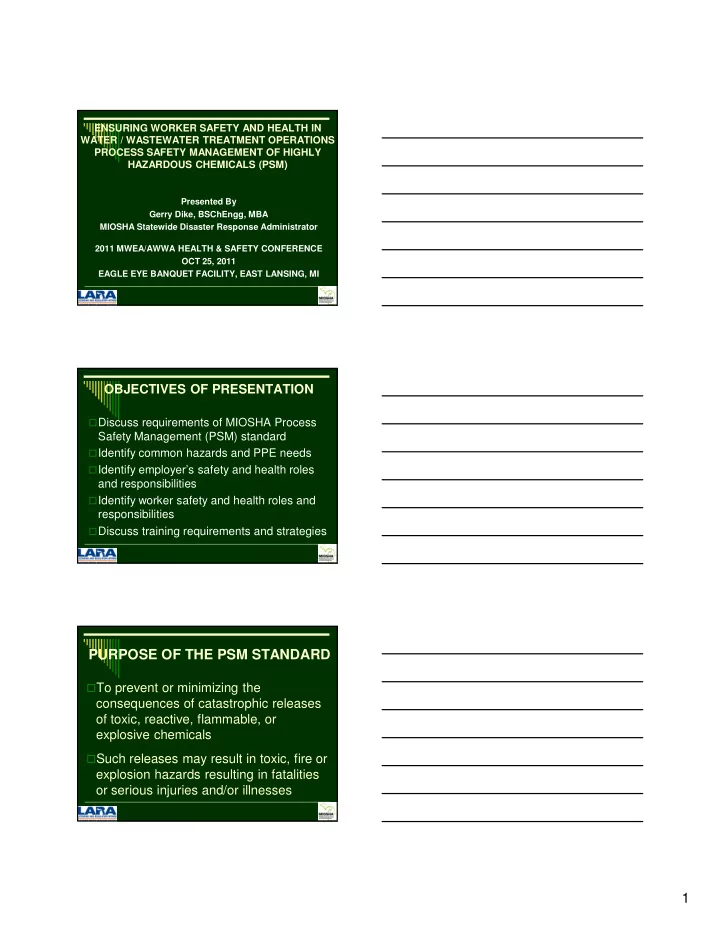
PURPOSE OF THE PSM STANDARD

To prevent or minimizing the

consequences of catastrophic releases

  • f toxic, reactive, flammable, or

explosive chemicals

Such releases may result in toxic, fire or

explosion hazards resulting in fatalities

  • r serious injuries and/or illnesses
slide-2
SLIDE 2

2

4

POSSIBLE RESULT OF NON-COMPLIANCE WITH PSM REQUIREMENTS

5

POSSIBLE RESULT OF NON-COMPLIANCE WITH PSM REQUIREMENTS

6

POSSIBLE RESULT OF NON-COMPLIANCE WITH PSM REQUIREMENTS

slide-3
SLIDE 3

3

7

APPLICATION OF THE PSM STANDARD

Processes that involve use of a chemical

listed in Appendix A at or above the specified threshold quantities

Processes that involve use of a

flammable liquid or gas on site in one location, in a quantity of 10,000 pounds (4535.9 kg) or more.

8

APPLICATION OF THE PSM STANDARD EXCEPTIONS

Hydrocarbon fuels used solely for workplace

consumption as a fuel (e.g., propane used for comfort heating, gasoline for vehicle refueling), if such fuels are not a part of a process containing another highly hazardous chemical covered by this standard

Flammable liquids stored in atmospheric tanks which

are kept below their normal boiling point without benefit of chilling or refrigeration

9

APPLICATION OF THE PSM STANDARD EXCEPTIONS

Retail facilities Oil or gas well drilling or servicing

  • perations

Normally unoccupied remote facilities

slide-4
SLIDE 4

4

10

PSM COVERED CHEMICALS IN WATER / WASTEWATER TREATMENT OPERATIONS CHLORINE (Cl2) TLQ = 1500 lbs SULFUR DIOXIDE

(SO2)

TLQ = 1000 lbs

11

Chlorine Use in Water /Wastewater Chlorine Use in Water /Wastewater Treatment Operations Treatment Operations

Excellent sanitizing agent Forms hypochlorous acid in

solution – active biocidal material Cl2 + H2O HOCl + HCl

Good residual action –

bacteriostatic at 1-5 ppm Cl2 in water

12

Chlorine Use in Water /Wastewater Treatment Operations

Can form undesirable

chlorinated organic materials, e.g., chloromethanes

Chlorine Institute

Pamphlet 155 – Water & Wastewater Operators Chlorine Handbook

slide-5
SLIDE 5

5

13

Health Effects of Chlorine Health Effects of Chlorine

Chlorine is extremely irritating and can burn the

skin and eyes

If inhaled, chlorine causes respiratory distress,

and can be fatal

Liquid chlorine releases will form an immediate

cloud (flash vapor) and will cool to -29 F.

Exposure to liquid can cause frostbite, as well

as chemical burns.

14

Health Effects of Chlorine Exposure Health Effects of Chlorine Exposure

Concentration (ppm in air) Health Effects 1-3 ppm Mild mucous membrane irritation 5-15 ppm Upper respiratory tract irritation 30 ppm Immediate chest pain, vomiting, shortness of breath (dyspnea) and cough 40-60 ppm Inflammation of lung tissues (toxic pneumonitis) and fluid accumulation (pulmonary edema) 430 ppm Death within 30 minutes 1,000 ppm Death within a few minutes

15

Exposure Limits for Chlorine Exposure Limits for Chlorine

Standard Setting Body Permissible Exposure ppm Description NIOSH 0.5 Recommended Exposure Limit (REL) OSHA 1 Permissible Exposure Limit (PEL) NIOSH 1 Short Term Exposure Limit (STEL) AIHA 3 Emergency Response Planning Guideline Level 2 NIOSH 10 Immediately Dangerous to Life or Health (IDLH) AIHA 20 Emergency Response Planning Guideline Level 3

slide-6
SLIDE 6

6

16

KEY ELEMENTS OF THE PSM STANDARD

  • Employee participation

Employee participation

  • Process safety information

Process safety information Process hazard analysis hazard analysis

  • Operating procedures

Operating procedures

  • Training

Training

17

KEY ELEMENTS OF THE PSM STANDARD

Contractors Pre-startup safety review Mechanical integrity Hot work permit Management of change

18

KEY ELEMENTS OF THE PSM STANDARD

Incident investigation Emergency planning and response Compliance audits Trade secrets Appendix A

slide-7
SLIDE 7

7

19

Employee participation

Employers shall develop a written plan of action

regarding the implementation of the employee participation

Employers shall consult with employees and their

representatives on the conduct and development of process hazards analyses and on the development

  • f the other elements of process safety management

in this standard

Employers shall provide to employees and their

representatives access to process hazard analyses and to all other information required to be developed under this standard

20

Process Safety Information (PSI) Process Safety Information (PSI) 1910.119 (d) 1910.119 (d)

The employer shall complete a

compilation of written process safety

  • information. The written process safety

information is to enable the employer and the employees involved in operating the process to identify and understand the hazards posed by those processes involving highly hazardous chemicals.

21

Process Safety Information Process Safety Information 1910.119 (d) 1910.119 (d)

The process safety information shall

include information pertaining to the hazards of the highly hazardous chemicals used or produced by the process, information pertaining to the technology of the process, and information pertaining to the equipment in the process.

slide-8
SLIDE 8

8

22

Process Safety Information Process Safety Information

Information pertaining to the hazards of the highly hazardous chemicals (Can use MSDS)

Toxicity information Permissible exposure limits Physical data Reactivity data Corrosivity data Thermal and chemical stability data Hazardous effects of inadvertent mixing of different

materials that could foreseeably occur

23

Process Safety Information Process Safety Information

Information pertaining to the technology

  • f the process

Block flow diagram or simplified process flow

diagram

Process chemistry Maximum intended inventory Safe upper and lower limits for such items as

temperatures, pressures, flows or compositions

An evaluation of the consequences of deviations,

including those affecting the safety and health of employees

24

Process Safety Information Process Safety Information

Information pertaining to the equipment in the process

Materials of construction Piping and instrument diagrams (P & ID’s) Electrical classification Relief system design and design basis Ventilation system design Design codes and standards employed Material and energy balances Safety systems (e.g. interlocks, detection or

suppression systems).

slide-9
SLIDE 9

9

25

Process Safety Information Process Safety Information 1910.119 (d): Piping 1910.119 (d): Piping

Do materials for piping and components

comply with Chlorine Institute recommendations – for metallurgy, schedule, and welding? (CI 6 Sec 2)

Are materials for threaded connections PTFE

tape or non-reactive pipe dope? (CI 1 and 6

  • Sec. 3)

26

Process Safety Information Process Safety Information 1910.119 (d): Piping Cont. 1910.119 (d): Piping Cont.

Are gaskets

compatible with liquid and gaseous chlorine? (CI 95 Sec 3)

27

Process Safety Information Process Safety Information 1910.119 (d): Piping Cont. 1910.119 (d): Piping Cont.

Is piping adequately supported

and braced? (CI 6 Sec 10)

Is piping system protected from

vehicular traffic? (CI 6 Sec 10)

If piping is underground, is it

continuously leak monitored? (CI 60 Sec 3)

slide-10
SLIDE 10

10

28

Process Safety Information Process Safety Information 1910.119 (d): Piping Cont. 1910.119 (d): Piping Cont.

Are there expansion pots

where liquid Cl2 can be blocked in? (CI 5 Sec 5)

Is the expansion pot

isolated by rupture disk and monitored? (CI 6 Sec 5)

29

Process Safety Information Process Safety Information 1910.119 (d): Piping Cont. 1910.119 (d): Piping Cont.

Are liquid valves designed

to prevent trapping Cl2 in the body? (CI 6 Sec 4)

When Cl2 pressure is

lower than process pressure, is there backflow prevention? (CI 9 Sec 4 and 5)

30

Process Safety Information (d) Process Safety Information (d) (Vaporizers) (Vaporizers)

Is the vaporizer heating medium non-organic and

limited to 250 F? (CI 9 Sec 3)

Is the heating medium pressure lower than the

chlorine supply pressure? (CI 9 Sec 3)

Is the vaporizer designed for a minimum metal

temperature of -40 F? (CI 9 Sec 3)

Does the vaporizer outlet have a pressure relief

valve? (CI 9 Sec 4)

Is there a program in place to monitor NCl3 levels?

(CI 9 Sec 5 and CI 152 Sec 5)

slide-11
SLIDE 11

11

31

Process Safety Information (d) Process Safety Information (d) (Bulk Container Unloading) (Bulk Container Unloading)

Are there a remotely operated or

automatically actuated emergency shutoff valves to isolate both sides of flexible hoses? (CI 57 Sec 3, CI 66 Sec 9)

Are there at least 2 remote shutoff valve

  • perators? (CI 57 Sec 3)

Is there a tank motion detector that closes

shutoff valves? (CI 57 Sec 3)

32

Process Safety Information (d) (Bulk Process Safety Information (d) (Bulk Container Unloading) cont. Container Unloading) cont.

Does the padding system include backflow

prevention? (CI 49 Sec 7)

Are Cl2 hoses constructed of compatible

materials? (CI 6 App A)

33

Process Safety Information (d) Process Safety Information (d) (Storage Systems) (Storage Systems)

Is the Cl2 tank protected with a pressure relief

device? (CI 5 Sec 5)

Are there emergency shutoff devices on the liquid

lines? (CI 5 Sec 5)

Is there a pressure sensing device on the tank? Does the tank have a reliable level device? Are all tank openings (nozzles) on the tank top? Does the tank have sufficient spill protection?

slide-12
SLIDE 12

12

34

Process Safety Information (d) Process Safety Information (d) (General Process) (General Process)

Are process areas monitored for

chlorine? (CI 1 Sec 7)

Are indoor chlorine areas properly

ventilated? (CI 1 Sec 7)

Are process vessels equipped with

relief devices? (CI 9 Sec 5)

35

Process Safety Information (d) Process Safety Information (d) (Scrubbers) (Scrubbers)

Is there a means to process chlorine gas

vented from equipment and piping?

Can the scrubber handle the most probable

release scenario? (CI 89 Sec 3)

Does the scrubber have passive capability or

emergency power? (CI 89 Sec 4)

Is the scrubbing medium appropriate?

36

Process Safety Information (d) Process Safety Information (d) (Scrubbers) cont. (Scrubbers) cont.

Is the scrubbing solution monitored to

confirm continued capability?

Is the scrubbing vent monitored? Is there adequate backflow prevention?

(CI 89 Sec 4)

slide-13
SLIDE 13

13

37

Process Hazard Analysis Process Hazard Analysis 1910.119 (e) 1910.119 (e)

The employer shall perform an initial process

hazard analysis (hazard evaluation) on processes covered by this standard.

The process hazard analysis shall be

appropriate to the complexity of the process and shall identify, evaluate, and control the hazards involved in the process.

38

Process Hazard Analysis Process Hazard Analysis 1910.119 (e) Cont. 1910.119 (e) Cont.

The process hazard analysis shall

address:

The hazards of the process The identification of any previous

incident which had a likely potential for catastrophic consequences in the workplace

39

Process Hazard Analysis Process Hazard Analysis 1910.119 (e) Cont. 1910.119 (e) Cont.

Engineering and administrative controls

applicable to the hazards and their interrelationships such as appropriate application of detection methodologies to provide early warning of releases. (Acceptable detection methods might include process monitoring and control instrumentation with alarms, and detection hardware such as hydrocarbon sensors.)

slide-14
SLIDE 14

14

40

Process Hazard Analysis Process Hazard Analysis 1910.119 (e) Cont. 1910.119 (e) Cont.

Consequences of failure of engineering

and administrative controls

Facility siting Human factors A qualitative evaluation of a range of the

possible safety and health effects of failure of controls on employees in the workplace.

41

Process Hazard Analysis Process Hazard Analysis 1910.119 (e) Cont. 1910.119 (e) Cont.

The process hazard analysis shall be performed by

a team with expertise in engineering and process

  • perations.

The team shall include at least one employee who

has experience and knowledge specific to the process being evaluated.

One member of the team must be knowledgeable

in the specific process hazard analysis methodology being used.

42

Process Hazard Analysis Process Hazard Analysis 1910.119 (e) Cont. 1910.119 (e) Cont.

The employer shall establish a system to promptly

address the team’s findings and recommendations; assure that the recommendations are resolved in a timely manner and that the resolution is documented; document what actions are to be taken; complete actions as soon as possible; develop a written schedule of when these actions are to be completed; communicate the actions to operating, maintenance and other employees whose work assignments are in the process and who may be affected by the recommendations or actions.

slide-15
SLIDE 15

15

43

Process Hazard Analysis Process Hazard Analysis 1910.119 (e) Cont. 1910.119 (e) Cont.

At least every five (5) years after the

completion of the initial process hazard analysis, the process hazard analysis shall be updated and revalidated by a qualified team to assure that the process hazard analysis is consistent with the current process.

44

Process Hazard Analysis Process Hazard Analysis 1910.119 (e) Cont. 1910.119 (e) Cont.

Employers shall retain process hazards

analyses and updates or revalidations for each process covered by this section, as well as the documented resolution of recommendations for the life of the process

45

Process Hazard Analysis Process Hazard Analysis 1910.119 (e) Cont. 1910.119 (e) Cont.

Is there chlorine monitoring at the railcar

unloading site? (CI 64 Sec 3)

Has the facility investigated the potential

for nitrogen trichloride to accumulate? (CI 9 Sec 5, CI 152 Sec 5)

slide-16
SLIDE 16

16

46

Operating Procedures Operating Procedures 1910.119 (f) 1910.119 (f)

The employer shall develop and

implement written operating procedures that provide clear instructions for safely conducting activities involved in each covered process

47

Operating Procedures Operating Procedures 1910.119 (f) Cont. 1910.119 (f) Cont.

The Operating Procedures shall address

at least the following steps for each

  • perating phase:

Initial startup Normal operations Temporary operations

48

Operating Procedures Operating Procedures 1910.119 (f) Cont. 1910.119 (f) Cont.

Emergency shutdown including the conditions

under which emergency shutdown is required, and the assignment of shutdown responsibility to qualified operators to ensure that emergency shutdown is executed in a safe and timely manner.

Emergency Operations Normal shutdown Startup following a turnaround, or after an

emergency shutdown

slide-17
SLIDE 17

17

49

Operating Procedures Operating Procedures 1910.119 (f) Cont. 1910.119 (f) Cont.

Operating limits:

Consequences of deviation; and Steps required to correct or avoid

deviation.

Safety systems and their functions

50

Operating Procedures Operating Procedures 1910.119 (f) Cont. 1910.119 (f) Cont.

Safety and health considerations:

Properties of, and hazards presented by, the chemicals

used in the process

Precautions necessary to prevent exposure (engineering

controls, administrative controls, PPE)

Control measures to be taken if physical contact or

airborne exposure occurs

Quality control for raw materials and control of hazardous

chemical inventory levels

Any special or unique hazard

51

Operating Procedures Operating Procedures 1910.119 (f) Cont. 1910.119 (f) Cont.

Operating procedures shall be readily accessible to

employees who work in or maintain a process

The operating procedures shall be reviewed as often

as necessary to assure that they reflect current

  • perating practice (changes in process chemicals,

technology, and equipment, facilities)

The employer shall certify annually that these

  • perating procedures are current and accurate
slide-18
SLIDE 18

18

52

Operating Procedures Operating Procedures 1910.119 (f) Cont. 1910.119 (f) Cont.

The employer shall develop and implement

safe work practices to provide for the control

  • f hazards during operations such as

lockout/tagout, confined space entry, opening process equipment or piping, and control over entrance into a facility by maintenance, contractor, laboratory, or other support personnel.

These safe work practices shall apply to

employees and contractor employees.

53

Operating Procedures Operating Procedures 1910.119 (f) 1910.119 (f) (Bulk Container Unloading) (Bulk Container Unloading)

Do procedures include the following:

PPE for chlorine loading/unloading/line

breaking? (CI 1 Sec 5, CI 85 Sec 12)

Requirements for unloading lines and air

padding lines purged to a scrubber, evacuated, disconnected, and capped? (CI 1 Sec 3, CI 49 Sec 11, CI 66 Sec 9, CI 79 Sec 79)

54

Operating Procedures Operating Procedures 1910.119 (f) Cont. 1910.119 (f) Cont.

Do procedures include the following:

Leak testing containers before filling?

(CI 17 Sec 3)

Proper evacuation of lines before

disconnecting? (CI 17 Sec 3)

Appropriate torque setting of valves and

packing nuts? (CI 17 Sec 4)

slide-19
SLIDE 19

19

55

Training 1910.119 (g) 1910.119 (g) Initial training

Each employee involved in operating a

process, and each employee before being involved in operating a newly assigned process, shall be trained in:

An overview of the process The operating procedures

56

Training 1910.119 (g) 1910.119 (g) Initial training

The training shall include:

Emphasis on the specific safety and

health hazards

Emergency operations (shutdown) Safe work practices applicable to the

employee’s job tasks.

57

Training 1910.119 (g) 1910.119 (g) Initial training

In lieu of initial training for those

employees already involved in operating a process on May 26, 1992, an employer may certify in writing that the employee has the required knowledge, skills, and abilities to safely carry out the duties and responsibilities as specified in the operating procedures

slide-20
SLIDE 20

20

58

Training 1910.119 (g) 1910.119 (g) Refresher training

Refresher training shall be provided at least every

three years, and more often if necessary, to each employee involved in operating a process to assure that the employee understands and adheres to the current operating procedures of the process.

The employer, in consultation with the employees

involved in operating the process, shall determine the appropriate frequency of refresher training.

59

Training 1910.119 (g) 1910.119 (g) Training documentation

The employer shall ascertain that each

employee involved in operating a process has received and understood the required training.

The employer shall prepare a record which

contains the identity of the employee, the date

  • f training, and the means used to verify that

the employee understood the training.

60

Training Training - 1910.119 (g) 1910.119 (g) (employees and contractor) (employees and contractor)

Have employees been trained on:

Operation of chlorine equipment and

container handling

Properties and physiological effects of

chlorine

Equipment failure and leak reporting

procedures

slide-21
SLIDE 21

21

61

Training Training - 1910.119 (g) 1910.119 (g) (employees and contractor) (employees and contractor)

Location, purpose and use of emergency

equipment, fire fighting equipment, fire alarms, and shutdown equipment

Use of emergency kits if used at the site Locations, purpose and use of safety

equipment

Location, purpose, and use of specialized

first aid equipment.

62

Contractors - 1910.119 (h) 1910.119 (h)

Applies to contractors performing

maintenance or repair, turnaround, major renovation, or specialty work on or adjacent to a covered process.

It does not apply to contractors providing

incidental services which do not influence process safety, such as janitorial work, food and drink services, laundry, delivery or other supply services.

63

Contractors - 1910.119 (h) 1910.119 (h) Employer responsibilities

When selecting a contractor, the employer shall obtain

and evaluate information regarding the contract employer’s safety performance and programs.

The employer shall inform contract employers of the

known potential fire, explosion, or toxic release hazards related to the contractor’s work and the process.

The employer shall explain to contract employers the

applicable provisions of the facility’s emergency action plan.

slide-22
SLIDE 22

22

64

Contractors - 1910.119 (h) 1910.119 (h) Employer responsibilities Cont.

The employer shall develop and implement safe

work practices to control the entrance, presence and exit of contract employers and contract employees in covered process areas.

The employer shall periodically evaluate the

performance of contract employers in fulfilling their

  • bligations.

The employer shall maintain a contract employee

injury and illness log related to the contractor’s work in process areas

65

Contractors - 1910.119 (h) 1910.119 (h)

Contract employer responsibilities

The contract employer shall assure that each

contract employee is trained in the work practices necessary to safely perform his/her job.

The contract employer shall assure that each

contract employee is instructed in the known potential fire, explosion, or toxic release hazards related to his/her job and the process, and the applicable provisions of the emergency action plan.

66

Contractors - 1910.119 (h) 1910.119 (h)

Contract employer responsibilities Cont.

The contract employer shall document each contract

employee has received and understood the training required by this paragraph.

The contract employer shall prepare a record which

contains the identity of the contract employee, the date of training, and the means used to verify that the employee understood the training.

slide-23
SLIDE 23

23

67

Contractors - 1910.119 (h) 1910.119 (h)

Contract employer responsibilities Cont.

The contract employer shall assure that each

contract employee follows the safety rules of the facility including the safe work practices.

The contract employer shall advise the employer of

any unique hazards presented by the contract employer’s work, or of any hazards found by the contract employer’s work.

68

Pre-startup safety review

1910.119 (i) 1910.119 (i)

The employer shall perform a pre-

startup safety review for the new facilities and for modified facilities when the modification is significant enough to require a change in the process safety information

69

Pre-startup safety review 1910.119 (i) Cont. 1910.119 (i) Cont.

The pre-startup safety review shall confirm

that prior to the introduction of highly hazardous chemicals to a process:

Construction and equipment is in

accordance with design specifications

Safety, operating, maintenance, and

emergency procedures are in place and are adequate

slide-24
SLIDE 24

24

70

Pre-startup safety review 1910.119 (i) Cont. 1910.119 (i) Cont.

For new facilities, a process hazard analysis

has been performed and recommendations have been resolved or implemented before startup; and modified facilities meet the requirements contained in the management of change paragraph.

Training of each employee involved in

  • perating a process has been completed

71

Mechanical Integrity Mechanical Integrity 1910.119 (j) 1910.119 (j)

Applies to the following process equipment:

Pressure vessels and storage tanks Piping systems (piping components i.e. valves) Relief and vent systems and devices Emergency shutdown systems Controls (including monitoring devices and

sensors, alarms, and interlocks)

Pumps.

72

Mechanical Integrity Mechanical Integrity 1910.119 (j) Cont. 1910.119 (j) Cont.

The employer shall establish and

implement written procedures to maintain the on-going integrity of process equipment

slide-25
SLIDE 25

25

73

Mechanical Integrity Mechanical Integrity 1910.119 (j) Cont. 1910.119 (j) Cont.

Training for process maintenance activities -

Train each employee involved in maintaining the on-going integrity of process equipment in:

The overview of that process Process hazards The procedures applicable to the employee’s

job tasks to assure that the employee can perform the job tasks in a safe manner.

74

Mechanical Integrity Mechanical Integrity 1910.119 (j) 1910.119 (j) Equipment Equipment Inspection and testing

Inspections and tests shall be

performed on process equipment.

Inspection and testing procedures shall

follow recognized and generally accepted good engineering practices.

75

Mechanical Integrity Mechanical Integrity 1910.119 (j) 1910.119 (j) Equipment Equipment Inspection and testing

The frequency of inspections and tests of

process equipment shall be consistent with applicable manufacturers’ recommendations and good engineering practices, and more frequently if determined to be necessary by prior

  • perating experience.
slide-26
SLIDE 26

26

76

Mechanical Integrity Mechanical Integrity 1910.119 (j) 1910.119 (j) Equipment Equipment Inspection and testing

The employer shall document each inspection and test

and has been performed on process equipment.

The documentation shall identify the date of the

inspection or test, the name of the person who performed the inspection or test, the serial number or

  • ther identifier of the equipment on which the

inspection or test was performed, a description of the inspection or test performed, and the results of the inspection or test.

77

Mechanical Integrity Mechanical Integrity 1910.119 (j) 1910.119 (j) Equipment Equipment Inspection and testing

The employer shall correct deficiencies

in equipment that are outside acceptable limits before further use or in a safe and timely manner when necessary means are taken to assure safe operation.

78

Mechanical Integrity Mechanical Integrity 1910.119 (j) 1910.119 (j)

Appropriate checks and inspections shall be

performed to assure that equipment is installed properly and consistent with design specifications and the manufacturer’s instructions.

The employer shall assure that maintenance

materials, spare parts and equipment are suitable for the process application for which they will be used.

slide-27
SLIDE 27

27

79

Mechanical Integrity Mechanical Integrity - 1910.119 (j) 1910.119 (j) Preventive Maintenance is Crucial Preventive Maintenance is Crucial

80

Hot work permit - 1910.119 (k) 1910.119 (k)

The employer shall issue a hot work permit for hot

work operations conducted on or near a covered process.

The permit shall document that the fire prevention and

protection requirements in 29 C.F.R. 1910.252(a) have been implemented prior to beginning the hot work operations

It shall indicate the date(s) authorized for hot work;

and identify the object on which hot work is to be performed, and shall be kept on file until completion of the hot work operations.

81

Management of change - 1910.119 (l) 1910.119 (l)

The employer shall establish and

implement written procedures to manage changes (except for “replacements in kind”) to process chemicals, technology, equipment, and procedures; and, changes to facilities that affect a covered process.

slide-28
SLIDE 28

28

82

Management of change - 1910.119 (l) 1910.119 (l)

Address the following considerations during

management of change:

The technical basis for the proposed

change

Impact of change on safety and health Modifications to operating procedures Necessary time period for the change Authorization requirements for the

proposed change.

83

Management of change - 1910.119 (l) 1910.119 (l)

Employees involved in operating a

process and maintenance and contract employees whose job tasks will be affected by a change in the process shall be informed of, and trained in, the change prior to start-up of the process

  • r affected part of the process.

84

Management of change - 1910.119 (l) 1910.119 (l)

If a change results in a change in the

process safety information, such information shall be updated accordingly.

If a change results in a change in the

  • perating procedures or practices, such

procedures or practices shall be updated accordingly.

slide-29
SLIDE 29

29

85

Incident investigation - 1910.119 (m)

1910.119 (m)

The employer shall investigate each incident

which resulted in, or could reasonably have resulted in a catastrophic release of highly hazardous chemical in the workplace.

An incident investigation shall be initiated as

promptly as possible, but not later than 48 hours following the incident.

86

Incident investigation - 1910.119 (m)

1910.119 (m)

An incident investigation team shall be

established and consist of at least one person knowledgeable in the process involved, including a contract employee if the incident involved work of the contractor, and other persons with appropriate knowledge and experience to thoroughly investigate and analyze the incident.

87

Incident investigation - 1910.119 (m)

1910.119 (m)

A report shall be prepared at the conclusion of the

investigation which includes at a minimum:

Date of incident; Date investigation began; A description of the incident; The factors that contributed to the incident; and, Any recommendations resulting from the

investigation.

slide-30
SLIDE 30

30

88

Incident investigation - 1910.119 (m)

1910.119 (m)

The employer shall establish a system to promptly

address and resolve the incident report findings and

  • recommendations. Resolutions and corrective

actions must be documented.

The report shall be reviewed with all affected

personnel whose job tasks are relevant to the incident findings including contract employees were applicable.

Incident investigation reports shall be retained for

five years.

89

Emergency planning and response 1910.119 (n) 1910.119 (n)

The employer shall establish and implement an

emergency action plan for the entire plant in accordance with the provisions of 29 C.F.R. 1910.38(a).

The emergency action plan shall include procedures

for handling small releases.

Employers covered under this standard may also be

subject to the hazardous waste and emergency response provisions contained in 29 C.F.R. 1910.120(a), (p) and (q).

90

Compliance audits - 1910.119 (o) 1910.119 (o)

Employers shall certify that they have

evaluated compliance with the provisions of this standard at least every three years to verify that the procedures and practices developed under the standard are adequate and are being followed.

The compliance audit shall be conducted by at

least one person knowledgeable in the process.

slide-31
SLIDE 31

31

91

Compliance audits - 1910.119 (o) 1910.119 (o)

A report of the findings of the audit shall be

developed.

The employer shall promptly determine and

document an appropriate response to each of the findings of the compliance audit, and document that deficiencies have been corrected.

Employers shall retain the two (2) most recent

compliance audit reports.

92

Trade secrets - 1910.119 (p) 1910.119 (p)

Employers shall make all information necessary to

comply with the standard available to:

Those persons responsible for compiling the

process safety information

Those assisting in the development of the process

hazard analysis

Those responsible for developing the operating

procedures

Those involved in incident investigations,

emergency planning and response, and compliance audits without regard to possible trade secret status of such information.

93

Trade secrets - 1910.119 (p) 1910.119 (p)

The standard does not preclude the employer from

requiring the persons to whom the information is made available to enter into confidentiality agreements not to disclose the information

Employees and their designated representatives

shall have access to trade secret information contained with the process hazard analysis and

  • ther documents required to be developed by this

standard.

slide-32
SLIDE 32

32

94

PROTECT YOUR FACILITY

95 96

QUESTIONS

slide-33
SLIDE 33

33

97

THANK YOU FOR YOUR ATTENTION