AAAG MONTHLY MEETING & MOCK PSM VIVA PRESENTATIONS SEMESTER II, - - PDF document

aaag monthly meeting mock psm viva presentations semester
SMART_READER_LITE
LIVE PREVIEW

AAAG MONTHLY MEETING & MOCK PSM VIVA PRESENTATIONS SEMESTER II, - - PDF document

AAAG MONTHLY MEETING & MOCK PSM VIVA PRESENTATIONS SEMESTER II, 2018/2019 Day/Date : Thursday, 25 April 2019 Time : 2.00 PM 5.00 PM Venue : Main Meeting Room, Level 3, C22, Faculty of Science TENTATIVE


slide-1
SLIDE 1

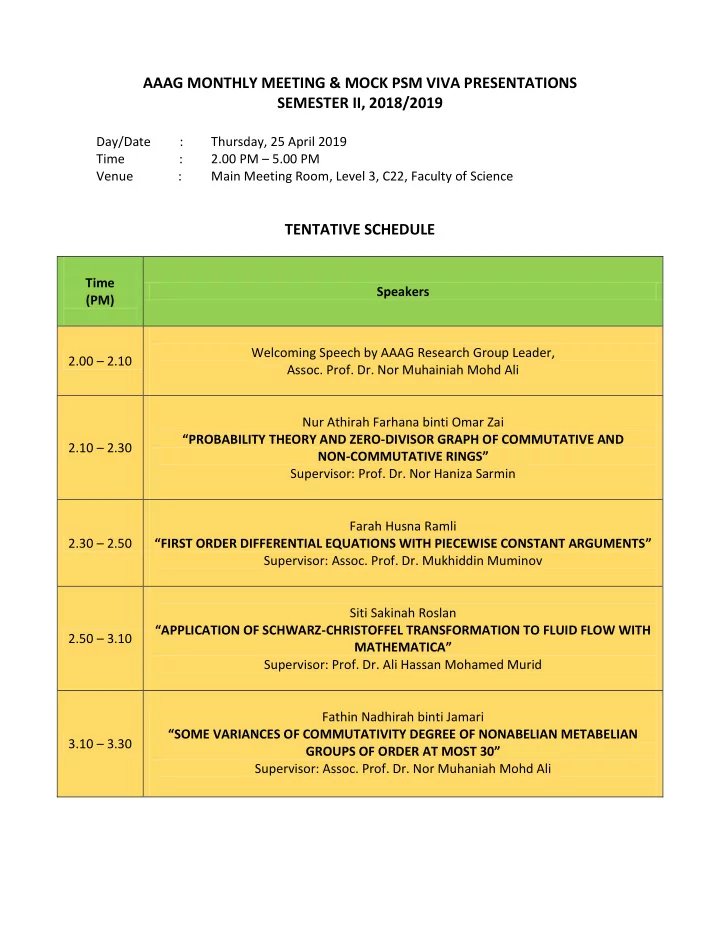
AAAG MONTHLY MEETING & MOCK PSM VIVA PRESENTATIONS SEMESTER II, 2018/2019

Day/Date : Thursday, 25 April 2019 Time : 2.00 PM – 5.00 PM Venue : Main Meeting Room, Level 3, C22, Faculty of Science

TENTATIVE SCHEDULE

Time (PM) Speakers 2.00 – 2.10 Welcoming Speech by AAAG Research Group Leader,

  • Assoc. Prof. Dr. Nor Muhainiah Mohd Ali

2.10 – 2.30 Nur Athirah Farhana binti Omar Zai “PROBABILITY THEORY AND ZERO-DIVISOR GRAPH OF COMMUTATIVE AND NON-COMMUTATIVE RINGS” Supervisor: Prof. Dr. Nor Haniza Sarmin 2.30 – 2.50 Farah Husna Ramli “FIRST ORDER DIFFERENTIAL EQUATIONS WITH PIECEWISE CONSTANT ARGUMENTS” Supervisor: Assoc. Prof. Dr. Mukhiddin Muminov 2.50 – 3.10 Siti Sakinah Roslan “APPLICATION OF SCHWARZ-CHRISTOFFEL TRANSFORMATION TO FLUID FLOW WITH MATHEMATICA” Supervisor: Prof. Dr. Ali Hassan Mohamed Murid 3.10 – 3.30 Fathin Nadhirah binti Jamari “SOME VARIANCES OF COMMUTATIVITY DEGREE OF NONABELIAN METABELIAN GROUPS OF ORDER AT MOST 30” Supervisor: Assoc. Prof. Dr. Nor Muhaniah Mohd Ali

slide-2
SLIDE 2

3.30 – 3.50 Rubeniy A/P Ramanaidoo “THE ENERGY OF GRAPHS FOR NON-ABELIAN p-GROUPS OF ORDER 27” Supervisor: Dr. Hazzirah Izzati Mat Hassim 3.50 – 4.10 Putri Nurdiyanah binti Md Rizal “THE COMMUTING AND NON-COMMUTING GRAPHS OF ALL 2-ENGEL GROUPS OF ORDER AT MOST 16” Supervisor: Dr. Hazzirah Izzati Mat Hassim 4.10 – 4.30 Muhammad Nur Syiham Bin Abdul Razak “SEMIGRAPH ON GRAPH SPLICING SYSTEM IN DNA” Supervisor: Dr. Fong Wan Heng 4.30 – 4.50 Muhamad Hafiz Bin Abd Rahman “THE COMPUTATIONAL SOFTWARE MODEL FOR VISUALISING SOME PROPERTIES OF FINITE ABELIAN GROUPS AND SOME DIHEDRAL GROUPS” Supervisor: Assoc. Prof. Dr. Nor Muhaniah Mohd Ali 4.50 – 5.00 Refreshments

Organised by Applied Algebra and Analysis Group (AAAG), Frontier Materials Research Alliance Universiti Teknologi Malaysia, Johor Bahru, Johor www.science.utm.my/AAAG

slide-3
SLIDE 3

ABSTRACT _____________________________________________

PROBABILITY THEORY AND ZERO-DIVISOR GRAPH OF COMMUTATIVE AND NON-COMMUTATIVE RINGS Nur Athirah Farhana binti Omar Zai Department of Mathematical Sciences, Faculty of Science Universiti Teknologi Malaysia 81310 UTM Johor Bahru, Johor atyrafarhana@gmail.com Supervisor:

  • Prof. Dr. Nor Haniza Sarmin

Department of Mathematical Sciences, Faculty of Science Universiti Teknologi Malaysia 81310 UTM Johor Bahru, Johor nhs@utm.my Abstract

The development of theory of rings was stimulated by the abundant amount of seemingly unapproachable problems. One such problem is to determine the zero-divisors of commutative and non-commutative rings. In response to this problem, the focus of this study is given to the determination of the probability of elements that have product zero and the zero-divisor graphs of commutative and non-commutative rings. The zero-divisor graph of a ring is a simple graph which its vertices are all non-zero elements of the ring such that two different elements are adjacent if and only if the product of the elements is zero. Using the result of the zero-divisors found earlier, the zero-divisor graphs are then constructed for commutative rings, namely the ring of integers modulo 20 and the direct product of the ring of integers modulo two with ring of integers modulo nine. In addition, the zero-divisor graphs are also constructed for non-commutative rings, which are the ring of 2 x 2 matrices

  • ver integers modulo two and the direct product of the ring of integers modulo two with the ring of 2 x

2 matrices over integers modulo two. Two properties of graphs which are clique number and chromatic number are also found in this study. It is found that the zero-divisor graph of the commutative rings are undirected graphs while the zero-divisor graph of the non-commutative rings are directed graphs. Keywords: Ring, Zero-divisor, Probability, Graph

slide-4
SLIDE 4

ABSTRACT _____________________________________________

FIRST ORDER DIFFERENTIAL EQUATIONS WITH PIECEWISE CONSTANT ARGUMENTS Farah Husna Ramli Department of Mathematical Sciences, Faculty of Science Universiti Teknologi Malaysia 81310 UTM Johor Bahru, Johor farahhusnar@gmail.com Supervisor:

  • Assoc. Prof. Dr. Mukhiddin Muminov

Department of Mathematical Sciences, Faculty of Science Universiti Teknologi Malaysia 81310 UTM Johor Bahru, Johor mukhiddin@utm.my Abstract

In this paper, we consider the differential equation with piecewise constant arguments of the form of x’(t)+m(t)x(t)+M(t)x(*t+)=σ(t), where *.+ denotes the greatest integer function and m(t), M(t), σ(t) are continuous functions. We give a method of finding the unique solution of the differential equation on the interval [0,3]. Using obtained method, we give numerical solutions of the equation in examples by using the Maple software. Keywords: piecewise constant arguments, first order differential equation, continuous parameters, constant parameters.

slide-5
SLIDE 5

ABSTRACT _____________________________________________

APPLICATION OF SCHWARZ-CHRISTOFFEL TRANSFORMATION TO FLUID FLOW WITH MATHEMATICA Siti Sakinah Roslan Department of Mathematical Sciences, Faculty of Science UniversitiTeknologi Malaysia 81310 UTM Johor Bahru, Johor siti_davilla@yahoo.com Supervisor:

  • Prof. Dr. Ali Hassan Mohamed Murid

Department of Mathematical Sciences, Faculty of Science Universiti Teknologi Malaysia 81310 UTM Johor Bahru, Johor alihassan@utm.my Abstract

The purpose of this report is to study the Schwarz-Christoffel transformation that maps the upper-half plane onto a region bounded by a polygonal curve. We show some examples of transformations that map the upper-half plane onto branch channel, semi-infinite strip and flow over a step boundary. We show how to use Mathematica software to visualize fluid flows. Keywords: conformal mapping, fluid flow, potential flow, Schwarz-Christoffel transformation

slide-6
SLIDE 6

ABSTRACT _____________________________________________

SOME VARIANCES OF COMMUTATIVITY DEGREE OF NONABELIAN METABELIAN GROUPS OF ORDER AT MOST 30 Fathin Nadhirah binti Jamari Department of Mathematical Sciences, Faculty of Science Universiti Teknologi Malaysia 81310 UTM Johor Bahru, Johor fathinnadhirah.jamari@gmail.com Supervisor:

  • Assoc. Prof. Dr. Nor Muhainiah Mohd Ali

Department of Mathematical Sciences, Faculty of Science Universiti Teknologi Malaysia 81310 UTM Johor Bahru, Johor normuhainiah@utm.my Abstract

A group G is metabelian if and only if there is exist an abelian normal subgroup A such that the quotient group G A is also abelian. The scope of this research is only for nonabelian metabelian groups of order at most 30. The abelianness of a nonabelian group can be measured by using commutativity degree. The concept of the commutativity degree has been extended to the nth commutativity degree where it is defined as the probability that the nth power of a random element commutes with another random element from the same group. Another extension of commutativity degree is the relative commutativity degree of a subgroup G where it is the probability of an element in H commutes with element in G. Furthermore, the study of the co-prime probability is included in this research where it is defined as the probability of a random pair of elements (x,y) in G for which the greatest common divisor of order x and

  • f order y in G are equal to one. In this research, the nth commutativity degree for nonabelian

metabelian groups of order 26 to 30 are determined. Meanwhile, the noncyclic subgroups for nonabelian metabelian groups of order 24 until 30 are obtained and hence, its relative commutativity degree for those groups are found. As for the co-prime probability, this research only covers for nonabelian metabelian groups of order 26 to 30. Keywords: nonabelian metabelian group, commutativity degree, nth commutativity degree, relative commutativity degree, co-prime probability

slide-7
SLIDE 7

ABSTRACT _____________________________________________

THE ENERGY OF GRAPHS FOR NON-ABELIAN -GROUPS OF ORDER 27 Rubeniy A/P Ramanaidoo Department of Mathematical Sciences, Faculty of Science Universiti Teknologi Malaysia 81310 UTM Johor Bahru, Johor rubeniyramanaidoo24@gmail.com Supervisor: Dr.Hazzirah Izzati binti Mat Hassim Department of Mathematical Sciences, Faculty of Science Universiti Teknologi Malaysia 81310 UTM Johor Bahru, Johor hazzirah@utm.my Abstract

Energy of a graph is the sum of all absolute values of the eigenvalues for the adjacency matrix of the

  • graph. An adjacency matrix of a graph is a square matrix with rows and columns represented by graph

vertices with 1 or 0 entries depending on the adjacency of the vertices. A commuting graph is a graph with non-central elements as its vertices and the vertices are connected if they commute. Meanwhile, a non-commuting graph is a graph with non-central elements as its vertices and two distinct vertices are connected if they do not commute. A conjugacy class graph is a graph with conjugacy classes as its vertices and two vertices are connected if the orders of the conjugacy classes are not coprime. In addition, a conjugate graph is a graph with non-central elements as its vertices and two vertices are connected if they belong to the same conjugacy class. In this research, the energy of commuting graph, non-commuting graph, conjugacy class graph and conjugate graphs for non-abelian - groups of order 27 are computed. A -group is a group with order where is a prime and is a natural number. Based on the Cayley table and conjugacy class table of the groups found in the previous research, the adjacency matrices of the graphs are determined by using the definition. Then, the characteristics polynomial and eigenvalues are determined by using their definitions and assisted by Maple software. Finally, the energy of these four graphs for the two non-abelian - groups of order 27 are computed. From the results, it is found that the energy of same type of graphs for both non-abelian - groups of

  • rder 27 are equal.

Keywords: non-abelian -group, group graphs, energy of graphs

slide-8
SLIDE 8

ABSTRACT _____________________________________________

THE COMMUTING AND NON-COMMUTING GRAPHS OF ALL ENGEL GROUPS OF ORDER AT MOST 16 Putri Nurdiyanah binti Md Rizal Department of Mathematical Sciences, Faculty of Science Universiti Teknologi Malaysia 81310 UTM Johor Bahru, Johor yanahr96@gmail.com Supervisor:

  • Dr. Hazzirah Izzati binti Mat Hassim

Department of Mathematical Sciences, Faculty of Science Universiti Teknologi Malaysia 81310 UTM Johor Bahru, Johor hazzirah@utm.my Abstract

The origin of Engel group lies in the theory of Lie algebras. An Engel group is a group if there is a positive integer such that in G for all elements and in . Focusing only on Engel groups of order at most , this research aims to construct the commuting and non-commuting graphs associative to these groups. A graph of a group is constructed with the set of vertices is determined based on the groups’ elements. For a commuting graph, two distinct vertices are connected if they commute with each other. The connection becomes the set of edged of the commuting graph. Meanwhile, a non-commuting graph is a graph where the edges are obtained when the vertices do not

  • commute. In this research, eight

Engel groups of order at most are being considered. The presentations for these groups found in previous study are used to determine the central elements, commuting and non-commuting elements. Then, the findings are used to construct the commutive and non-commutive graphs of these group. Maple software is used to assist the construction of the graphs. From the results, it can be seen that there are common patterns of graphs for every Engel group of

  • rder at most 16.

Keywords: Engel group, commuting graph, non-commuting graph

slide-9
SLIDE 9

ABSTRACT _____________________________________________

SEMIGRAPH ON GRAPH SPLICING SYSTEM IN DNA

Muhammad Nur Syiham Bin Abdul Razak Department of Mathematical Sciences, Faculty of Science Universiti Teknologi Malaysia 81310 UTM Johor Bahru, Johor syihamrazak96@gmail.com Supervisor:

  • Dr. Fong Wan Heng

Department of Mathematical Sciences, Faculty of Science Universiti Teknologi Malaysia 81310 UTM Johor Bahru, Johor fwh@utm.my

Abstract

In the field of DNA computing, the notion of splicing system implemented in DNA molecules called as DNA splicing system. DNA splicing system concerns on the recombination behaviours of DNA molecules which require the presence of restriction enzymes. However, the complexity process of DNA splicing system is quite incompetent to describe in one-dimensional strings. Hence, graph splicing system is used to describe DNA splicing system in the form of a graph, where rules is needed to restrict the cutting sites

  • f the graph. In the manner of DNA splicing system, the vertices represent the DNA molecules; while the

rules represent the restriction enzymes. On the other hand, semigraph is a type of graph which generally consists of subedges and partial edges. Since semigraph holds various properties through its structure in describing fundamental operation, it can be used in generalizing concepts of graphs. There are various types of graph splicing and one of them is the n -cut splicing which will fabricate two components of n - cut spliced semigraphs. An n -cut spliced semigraph is a type of semigraph which consists of at least one vertex, one semivertex, one edge and one semiedge. This research focuses on the behaviour of n -cut splicing system in producing the n -cut spliced semigraph by considering ‘ L ’ number of bonds to be cut and to apply the concept of bipartite semigraph and folding technique on them. A language is obtained when the rule is applied iteratively in the graph splicing system. Meanwhile, two components of 1-cut spliced semigraphs and 2 -cut spliced semigraphs are obtained after 1-cut splicing and 2 -cut splicing,

  • respectively. The structure of the n -cut spliced semigraph is then explained by using Euler’s Polyhedral
  • Formula. The n -cut spliced semigraphs are transformed into bipartite semigraphs by partitioning the

vertices into two independent sets which can be folded for ‘

1 n ’ times to obtain a new semigraph. In

this research, graph splicing system describes the DNA splicing process where the semigraph obtained after the process represents the decomposition of the DNA molecule. Keywords: DNA, graph splicing system, n -cut splicing, bipartite semigraph, semigraph folding

slide-10
SLIDE 10

ABSTRACT _____________________________________________

THE COMPUTATIONAL SOFTWARE MODEL FOR VISUALISING SOME PROPERTIES OF FINITE ABELIAN GROUPS AND SOME DIHEDRAL GROUPS Muhamad Hafiz Bin Abd Rahman Department of Mathematical Sciences, Faculty of Science Universiti Teknologi Malaysia 81310 UTM Johor Bahru, Johor hafiz.rahman0605@gmail.com Supervisor:

  • Assoc. Prof. Dr. Nor Muhainiah Mohd Ali

Department of Mathematical Sciences, Faculty of Science Universiti Teknologi Malaysia 81310 UTM Johor Bahru, Johor normuhainiah@utm.my Abstract Groups of integers under addition and multiplication modulo n, where n is any positive integer with certain conditions are finite abelian groups in which all its elements commute. The manual computations of some properties of the group including the order of group, the order and the inverse of each element, the cyclic subgroups of the group, list of the generators of the group and the lattice diagrams are time consuming as n increases. Same goes with the dihedral groups

  • f finite order which are the symmetric group of an n-sided polygon since the group involves

rotations and reflections. Thus, in this research, a program for the groups of integers under addition and multiplication modulo n and dihedral groups is developed using Microsoft Visual C++. This program enables users to enter the value of n at most 400 for the finite abelian group to generate the properties of the groups as the results of this research. This program is also designed to compute the elements of some dihedral group in the form of Cayley table. Keywords: groups of integer modulo n, dihedral groups, microsoft visual C++