Puget Sound Gatew ay Program SR 167 and SR 509 Completion Projects - - PowerPoint PPT Presentation

puget sound gatew ay program
SMART_READER_LITE
LIVE PREVIEW

Puget Sound Gatew ay Program SR 167 and SR 509 Completion Projects - - PowerPoint PPT Presentation

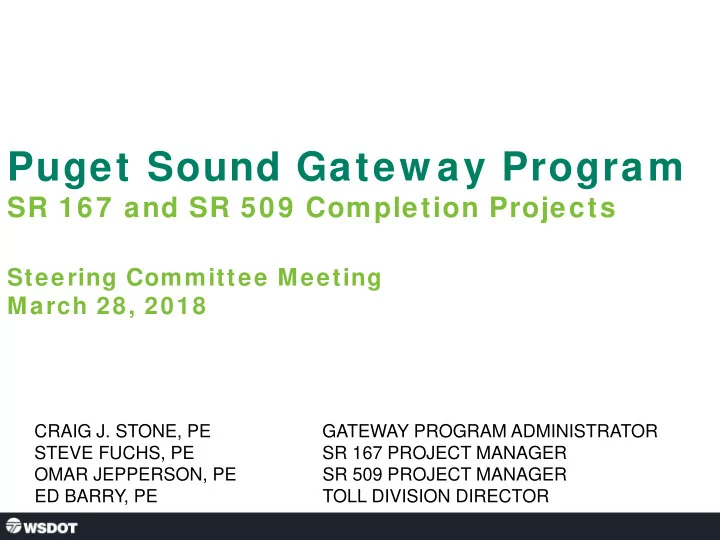
Puget Sound Gatew ay Program SR 167 and SR 509 Completion Projects Steering Committee Meeting March 28, 2018 CRAIG J. STONE, PE GATEWAY PROGRAM ADMINISTRATOR STEVE FUCHS, PE SR 167 PROJECT MANAGER OMAR JEPPERSON, PE SR 509 PROJECT MANAGER


slide-1
SLIDE 1

Puget Sound Gatew ay Program

SR 167 and SR 509 Completion Projects

Steering Committee Meeting March 28, 2018

CRAIG J. STONE, PE GATEWAY PROGRAM ADMINISTRATOR STEVE FUCHS, PE SR 167 PROJECT MANAGER OMAR JEPPERSON, PE SR 509 PROJECT MANAGER ED BARRY, PE TOLL DIVISION DIRECTOR

slide-2
SLIDE 2
  • Welcome and introductions
  • Legislative updates
  • CEVP Results
  • Endorse Updated Preferred Scenario
  • Project updates
  • Next Steps

2

Agenda

slide-3
SLIDE 3

Legislative Direction - 2015

In making budget allocations to the Puget Sound Gateway project, the department shall implement the project's construction as a single corridor investment. The department shall develop a coordinated corridor Construction and Implementation Plan for SR 167 and SR 509 in collaboration with affected stakeholders. Specific funding allocations must be based on where and when specific project segments are ready for construction to move forward and investments can be best

  • ptimized for timely project completion. Emphasis must be placed on avoiding

gaps in fund expenditures for either project.

3

slide-4
SLIDE 4

4

Gatew ay Funding Spheres

Total $1,986 M

slide-5
SLIDE 5

Legislative Direction – 2017 Update

The secretary of transportation must develop a memorandum of understanding with local project stakeholders that identifies a schedule for stakeholders to provide local matching funds for the Puget Sound Gateway project. Criteria for eligibility of local match includes matching funds and equivalent in-kind contributions including, but not limited to, land donations. The memorandum of understanding must be finalized by July 1, 2018. The department must submit a copy of the memorandum of understanding to the transportation committees of the legislature and report regularly on the status. During the course of developing the memorandum of understanding, the department must evaluate the project schedules to determine if there are any benefits to be gained by moving the project schedule forward. Any savings on the project must stay on the Puget Sound gateway corridor until the project is complete.

5

slide-6
SLIDE 6

Puget Sound Gatew ay Funding

as enacted by the 2017 Legislature

6

$20m

slide-7
SLIDE 7

7

Legislative Direction – 2018 Update

(c) During the course of developing the memorandum of understanding, the department must evaluate the project schedules to determine if there are any benefits to be gained by moving the project schedule forward. It is the legislature's intent that if the department identifies any savings after the funding gap on the base project is closed as part of the proposal to expedite the project, that these cost savings shall go toward construction of a full single-point urban interchange at the junction of state route number 161 (Meridian avenue) and state route number 167 and a full single point urban interchange at the junction of state route number 509 and 188th Street. If the department receives additional funds from an outside source for this project after the funding gap on the base project is closed, the funds must be applied toward the completion of these two full single- point urban interchanges. (b) Proceeds from the sale of any surplus real property acquired for the purpose of building the SR 167/SR 509 Puget Sound Gateway (M00600R) project must be deposited into the motor vehicle account for the purpose

  • f constructing the project.
slide-8
SLIDE 8

8

Legislative Direction – 2018 Update

(d) For the SR 167/SR 509 Puget Sound Gateway project (M00600R) the department is strongly encouraged to work to relocate any significant businesses currently located within the planned path of the state route number 509/Interstate 5 under-crossing to a location within the Kent city limits. The department shall provide regular updates on its progress to the joint transportation committee and affected stakeholders. (e) In designing the state route number 509/state route number 516 interchange component of the SR 167/SR 509 Puget Sound Gateway project (M00600R), the department shall make every effort to utilize the preferred "4B" design.

  • $1,200,000 of the multimodal transportation account—state appropriation is

provided solely to relocate and rebuild a 2,100-foot section of the Interurban trail and trailhead in Fife.

  • $200,000 awarded to Interurban Trail from the state Capital Budget.
slide-9
SLIDE 9
  • Applied on November

2ND for $111 million

  • If fully awarded, up to

$20 M could be applied to the local funding

  • No announcement on

award timing so far

  • Application available on

the program website:

www.wsdot.wa.gov/projects/gateway

9

INFRA Grant Status

slide-10
SLIDE 10

10

Program Timeline

slide-11
SLIDE 11

Construction & Implementation Plan

11

slide-12
SLIDE 12

12

Construction and Implementation Plan

Develop outline and major topic areas

  • Feb – March 2018

Define updated preferred scenario

  • March 28 & April 5,

2018

Identify delivery packages, expenditure and sequencing plans

  • April - June 2018

Submit Construction & Implementation Plan

  • July 2018
slide-13
SLIDE 13

Funding and Phasing Subcommittee Update

13

slide-14
SLIDE 14

Projects SR 167 SR 509 TOTAL

Port contributions $30 million $30 million $60 million Federal INFRA grant $10 million $10 million $20 million Local partner match $10 million $10 million $20 million Other Grants (PSRC, FMSIB, TIB) $20 million $10 million $30 million

Potential Total $70 million $60 million $130 million

14

Local Contribution Construct

slide-15
SLIDE 15

Benefit Level and Partner Roles

Benefit Level Proposed Partner Roles

Tier 1 (Ports and Cities)

  • Contribute to local projects
  • Donate right-of-way (if applicable)
  • Sponsor, initiate and help write grants
  • Support project and grant requests
  • Participate in project development review

& project meetings Tier 2 (Cities and Counties)

  • Contribute to match to local projects
  • Support project and grant requests
  • Participate in project development review &

project meetings Tier 3 (Cities)

  • Support project and grant requests
  • Participate in project meetings

15

slide-16
SLIDE 16

16

Grant and Match Financial Plan:

slide-17
SLIDE 17

17

MOU Development Process

Concur on goals, partnership principles and responsibilities

  • October 4, 2017

Approach to Benefit Framework and Partner Roles

  • December 13, 2017

Partner Concurrence on MOU

  • January-March

2018

Ratify MOU

  • April – June 2018
slide-18
SLIDE 18
  • Funding and Phasing Subcommittee approved of the

grant focused strategy

  • Working closely with Tier 1 and Tier 2 partners
  • There is consensus on the components of the MOU

and a draft is out now for review

– Comments are due by March 30 – Finalize and submit to Legislature by July 1

Memorandum of Understanding Update

18

slide-19
SLIDE 19

Schedule Acceleration

19

slide-20
SLIDE 20

20

Schedule Acceleration Analysis

Determine cost inputs, CEVP and CCI

  • Nov 2017 – Apr 2018

Travel demand and toll funding analysis

  • Dec 2017 – May

2018

Determine funding and phasing

  • pportunities and

constraints

  • March - June 2018

Issue report identifying acceleration benefits

  • July 2018
slide-21
SLIDE 21

Tolling

21

slide-22
SLIDE 22

22

Tolling in Washington State

Current toll facilities

  • SR 16 Tacoma Narrows Bridge
  • SR 167 HOT Lanes Pilot Project
  • SR 520 Floating Bridge
  • I-405 Express Toll Lanes

(Bellevue to Lynnwood) Authorized toll facilities

  • SR 99 Tunnel

Future toll facilities

  • Puget Sound Gateway Program

– SR 509 and SR 167

  • I-405 Express Toll Lanes

(Renton to Bellevue)

slide-23
SLIDE 23

Tolling responsibilities in Washington State

23

slide-24
SLIDE 24

Tolling Reports

24

slide-25
SLIDE 25

Tolling Process

  • Legislature directed $180 million from tolls for

SR 509 and SR 167

  • Toll rates have not been determined
  • Traffic and Revenue study under way by

Stantec

  • Scenario Tests (January-May 2018)
  • General revenue, toll rate, and usage

information for each scenario

  • Level 2 Traffic and Revenue (June-

September 2018)

  • Refined analysis of revenue, toll rates

and usage

  • Agency request for toll authorization planned in

2019

  • The Washington State Transportation

Commission will set toll rates closer to toll commencement

25

slide-26
SLIDE 26

26

Gatew ay Tolling

  • SR 167 and SR 509 will begin tolling in 2025

– SR 167:

  • Stage 1 (SR 509 Spur) includes a toll point between the I-5

interchange and the Port of Tacoma

  • Stage 2 (SR 167) will build another toll point between Valley

and the I-5 interchange – SR 509:

  • Toll point between the I-5 interchange and 28th/24th
  • Toll rates will be set by time of day – higher during peak periods and

less during off-peak times.

slide-27
SLIDE 27

27

Gatew ay Toll Points

SR 509 SR 167

slide-28
SLIDE 28

28

Toll Funding Scenario Test Conditions

Scenario SR 509 SR 167 SR 509 Spur

1 Base Condition All tolled, >2 axle multiplier All tolled, >2 axle multiplier All tolled, >2 axle multiplier 2 Commercial Trucks Equal All tolled, No commercial truck axle multiplier All tolled, No commercial truck axle multiplier All tolled, No commercial truck axle multiplier 3 SR 509 Spur: Commercial Trucks Free All tolled, >2 axle multiplier All tolled, >2 axle multiplier Commercial trucks free, all others tolled 4 Commercial Trucks Free Commercial trucks free Commercial trucks free Commercial trucks free 5 SR 509 Spur: Free All tolled, >2 axle multiplier All tolled, >2 axle multiplier All Free 6 HOV Free All tolled, >2 axle multiplier, HOV 2+/transit Free All tolled, >2 axle multiplier, HOV 2+/transit Free All tolled, >2 axle multiplier, HOV 2+/transit Free 7 Non-Tolled: Managed By Vehicle Class Commercial trucks & HOV2+/transit allowed, all others prohibited Commercial trucks & HOV2+/transit allowed, all others prohibited Commercial trucks & HOV2+/transit allowed, all others prohibited 8 Non-Tolled All vehicles free All vehicles free All vehicles free

Tolled Un-Tolled

slide-29
SLIDE 29

CEVP Results & Preliminary Preferred Scenario

29

slide-30
SLIDE 30

30

Practical Design Scenario Refinement Process

Schedule

1 2 3 4 5 2A 3A 4A 2A 2B 4A 1 2 3 4 5 3A 2C 2D 3B 3A 2B 2E 2C

slide-31
SLIDE 31

31

Program Cost Results: 2C/3A Constrained

Using WSDOT CCI

slide-32
SLIDE 32

32

Program Cost Results: 2E/3B Constrained

Using WSDOT CCI

0% 1% 2% 3% 4% 5% 6% 7% 8% 0% 10% 20% 30% 40% 50% 60% 70% 80% 90% 100% 1,400 1,600 1,800 2,000 2,200 2,400

Probability (for Individual Ranges) Percentile (Cumulative Probability) Program Cost (Escalated $M) 50%: $1.889 B 70%: $1.986 B

slide-33
SLIDE 33

33

Cost Estimate Accuracy Over Time

Conceptual Engineering Preliminary Engineering Final Design Construction

Project Stage Accuracy Range (%)

  • 50
  • 40

100

  • 30
  • 20
  • 10

10 20 30 40 50 60 70 80 90

slide-34
SLIDE 34

34

Bridge Construction Costs

$0 $100 $200 $300 $400 $500 $600 $700 $800 $900 $1,000

Unit Price / S.F. Bridge Type

Bridge Construction Costs

2013 CEVP 2016 CEVP 20% INCREASE 2017 CEVP 50% INCREASE

slide-35
SLIDE 35

35

Construction Cost Index Annual Change

  • 4%
  • 2%

0% 2% 4% 6% 8% 10% 12% 14% 16% 18% 20% 22% 1988 1989 1990 1991 1992 1993 1994 1995 1996 1997 1998 1999 2000 2001 2002 2003 2004 2005 2006 2007 2008 2009 2010 2011 2012 2013 2014 2015 2016

Construction Cost Index Annual Change WSDOT CCI Historical Data

slide-36
SLIDE 36

36

Construction Cost Index

100 150 200 250 300 350 400 450 500 1988 1989 1990 1991 1992 1993 1994 1995 1996 1997 1998 1999 2000 2001 2002 2003 2004 2005 2006 2007 2008 2009 2010 2011 2012 2013 2014 2015 2016 2017 2018 2019 2020 2021 2022 2023 2024 2025 2026 2027 2028 2029 2030

Construction Cost Index (1987 = 100) WSDOT CCI Historical Data WSDOT CCI Forecast WSP CCI Forecast for Puget Sound Region

slide-37
SLIDE 37

37

Program Cost Results:2E/3B Constrained

Using WSP CCI w ith Local Market Conditions

0% 2% 4% 6% 8% 10% 12% 14% 0% 10% 20% 30% 40% 50% 60% 70% 80% 90% 100% 1,400 1,600 1,800 2,000 2,200 2,400 2,600 2,800

Probability (for Individual Ranges) Percentile (Cumulative Probability) Program Cost (Escalated $M) 50%: $2.067 B

slide-38
SLIDE 38

38

Program Cost Comparison: 2E/3B

Constrained vs. Unconstrained

slide-39
SLIDE 39

39

Gateway Cost Estimates

$3,830 $1,750 $1,915 $1,989 $1,889 $1,933 $776 $816 $780 $1,897 $586 $712 $754 $40 $92 $67 $74 $296 $394 $241 $0 $250 $500 $750 $1,000 $1,250 $1,500 $1,750 $2,000 $2,250 $2,500 $2,750 $3,000 $3,250 $3,500 $3,750 $4,000

Full EIS Design 2013 CEVP Gateway Concept 2015 Project List Provided to Legislature 2016 CEVP Update (2C & 3A Scope) 2017 CEVP Update (2E & 3B Scope) Millions

Mkt Conds. Inflation Risk Added Scope SR 509 SR 167

$1,548 to $1,915 $2,067

slide-40
SLIDE 40

40

Initial Gateway Report – 2013

62nd Ave. E 26thSt.E 70th Ave. E Freeman Milwaukee Ave. E 54th Ave. E 5 20thSt.E 509 99 512 167 5

TACOMA MILTON EDGEWOOD PUYALLUP

161

SR 167 Phase 1

5 28th Ave. S. Sea-Tac Airport S.188th St. S.188th St. Built byOthers

DES MOINES SEATAC KENT BURIEN

516 99 99 516 24th Ave. S.
  • S. 320thSt.
  • S. 317thSt.
  • S. 272thSt.
S.231st Way Military Road S.
  • S. 200thSt.

FEDERAL WAY

Future Sound Transit
  • S. 200th St.
station (by others) 5 509

SR 509 Phase 1

Completing the Gateway Vision: A phased approach to corridor completion

In alignment with regional planning, SR 167 and SR 509 will be fully tolled corridors. Traffic analyses show that tolling the new SR 167 and SR 509 corridors will help relieve congestion by encouraging drivers to use the freeway during non-peak hours, take other routes, or make

  • ther travel choices. WSDOT proposes to build 1-2 additional lanes in

each direction of SR 167 and SR 509 in Phase 1 to accommodate traffic volumes and freight movement. Additional lanes can be added

  • ver time to accommodate regional growth.

SR 509 Phase 1 (Cost: $708 million to $784 million)

  • One lane in each direction between S. 188th St. and I-5
  • Second lane in each direction between S. 200th St. and I-5
  • Truck climbing lanes as needed where steep grades exist
  • New or improved interchanges at S. 188th St., 28th/24th Avenues

S., I-5, S. 231st St., SR 516 I-5 Express Toll Lanes (Cost: $131 million to $145 million)

  • Existing HOV lane to express toll lane from SR 16 to I-90

SR 167 Phase 1 (Cost: $770 million to $852 million)

  • One lane in each direction between SR 161 and SR 509
  • Second lane in each direction between Valley Avenue and 54th

AvenueEast

  • New or improved interchanges at I-5, 54th Ave E., Valley Ave,

Freeman Rd., SR 161 If funding is received in 2014, WSDOT can utilize an integrated development and delivery approach to accelerate design and begin construction by 2017 and open to traffic by 2021. WSDOT intends to use the design-build delivery method to complete the project within the accelerated schedule. Future phases of the Gateway would build upon the initial investments in Phase 1, ultimately expanding SR 167 and SR 509 to two lanes in each direction while completing all planned connections. Timing of future phases is based

  • n the needs of corridor users and the capacity needed

to support regionalgrowth. Gateway Funding Phase1 Potential toll funding $330 million Total Cost of Phase1 $1.6 billion - $1.8billion*

*Cost estimates, presented in year of expenditure dollars, include risk.

FIFE

Future expansion of the Gateway project is estimated to be an additional $1.2 billion to $1.3 billion, bringing the total cost to complete all phases of the Gateway vision to $2.8 billion to $3.1billion.

L e g e n d Express TollLane 1 New GPLane 2 New GPLanes Diamond Interchange Half-Diamond Interchange SinglePoint Urban Interchange Half single Point Urban Interchange Tollpoint

<> <
slide-41
SLIDE 41

Local Access

  • Meridian Interchange (west half)
  • 188th Interchange (south half)
  • 200th Interchange
  • Valley Interchange (east half)

I-5

  • SR 167 – SR 18 NB auxiliary lane
  • 272nd – SR 516 NB auxiliary lane
  • SR 516 – SR 509 NB collector/distributor lanes

HOV

  • SR 509 HOV (fifth and sixth lanes)
  • SR 509 HOV Direct Access Ramps
  • SR 167 HOV (fifth and sixth lanes)
  • SR 167 HOV Direct Access Ramps

Forward Compatibility (features that could be constructed in Phase 1 that are needed in Phase 2)

  • SR 509
  • Sea-Tac Airport South Access Expressway
  • I-5
  • SR 167

Gatew ay Phasing

41

SR 509: 3A SR 167: 2C

PHASE 1 (to 2031) PHASE 2 (future)

slide-42
SLIDE 42

42

Practical Design – Update Scenario Refinement Process

Schedule

1 2 3 4 5 2A 3A 4A 2A 2B 4A 1 2 3 4 5 3A 2C 2D 3B 3B 2B 2E 2E

slide-43
SLIDE 43

SR 509 Update

43

slide-44
SLIDE 44

44

SR 509: Updated Preferred Scenario 3B

slide-45
SLIDE 45

Scenario 3B: Full Diamond at 188th

45

SR 509 188th Interchange – Full Diamond

slide-46
SLIDE 46

46

SR 509 188th Interchange – Folded Diamond

slide-47
SLIDE 47

47

SR 516 Interchange – 4B

slide-48
SLIDE 48

48

SR 509 Construction Stages

slide-49
SLIDE 49
  • Stage 1a (built by Sound Transit):

– Builds new SR 99 Bridge – Constructs retaining walls along I-5 between the guideway and the southbound collector/distributor.

  • Stage 1b:

– Reconstructs the SR 516 interchange including the connection to Veterans Drive – Reconstructs the S. 216th St. Bridge – Builds new northbound I-5 auxiliary lane, southbound I-5 collector/distributor – Installs toll point at S. 210th St vicinity – Builds two lanes in each direction between 28th/24th Ave S. and SR 516 interchange

  • Stage 2:

– Builds two lanes in each direction between 28th/24th Ave S. and S. 188th St. – Builds folded diamond interchange at S. 188th St.

49

SR 509 Phase 1 Construction Stages

slide-50
SLIDE 50
  • 28th/24th bridge completion
  • Basis of Design Report
  • Phase 1 – 15% plans
  • Environmental Re-Evaluation
  • CEVP update

50

SR 509 Accomplishments

slide-51
SLIDE 51

51

Urban Design Criteria

slide-52
SLIDE 52

52

Barrier and Wall Elevation

slide-53
SLIDE 53

53

Coarse River Rock Construction

slide-54
SLIDE 54

Voluntary comment period. Public comments on the NEPA Re-Evaluation were collected via the online open house through February 22, 2018.

SR 509 NEPA Re-Evaluation

WSDOT and FHWA completed the NEPA Re-Evaluation and found no new significant effects comparing the 2003 FEIS/ROD to the 2018 Phase 1 improvements.

Key Findings

  • Effects of tolling. Considered the effect that tolling would have on low-income

and minority populations and found that I-5 and surrounding arterials would remain accessible alternatives to the new tolled facility.

  • Improved travel times. The new SR 509 is expected to offer improved travel

times, compared to if the Phase 1 Improvements were not built.

  • Smaller project footprint. Phase 1 Improvements are 78-feet wide as

compared to 120-feet wide in the 2003 Selected Alternative, resulting in fewer impacts on vegetation, wildlife, fish, parks and recreational resources.

  • Fewer property acquisitions. Phase 1 Improvements identify 88 parcels for

acquisition in comparison to 133 parcels identified in the 2003 Final EIS.

54

slide-55
SLIDE 55
  • Open from January 22 –

February 22

  • 3,663 unique users
  • 43,929 total page views

Online Open House – 30 Day Comment Period

  • 19 Comments
  • Common themes:
  • Tolling
  • South 188th Avenue

Interchange improvements

  • Sea-Tac Airport traffic

55

slide-56
SLIDE 56

SR 509 Right of Way 2018

56

slide-57
SLIDE 57

SR 509 ROW Acquisition Dashboard

57

slide-58
SLIDE 58

Federal Way Link Extension Project

58

slide-59
SLIDE 59

59

I-5 Retaining Walls

slide-60
SLIDE 60

60

SR 99 Bypass

slide-61
SLIDE 61
  • Continue right of way acquisition
  • Include SR 99 bridge scope in Sound Transit Summer 2018 RFP
  • Complete land exchange agreement with Sound Transit by June 2018
  • Complete construction agreement with Sound Transit by July 2018
  • Continue coordination with King County regarding Lake to Sound Trail

design

  • Participate in summer outreach activities
  • Design parameters
  • Develop Phase 1 30% design by Fall 2018
  • IJR update
  • Develop Phase 2 10% design by Fall 2018

61

SR 509 Next Steps

slide-62
SLIDE 62

62

SR 509 and Adjacent Projects Milestones

slide-63
SLIDE 63

SR 167 Update

63

slide-64
SLIDE 64

SR 167: Updated Preferred Scenario 2E

64

slide-65
SLIDE 65

SR 167 Construction Stages

65

slide-66
SLIDE 66
  • Stage 1a:

– Reconstructs 70th Avenue bridge – Builds new connection at SR 99 and 20th St. E. – Builds new Interurban Trailhead – Relocates utilities

  • Stage 1b:

– Builds SR 509 Spur – two new lanes in each direction between I-5 and 54th – Builds 54th Ave. interchange – Constructs I-5 diverging diamond interchange – Constructs Riparian Restoration Program – Builds Wetland Mitigation sites – Relocates utilities

  • Stage 2:

– Builds south ramps at I-5 interchange – Constructs Valley and Meridian interchanges – Builds two new lanes between I-5 and N. Meridian Ave. – Adds new weigh stations (possible scope)

66

SR 167 Phase 1 Construction Stages

slide-67
SLIDE 67
  • Environmental
  • Riparian Restoration Program (RRP)
  • Right of Way Acquisition
  • Interurban Trail

67

SR 167 Accomplishments

slide-68
SLIDE 68
  • Five of 19 Tech memos complete
  • NEPA Re-Evaluation - target completion August 2018
  • Biological Assessment - submit to Federal Services on April 16
  • Amended Section 106 MOA – target completion June 2018
  • JARPA preparation to begin in April
  • Online open house – Fall 2018

68

SR 167 Environmental Status

slide-69
SLIDE 69
  • Met with Technical Advisory Group (TAG) on Feb. 7, 2018
  • Hydraulic model of Hylebos & Surprise Lake trib. advancing
  • Survey work nearing completion
  • Sea-level rise assumptions agreed upon with HQ Hydraulics
  • New Hylebos Creek crossing of I-5 is critical element
  • 16 Piezometers installed for groundwater monitoring
  • Focus is on I-5 crossing and new stream channel geometry
  • Next TAG meeting in May

69

SR 167 RRP Status

slide-70
SLIDE 70

70

SR 167 Right of Way 2018

slide-71
SLIDE 71

71

SR 167 ROW Acquisition Dashboard

slide-72
SLIDE 72
  • Fife secured $1.4 million from 2018 Supplemental Transportation

Budget

  • Incorporate trail scope into Stage 1a
  • Likely combine with relocation of Olympic Pipeline
  • New trailhead parking at 20th St.
  • Improvements to 20th St.

72

SR 167 Interurban Trail

slide-73
SLIDE 73

73

SR 167 Interurban Trail Refinement

Hylebos Creek Realignment Surprise Lake Tributary Realignment Google Earth

slide-74
SLIDE 74

74

SR 167 Project Milestones

slide-75
SLIDE 75
  • Continue right of way acquisition process
  • Complete NEPA Re-Evaluation
  • Participate in summer outreach activities
  • Continue coordination with Fife regarding the Interurban Trail

design and construction

  • Increase coordination with Sound Transit regarding Tacoma

Dome Link Extension

  • Develop 30% design and design approval late 2018
  • Beginning Urban Design Criteria process at each interchange

location

  • Accepting clean fill dirt

75

SR 167 Next Steps

slide-76
SLIDE 76

Program Next Steps

  • Complete and submit grant applications for local

nexus projects

  • Complete the Construction and Implementation Plan,

Schedule Acceleration Report, Local Funding MOU, and tolling traffic and revenue.

  • Upcoming Meetings:

– Executive Committee – April 5 – Funding & Phasing Subcommittee – May 3 – Funding & Phasing Subcommittee – June 7 – Steering Committee – June 27 – Executive Committee – July 11

76

slide-77
SLIDE 77

77

More information:

Craig J. Stone, PE Puget Sound Gateway Program Administrator (206) 464-1222 StoneC@wsdot.wa.gov Omar Jepperson, PE SR 509 Project Manager (206) 464-1286 JepperO@wsdot.wa.gov Steve Fuchs, PE SR 167 Project Manager (360) 357-2623 FuchsS@wsdot.wa.gov Ed Barry, PE Toll Division Director (206) 464-1217 Barryed@wsdot.wa.gov