Publico Summer 2002 Welcome to the first issue of Pro Bono Publico! - - PDF document

publico
SMART_READER_LITE
LIVE PREVIEW

Publico Summer 2002 Welcome to the first issue of Pro Bono Publico! - - PDF document

Pro Bono Publico Summer 2002 Welcome to the first issue of Pro Bono Publico! This quarterly newsletter will highlight V enables participation in a wide variety of pro bono projects, as well as bring to your attention opportunities available


slide-1
SLIDE 1

Publico

Contents

Summer 2002

Pro Bono

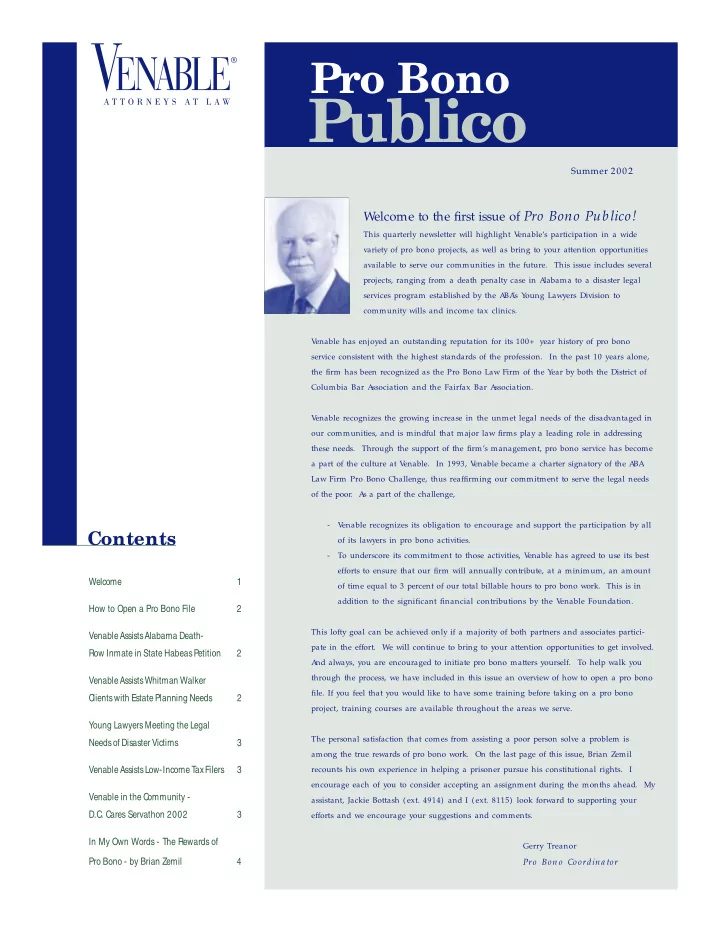
Welcome to the first issue of Pro Bono Publico!

This quarterly newsletter will highlight V enable’s participation in a wide variety of pro bono projects, as well as bring to your attention opportunities available to serve our communities in the future. This issue includes several projects, ranging from a death penalty case in A labama to a disaster legal services program established by the A BA ’s Y

  • ung Lawyers Division to

community wills and income tax clinics. V enable has enjoyed an outstanding reputation for its 100+ year history of pro bono service consistent with the highest standards of the profession. In the past 10 years alone, the firm has been recognized as the Pro Bono Law Firm of the Y ear by both the District of Columbia Bar A ssociation and the Fairfax Bar A ssociation. V enable recognizes the growing increase in the unmet legal needs of the disadvantaged in

  • ur communities, and is mindful that major law firms play a leading role in addressing

these needs. Through the support of the firm’s management, pro bono service has become a part of the culture at V

  • enable. In 1993, V

enable became a charter signatory of the A BA Law Firm Pro Bono Challenge, thus reaffirming our commitment to serve the legal needs

  • f the poor. A

s a part of the challenge,

  • V

enable recognizes its obligation to encourage and support the participation by all

  • f its lawyers in pro bono activities.
  • To underscore its commitment to those activities, V

enable has agreed to use its best efforts to ensure that our firm will annually contribute, at a minimum, an amount

  • f time equal to 3 percent of our total billable hours to pro bono work. This is in

addition to the significant financial contributions by the V enable Foundation. This lofty goal can be achieved only if a majority of both partners and associates partici- pate in the effort. We will continue to bring to your attention opportunities to get involved. A nd always, you are encouraged to initiate pro bono matters yourself. To help walk you through the process, we have included in this issue an overview of how to open a pro bono

  • file. If you feel that you would like to have some training before taking on a pro bono

project, training courses are available throughout the areas we serve. The personal satisfaction that comes from assisting a poor person solve a problem is among the true rewards of pro bono work. On the last page of this issue, Brian Zemil recounts his own experience in helping a prisoner pursue his constitutional rights. I encourage each of you to consider accepting an assignment during the months ahead. My assistant, Jackie Bottash (ext. 4914) and I (ext. 8115) look forward to supporting your efforts and we encourage your suggestions and comments. Gerry Treanor

Pro Bon o Coordin a tor

Welcome 1 How to Open a Pro Bono File 2 Venable Assists Alabama Death- Row Inmate in State Habeas Petition 2 Venable Assists Whitman Walker C lients with Estate Planning Needs 2 Young Lawyers Meeting the Legal Needs of Disaster Victims 3 Venable Assists Low-Income T ax Filers 3 Venable in the C

  • mmunity -

D.C . C ares Servathon 2002 3 In My Own Words - The Rewards of Pro Bono - by Brian Zemil 4

slide-2
SLIDE 2

Pro Bono Publico

Open a Pro Bono File

Opening a pro bono file is no different than

  • pening any other file. A conflicts check is

absolutely necessary even if the possibility of a conflict appears to be less than remote. If you are an associate, you will need to find a responsible, knowledgeable partner willing to serve as the case supervisor. You should speak to our Pro Bono Coordinator, Gerry Treanor, to describe the nature of the representation and get his approval (usually an e-mail or written memo in advance will work wonders to expedite the process). You should make clear that the terms of the representation, such as responsibility for disbursements, have been discussed and approved by the client. The file opening form is the same for billable and pro bono matters. You will need to describe the matter, specify the lawyers, estimate the likely disbursements, and indicate the client’s responsibility for some, all, or none of the disbursements. If these are likely to be significant, be sure to let Gerry know the details. Once filed, the matter will receive the same tri-partite review as do all

  • ther cases. After the file is approved, you

should be sure to send a retainer to the client (if competent) or the client’s guardian/ representative setting forth the terms of the representation. These steps are not materially different from

  • pening billable files. If you have any

questions, feel free to call Gerry Treanor or Jackie Bottash.

How to

Venable Assists Alabama Death-Row Inmate in State Habeas Petition

V enable is representing 25-year-old Frederick Woods, who is currently on death row in Donaldson prison outside of Birmingham, A

  • labama. Mr. Woods was tried and convicted in

A ugust 1997 of murder during a robbery (of a convenience store) that occurred in September

  • 1996. A

fter a jury recommendation of death rather than life without parole by a vote of 10 to 2,

  • Mr. Woods was sentenced to death. He unsuccessfully appealed to the A

labama Court of Criminal A ppeals, the A labama Supreme Court, and his petition for certiorari to the United States Supreme Court was denied October 1, 2001. A labama, unlike many other states, does not provide counsel to indigent, death-row defendants after they have concluded their direct

  • appeals. So like approximately 30 other death row inmates in A

labama, Mr. W

  • ods did not

have a lawyer to help him pursue his additional post-conviction, habeas corpus remedies. The V enable team includes partner Jerry Block, associates Damon Wright, Brian Flack, Julia Kiraly and Ron Jacobs, and paralegal Claudia Reyes. The team is currently reviewing and researching the trial record, conducting additional investigation, and preparing a Rule 32 petition (a state habeas corpus petition) to be filed with the trial court in St. Clair County , in A shville, A labama in July . The petition will raise issues and allege errors that occurred both in the guilt phase and the penalty phase of the trial. V enable took on the matter after being approached by the A merican Bar A ssociation Death Penalty Project, and the Equal Justice Initiative headquartered in Montgomery , A labama.

Venable Assists Whitman Walker Wills Clients with Estate Planning Needs

The Whitman Walker Clinic, Inc. offers a myriad of legal services to persons who are HIV

  • positive. One of the services offered is a wills clinic. Eligible individuals can come to the clinic

and receive free advice about estate planning. Lawyers from the Washington, D.C. area meet with clients and usually draft wills, durable financial powers of attorney , durable health care powers of attorney and living wills. Clients also receive planning advice about life insurance, retirement assets and guardianship of children. For many clients, the issue of who will care for surviving children is pressing. Each Monday night, up to four clients are scheduled for the wills clinic, which meets at 1701 14th Street, N.W . Several law firms in Washington, D.C. have a standing commitment to staff several Monday night clinics. In 2002, V enable committed to staff two clinics in A

  • pril. V

enable associates Jeanne Newlon, Molly Delea, Jackie McCarthy and Gilda Zimmet volunteered at the clinics and are currently completing estate plans for several clients. Our plan is to increase our participation by staffing additional clinics. In addition, we often receive requests from Whitman Walker to do hospital or home visits. In these cases, the clients are too ill to come to a clinic. A volunteer lawyer meets with the client at their home or hospital to discuss their estate planning needs. Y

  • u do not need to practice in the estates and trusts area to participate in the wills clinic. The
  • pportunity is wonderful for anyone, especially for business lawyers who may not be interested

2

con tin u ed

Members of Venable’s Pro Bono Committee:

Gerard Treanor, Lars Anderson, Shannon Bloodworth, Jacqueline Bottash, Rosemary Dailey, Kathleen Dolan, Sarah Gudsnuk, Elaine Clark Jones, Julia Kiraly, Brock Landry, Mitchell Mirviss, Kali Murray, Otho Thompson, Meg Watkins, Brian Zemil, and Gilda Zimmet.

slide-3
SLIDE 3

Continued from pa ge 2

in a case involving court appearances. Whitman Walker provides in-house training and supervision to anyone who is interested in participating. In addition, Whitman Walker has a V

  • lunteer A

ttorney Practice Manual. A s one client put it, “the ability to write a will gives me peace of mind and a sense of control.” Our clients from Whitman Walker are appreciative of our work and the need for volunteers is great. Please contact Gilda Zimmet if you are interested in participating in the wills clinic or if you are willing to take a direct referral.

Y

  • ung Lawyers Meeting the Legal Needs of Disaster Victims

A s the 8th District Representative to the A merican Bar A ssociation’s Y

  • ung Lawyers Division,

Kathleen Dolan has been coordinating the Disaster Legal Services Program for Maryland and V irginia for the past nine months. The Disaster Legal Services Program results from an agreement between FEMA ( Federal Emergency Management A gency) and the A BA /

  • YLD. Pursuant to the

agreement, the YLD agrees to mobilize local lawyers to render volunteer legal services to disaster victims when requested by the FEMA Regional Director. A BA / YLD District Representatives organize volunteer lawyers in each state in their district and coordinate several aspects of the disaster legal services, including training volunteers, establishing the hotline for legal services, and coordinating volunteers to handle calls from victims. Unfortu- nately , the past nine months have seen several FEMA disasters and the legal services hotline has been in constant operation. Following the tragic events of September 11th, V irginia activated its hotline for disaster legal services and the volunteer lawyers helped families of victims from all over the state. A number of V enable personnel were essential during this time, including Brian Zemil, Theo Ogune, and Janice Toepper. Invaluable support also came from many D.C. associates, a number of whom attended the disaster legal services training. In the aftermath of the tornado that hit southern Maryland, the MSB/ YLS has been working with the Charles County Bar to coordinate young lawyers for the disaster legal services hotline. V irginia has felt the effects of both tornadoes and flooding in the southwestern parts, particularly in Norton, Wise County , Buchanan County and Tazewell. The V irginia hotline was activated to assist these victims, and volunteers from across the state have been handling calls. V ictims calling the hotline request legal assistance on a variety of issues including insurance claims, lost documents, landlord/ tenant rights, probate, and federal disaster benefits. The disaster legal services provided by young lawyers fills a much needed service to the victims and its continued success is due to the volunteer spirit of young lawyers.

Venable Assists Low-Income Tax Filers

This year seven V enable lawyers and one paralegal ( including several CPA s among them) volunteered for Maryland V

  • lunteer Lawyers Service’s annual income tax clinic that is jointly

sponsored by the Tax Section of the Maryland State Bar A

  • ssociation. 190 returns for low-income

taxpayers were prepared on four Saturdays in February . Many of the clients qualified for the earned income credit and other federal and state tax credits. The average earned income credit was $1,004, and the average refund was $2,157. V enable volunteers included: Neal Borden, Walter Calvert, Douglas Coats, Jeff Haines, Jane Obaza, V asilios Peros, Jennifer Pratt, and Gilda Zimmet.

V V V V Venable in the Community - enable in the Community - enable in the Community - enable in the Community - enable in the Community - D.C. Cares Servathon 2002 D.C. Cares Servathon 2002 D.C. Cares Servathon 2002 D.C. Cares Servathon 2002 D.C. Cares Servathon 2002

We did it! Servathon 2002 (rain, included) was a success and Venable was there! If you’re in to statistics, you’ll love this!

  • $290,000 raised to

support D.C . C ares

  • 2,600 volunteers
  • 29 community

service organizations supported

  • 29 tons of mulch
  • 503 gallons of paint
  • 689 9" roller cages
  • 309 shovels
  • 275 rolls of masking tape
  • 620 pieces of lumber

all used to beautify our Nation’s C apital! Venable volunteers Jackie Bottash, Meg Watkins, C hellis Neal-González and C hellis’ husband and brother-in-law put their bodies where their hearts are and provided service that will continue to be real and meaningful for our community with great style and strength. The Venable’s Fab Five toiled in the rain and through clearing skies to build flower boxes along Linden Place and H Street, NE on May 18 all in the name of beautifying the city. And boy were they All Stars! Victor González (C hellis’ husband) and his brother both do landscaping for a living, so with the aid of Jackie, Meg, and C hellis, they lapped the field when it came to completing their projects! Flowerbeds were cleared of weeds and debris, flower boxes built, and flowers planted. The block of H Street, NE between 12

th and 13 th Streets have been given

a face lift and the residents are most appreciative

  • f the work. Many stopped the crew to ask what

they were doing and why, and were touched that anyone would come to their neighborhood just to make it look better, much less non- resident volunteers! The day was rewarding for all and we left with the hope that the flowers would grow and next year we share the experience with even more of Venable’s best!

Pro Bono Publico

3

slide-4
SLIDE 4

In My Own Words — The Rewards of Pro Bono

by Bria n Zem il

Over three years ago, Ted Roberts approached me to try

, on a pro bono basis, a prisoner’s rights excessive force case. Without hesitation, I accepted the case primarily because it presented the opportunity to sharpen my litigation skills in federal court. Then, I learned the facts of the case. On January 11, 1994, Mr. Jackson, an inmate securely locked in his cell at the Maryland Correctional A djustment Center (MCA C), was sprayed with 12 bursts of mace by the MCA C officers donning riot gear and gas masks. Mr. Jackson was subsequently shackled and taken to a sink where he was inadequately decontaminated from the mace, even though it had covered his entire body . While en route to the sink, Mr. Jackson, fully secured in chains and surrounded by eight officers, was assaulted by an officer from behind. Ultimately , the officers stripped Mr. Jackson down to his underwear and locked him in an isolation cell, in painfully tight shackles, for 44 hours. (The shackles were three-piece mechanical restraints consisting

  • f leg irons, a waist chain, handcuffs, that go through the waist chain, and a black box that covers the locking mechanism of the cuffs.) The isolation cell

was a barren, cold, feces-encrusted concrete chamber with no toilet, bed, blankets, or running water. The officers withheld food from Mr. Jackson for 16

  • hours. Moreover, over the two-day period of his confinement, Mr. Jackson could not eat and was forced to urinate on himself because the shackles were

applied so tightly that he could not sufficiently maneuver his arms. Over five days of trial, the jury heard Mr. Jackson’s story to support his Eighth A mendment right to be free from cruel and unusual punish-

  • ment. The jury also heard from a nationally recognized expert ( paid for by the court) who explained with exactness the severity of the force

and pain inflicted upon Mr. Jackson. The jury returned a verdict in favor of Mr. Jackson. The jury specifically found that Mr. Jackson’s constitutional rights were violated by the use of excessive force by the officers. Mr. Jackson was awarded compensatory and punitive damages. The jury , on its own initiative, requested and received permission from the court and parties to read a statement they had unanimously prepared in conjunction with the verdict. The statement, read by the jury foreperson, condemned the conditions at MCA C, in particular its isolation cell, as “of a sort repugnant to the conscience of mankind.” Never before had I experienced a jury expressing its justice in such terms. What began as an opportunity to build upon my litigation skills turned into a sense of gratitude for the chance to participate in the process of championing a constitutional right. Shortly after the verdict and post-trial motions, the trial judge confirmed the obvious and upheld the jury verdict. The “process” had just begun. The officers appealed to the Fourth Circuit, arguing, among other things, that the trial court erred in finding that there was sufficient evidence to support the jury’s conclusion that the officers’ use of force upon Mr. Jackson constituted cruel and unusual punishment. I enlisted Mitchell Mirviss to help with the appeal. Together, with Ted Roberts, we presented a strong opposition to the state’s papers. I was proud of the work. I argued before a three-judge panel in Richmond. Judge Wilkinson bombarded me with questions for over 45 minutes (I thought I only had to last 20). Judge Motz and a visiting judge were less confrontational and seemed to support Mr. Jackson’s position. The Fourth Circuit, in a 2-1 decision, reversed the jury’s verdict and called its statement “gratuitous.” The majority’s decision to reverse the jury verdict was based solely on the ground that Mr. Jackson failed to offer sufficient evidence that he suffered more than de m inim is pain or injury in his excessive force claim. Judge Motz’s dissent concluded that “despite the majority’s efforts to recast the evidence, a reasonable jury could certainly have found that the evidence offered of 44 hours of pain and inhuman treatment demonstrated an impermissible infliction of pain resulting in greater than de m inim is injury.” The opinion was noticed by local and national news organizations including 60 Minutes II. Mr. Jackson wanted to know what could we do now . I learned a lot about the United States Supreme Court in Con Law . But, I never learned how to draft a petition for certiorari to the Supreme Court. So, I enlisted Mitchell, again, and John Cooney to guide Ted and me through the labyrinth of Supreme Court practice. A fter painstaking research, we discovered that the Court of A ppeals’ decision in Mr. Jackson’s case highlighted an ongoing and longstanding split in the circuit courts as to whether the Supreme Court requires an inmate to plead and prove more than de m inim is pain or injury to sustain an Eighth A mendment claim. This appeared to be a textbook case for review . Moreover, the Court was commenting that it needed to examine prisoner rights cases more closely . We filed the petition. I was proud of the work. The Supreme Court denied the petition. A lthough the result was difficult to accept, the experience has been and remains extraordinary . From trial through appeal, I was part of a process that ignited a sense of excitement, fulfillment and gratitude. The pro bono experience can do that.

Pro Bono Publico

4