LA IMPORTANCIA DE LAS ASOCIACIONES PUBLICO PRIVADAS EN EL DESARROLLO - - PowerPoint PPT Presentation

la importancia de las asociaciones publico privadas en el
SMART_READER_LITE
LIVE PREVIEW

LA IMPORTANCIA DE LAS ASOCIACIONES PUBLICO PRIVADAS EN EL DESARROLLO - - PowerPoint PPT Presentation

LA IMPORTANCIA DE LAS ASOCIACIONES PUBLICO PRIVADAS EN EL DESARROLLO PORTUARIO XXXIX REPICA, JULY 25-28, 2017, BELIZE CITY, BELIZE Jorge Durn Chief of the Secretariat Inter-American Committee on Ports (CIP) #OAS_CIP #OEA_CIP


slide-1
SLIDE 1

LA IMPORTANCIA DE LAS ASOCIACIONES PUBLICO PRIVADAS EN EL DESARROLLO PORTUARIO

#OAS_CIP #OEA_CIP www.portalcip.org

Jorge Durán Chief of the Secretariat Inter-American Committee on Ports (CIP) jduran@oas.org
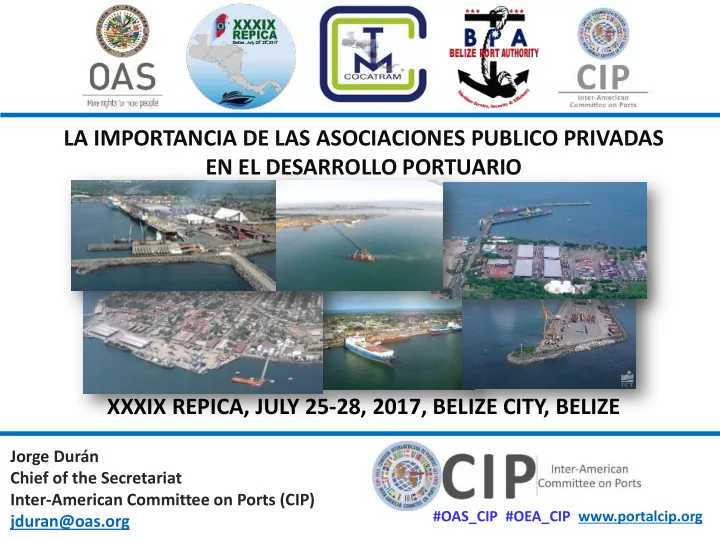
XXXIX REPICA, JULY 25-28, 2017, BELIZE CITY, BELIZE

slide-2
SLIDE 2

Member States

1. Antigua and Barbuda 2. Argentina 3. Bahamas 4. Barbados 5. Belize 6. Bolivia 7. Brazil 8. Canada 9. Chile

  • 10. Colombia
  • 11. Costa Rica
  • 12. Cuba
  • 13. Dominica
  • 14. Ecuador
  • 15. El Salvador
  • 16. Grenada
  • 17. Guatemala
  • 18. Guyana
  • 19. Haiti
  • 20. Honduras
  • 21. Jamaica
  • 22. Mexico
  • 23. Nicaragua
  • 24. Panama
  • 25. Paraguay
  • 26. Peru
  • 27. Dominican Republic
  • 28. St. Kitts and Nevis
  • 29. St. Vincent and the

Grenadines

  • 30. St. Lucia
  • 31. Suriname
  • 32. Trinidad and Tobago
  • 33. United States
  • 34. Uruguay
  • 35. Venezuela

National Port Authorities

slide-3
SLIDE 3

United States

CIP IP Structure

Mexico Barbados Uruguay

CIP Secretariat

Panama Mexico Peru Uruguay Argentina Public Policy, Legislation and Regulation CSR, Gender Equality and Empowerment

  • f Women

Port Protection and Security Sustainable Port Management and Environmental Protection Logistics, Innovation and Competitiveness Tourism, Inland Ports and Waterways, Ship Services and Navigation Safety

CIP Structure

slide-4
SLIDE 4

Inter-American Committee on Ports(CIP)

1.

l

  • Only permanent inter-governmental forum at the highest

level to promote the development of the maritime sector in the region.

2.

C

  • Promote and improve management and technical

capabilities of port officials.

3.

A

  • Assist Member States on issues or specific projects upon

request.

4.

P

  • Promote win - win partnerships with private sector in the

maritime industry to develop projects. Political Dialogue Capacity Building Technical Assistance Active Collaboration with the Private Sector

slide-5
SLIDE 5

Associate Members

slide-6
SLIDE 6

Strategic Partners

slide-7
SLIDE 7

Competitiveness

In Ports, what is Competitiveness? It is determined by the cost, speed and efficiency of each one

  • f the factors and processes that are used by trading in the

logistics corridor.

slide-8
SLIDE 8

Member States

“Competitiveness is the set of institutions, policies and factors that determine the level of productivity of a country”.

102 83 79 88 80 93 127 100 115 113 80 90

20 40 60 80 100 120 140

Institutions Infrastructure Macroeconomic Environment Health and Primary Education Training and Higher Education Goods Market efficiency Labor Market Efficiency Financial Market Development Technology Readiness Market Size Business Sophistication Innovation

Source: WEF Competitiveness Index 2015–2016

slide-9
SLIDE 9

Global Competitiveness Map 2016-2017

Source: WEF Competitiveness Index 2016–2017

slide-10
SLIDE 10

Country LPI Ranking

Germany 1 USA 10 Canada 14 Panama 40 El Salvador 83 Costa Rica 89 Nicaragua 102 Guatemala 111 Honduras 112 Bahamas 78

Source: World Bank, 2016

The LPI analyzes 160 Countries in areas such as Customs, Infrastructure, Logistics Competence, International Shipments, among others.

Global Logistic Performance 2016

slide-11
SLIDE 11

Source: World Bank, 2016

Country Quality Panama 6.3 USA 5.7 Canada 5.5 Honduras 4.6 El Salvador 4 Guatemala 3.9 Costa Rica 3.1 Nicaragua 2.8

Port Infrastructure Quality 2016

slide-12
SLIDE 12

Source: ECLAC

#1 Santos: 3. 64 #2 Colon: 3.57 #3 Balboa: 3.29 #4 Cartagena: 2.60 #5 Manzanillo: 2.45

Millions of TEUs

Port Ranking in Latin America and the Caribbean

slide-13
SLIDE 13

Vessel Design: Capacity: 14.000 TEU Tonnage: 157.000 DWT Total Longitude: 365.8 m Bao: 48.8 m Draft: 15.2 m

However , vessels of 16, 18 and 20 thousand TEUs do not fit

Panama Canal Expansion

slide-14
SLIDE 14

Infrascope 2017

  • Infrascope measures a

country’s ability to mobilize private investment in infrastructure through PPPs.

slide-15
SLIDE 15

Privatization of the Kingston Container Terminal

Concession Agreement Project Funding

  • High cost to optimize and expand the KCT and dredge the navigation channel.
  • Expansion plans by competitors; investment needed to maintain and grow

business.

  • Other developments in the International Shipping Industry.
slide-16
SLIDE 16

Privatization of the Kingston Container Terminal

The Outcome – Win Win

slide-17
SLIDE 17

Privatization of the Kingston Container Terminal

Jamaica investing US$ 660 million to become a Regional Logistic Hub

slide-18
SLIDE 18

Mexico National Infrastructure Program

52 Highways 80 Roads 3 Passenger Trains 1 New Airport in CDMX 25 Port Projects 1 Telecom Network

~83

Billions USD

slide-19
SLIDE 19

Mexico National Infrastructure Program

The Program consider 25 port expansion/improvement projects with an investment

  • f more than 62 billion Mexican Pesos (USD $ 3.7 billion).

Investment in the National Infrastructure Program

(by type of investment in millions of Mexican Pesos)

[VALUE] [VALUE] [VALUE]

Investment

Private Sector (75%) Fiscal Resources (13%) Own Resources (12%)

slide-20
SLIDE 20

Mexico National Infrastructure Program

Lázaro Cárdenas Manzanillo

Puerto Vallarta Tampico Salina Cruz Seybaplaya* Isla del Carmen* Coatzacoalcos

Tuxpan

Topolobampo Ensenada Guaymas Mazatlán

Altamira

Matamoros*

Veracruz

Puerto Chiapas Dos Bocas

2.62 62 6.37 37 7.11 11

26.60 42.34 44.77

5.82 82 13.6 .69 18.8 .88 6.92 92 12.3 .36 17.5 .55 5.39 39 12.8 .89 9 18.8 .81 3.27 27 8.72 72 12.1 .16

29.1 .10 0 38.0 .09 9 47.4 .49

10.6 .66 17.1 .11 22.4 .42 0.56 56 1.43 43 3.03 03

15.2 .21 1 26.1 .17 36.2 .26 12.1 .17 7 24.7 .76 31.8 .88 20.8 .89 9 30.2 .26 46.0 .03

30.7 .71 45.8 .86 56.2 .24 4 8.16 16 27.8 .80 45.65 .65 3.86 86 7.14 14 8.72 72

slide-21
SLIDE 21

Other PPPs Samples

Costa Rica: Concession Agreement for Moin Container Terminal

  • Concession agreement for the design, planning,

financing, building, exploitation and maintenance of the new Puerto Moín Container Terminal in Costa Rica.

  • The project involves the Government of Costa Rica,

APM Terminals Moín S.A. and APM Terminals Central America B.V.

Honduras: Puerto Cortés Container and Cargo Terminal

  • Management Trust Agreement for the Structuring,

Development and Financing of the Operation of the Puerto Cortés Container and Cargo Terminal between the Comisión para la Promoción de Alianzas Públicas- Privadas (COALIANZA), Empresa Nacional Portuaria (National Port Company) and Banco Financiera Comercial Hondurena S.A. (FICOHSA BANK).

Honduras: Puerto Cortés Bulk Cargo Terminal

  • Management Trust Agreement for the Structuring,

Development and Financing of the Operation of the Puerto Cortés Container and Cargo Terminal between the Comisión para la Promoción de Alianzas Públicas- Privadas (COALIANZA), Empresa Nacional Portuaria (National Port Company) and Banco Atlantida S.A.

Source: World Bank, 2016

slide-22
SLIDE 22

Port Community System/ Single Window

Cyber Security risk at each step/Institution due to more Automated Processes

slide-23
SLIDE 23

Final Considerations

  • The private sector is the main catalyst for change. Treat the private

sector as a partner: private sector are the solutions.

  • PPPs critical for sustainable development.
  • Cooperation is essential for progress.
  • Countries should consider:
  • A coherent PPP policy with directions, responsibilities and goals;
  • Strong enabling institutions;
  • Legal Framework;
  • Cooperative risk sharing and mutual support. Focus on a concrete

deliverables that is in everyone's interest, a Win – Win partnership;

  • A confident investment and business climate.
  • More transparency and accountability in the development PPPs.
  • Developing strong, well-functioning maritime transport infrastructure is

a key element of economic growth.

  • Public-private partnerships (PPPs) in ports have become a means to

manage port operations more effectively.

slide-24
SLIDE 24

Jorge Durán

Chief of the Secretariat Inter-American Committee on Ports (CIP)

jduran@oas.org

Inter-American Committee on Ports (CIP) #OAS_CIP www.portalcip.org

Thank You!