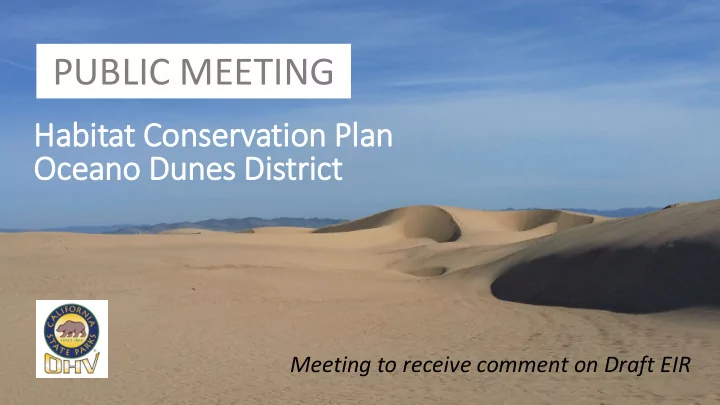
PUBLIC MEETING Habi abitat Co Conse nservation Plan Oc Ocean - - PowerPoint PPT Presentation

public meeting
SMART_READER_LITE
LIVE PREVIEW

PUBLIC MEETING Habi abitat Co Conse nservation Plan Oc Ocean - - PowerPoint PPT Presentation

PUBLIC MEETING Habi abitat Co Conse nservation Plan Oc Ocean eano Dun unes D s District ct Meeting to receive comment on Draft EIR Meeting ng A Agenda Welcome! Welcome Meeting Purpose Meeting Verbal Comments on Presentation


slide-1
SLIDE 1

PUBLIC MEETING

Habi abitat Co Conse nservation Plan Oc Ocean eano Dun unes D s District ct

Meeting to receive comment on Draft EIR

slide-2
SLIDE 2

Meeting ng A Agenda

Welcome!

Welcome Meeting Purpose Meeting Presentation Verbal Comments on Draft EIR

slide-3
SLIDE 3

Online M Meeting F Format

  • Video and audio will be muted during the meeting.
  • During the presentation, you have the opportunity to submit

clarifying questions to “MIG – QUESTIONS”.

  • Chat is only visible to the Host
  • Instructions will be provided at the end of the presentation on

how to provide public comment.

slide-4
SLIDE 4

How to U

  • Use C

e Chat

Chat: Address clarifying questions to “MIG – Questions” Audio: Participant voice and video will be muted. Presentation

slide-5
SLIDE 5

Introduc uctions ns

Paula Hartman Principal Kate Werner Project Manager Joan Chaplick Senior Facilitator Ronnie Glick Senior Environmental Scientist Dan Canfield Park and Recreation Specialist

slide-6
SLIDE 6

Meeting Purpose

slide-7
SLIDE 7

Meeting ng P Purpose se

  • Present overview of the HCP
  • Present conclusions of Draft EIR
  • Provide opportunity for verbal

comment to be received

  • Provide direction on submittal
  • f written comments
slide-8
SLIDE 8

HCP and S State P Park M Mission

How does HCP fit in with State Park’s mission?

To provide for the health, inspiration, and education of the people of California by helping to preserve the state’s extraordinary biological diversity, protecting its most valued natural and cultural resources, and creating opportunities for high-quality recreation.

slide-9
SLIDE 9

Ocean ano Du Dunes Di District

  • Natural Resources
  • Diversity of biological resources
  • Conservation beginning 1991
  • Cultural Resources
  • Multiple areas of high sensitivity
  • Coastal Dependent Activity
  • Non-vehicle recreation activities (e.g.,

pedestrian, equestrian, surfing, kite- boarding, etc.)

  • Beach and coastal dune camping
  • Beach and coastal dune vehicle recreation

District Context

  • 2 million visitors every year
  • Pismo State Beach is 1 of 62 state

beaches (6% of total acreage)

  • Oceano Dunes SVRA is 1 of 9 SVRAs

(2.5% of total acreage)

  • Oceano Dunes SVRA is only SVRA in

beach location a

slide-10
SLIDE 10

Three P Planning E Efforts – One ne HC HCP

Three separate planning efforts are currently underway:

  • HCP – Conservation plan supports the application for an

Incidental Take Permit required by the federal Endangered Species Act

  • Public Works Plan (PWP) – Comprehensive, long-range land

use management plan to comply with the California Coastal Act

  • Particulate Matter Reduction Plan (PMRP) – Dust control and

monitoring measures supporting compliance with the SLOAPCD Stipulated Order of Abatement

slide-11
SLIDE 11

Status of

  • f Draft H

HCP a and N NEPA R Revie iew

  • Joint scoping period held with USFWS in 2018
  • Separation of NEPA analysis from CEQA EIR
  • USFWS still reviewing HCP and preparing separate EA
  • Separate opportunity for public comment on EA
  • Estimate release of EA in Summer 2020
slide-12
SLIDE 12

Habitat Conservation Plan

slide-13
SLIDE 13

HC HCP O Overview

  • Conservation plan required as part of an application

for an “incidental” take permit, i.e., a permit allowing take caused by otherwise lawful activities.

(Federal Endangered Species Act, Section 10(a))

  • “Take” includes actions that harass, harm, pursue,

wound, kill, etc. listed species.

(Federal Endangered Species Act, Section 3)

slide-14
SLIDE 14

HC HCP G Goals

  • Ensure habitat-level protection and management
  • Minimize human-related impacts to covered species
  • Enhance survival and recovery of the covered species
  • Meet resource management objectives
slide-15
SLIDE 15

Cover ered P Park Un Units ts

HCP Area = 5,005 acres

Pismo State Beach

  • 1,515 acres natural and

developed

  • Pismo Dunes Natural Preserve

694-acre sub-unit

  • 70 acres Pismo Lake

Oceano Dunes SVRA

  • 3,490 acres
slide-16
SLIDE 16

Cov

  • vered

ed S Species es

Western snowy plover (FT) California red-legged frog (FT)

California least tern (FE, SE, SP)

Tidewater goby (FE)

slide-17
SLIDE 17

Cov

  • vered

ed S Species es

John Game 2014

Beach spectaclepod (ST)

CNPS San Luis Chapter 2011

Marsh sandwort (FE, SE)

Chris Winchell 2011

La Graciosa thistle (FE, ST)

CNPS 1984

Surf thistle (ST)

Dieter Wilken 2005

Nipomo Mesa lupine (FE, SE)

Chris Winchell 2010

Gambel’s watercress (FE, ST)

slide-18
SLIDE 18

Cov

  • vered

ed A Activities es

  • Park Visitor Activities
  • Natural Resource Management
  • Park Maintenance
  • Visitor Services
  • Other Activities

e.g., creek crossings, exclosure adjustments, dust control, and special projects

slide-19
SLIDE 19

Park V Visitor

  • r A

Activi viti ties es

CA-1: Motorized recreation CA-2: Camping CA-3: Pedestrian activities CA-4: Bicycling and golfing CA-5: Fishing CA-6: Dog walking (on leash only) CA-7: Equestrian recreation CA-8: Boating/surfing CA-9: Aerial/wind-driven activities, including kiteboarding CA-10: Holidays CA-11: Special events

slide-20
SLIDE 20

Natu tural R Resou

  • urces

ces M Managemen ent

CA-12a: SNPL/CLTE habitat protections/fencing CA-12b: SNPL/CLTE monitoring and management including ongoing programs CA-13: Tidewater goby and salmonid surveys CA-14: CRLF surveys and associated management CA-15: Listed plant management CA-16: Habitat restoration program CA-17: Invasive plant and animal control CA-18: Habitat Monitoring System (HMS) implementation CA-19: Water quality monitoring projects

slide-21
SLIDE 21

Park M Mainten enance ce

CA-20: Campground maintenance CA-21: General facilities maintenance CA-22: Trash control CA-23: Wind fencing installation, maintenance, and removal CA-24: Sand ramp and

  • ther vehicular access

maintenance CA-25: Street sweeping CA-26: Routine riparian maintenance

slide-22
SLIDE 22

Park M Mainten enance ce

CA-27: Perimeter and vegetation island fence installation, maintenance, and removal CA-28: Cable fence maintenance and replacement CA-29: Heavy equipment response in all areas of Oceano Dunes District CA-30: Minor grading (i.e., less than 50 cubic yards) CA-31: Boardwalk and other pedestrian access maintenance

slide-23
SLIDE 23

Vi Visitor

  • r S

Servi vices ces

CA-32: Ranger, lifeguard, and park aide patrols CA-33: Emergency response by CDPR staff CA-34: Access by non-CDPR vehicles CA-35: American Safety Institute (ASI) courses CA-36: Beach concessions CA-37: Pismo Beach Golf Course

  • perations

CA-38: Grover Beach Lodge and Conference Center CA-39: Natural history and interpretation programs

slide-24
SLIDE 24

Ot Other er H HCP C Cover ered ed Ac Activi viti ties es

CA-40: Motorized vehicle crossing of Pismo/Carpenter, Arroyo Grande, and Oso Flaco creeks CA-41: Pismo Creek estuary seasonal (floating) bridge CA-42: Riding in 40 Acres CA-43: Replacement of the Safety and Education Center CA-44: Dust control activities CA-45: Cultural resources management CA-46: CDPR management of agricultural lands CA-47: Maintenance of a bioreactor on agricultural lands CA-48: Oso Flaco Lake boardwalk replacement CA-49: Special projects CA-50: Reduction of the Boneyard and 6 exclosures CA-51: Use of pesticides CA-52: CDPR UAS use for park activities

slide-25
SLIDE 25

Conser ervati tion

  • n P

Program

Key Elements:

  • Built on 20+ years of survey data
  • Includes Avoidance and Minimization Measures
  • Utilizes adaptive management
  • Identifies permit take limits
  • Commitment to secure funding for 25-year permit

term

slide-26
SLIDE 26

Population Da Data – Snow

  • wy P

Plov

  • ver

er

Number of breeding adult snowy plovers in the HCP area from 2004-2019 with Recovery Plan management target

slide-27
SLIDE 27

Population Da Data – Lea Least T t Ter ern

Number of least tern juveniles produced in the HCP area and reference sites from 2004-2019

slide-28
SLIDE 28

HC HCP Avoidanc ance a and M Minimization M Measures

407 Distinct AMMs

slide-29
SLIDE 29

Examp mple o

  • f AMMs

MMs

Avoidance and Minimization Measures (AMMs) for Snowy Plover Park Visitor Activities: Motorized recreation (CA-1)

Potential Effects: Adults/juveniles/chicks struck by vehicles; Breeding/foraging/roosting disturbance; Chicks separated from adult(s) and inadequately attended or exposed to predation/inclement weather; Eggs buried by sand, exposed to predation, or not properly incubated when adults are disturbed; Chicks/eggs abandoned when adults are disturbed, killed, or injured; Eggs crushed

AMM 24 CDPR peace officers will continue to provide focused enforcement of HCP area regulations (e.g., 15-mph speed limits). CDPR peace officers will continue to respond to requests by monitors for assistance with SNPL protection and security. Enforcement of laws affecting safety of SNPL will continue to be the highest non- emergency Law Enforcement priority.

slide-30
SLIDE 30

Take P Per ermit it R Req equest

  • Take numbers broadly split into categories
  • Park operations, recreation, and other non-covered species

management

  • Covered species management
  • Take numbers quantified as follows (HCP Tables 4-1 – 4-6):
  • Snowy plover and least tern: 1- and 5-year limits
  • Red-legged frog: annual and 25-year limits for aquatic and upland

habitat

  • Tidewater goby: annual survey numbers + 5-year and 25-year take

limits

slide-31
SLIDE 31

Program am F Funding

  • What d

does

  • es i

it t cos

  • st?

Estimated Annual Cost Estimated Cost

  • ver 25-year Life of HCP

$79,600,000 to $90,600,000

slide-32
SLIDE 32

Draft Environmental Impact Report

slide-33
SLIDE 33

Scop

  • pe of
  • f Analy

lysis is

Existing Activities (Baseline Conditions)

  • Park Visitor Activities (11 CAs)
  • Natural Resources Management (8 CAs)
  • Park Maintenance (12 CAs)
  • Visitor Services (7 CAs)
  • Other Activities (6 CAs)

Environmental review (CEQA) not required for existing activities

slide-34
SLIDE 34

Scop

  • pe of
  • f Analy

lysis is c con

  • ntin

inued

Potential Future Activities

  • SNPL Adult Banding (CA-12-b)
  • Listed Plant Propagation and

Outplanting (CA-15)

  • Cable Fence Replacement (CA-28)
  • Grover Beach Lodge (CA-38)
  • Pismo Creek Estuary Seasonal

(Floating) Bridge (CA-41)

  • Riding in “40 Acres” (CA-42)
  • Safety and Education Center

Replacement (CA-43)

  • Dust Control Activities –New

PMRP (CA-44)

  • Oso Flaco Lake Boardwalk

Replacement (CA-48)

  • Special Projects (CA-49)

Potential future activities considered in EIR cumulative analysis

slide-35
SLIDE 35

Scop

  • pe of
  • f Analy

lysis is c con

  • ntin

inued

Proposed New Activities

  • Plover chicks and eggs captive

rearing (CA-12b)

  • Mechanical trash removal (CA-21)
  • Reduction of Seasonal Exclosures

(CA-50)

  • CDPR use of unmanned aircraft

systems (CA-52)

Proposed new activities subject to CEQA review in HCP EIR

slide-36
SLIDE 36

Scop

  • pe of
  • f Analy

lysis is c con

  • ntin

inued

Seasonal Exclosure Changes (CA-50)

  • Elimination of East Boneyard Exclosure (49 acres)
  • Phased reduction 6 Exclosure (up to 60 acres)

Criteria for Reducing 6 Exclosure

  • Breeding SNPL population size ≥ 155 for 3 consecutive years,

including the year before the 6 Exclosure is reduced in size

  • SNPL fledge rate ≥ 1.0 fledglings per male for same 3 consecutive

years, including the year before the 6 Exclosure is reduced in size

  • Breeding CLTE population size ≥ a 5-year running average of 35

nesting pairs, including the year before the 6 Exclosure is reduced in size.

  • CLTE fledge rate averages ≥ 1.0 fledglings per pair over the same 5

consecutive years, including the year before the 6 Exclosure is reduced in size.

  • Operational criteria
slide-37
SLIDE 37

Envir ironmental I l Impact ct Analy lysis is

  • Land Use
  • Air Quality
  • Biological Resources
  • Cultural/Tribal Resources
  • Recreation/Public Access
slide-38
SLIDE 38

Analy lysis is C Conclu lusio ions

  • Land Use: No significant changes
  • Air Quality: Potential dust increases offset by mitigation
  • Biological Resources: AMMs sufficient to avoid significant effects
  • Cultural and Tribal Resources: No significant impact
  • Recreation and Public Access: Increased opportunity on 109 acres
slide-39
SLIDE 39

Proj

  • ject

ect Al Alter ernati tives es

Considered and Rejected Alternatives

  • No Take park operations
  • Off-site mitigation in lieu of nesting

exclosures

  • Changes in SVRA access
  • Restricted riding times
  • Increased vehicle limits
slide-40
SLIDE 40

Proj

  • ject

ect Al Alter ernati tives es

  • Alternatives Considered in Detail
  • No Project Alternative
  • Reduced Disturbance in High PM10 Emissivity Areas
  • Permanent Year-Round Exclosures
  • Reduced Vehicle Limits
  • Environmentally Superior Alternative
slide-41
SLIDE 41

CEQA P Proces

  • cess
  • Adopts findings on feasibility of reducing or

avoiding significant environmental effects

Public input

State Parks determines HCP is a “project” under CEQA and has potential for significant impacts Scoping Period: Public input on scope of EIR (60 days)

  • State Parks prepares Draft EIR

Review Period: public/agency review and comment on Draft HCP and Draft EIR (98 days)

You Are Here

Public input

State Parks responds to comments and prepares Final EIR State Parks: Considers and certifies final EIR Adopts Mitigation Monitoring and Reporting Plan Agency Decision File Notice of Determination

slide-42
SLIDE 42

Status of

  • f Draft H

HCP a and T Take P Per ermit it

  • USFWS still reviewing HCP and preparing separate EA
  • USFWS release of Draft HCP and EA in Summer 2020
  • 45-day public review
  • Estimated Take Permit issuance Early 2021
slide-43
SLIDE 43

Clarifying Questions

slide-44
SLIDE 44

Public Comment

slide-45
SLIDE 45

Public Comme ment

Per CEQA Guidelines, State Parks is required to respond to any significant environmental issues raised Examples:

  • Adequacy of EIR in identifying significant environmental effects of

proposed new activities

  • Ways environmental impacts can be avoided or significantly reduced
  • Changes in project through the use of alternatives or mitigation

measures

slide-46
SLIDE 46

Ver erbal P l Publi lic C c Com

  • mment I

Instr truct ctio ions

  • Send your full name to “Joan Chaplick – Public Comment”
  • If you are using your phone for the audio, please provide your phone

number so we can unmute you when it is time to speak

  • Chat is only visible to the Host
  • Moderator will call out names in groups of 3 so you know if your turn

is coming up

  • Each speaker will get up to 2 minutes for their comments
slide-47
SLIDE 47

How to U

  • Use C

e Chat

Chat: Will act like a speaker card, participants who want to make public

  • comment. Please type in

your name and

  • rganization (if any).

Audio: Participant voice and video will be muted. Moderator will call out the names of those seeking to comment.

Presentation

slide-48
SLIDE 48

Ways t to Provi vide e Commen ents

1) Provide verbal comment now Submit your name using chat feature. 2) Mail written comments to: California State Parks, Oceano Dunes District 340 James Way, Suite 270 Pismo Beach, CA 93449 Attn: Ronnie Glick 3) E-mail comments to: Oceano Dunes District OceanoDunesHCP@parks.ca.gov Submit written comments by: Monday, June 1, 2020, 5:00 p.m.

slide-49
SLIDE 49

Time for Public Comments

  • n Draft EIR