Heritage Walnut Conservation Project An Appeal for Funding to - - PowerPoint PPT Presentation

heritage walnut conservation project
SMART_READER_LITE
LIVE PREVIEW

Heritage Walnut Conservation Project An Appeal for Funding to - - PowerPoint PPT Presentation

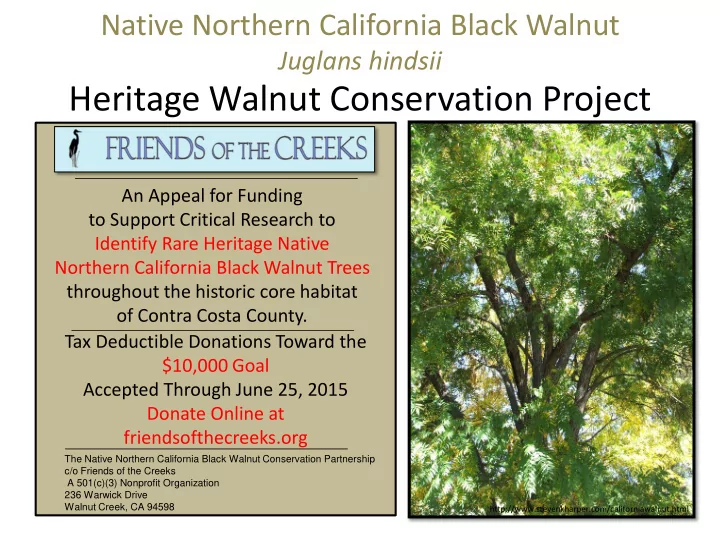
Native Northern California Black Walnut Juglans hindsii Heritage Walnut Conservation Project An Appeal for Funding to Support Critical Research to Identify Rare Heritage Native Northern California Black Walnut Trees throughout the historic


slide-1
SLIDE 1

An Appeal for Funding to Support Critical Research to Identify Rare Heritage Native Northern California Black Walnut Trees throughout the historic core habitat

  • f Contra Costa County.

Heritage Walnut Conservation Project

Native Northern California Black Walnut

Juglans hindsii

http://www.stevenkharper.com/californiawalnut.html

Tax Deductible Donations Toward the $10,000 Goal Accepted Through June 25, 2015 Donate Online at friendsofthecreeks.org

The Native Northern California Black Walnut Conservation Partnership c/o Friends of the Creeks A 501(c)(3) Nonprofit Organization 236 Warwick Drive Walnut Creek, CA 94598

slide-2
SLIDE 2

6.2

Juglans hindsii

Natural groves of native trees, could you help us find them please? Are they hidden in our midst? Or do they no longer still exist? Only DNA testing can tell us for sure if walnuts are hybridized

  • r genetically pure.

Walnuts, walnuts everywhere, Juglans hindsii, are they rare? Is there a native nut to spare? Support our research if you care!

Support the Search for Our Native Heritage Trees!

Target Sample: 60 Trees @ $1,000 per 6 Trees

Northern California Black Walnut Conservation Project

slide-3
SLIDE 3

MAP: www.calarchives4u.com/history/contracosta/1917-ch23.htm

(Present Day Contra Costa, Napa, Alameda, Sacramento and San Joaquin Counties)

Only one kind of walnut tree grew in Northern California when the pioneers arrived with other orchard varieties in 1840. Indigenous Juglans hindsii groves were historically located in five isolated regions.

slide-4
SLIDE 4

The Native Northern California Black Walnut is a

Rare, Seriously Endangered, Critically Imperiled Plant

in California and the World

Northern California Black Walnut Juglans hindsii

California Native Plant Society

Rare Plant Rank 1B

  • Endemic / Native to California
  • Rare throughout their range
  • Declined significantly over the

last century California Department of Fish and Wildlife

Listed Endangered Species

  • Listed under the California Endangered

Species Act, meeting definitions of California Department of Fish and Wildlife Code Sections 2062 and 2067

  • Inventoried in the official California

Natural Diversity Database (CNDDB)

  • Mandatory consideration during

preparation of environmental documents relating to CEQA

slide-5
SLIDE 5

4

http://en.wikipedia.org/ (2014)

1USDA (1976) 2CDFW (2014) 3Potter, D. , UC Davis; Napa County (2010)

Possibly Pre-1840: Per 1892-1963 Documents1 1892-1963: Documented1 2005-2011: Presumed Extant2 2014: Verified Genetically Pure3

Only Three Known Native Old Growth Stands Remain

Northern California Black Walnut Juglans hindsii

Remaining Indigenous Old Growth Stands

slide-6
SLIDE 6

Northern California Black Walnut Trees Now Grow throughout the State

http://www.calflora.org/entry/dgrid.html?crn=8943

UNVERIFIED For Native Status, Genetic Purity / Hybridization, and Specimen Age

slide-7
SLIDE 7

Swanson Vineyards 13 Old & Young Trees

VERIFIED NATIVE GENETICS Genetic purity tested by UC Davis Lab

So are Juglans hindsii Black Walnuts Rare or Not?

Northern California Black Walnut Cal Flora Database 415 Tree Records

NATIVE STATUS UNVERIFIED

Degree of genetic purity and hybridization is unknown

CNDDB Database 3 Official Remaining Native Groves

VERIFIED NATIVE

Original old growth Northern California Black Walnuts existing in Historic Core Habitats

1 2 3

slide-8
SLIDE 8

1 3 1 3 76 77 14 27 40 77 7 6 13 12 10

Known Priority Candidate Juglans hindsii Heritage Trees to Field Sample and Test DNA to Verify Native Species Status

Do you know where to find another big old Northern California Black Walnut tree? Target Sample: 60 Trees $1,000 per 6 Trees Contra Costa County Watersheds

slide-9
SLIDE 9

Uniquely Californian

Because Northern California Black Walnuts are native to California, they are best adapted to growing in the local soil, habitat, and climate.

Luther Burbank “The Plant Wizard”

In the late 1800s, Luther Burbank grafted English Walnuts onto native Northern California Black Walnuts to develop the successful Paradox Walnut variety grown throughout California orchards. Native Northern California Black Walnuts remain prized today as rootstock for

  • ther walnut tree varieties.

The California walnut orchard industry literally grew out of those few native Northern California Black walnut groves existing in the 1800s.

The Roots of the California Walnut Orchard Industry

Northern California Black Walnut Juglans hindsii

slide-10
SLIDE 10

Who says if this native tree is rare? The CNPS defines a Northern California Black Walnut tree as a California native rare plant only if it germinated prior to 1840. Why does a walnut tree have to be at least 175 years old to be considered native? Walnut trees hybridize easily by wind pollination, and hybridized offspring look the same as their native parent tree. Trees that germinated before Europeans introduced other walnut species in 1840 are most likely not to be hybridized. Pre-1840 trees are also more likely to have propagated naturally in native habitat instead of being planted. How else can we tell if a tree is native or hybridized? Genetic testing can determine whether a walnut tree has the same DNA as the original native California species or if it is hybridized.

Still a “Hopelessly Confused” Situation

Northern California Black Walnut Juglans hindsii

slide-11
SLIDE 11

Unidentified rare native trees will be lost to due

  • ld age and

needed removal.

How do we protect these rare native plants?

Northern California Black Walnut Juglans hindsii

No one really does!

Who Knows?

Regulation is inconsistent across jurisdictions.

slide-12
SLIDE 12
  • Landowners
  • Native Plant

Scientists

  • Walnut Growers
  • Resource

Preservationists

  • Environmental

Regulators

Who Cares?

Northern California Black Walnut Juglans hindsii

slide-13
SLIDE 13

Not knowing the status of the resource results in costly lost opportunities!

Why?

Northern California Black Walnut Juglans hindsii

  • Rare Plant Resource Preservation

and Recovery

  • Conservation Science Advancement
  • Guidance to Provide Regulatory

Clarity and Consistency

  • Permit Streamlining
  • Community Engagement

Opportunities

  • Commercial Rootstock Genetic

Diversification Source Expansion

Ecological, Scientific and Commercial Benefits to Proactive Heritage Walnut Population Assessment and Recovery

slide-14
SLIDE 14
  • Are genetically pure native Juglans hindsii rare?
  • Does a refuge population of genetically pure native Juglans hindsii

still exist in Contra Costa and Napa Counties?

  • Do refuge populations of genetically pure native Juglans hindsii

still exist in other historic core habitat areas?

  • If yes, can self-sustaining native refuge populations be expanded?
  • If no, can self-sustaining native refuge populations be restored?
  • Are genetically pure Juglans hindsii more resilient to drought

conditions than hybridized Juglans hindsii?

What do We Need to Know?

Northern California Black Walnut Juglans hindsii

slide-15
SLIDE 15

ASSESS Conduct research to assess the current state of knowledge INVENTORY Collect inventories of known specimens in historic core habitats EVALUATE CONTEXT Study historical ecology to assess the likelihood of natural propagation and possible sources of hybridization PLAN Create field documentation and sampling methodologies SAMPLE Collect specimen samples TEST GENETICS Conduct genetic testing of the samples PROPAGATE Propagate genetically native specimens PLANT Plant native trees in restoration projects MONITOR Assess whether native trees have self-propagated in natural habitat TEST AGAIN Test offspring for genetic purity SHARE THE STORY

How Will We Find Out?

Northern California Black Walnut Juglans hindsii

slide-16
SLIDE 16
  • 1. PILOT SAMPLING & PROPAGATION PROJECT

Research Propagation Methods that Maintain Genetic Purity; Propagate from verified DNA tested Native Trees on Swanson Vineyards; Plant seedlings in Napa River Restoration Project. Research State of Knowledge About Resource Status and Recovery; Compile Existing Inventories of known Specimens in Napa County; Collect Initial Specimen Samples for Genetic Testing

  • 2. SAMPLE & TEST DNA OF TREES IN HISTORIC RANGE

Collect Specimen Samples for Genetic Testing from throughout Contra Costa and Napa Counties and from the three CNDDB Verified Occurrences; Research Historical Ecology of Inventoried Specimens; Test Genetics of Samples

  • 3. REGIONAL RESOURCE RECOVERY ASSESSMENT

Evaluate Resource Recovery Options Throughout Historic Range

  • 4. HABITAT RESTORATION, EDUCATION & OUTREACH

Partner with organizations to propagate seedlings from identified heritage trees for planting in habitat restoration projects; conduct education and outreach programs

Heritage Walnut Recovery Project Proposed Phases

Northern California Black Walnut Juglans hindsii

slide-17
SLIDE 17

Heritage Walnut Conservation Project

Native Northern California Black Walnut

Juglans hindsii

to pass these gifts on undiminished to the next generation.

  • The Roman Poet Caecilius Statius

(c. 220 BC - c. 166 BC)

Plant trees for posterity