
SLIDE 1
Official Plan Update Open House - Urban Design November 26, 2018
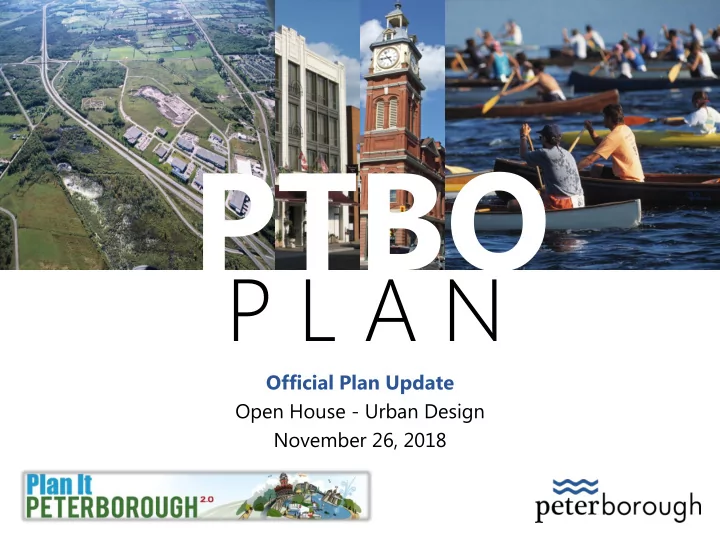
PTBO P L A N Official Plan Update Open House - Urban Design - - PowerPoint PPT Presentation
PTBO P L A N Official Plan Update Open House - Urban Design November 26, 2018 PTBO Outline P L A N 1. What is Urban Design? 2. Community Design Charrette 3. Urban Design Survey 4. Question & Answer / Comment Period What is
Official Plan Update Open House - Urban Design November 26, 2018
Outline
1. What is “Urban Design”? 2. Community Design Charrette 3. Urban Design Survey 4. Question & Answer / Comment Period
P L A N
PTBO
What is “Urban Design”?
Urban Design concerns the arrangement, appearance, and functionality of spaces within the city; in particular, the shaping and uses of urban public space. Urban design theory deals primarily with the design and management of public space and the way public places are experienced and used.”
What is “Urban Design”?
Urban Design needs to consider multiple issues or disciplines:
their surroundings.
What is “Urban Design”?
Design of buildings (features, not styles)
Features – includes scale, street facing windows, entrance locations, etc. Style – appearance (e.g. “Art Deco”, “Brutalism”, etc.). Urban design doesn’t dictate or limit style.
What is “Urban Design”?
Design of the streetscape and other public places
Materials – function and form. Do they make the space distinct. Layout – example, wide sidewalks; views. Amenities – lighting, seating, signage.
What is “Urban Design”?
Considers how users of the street interact with their surroundings.
Is there a “main” user of the space or multiple? Are there conflicts? How can infrastructure support the users? (signage, crossings, etc.)
What is “Urban Design”?
The ultimate goal of urban design is to make the use of a space as positive an experience as possible, for all users of the space.
The Community Design Charrette
What was the Community Design Charrette?
What was the Community Design Charrette?
Consultation
“a meeting in which all stakeholders in a project attempt to resolve conflicts and map solutions”
What was the Community Design Charrette?
Creating a Vision
Looking at downtown, major intersections, and major streets and determining what they could look like in the future. Then, establishing principles so that future development improves these places.
The Results – a Vision and Guidelines
Guidelines can be grouped into three major themes
Mobility Built Form Public Realm
Guidelines: Built Form
Range and Mix of Uses
Range & Mix of Uses
Guidelines: Built Form
Neighbourhood Sensitivity
Guidelines: Built Form
Transitioning Heights
Guidelines: Built Form
Transitioning Heights
Stepbacks hide “massing”, the perceived size of a
used to make buildings compatible with the street or neighbouring properties
Guidelines: Built Form
Architectural Features
Guidelines: Built Form
Framing the Streets
Guidelines: Public Realm
Range & Mix of Uses
Large Scale Projects
Guidelines: Public Realm
Range & Mix of Uses
Urban Tree Canopy
Guidelines: Public Realm
Range & Mix of Uses
Public Spaces
Guidelines: Public Realm
Range & Mix of Uses
Maintain Important Views
Guidelines: Public Realm
Range & Mix of Uses
Enhance Gateways
Guidelines: Mobility
Improved Walkability
Guidelines: Mobility
Downtown Street Character
Guidelines: Mobility
Complete Streets
Urban Residential Street Suburban Residential Street Arterial Street
Guidelines: Mobility
Cycling Infrastructure
Guidelines: Mobility
Increase Connectivity
The Urban Design Survey
Design Principles – Built Form
Range & Mix of Uses Neighbourhood Sensitivity Transitioning Heights Building Features Frame the Streets 96% 93% 92% 92% 69%
% Agree
Design Principles – Public Realm
“Daylighting” Jackson Creek Urban Tree Canopy Public Spaces Maintain Important Views Enhance Gateways 98% 96% 96% 91% 88%
% Agree
Design Principles – Mobility
Improved Walkability Downtown Street Character Complete Streets Cycling Infrastructure Increase Connectivity 98% 98% 95% 89% 71%
% Agree
Downtown Development & Heritage
Adaptive Re-use Building Addition Façade Retention Deconstruction Redevelopment /Demolition
Amount of original structure maintained
91% 80% 63% 67% 79%
% of participants indicating “Agree” or “Strongly Agree”
Likes:
colours for building additions
additions more than vertical
Dislikes:
setbacks/massing that detract from original building
gentrification
Overall Comments on Downtown Redevelopment
Important Landmarks & Views
Waterways Liftlock Market Hall Church Row Armour Hill
% of participants selecting “Agree”
1 2 3 4 5
99% 95% 92% 73% 73%
Important Landmarks & Views
Other Suggestions:
Cenotaph
St bridge, General Electric
the city
south of Tower Hill
Community Benefits
93% 92% 90% 89% 77%
Energy Efficiency Heritage Preservation On-site amenities Affordable/ Accessible Public Art % of participants selecting “Agree”
1 2 3 4 5
Comment Sheet and Urban Design Posters