
SLIDE 1
Official Plan Update General Committee February 26, 2018
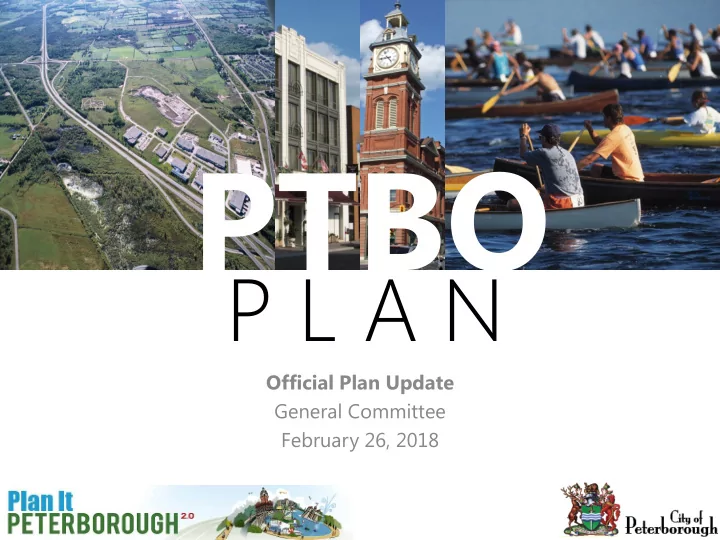
PTBO P L A N Official Plan Update General Committee February 26, - - PowerPoint PPT Presentation
PTBO P L A N Official Plan Update General Committee February 26, 2018 Outline 1. Official Plan Role 2. Background & Council Direction 3. Vision and Guiding Principles 4. Growth Management 5. Land Needs Assessment 6. Land Use and
Official Plan Update General Committee February 26, 2018
Outline
goals, objectives, and policies for the next 20 years.
natural environment.
Official Plan
Official Plan Context:
Ontario Land Use Planning Framework
Planning Act Provincial Policy Statement Growth Plan for the Greater Golden Horseshoe
OFFICIAL PLAN
Zoning By-law Specific
(Higher level
Strategic
(Lower level
Municipal level Provincial level
Secondary Plans
Mar 21 Planning Committee Meeting
The Official Plan: Background
April Online Public Survey via OP website June 1st Round of Public Workshops/Open Houses Aug-Nov Three issue-themed stakeholder workshops Sep-Oct Three guest speaking appearances
2011
Oct 14 Arts, Culture and Heritage Advisory Committee
2012
Jul Draft ‘Directions Report’ Prepared Jan Issue-themed stakeholder workshop Nov Arts, Culture and Heritage Advisory Committee Apr 30 Planning Committee Meeting: OP Progress Update Jun 12 Peterborough Architectural Conservation Advisory Committee
2013
Mar 4 Planning Committee Meeting for Final ‘Directions Report’ and Special Public Meeting Mar 12 Peterborough Architectural Conservation Advisory Committee Mar 20 Sustainable Peterborough Meeting
2017 Council Direction
– Staff resources and online engagement software to complete the Official Plan Update. – Beacon Environmental appointed to complete the Natural Heritage System component.
2018 based on a robust public engagement process.
Council Steering Committee Technical Group Working Advisory Group Peterborough Citizens
Public Engagement Reporting Structure
Public Engagement
MetroQuest - Online Planning Surveying Tool Engagement Sessions
Vision and Guiding Principles
790 participants
(representative sample: 383)
<18
3%18-34
20%35-44
23%45-64
42%65+
12%Vision and Guiding Principles Survey Results
Pop-up Sessions Respondents Age
Peterborough will continue to develop as a complete, linked city that strives to provide for a decent home for everyone, fosters a sustainable environment, values its natural and cultural heritage, supports a strong and diverse economy and promotes a unique, vibrant sense of place for its residents and visitors.
Environment
(Natural & Built)
Social/ Cultural Economic
Components
2041 Vision Components
A City that is:
character
well-being
Summary of Feedback
specific
Our Ptbo 2041 Vision:
A prospering community in unity with its natural beauty, rich heritage, and progressive leadership in sustainability with equitable opportunity for continued well- being, engagement, and vitality.
Survey Results - Vision
Healthy & Sustainable
PTBO
Environmental Stewardship Economic Strength Complete Communities Connectivity & Mobility Unique & Vibrant
Complete Communities
Housing Affordability Safe & Livable Accessible & Inclusive Compact Form & Mixed Land Uses Community HubsEnvironmental Stewardship
Infrastructure Resilience Natural Heritage System Sustainable Development Urban Forest Local Food SecurityEconomic Strength
Diverse/Adaptive Economy Local Markets Fiscal Sustainability Business Incubation Protected Employment AreasUnique & Vibrant
Downtown Peterborough Arts & Culture Waterfront Development Heritage Resources Urban DesignConnectivity & Mobility
Multi-Modal Systems Public Engagement Major Transportation Networks Transit Supportive Smart Technology Environmental Stewardship Economic Strength Complete Communities Unique and Vibrant Connectivity and Mobility 7 in 10 people ranked the majority
Priority ranking of themes
Survey Results – Themes and Strategies
Growth Management
Places to Grow Act: Growth Plan for the Greater Golden Horseshoe (GGH) in Ontario
Places to Grow Act
P2G in Peterborough Context
44k
JOBS
83.5k
PEOPLE
58k
JOBS
115k
PEOPLE
2016-2041:
+14,000 jobs +31,500 people
Population and Employment Growth
Residential Intensification Target
50% 50%2018(next OP)-2031
60% 40%Previous/Current
40% 60%2031-2041
P2G Requirements for Peterborough
Growth Management: Context
Above Target Below Target
2007-2016: 340 units/year
68% 41% 29% 23% 27% 42% 32% 57% 29% 49%
0% 10% 20% 30% 40% 50% 60% 70% 2007 2008 2009 2010 2011 2012 2013 2014 2015 2016 Intensification Rate
2007-2016 Intensification Rate
40%
Residential Intensification Rate
2001-2016 Residential Growth by Type
65% 17% 18% 0% 0% 53% 24% 22% 1% 2% 52% 16% 24% 8% 4%
0% 10% 20% 30% 40% 50% 60% 70%
Single-Detached /Semi-Detached Rows /Townhouse Apartment (<5 stories) Apartment (≥5 stories) Mixed-Use 2001-2005 2006-2010 2011-2016
Growth
% of Units
Density Target Rate
Low Density High Density Medium Density High or Medium Density Growth Management Scenarios
Less Compact More Compact
2016-2041: +13,200 units
Scenario 1 (40/60) Scenario 2 (45/55) Scenario 3 (50/50) Scenario 4 (60/40) 7,920 6,600 5,940 5,280
2001-2041 Residential Growth by Type
65% 17% 18% 0% 42% 13% 27% 18% 23% 8% 38% 32%
0% 10% 20% 30% 40% 50% 60% 70%
Single-Detached /Semi-Detached Rows /Townhouse Apartment (<5 stories) Apartment (≥5 stories)
2001-2005 2006-2016 Scenario 1 (40/60) Scenario 2 (45/55) Scenario 3 (50/50) Scenario 4 (60/40)Scenarios Scenarios Scenarios Scenarios
Growth Management Model
Residential Intensification Scenarios
Scenario 1 (40/60) Scenario 2 (45/55) Scenario 3 (50/50) Scenario 4 (60/40)
UGC 760 units 920 units 1,090 units 1,420 units BUA 4,520 units 5,940 units 5,510 units 6,500 units DGA 7,920 units 7,260 units 6,600 units 5,280 units
BUA DGA DGA UGC
Growth Management Public Engagement
Growth Management Survey
0.3% 4.8% 17.8% 22.4% 20.9% 18.3% 11.1% 4.1% 0.2% Under 18 18-24 25-34 35-44 45-54 55-64 65-74 75-84 85+ 0% 10% 20% 30%
What is your age? (n=918)
Direct Advertisements:
Resource Centre
Coordinating Committee
Partners
Growth Management Survey
Female 51% Male 48% Other 1%What is your gender?
(n=914)How long have you lived in Peterborough? (n=938)
Less than 2 years 2-10 years 11-20 years More than 20 years I do not reside in Peterborough6% 10% 15% 17% 15% 20% 17%
What is your annual household income? (n=857)
Less than $20,000 $20,000-$39,999 $40,000-$59,999 $60,000-$79,999 $80,000-$99,999 $100,000-$149,999 $150,000 and over2016 Census Median Household Income: $58,127
Growth
Build Up Build Outwards
1 2 3 4 5 4.1 Average 96 84 89 256 714 Total Count
Neighbourhoods
High Mix Low Mix
94 112 69 264 635 Total Count 1 2 3 4 5 4.1 Average
Stores & Services
High Mix Low Mix
87 102 116 286 550 Total Count 1 2 3 4 5 4.0 Average
Parkland
More public More private
77 89 84 258 628 Total Count 1 2 3 4 5 4.1 Average
Growth Management Survey
22% 84% 82% 76% 61%
% of participants “Agree/Strongly Agree” growth and development
Transit Areas Downtown Existing
Neighbourhoods
Major Corridors & Nodes
Undeveloped
Areas
Growth Management Survey
Mixed-Use Low/Mid-Rise Townhouses Residential Apartments High-Rise Single/Semi- Apartments Detached
90% 89% 64% 49% 26%
% of participants indicating “Agree/Strongly Agree”
Land Use and Transportation
Land Use and Transportation
Downtown/UGC
(500m buffer)
Major Corridors
(250m buffer)
Nodes
(500m buffer)
Strategic Growth Areas
Scenario 1 Scenario 2 Scenario 3 Scenario 4
Residential Growth
Residential Growth Split (BUA) Downtown (25%) Nodes (40-42%) Corridors (35-38%) 2016-2041: +31,500 people
Scenario 1 Scenario 2 Scenario 3 Scenario 4
2016-2041: +14,000 jobs Job Growth Split (BUA) Downtown (25%) Nodes (40-42%) Corridors (35-38%)
Employment Growth
City-wide Transportation Model
travel activity.
trip, purpose of trip (i.e. home to work), in which traffic zone, and what mode they are using:
– Transit, – Walk-Cycle – School Bus – Auto (passenger or driver).
Trips by Travel Mode & Length
Measure Today Scenario 1 Scenario 2 Scenario 3 Scenario 4 Transit Trips * 4.2% 4.3% 4.3% 4.3% 4.4% Walk / Cycle Trips* 6.9% 7.1% 7.1% 7.1% 7.2% Auto Driver Trips* 67.5% 67.2% 67.2% 67.1% 67.0%
* Based on current infrastructure and servicesMeasure Today Scenario 1 Scenario 2 Scenario 3 Scenario 4 Average Trip Length (km) 4.79 5.03 4.99 4.95 4.88 Trips Under 2 km in Length (14.5%) (13.6%) (13.9%) (14.2%) (14.8%) Trips Under 5 km in Length (59.6%) (55.5%) (56%) (56.7%) (57.9%)
Transportation Network Performance
Growth results in:
Measure Today 2041 Scenario 1 2041 Scenario 2 2041 Scenario 3 2041 Scenario 4 Vehicle Hours Traveled 1,2 2,020 2,950 2,950 2,940 2,925 Vehicle-km Traveled1,2 107,800 149,500 149,300 149,000 148,200 Road Links Over Capacity (v/c > 1.0) 1.6 km 23.7 km 22.0 km 22.5 km 21.8 km
Assumes no road network improvementsPM Peak Hour Performance of Road Network
Transportation Key Findings
performance.
enough to differentiate transportation performance.
system
– Lowest trip lengths – Highest potential for non-auto trip making – Lowest travel demand, emissions, and road widening needs – Highest overall self containment of trip making
Draft MetroQuest Surveys
1) Transportation Survey 2) Land Use Survey
Land Needs Assessment
Land Needs Assessment
2016-2041: +31,500 people +14,000 jobs
Land Needs:
Employment Area Community Area Provincial Guidelines Intensification Strategy Housing Strategy Employment Strategy
Expansion
New OP-2031
60% 40%Previous Target /Current OP
40% 60%2031-2041
Land Needs Assessment: Context
Previous P2G Target 50 r+j/ha Current P2G Target 80 r+j/ha 150 r+j/ ha
Land Needs Assessment: Context
Land Needs Assessment : Employment
Job generators:
1) Population- Related 2) Employment Lands
80 r+j/ha 150 r+j/ ha
2016-2041: 14,000 new jobs
Land Needs Assessment: Employment
Existing Capacity Required Capacity
Land (hectares)
2016-2041 Employment Lands Needs
Natural Heritage System
Limited was awarded contract in December.
January with NHS Technical Advisory Group.
commenced and public engagement approach TBD.
Natural Heritage System
Official Plan Schedule
Feb- March April- May June
Aug- Sept Oct- Nov Dec- Jan Feb- March
2018
Official Plan Schedule
Consultation
Land Use & Transportation Surveys Urban Design & Heritage Surveys Four-day Design Charrette
February
Committee
Area Board of Management TBD
Advisory Committee
Pop-Ups in collaboration with Trent U
Council Adoption March ‘19
Project Timelines
Feb- March April- May June
Aug- Sept Oct- Nov Dec- Jan Feb- March
2019 2018
Draft Policy Formulation Policy Review
Open Space
Culture
Implementation
Final OP Review
~Provincial Guidelines Final Provincial Land Needs Methodology
Recommendations
b) Endorsement of public engagement framework c) Community Design Charrette & Architectural and Urban Design Guidelines for Intensification of BUA d) Sole Sourcing to The Planning Partnership and Lett Architects
Public Engagement
Recommendations – e) Places to Grow Act
i) Adopt already prescribed target of 150 residents and jobs per hectare for the Downtown.
Existing density:
117 r+j/ha
BUA DGA DGA
50% 50%
New OP-2031
50% 50%
New OP-2031
ii and iii) Intensification Targets
P2G Proposed “Alternative” Target
40% 60%
2031-2041
45% 55%
2031-2041
Recommendations – Places to Grow Act
Recommendations – Places to Grow Act
P2G Proposed “Alternative” Target
(new subdivisions only )
80 r+j/ha by 2041
(includes existing and approved)
55 r+j/ha by 2031 60 r+j/ha 2031-2041
iv) Intensification Targets
Questions