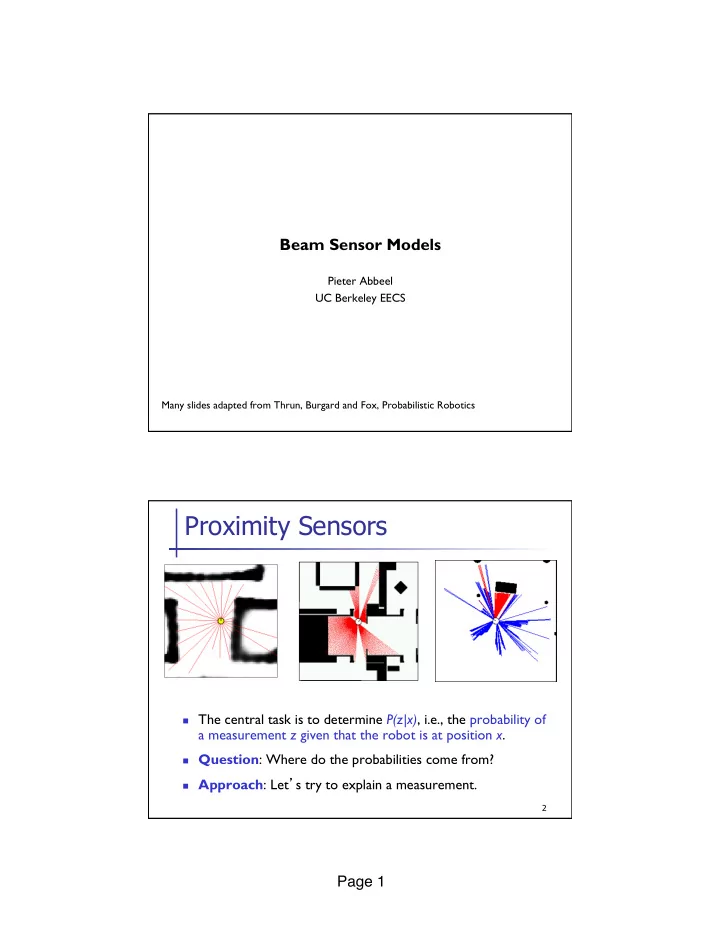
Proximity Sensors n The central task is to determine P(z|x) , i.e., - - PDF document

proximity sensors
SMART_READER_LITE
LIVE PREVIEW

Proximity Sensors n The central task is to determine P(z|x) , i.e., - - PDF document

Beam Sensor Models Pieter Abbeel UC Berkeley EECS Many slides adapted from Thrun, Burgard and Fox, Probabilistic Robotics Proximity Sensors n The central task is to determine P(z|x) , i.e., the probability of a measurement z given that the


slide-1
SLIDE 1

Page 1

Beam Sensor Models

Pieter Abbeel UC Berkeley EECS

Many slides adapted from Thrun, Burgard and Fox, Probabilistic Robotics

2

Proximity Sensors

n The central task is to determine P(z|x), i.e., the probability of

a measurement z given that the robot is at position x.

n Question: Where do the probabilities come from? n Approach: Let’s try to explain a measurement.

slide-2
SLIDE 2

Page 2

3

Beam-based Sensor Model

n Scan z consists of K measurements. n Individual measurements are independent given the robot

position.

} ,..., , {

2 1 K

z z z z =

=

=

K k k

m x z P m x z P

1

) , | ( ) , | (

4

Beam-based Sensor Model

=

=

K k k

m x z P m x z P

1

) , | ( ) , | (

slide-3
SLIDE 3

Page 3

5

Typical Measurement Errors of an Range Measurements

  • 1. Beams reflected by
  • bstacles
  • 2. Beams reflected by

persons / caused by crosstalk

  • 3. Random

measurements

  • 4. Maximum range

measurements

6

Proximity Measurement

n Measurement can be caused by …

n a known obstacle. n cross-talk. n an unexpected obstacle (people, furniture, …). n missing all obstacles (total reflection, glass, …).

n Noise is due to uncertainty …

n in measuring distance to known obstacle. n in position of known obstacles. n in position of additional obstacles. n whether obstacle is missed.

slide-4
SLIDE 4

Page 4

7

Beam-based Proximity Model

Measurement noise

zexp zmax

b z z hit

e b m x z P

2 exp)

( 2 1

2 1 ) , | (

− −

= π η ⎭ ⎬ ⎫ ⎩ ⎨ ⎧ < =

  • therwise

z z m x z P

z

e ) , | (

exp unexp λ

λ η Unexpected obstacles

zexp zmax

8

Beam-based Proximity Model

Random measurement Max range

max

1 ) , | ( z m x z P

rand

η =

small

z m x z P 1 ) , | (

max

η =

zexp zmax zexp zmax

slide-5
SLIDE 5

Page 5

9

Resulting Mixture Density

⎟ ⎟ ⎟ ⎟ ⎟ ⎠ ⎞ ⎜ ⎜ ⎜ ⎜ ⎜ ⎝ ⎛ ⋅ ⎟ ⎟ ⎟ ⎟ ⎟ ⎠ ⎞ ⎜ ⎜ ⎜ ⎜ ⎜ ⎝ ⎛ = ) , | ( ) , | ( ) , | ( ) , | ( ) , | (

rand max unexp hit rand max unexp hit

m x z P m x z P m x z P m x z P m x z P

T

α α α α How can we determine the model parameters?

10

Raw Sensor Data

Measured distances for expected distance of 300 cm. Sonar Laser

slide-6
SLIDE 6

Page 6

11

Approximation

n Maximize log likelihood of the data n Search space of n-1 parameters.

n Hill climbing n Gradient descent n Genetic algorithms n …

n Deterministically compute the n-th parameter to

satisfy normalization constraint.

) | (

exp

z z P

12

Approximation Results

Sonar Laser

300cm 400cm

slide-7
SLIDE 7

Page 7

13

Example

z P(z|x,m)

15

Approximation Results

Laser Sonar

slide-8
SLIDE 8

Page 8

16

"sonar-0" 10 20 30 40 50 60 70 0 10203040506070 0.05 0.1 0.15 0.2 0.25

Influence of Angle to Obstacle

17

"sonar-1" 10 20 30 40 50 60 70 0 10203040506070 0.05 0.1 0.15 0.2 0.25 0.3

Influence of Angle to Obstacle

slide-9
SLIDE 9

Page 9

18

"sonar-2" 10 20 30 40 50 60 70 0 10203040506070 0.05 0.1 0.15 0.2 0.25 0.3

Influence of Angle to Obstacle

19

"sonar-3" 10 20 30 40 50 60 70 0 10203040506070 0.05 0.1 0.15 0.2 0.25

Influence of Angle to Obstacle

slide-10
SLIDE 10

Page 10

20

Summary Beam-based Model

n Assumes independence between beams.

n Justification? n Overconfident!

n Models physical causes for measurements.

n Mixture of densities for these causes. n Assumes independence between causes. Problem?

n Implementation

n Learn parameters based on real data. n Different models should be learned for different angles at which the

sensor beam hits the obstacle.

n Determine expected distances by ray-tracing. n Expected distances can be pre-processed.