SLIDE 1 Providing Regional Climate Services
Doug Kluck NOAA/NESDIS/National Climatic Data Center Kansas City, MO Doug.kluck@noaa.gov
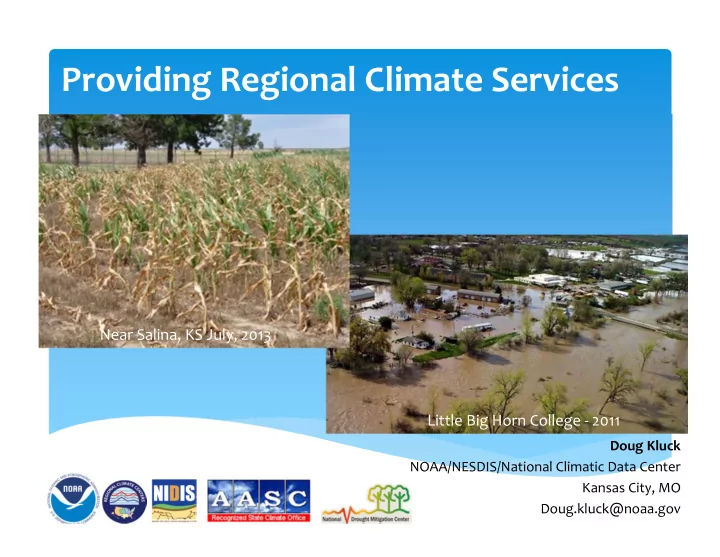
Little Big Horn College ‐ 2011 Near Salina, KS July, 2013
SLIDE 2 Regional Climate Services
The development and delivery of climate products and services that are on time and spatial scales needed most by decision‐ makers
Development and Delivery: requires and end‐to‐end iterative system that links research, modeling and assessment activities to product and services development, along with delivery systems and capacity building to help users incorporate new knowledge into their decision making. Products and Services: climate information and decision support tools that expand one’s understanding of risk and impacts and promote identification of adaptation and mitigation options Time and spatial scales: climate impacts are felt closest to home. Users need timely, place‐based information on climate risks and impacts in order to make informed decisions. Decision‐makers: users of climate information representing all public and private sectors of activity. These are climate stakeholders.
credit Eileen Shea
SLIDE 3
Maintain and evaluate relevance – regional/local issues, in touch with what matters Iterative, consistent, continuous, reliable, trustworthy Across time scales – 2 weeks to 100 years Problem‐focused approach – understand place & history Avoid reinvention – build on existing relationships and work Joint solutions – work together to solve needs Leverage partnerships & networks – key element for success Recognize capacities – resources (time, funds, experience, knowledge)
Some Regional Climate Service Fundamentals:
The process of engagement is as important as the outcome
SLIDE 4
Monitoring – value add, trends, anomalies Data – instrumentation, collection, database Prediction – interpret, place/sector based Outreach – inform decisions, accessibility Education – building capacity for understanding Research – applied, useable Linkages – leveraging networks, knowledge and resources
Key Services
SLIDE 5
Regional Climate Service Partnerships
SLIDE 6
Key Federal Partnerships
SLIDE 7 Climate Resources: (Federal, States, Tribes, Urban, academic, NGOs, Private Interests)
Monitoring & Forecasting Climate Impacts Assessments and Scenarios Communication and Outreach Engaging Preparedness & Adaptation
Regional Climate Services
SLIDE 8
RCS Examples
SLIDE 9 Since November 2011 Response to climate extremes Popular w/states, feds, tribes, private interests Presenters: AASC, NDMC, RCCs, USDA, LCC and others
Last Updated: 5/30/2012
Building Awareness: Regional Monthly Climate & Drought Webinars
SLIDE 10 Webinars:
Consistent and all‐in‐one place from many sources Blend past, present and future climate information Drought, Flood, Fire, Heat, Cold, Agriculture, Snow, soil moisture/temperature, precipitation, temperatures, rivers, reservoirs, etc… Monthly (3rd Thursday) unless it gets really bad then every
Sign up here: http://drought.gov/drought/content/regional‐ programs/regional‐drought‐webinars Webinars are recorded: http://www.hprcc.unl.edu/webinars.php
SLIDE 11 Quarterly Sub‐Regional Summary & Outlooks
http://www.drought.gov/drought/content/resources/reports Midwest Missouri Basin States Great Lakes Region
SLIDE 12
2014 – El Nino?
What does it mean for the Missouri Basin?
SLIDE 13 Attribution and Assessments
Devil’s Lake (ND) Attribution 2011 Flood Attribution Study 2012 Drought Attribution Study
http://www.esrl.noaa.gov/psd/csi/factsheets/
2007 April Freeze
http://www1.ncdc.noaa.gov/pub/data/tech rpts/tr200801/tech‐report‐200801.pdf
SLIDE 14
2012 Drought Assessment
SLIDE 15 15
Engagements & Interactions
NIDIS Missouri Basin Tribal Meeting, Rapid City, SD ‐ 2014
SLIDE 16 National Integrated Drought Information System – Missouri Basin
http://drought.unl.edu/Portals/0/docs/EPC/MRB%20Feb%202‐14%20wkshop%202‐pager.pdf
System (DEWS)
- Informing Planning
- Wind River Reservation
- States
- Federal Agencies
- Enhancing Monitoring
- Drought/flood
- Tribally focused drought
meeting
SLIDE 17
NIDIS Pilots Areas
SLIDE 18
North American Climate Services Partnership
Canada/U.S. climate focus on Great Lakes Great Lakes Water Quality Agreement – Climate Change Annex
Missouri Basin and Midwest Federal Climate Collaborations National Climate Assessment
Regional and sector interpretation
Information Delivery via Interpretation
Synthesizing per audience
Other Regional Services
SLIDE 19 Doug Kluck Regional Climate Services Director (Central Region) Kansas City, MO – NWSTC 816‐994‐3008 (O) 816‐564‐2417 (C)
Thank You