Regional Climate Modelling Techniques: Impacts on Regional Climate - - PowerPoint PPT Presentation

regional climate modelling techniques impacts on regional
SMART_READER_LITE
LIVE PREVIEW

Regional Climate Modelling Techniques: Impacts on Regional Climate - - PowerPoint PPT Presentation

Regional Climate Modelling Techniques: Impacts on Regional Climate Change Climate Adaptation Flagship Jack Katzfey, M. Chattopadhyay, J. McGregor, K. Nguyen and M. Thatcher CAWCR, CMAR, Aspendale GH2011 Outline Uncertainty and downscaling


slide-1
SLIDE 1

Regional Climate Modelling Techniques: Impacts on Regional Climate Change

Jack Katzfey, M. Chattopadhyay, J. McGregor, K. Nguyen and M. Thatcher CAWCR, CMAR, Aspendale GH2011

Climate Adaptation Flagship
slide-2
SLIDE 2

Regional Climate Modelling

Outline

  • Uncertainty and downscaling
  • Our dynamical downscaling approach (and why)
  • Some results – CFT and PCCSP
  • Summary
slide-3
SLIDE 3

Cascade of uncertainty?

Regional Climate Modelling

slide-4
SLIDE 4

Cascade of uncertainty?

Regional Climate Modelling

Need for ensembles

slide-5
SLIDE 5

Cascade of uncertainty?

Regional Climate Modelling

But is this really true?

slide-6
SLIDE 6

Cascade of uncertainty?

But is this really true? I think not!

Regional Climate Modelling

Increased resolution Additional surface forcing

slide-7
SLIDE 7

Regional Climate Modelling

Scenario selection

  • SRES - RCP

GCM selection

  • Good current climate – necessary?
  • Good variability – yes
  • Patterns of climate change? (Whetton)

Bias correct SSTs

  • Determine climatology for each month
  • For whole run, subtract bias for each month
  • Preserves variability and change signal

Regional Climate Modelling

slide-8
SLIDE 8

Regional Climate Modelling

Large-scale bias-correction

  • In addition to fixing biases,

allows simulation to have more realistic weather systems and how they may change in response to climate change

  • Affect on downscaling later

Surface temperature average 115 E to 155 E, 40 S to 10 S 3 year running average

Model uncertainty/error (2.3°C) Model uncertainty plus change (3.7°C) Spread of change signal (1.4°C)

Example of SST bias in a GCM

Same mean

slide-9
SLIDE 9

Regional Climate Modelling

RCM setup

  • Region of interest – domain
  • Resolution
  • Surface specification – land use/orography
  • Physics/parameterisations chosen

Simulation

  • Time period
  • Outputs
  • Forcing?

Multiple downscaling

  • New domain/resolution/surface inputs
  • Forcing from courser resolution simulation

Regional Climate Modelling

slide-10
SLIDE 10

Regional Climate Modelling Approaches

  • Also need to consider:
  • Domain size
  • Resolution
  • Two-way interaction
  • Internal variability

Limited area Lateral boundary influence Computational expense None High Low High Variable resolution Global high-resolution

Regional Climate Modelling

slide-11
SLIDE 11

Regional Climate Modelling

Stretched grid – No lateral boundaries

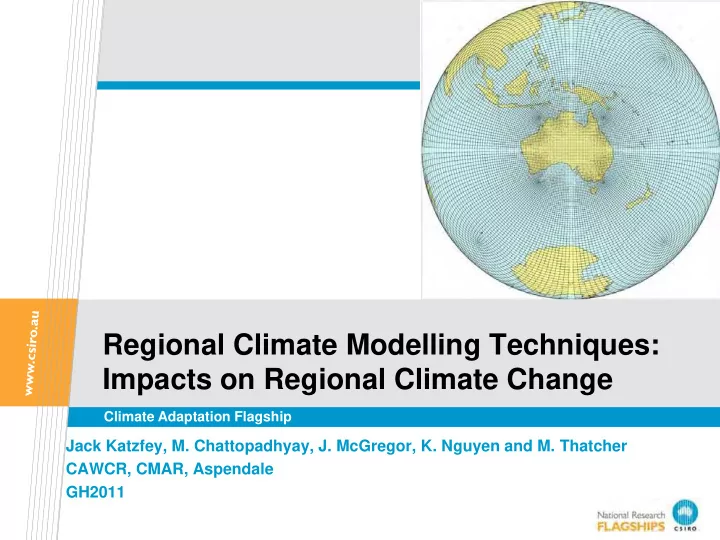
Example of variable resolution CCAM grid – 60 km over Australia

Conformal Cubic Atmospheric Model (CCAM) Full atmospheric model – like GCMs Allows interaction with larger scales

11

slide-12
SLIDE 12

Regional Climate Modelling

Bias adjustment of sea surface temperatures

  • Sea surface temperatures main influence on

climate (ENSO, climate change)

  • Dommenget, Dietmar, 2009: The Ocean’s Role in

Continental Climate Variability and Change. J. Climate, 22, 4939–4952

  • Can we improve our representation of the

current climate by fixing the biases? (yes)

12

slide-13
SLIDE 13

Regional Climate Modelling

Comparison of downscaling approaches: July rainfall (1970-1979)

Observed CCAM, SST, NF CCAM, bcSST, NF GCM

Note the similarities of CCAM with uncorrected SSTs to the GCM (RHS) CCAM with bias-corrected SSTs is more similar to the observed (LHS)

slide-14
SLIDE 14

Regional Climate Modelling

Bias adjustment of sea surface temperatures

  • CCAM is an atmosphere only model – require

GCMs to provide projections of sea surface temperatures

  • Does using one downscale model decrease

spread of climate change signal? (no)

14

slide-15
SLIDE 15

Ensemble Mean and Spread: Changes in DJF precipitation

6 GCM mean 6 CCAM sdev 6 CCAM mean 6 GCM sdev

2085-1980 change 2070-2100 change spread (Std.Dev.) The spread of climate change signals in CCAM is similar to that in the GCMs

Regional Climate Modelling

slide-16
SLIDE 16

Regional Climate Modelling

Adding more information with higher resolution

  • Can multiply downscale
  • CCAM within itself
  • Other RCMs
  • CCAM uses a digital filter to forcing large-scale

information from coarser resolution run into higher resolution run

16

slide-17
SLIDE 17

Regional Climate Modelling

Multiple downscaling to higher resolution

Simulated annual rainfall for Tasmania at different resolutions Global Model CCAM 60 km CCAM 14 km

Bias-correc. Spectral forcing Increased resolution Increased resolution

Climate Futures for Tasmania project

slide-18
SLIDE 18

Regional Climate Modelling

DJF rainfall: percentage change

Change in rainfall 1970:1999 to 2070:2099 6 model mean

18

GCM 60 km RCM 14 km RCM

Climate Futures for Tasmania project

slide-19
SLIDE 19

Regional Climate Modelling

JJA rainfall: percentage change

Change in rainfall 1970:1999 to 2070:2099 6 model mean

19

GCM 60 km RCM 14 km RCM

Climate Futures for Tasmania project

slide-20
SLIDE 20

Regional Climate Modelling

Ensembles

20

Climate Futures for Tasmania project Change in annual rainfall 1961:1990 to 2070:2099 14 km results Although mean changes, pattern fairly consistent

slide-21
SLIDE 21

Regional Climate Modelling

Downscaling for the PCCSP

  • Can multiply downscale CCAM within itself
  • Use digital filter to forcing large-scale

information from coarser resolution run into higher resolution run

21

slide-22
SLIDE 22

Statistical (15 cities, 1980-2065) and CCAM (7 countries, 1980-2000,2045-2065,2080-2099) Extra Dynamical Downscaling (1980-2000,2045-2065)

Downscaling activities for PCCSP

Echam5 GFDL cm20 CSIRO Mk3.5 GFDL cm21 Miroc mr UK Hadcm2 60 km MM5 PRECIS RegCM Zetac WRF 60 km 60 km 60 km 60 km 60 km 8km + Stat. 8km + Stat. 8km + Stat. CCAM x 2 (1961-2099) GCMs Bias adjust SSTs

slide-23
SLIDE 23

PCCSP domains

  • 8 km domains in red
  • Extra DDS domain in green
slide-24
SLIDE 24

PNG JJA Rainfall

GCM CCAM 60 km CCAM 8 km TRMM 25 km CRU 50 km 8 km Orography

slide-25
SLIDE 25

Lamap, Vanuatu: 20th Century Validation Precipitation (mm/d)

Station Obs (black), CMAP (red), CRU (blue), GPCP (green) and TRMM (cyan) Station Obs (black), CCAM 8m(red)+2xsdev(gray), CCAM 60km(blue)+2xsdev(yellow), GCM(green)+2xsdev(tan) Station Obs (black), CCAM 8m(red)+2xsdev(gray), Stats Downscale(blue)+2xsdev(tan)

slide-26
SLIDE 26

Vanuatu : Lamap 20th Century PDF

f r e q u e n c y Sqrt(mm/day) Sqrt(mm/day)

Temperature

f r e q u e n c y

Station Obs (black), CCAM 8m(red)+2xsdev(gray), CCAM 60km(blue)+2xsdev(yellow), GCM(green)+2xsdev(tan) Station Obs (black), CCAM 8m(red)+2xsdev(gray), Stats Downscale(blue)+2xsdev(tan)

  • C
  • C

Precipitation

slide-27
SLIDE 27

Extra downscaling – NCEP2 – DJF rainfall

M M 5 PRECIS WRF CM AP GPCP RegCM _E

Zetac - JFM CCAM

mm/day

Preliminary results

slide-28
SLIDE 28

Regional Climate Modelling

Key results

  • Dynamical downscaling provides physically-based and

more detailed representation of the regional climate

  • Bias-correction of sea surface temperatures significantly

improves the representation of the current climate

  • Ensemble-based downscaling
  • Multiple GCMs
  • Multiple resolutions
  • Multiple RCMs (including different model set-ups)
slide-29
SLIDE 29

Regional Climate Modelling

Key results

  • Dynamical downscaling
  • Needs to be done carefully
  • Results may depend upon method, GCMs downscaled,

model set-up, resolution, etc.

  • Projections based upon dynamical downscaling
  • Physically-based patterns of change
  • May help reduce some of the uncertainty by providing

physically-based patterns of change, but need to understand physical causes of patterns of change

  • Only sub-sample of the full range of GCMs
  • Still based upon projections of GCMs, so uncertainty

still exists

slide-30
SLIDE 30

Thank you

CAWCR, CMAR Jack Katzfey MMA Team Leader Phone: +61 3 9239 4562 Email: jack.katzfey@csiro.au Web: www.csiro.au/cmar Contact Us Phone: 1300 363 400 or +61 3 9545 2176 Email: Enquiries@csiro.au Web: www.csiro.au