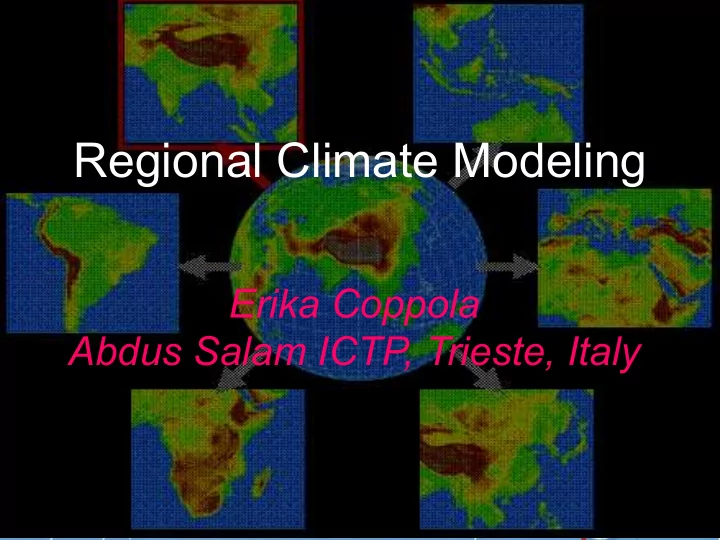
Regional Climate Modeling Erika Coppola Abdus Salam ICTP, Trieste, - - PowerPoint PPT Presentation

regional climate modeling
SMART_READER_LITE
LIVE PREVIEW

Regional Climate Modeling Erika Coppola Abdus Salam ICTP, Trieste, - - PowerPoint PPT Presentation

Regional Climate Modeling Erika Coppola Abdus Salam ICTP, Trieste, Italy Regional climate information is critical to assess impacts Information is needed at the regional scale Regional climate modeling: Why? Regional climates are determined


slide-1
SLIDE 1

Regional Climate Modeling

Erika Coppola Abdus Salam ICTP, Trieste, Italy

slide-2
SLIDE 2

Regional climate information is critical to assess impacts

Information is needed at the regional scale

slide-3
SLIDE 3

Regional climate modeling: Why?

  • Regional climates are determined by the

interactions of planetary/large scale processes and regional/local scale processes

– Planetary/large scale forcings and circulations determine the statistics of weather events that characterize the climate of a region – Regional and local scale forcings and circulations modulate the regional climate change signal, possibly feeding back to the large scale circulations

  • In order to simulate climate (and more

specifically climate change) at the regional scale it is thus necessary to simulate processes at a wide range of spatial (and temporal) scales

slide-4
SLIDE 4

Large scale natural climatic forcings

Volcanic eruptions Solar activity

slide-5
SLIDE 5

Like the sun, the Earth emits

  • radiation. It is much cooler

than the sun, though, so it emits in the infrared. Some of that infrared energy may be absorbed by molecules in the atmosphere, affecting the global energy balance. ! Extra CO2 or other GHGs lead to a positive forcing of the climate system, an excess greenhouse effect.

Anthropogenic climatic forcings

Mauna Loa Hawaii

The Greenhouse effect

slide-6
SLIDE 6

Regional and local climatic forcings

Direct effects

Aerosols absorb and reflect solar radiation

Indirect effects

Aerosols change the properties of clouds

Aerosols

slide-7
SLIDE 7

Regional and local climatic forcings: Topography and vegetation

slide-8
SLIDE 8

The scales of climate change

Global Continental Regional Local

slide-9
SLIDE 9

Nested Regional Climate Modeling: Technique and Strategy

  • Motivation: The resolution of GCMs

is still too coarse to capture regional and local climate processes

  • Technique:A Regional Climate

Model (RCM) is nested within a GCM in order to locally increase the model resolution. – Initial conditions (IC) and lateral boundary conditions (LBC) for the RCM are obtained from the GCM (One-way Nesting) or analyses of observations.

  • Strategy: The GCM simulates the

response of the general circulation to the large scale forcings, the RCM simulates the effect of sub-GCM-grid scale forcings and provides fine scale regional information – Technique borrowed from NWP

slide-10
SLIDE 10

The equations of a climate model

Conservation

  • f momentum

Conservation

  • f energy

Conservation

  • f mass

Conservation

  • f water

Equation of state

slide-11
SLIDE 11

RCM Nesting procedure

Inner Domain Fine Scale Buffer Zone (LBC Relaxation)

Large Scale Forcing Fields

slide-12
SLIDE 12

Regionalization techniques to enhance the AOGCM information

  • High Resolution Time-Slice AGCM

Experiments

  • Variable Resolution AGCM
  • Nested Regional Climate Model (RCM)
  • Empirical/Statistical and Statistical/

Dynamical Downscaling

  • Combined use of different techniques (e.g.

RCM nested in high resolution AGCM)

slide-13
SLIDE 13

Regional Climate Modeling Advantages

  • Physically based downscaling

– Comprehensive climate modeling system

  • Nesting within different GCMs or analyses of
  • bservations (perfect boundary conditions

experiments)

  • Wide variety of applications

– Process studies and validation – Paleoclimate – Climate change – Seasonal prediction

  • High resolution through multiple nesting

(currently 10-50 km grid interval)

  • Usable on PCs
slide-14
SLIDE 14

Regional Climate Modeling Limitations

  • One-way nesting

– No regional-to-global feedbacks

  • Technical issues in the nesting technique

– Domain, LBC procedure, physics, etc.

  • Not intended to correct systematic errors

in the large scale forcing fields

– Always analyse first the forcing fields

slide-15
SLIDE 15

Regional Climate Modeling: A Brief Historical Overview

slide-16
SLIDE 16

The birth of regional climate modeling The Yucca Mountain Project (1987)

slide-17
SLIDE 17

Model domain for the Yucca Mountain Project Yucca Mountain

slide-18
SLIDE 18

The first Regional Climate Model RegCM (1989)

  • Traditionally, limited area models (LAMs) had been used

for numerical weather prediction involving simulations of 1-5 days in length.

  • Dickinson et al. (1989) proposed to adopt the nesting

approach to climate problems by generating statistics of large numbers of short LAM simulations driven by GCM fields – The model used was a suitably modified version of the NCAR/Penn State mesoscale model MM4

  • Giorgi and Bates (1989) and Giorgi (1990) completed the

first LAM simulations in climate mode (1-month long) driven by ECMWF analyses of observations and by GCM fields, respectively.

  • This lead to the generation of the first version of

RegCM, which was based on MM4 with suitably modified radiative transfer and land surface process schemes

slide-19
SLIDE 19

The first LAM Experiment in climate mode When LAMs became RCMs

From Giorgi and Bates (1989)

slide-20
SLIDE 20

The first GCM-driven regional climate simulation Giorgi (1990)

slide-21
SLIDE 21

The Regional Climate Model RegCM An example of RCM development

  • RegCM1: Dickinson et al (1989), Giorgi and Bates (1989), Giorgi (1990)

– Dynamics from the NCAR/PSU MM4 (Anthes et al. 1987) – Physics from the NCAR CCM1 (Williamson et al. 1987) and MM4

  • RegCM2: Giorgi et al. (1993a,b)

– Dynamics from the hydrostatic NCAR/PSU MM5 (Grell et al. 1994) – Physics from the NCAR CCM2 (Hack et al. 1993) and MM5

  • RegCM2.5: Giorgi and Mearns (1999), RegCM special issue of JGR (1999)

– Dynamics from the hydrostatic MM5 – Physics from the NCAR CCM3 (Kiehl et al. 1996) and MM5 – Coupled lake model – Coupled tracer transport scheme

  • RegCM3: Pal et al. (2007), RegCNET Special Issue of TAC

– Dynamics from the hydrostatic MM5 – Physics upgrades for convective and non-convective precipitation, air sea fluxes – Coupled with a simple chemistry/aerosol scheme – Sub-grid land surface scheme

slide-22
SLIDE 22

Aerosols & Chemistry Snow & Sea Ice Biosphere & Soils Hydrology & Lake Meso-scale Dynamics Radiation Clouds & Precipitation Boundary Layer

Precipitation Radiation Surface Fluxes Albedo

ATMOSPHERE

LAND/OCEAN SURFACE Ecosystem Agriculture River Runoff AOGCM

  • r

Analysis Ocean Fluxes

slide-23
SLIDE 23

Regional Climate Modeling: Research landmarks

  • RCMs were born in the late 80s and early 90s when mesoscale models

used in NWP were modified for long-term integrations (Dickinson et al. 1989; Giorgi 1990; Giorgi et al 1994)

  • Milestone review papers: Giorgi and Mearns (1991), McGregor (1997),

Giorgi and Mearns (1999), Giorgi et al. (IPCC 2001), Leung et al. (2003), Wang et al. (2004)

  • The European Thrust

– Christensen et al. (1995, 1997, 1998), Jones et al. (1995, 1997), Machenauer et al. (1996, 1998) – The Rossby Center – The Baltex project – The Swiss extremes(ETH, U. Fribourg) – C21C->MERCURE->PRUDENCE->ENSEMBLES

  • Intercomparison projects: PIRCS , RMIP, NARCCAP etc.
  • The transferability project (Takle et al. 2007)
  • The West Coast Wave: PNL, UCSC, Scripps, LLNL, U. Alaska (Arcsym)
  • The Canadian RCM (Big Brother experiment, Denis et al. 2002)
  • The Australian DARLAM (first 140-year simulation, Mc Gregor et al. 1999)
  • RCM special issues (JGR 1999; JMSJ 2004; TAC 2006; CC 2007)
  • Two-way nesting (Lorenz et al. 2005)
slide-24
SLIDE 24

Regional Climate Modeling Applications

  • Model development and validation

– Perfect Boundary Condition experiments – Over 20 RCMs available Worldwide – Wide range of regional domains and resolutions (10-100 km)

  • Process studies

– Land-atmosphere interactions, topographic effects, cyclogenesis – Tropical storms, hurricanes – Regional hydrologic and energy budgets

  • Climate change studies

– Regional signals, variability and extremes

  • Paleoclimate studies
  • Regional climate system coupling

– Chemistry/aerosol – atmosphere (Climatic effects of aerosols) – Ocean/sea ice-atmosphere – Biosphere-atmosphere

  • Seasonal prediction
  • Impact studies
slide-25
SLIDE 25

Regional Climate Modeling: Some basic issues

slide-26
SLIDE 26

Regional Climate Modeling Issues Assimilation of LBC

  • Standard relaxation technique

– Only applied to a lateral buffer zone – Allows more freedom for the model to develop its own circulations in the interior of the domain

  • Spectral nesting (or nudging)

– Relaxation to the large scale forcing for the low wave number component of the solution throughout the entire domain – Standard boundary forcing for the high wave number component

  • f the solution

– Ensures full consistency between forcing and model produced large scale circulations

  • Ratio of forcing fields resolution to model resolution

should not exceed 6-8

slide-27
SLIDE 27

Regional Climate Modeling Issues Garbage in, garbage out

  • RCMs are not intended to strongly modify the large scale

circulation features in the forcing (GCM) fields

– Failure of this condition might lead to severe inconsistencies at the lateral boundaries

  • Due to the LBC forcing, large scale circulations are

generally similar in the nested RCM and driving GCM

– The nested RCM cannot correct for errors transmitted from the large scale GCM fields through the lateral boundaries

  • For a successful RCM simulation it is thus critical that the

driving large scale boundary conditions be of good quality

– Examples: Correct location of jet streams and storm tracks; realistic simulation of monsoons and ICTZ

slide-28
SLIDE 28

Regional Climate Modeling Issues Model physics

  • Should the physics schemes in the nested RCM and

driving GCM be the same?

– Same physics would lead to a better interpretation of model results – Same physics would maximize consistency between LBC and RCM – GCM physics (e.g. convection) may not be suitable for fine

  • scales. Each model uses schemes developed for their respective

resolutions – A given scheme may behave very differently at different resolutions

  • Simulations of comparable quality have been conducted

with RCMs having wither the same or different physics schemes from the driving GCM (PRUDENCE)

slide-29
SLIDE 29

Regional Climate Modeling Issues Model configuration

  • Domain selection

– The model domain should be large enough to include relevant circulations and forcings and to allow the model to fully develop its own internal dynamics

  • Resolution selection

– The model resolution should be sufficient to capture relevant forcings and to provide useful information for given applications

  • A compromise needs to be generally reached between

model domain size and resolution

– The model results generally depend on the model configuration (although this dependence should be made minimal) – There are no precise rules for the choice of model configuration

  • RCMs are characterized by a certain level of internal

variability due to the model non-linearities

slide-30
SLIDE 30

Regional Climate Modeling Issues Added value

  • What is the added value of the use of an RCM

for our research problem?

  • Increased resolution compared to the driving

GCM

– Fine scale forcings (e.g. topography) – Mesoscale circulations

  • Tool for process studies

– Aerosol effects, land-atmosphere interactions, regional feedbacks, circulations and processes etc.

  • Tool for parameterization development and

testing

slide-31
SLIDE 31

Regional Climate Modeling Examples of Added Value

slide-32
SLIDE 32

300km Global Model 25km Regional Model 50km Regional Model Observed

WINTER PRECIPITATION OVER BRITAIN

slide-33
SLIDE 33
  • correlation coefficient
  • Mean of the 12 Months: 0.58 vs 0.48

Spatial Correlation Coefficient between precipitation simulation and Frei & Schär data

slide-34
SLIDE 34

Example of regional vs. global model performance over Europe

slide-35
SLIDE 35

Summer Runoff in Sweden

Observations

GCM RCM – 55 km RCM - 18 km

slide-36
SLIDE 36
slide-37
SLIDE 37

Winter Precipitation Present Day

Observations RegCM CCM1

slide-38
SLIDE 38

Global and Regional Simulations of Snowpack

GCM under-predicts and misplaces snow

Regional Model Simulation Global Model Simulation

slide-39
SLIDE 39

WINTER DAILY RAINFALL OVER THE ALPS

RCMs simulate extreme rainfall much better than GCMs

slide-40
SLIDE 40

SIMULATION OF A TROPICAL CYCLONE

Global climate model Regional climate model

RCMs can simulate circulation features not resolved by GCMs

slide-41
SLIDE 41

CYCLONE SIMULATION with an RCM

Pressure (hPa) and wind fields (m/s) every 6h from control run

slide-42
SLIDE 42

Regional Climate Modeling End of lecture I