Prospects of Green Jobs in Waste Recycling Presented by Waste - - PowerPoint PPT Presentation

prospects of green jobs in waste recycling
SMART_READER_LITE
LIVE PREVIEW

Prospects of Green Jobs in Waste Recycling Presented by Waste - - PowerPoint PPT Presentation

Prospects of Green Jobs in Waste Recycling Presented by Waste Concern www.wasteconcern.org Workshop on Workshop on GREEN JOBS INITIATIVES IN GREEN JOBS INITIATIVES IN BANGLADESH BANGLADESH Jointly Organized by Jointly Organized by


slide-1
SLIDE 1

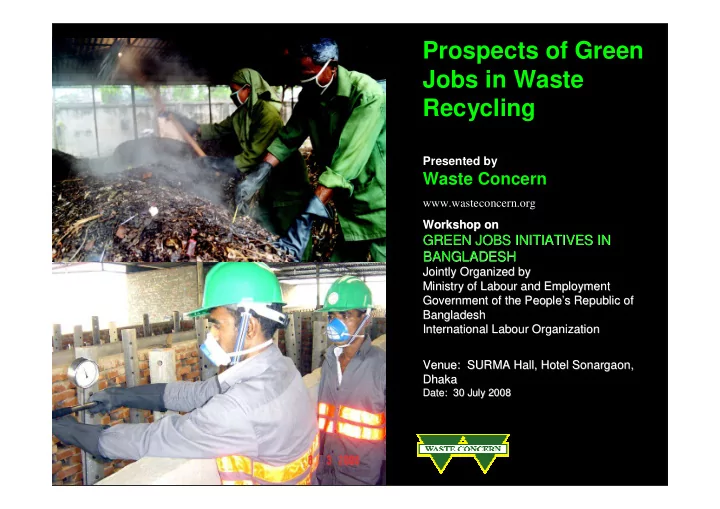
Prospects of Green Jobs in Waste Recycling

Presented by

Waste Concern

www.wasteconcern.org Workshop on Workshop on

GREEN JOBS INITIATIVES IN GREEN JOBS INITIATIVES IN BANGLADESH BANGLADESH

Jointly Organized by Jointly Organized by Ministry of Labour and Employment Ministry of Labour and Employment Government of the People Government of the People’ ’s Republic of s Republic of Bangladesh Bangladesh International Labour Organization International Labour Organization Venue: SURMA Hall, Hotel Sonargaon, Venue: SURMA Hall, Hotel Sonargaon, Dhaka Dhaka

Date: 30 July 2008 Date: 30 July 2008

slide-2
SLIDE 2
  • I.

Overview of Waste Sector in Bangladesh

II.

Baseline Situation of Waste Recycling

III.

Opportunity of Green Jobs from Waste Recycling

IV.

National Policies and Rules Linked with Green Jobs

V.

Barriers Faced

VI.

Way Forward

slide-3
SLIDE 3

Urbanization in Bangladesh

3.27 23.39 28808477 2001

  • 40.00

78440000 2025* 5.43 20.15 20872204 1991 10.63 15.54 13535963 1981 6.62 8.78 6273602 1974 3.75 5.19 2640726 1961 1.69 4.33 1819773 1951 Average Annual Growth Rate (%) Percent of Urban Population Total Urban Population Year 18055 8573 3008 2004 15333 4795 2179 1991 Dhaka City Corporation Area Dhaka Mega City Bangladesh Urban Urban Population Density/Sq.Km. Year

* source: UMP, Asia News, Summer, 1999

Overview of Waste Sector in Bangladesh

slide-4
SLIDE 4

Total Waste Generation in Urban Areas of Bangladesh in 2005

13,332.89

5,826.04 10,839.75 36,042,067 32,765,516 522

  • Total

1,700.65 2,018.66 1,382.64 9,217,612 8,379,647 218 0.15 Other Urban Centers 4,678.40 5,553.22 3,803.58 15,214,306 13,831,187 298 0.25 Pourashavas 142.76 169.46 116.07 386,896 351,724 1 0.3 Sylhet 134.38 159.51 109.25 437,009 397,281 1 0.25 Barisal 321.26 381.34 261.19 967,365 879,422 1 0.27 Khulna 172.83 205.15 140.51 468,378 425,798 1 0.3 Rajshahi 1,548.09 1,837.57 1,258.61 2,622,098 2,383,725 1 0.48 Chittagong 4,634.52 5,501.14 3,767.91 6,728,404 6,116,731 1 0.56 Dhaka Wet season Dry season Average TWG (Ton/day) TWG*** (Ton/day) Population** (2005) Total Population (2005)

  • No. of

City/Town *WGR (kg/cap/day) City/Town

*WGR= Waste Generation Rate, ** Including 10% increase for floating population, ***TWG= Total Waste Generation, which increases 46% in wet season from dry season Source: 1 JICA (2004), 2 Chittagong City Corporation, 3 Field Survey, 4 Sinha (2000), 5 Field Survey, 6 Sylhet City Corporation, 7, 8 Field Survey

Average per capita urban waste generation rate is estimated as 0.41 kg/capita/day.

slide-5
SLIDE 5
  • 0.60***

47,000 78.44 million 2025 US $ 482**** 0.41** 13,330 32.76 million 2005 US $ 220 0.31* 6493 20.8 million 1991 Per Capita GDP Per Capita Waste Generation Rate in urban areas Kg/cap/day Total Urban Waste Generation (Ton/day) Urban Population Year

* World Bank, 1998, *** Waste Concern, 2005, *** UMP, 1999, **** GOB, 2006

Relationship of GDP & Population with Waste Generation

slide-6
SLIDE 6

Fig 1: Average Physical Composition of Urban Solid Waste

67.65% 9.73% 5.10% 0.26% 1.13% 4.20% 2.50% 0.64% 8.79%

Food & Vegetable Paper Products Plastic, Leather, Rubber Metals Glass and ceramic Wood/ Grass/ Leaves Rags, Textile, Jute Medicine/ Chemical Rocks, Dirt & Misc

High organic matter >>(more than 70%) High moisture content >>(more than 50%) Low calorific value >>(less than 1000 Kcal/Kg) Lack of space for disposal of solid waste

slide-7
SLIDE 7

WASTE GENERATION IS RAPIDLY INCREASING

slide-8
SLIDE 8

Unsanitary Crude Dumping Practice

Mymensingh Town

slide-9
SLIDE 9

Unsanitary Crude Dumping Practice

slide-10
SLIDE 10

Negative Impacts of Unmanaged Waste

LEACHATE

Polluting Ground & Surface Water

VERMINS

Spreading more than

40 Diseases

METHANE GAS Bad Odor & Green House gas

slide-11
SLIDE 11

GLASS ALUMINIUM PLASTIC 500,000 nos. (estimated) poor from the informal sector involved in recycling trade in Bangladesh 120,000 nos. poor from informal sector are involved in recycling trade chain of Dhaka city PAPER BONES POLYTHENE

Baseline Situation of Waste Recycling

170.00 15.00 4,634.52 Dhaka Savings through recycling per year, (Tk. million) % of Inorganic Waste Recycling** TWG* (Ton/day) City

slide-12
SLIDE 12

`Waste is merely raw material in the

wrong place’,(Talbot, 1920).

Eighty eigght years ago, Fedrick A. Talbot in his book, Millions from Waste wrote this line.

Waste Concern’s Believes …

Strategy for Improvement

slide-13
SLIDE 13

Municipal Waste

  • Domestic
  • Commercial
  • Industrial
  • Street Sweeping
  • Hospital & Clinical Waste

Plastic Waste Recycling Lead Acid Battery Recycling Organic Waste Recycling

Opportunity of Green Jobs from Waste Recycling

Landfill Gas Extraction

slide-14
SLIDE 14

ENVIRONMENTAL AND HEALTH PROBLEMS IN URBAN AREAS DUE TO UNMANAGED WASTE ORGANIC MATTER DEPLETION IN THE SOIL OF RURAL AREAS

ADDRESSING TWO MAJOR PROBLMS

SOLUTION

Composting Organic Waste

Composting of Organic Waste

slide-15
SLIDE 15

Input

Collection

(Organic Waste From Markets)

Saving DCC cost

Process

Aerobic Composting Saving Landfill Area 700 tons/ day

  • f waste collection

Starting from 100 tons/day Job Creation 400 new jobs

Pro-poor element

Creating 800 new jobs Focusing on Waste Pickers Health Insurance Daycare Center Free Meal

Pro-poor element

Cheaper Less Irrigation Soil Quality Improved Higher Yield Leads to higher income

Pro-poor element 700 Tons/day Capacity Clean Development Mechanism (CDM) Based Composting Project in Dhaka (being implemented by Waste Concern) Output

Compost (50,000 tons/year) Producing environment friendly product Carbon Credits (89,000 ton Co2e)

slide-16
SLIDE 16

Prospects of Harnessing Kyoto Protocol and CDM to Create Green Job

Emission reduction credits (cer/ver) Industrialized country Project Reducing GHG emissions in developing country Investment $$

GHG emission potential from Urban Organic Waste of Bangladesh: 2 .19 million ton CO2e / year

slide-17
SLIDE 17

Before-After: Waste Collection System

Improved Covered Collection Present Collection Practice

slide-18
SLIDE 18

Aerobic Composting System

slide-19
SLIDE 19

Temperature Monitoring Quality Control

Aeration Control Regular Oxygen Monitoring

Process Quality Control

slide-20
SLIDE 20

Giving Better Working Environment

slide-21
SLIDE 21

Organic Cotton Production in Bogra

slide-22
SLIDE 22

Organic Crops

slide-23
SLIDE 23

Replication in Rural Areas of Bangladesh

slide-24
SLIDE 24

Organic Waste COMPOST PLANT

Joint Venture of WC, WWR, FMO & Triodos Bank of NL

DCC CDM Board

Project Investment Harnessing CDM Project Approval

PUBLIC PRIVATE COMMUNITY

Giving concession agreement for15 years

  • Direct Collection from Vegetable

markets

  • Paying CBOs/NGOs for waste

delivery

  • Promoting source separation and

community participation

PARTNERSHIP MODEL UNDER CDM PROJECT

BOI

Compost Compost CER (carbon credits) CER (carbon credits) Rural Farmers Urban Population International Market www.wasteconcern.org

Attracted 12 million Euro

slide-25
SLIDE 25

Opportunity of Green Jobs from Composting

Jobs for compost plant: 9,800 nos. Jobs for collection of waste: 4,200 nos.

Urban Municipal Waste

14,000 tons/day

Green Jobs

14,000 nos.

Composting

slide-26
SLIDE 26

Mitigation

A d a p t a t i

  • n

Mitigation-Adaptation Loop

slide-27
SLIDE 27

Electricity Generator LANDFILL GAS

Landfill Gas Extraction

This project will recover methane gas which is a major Green House Gas (GHG) from waste dumping site at Matuail and also to generate 3 MW (minimum) and 6 MW (maximum) of electricity, using the recovered methane gas. CDM project will create at least 250 new jobs for the urban poor. Enhance the life of the Matuail landfill site upto 2020, with no financial cost to DCC. Promote technology transfer and capacity building

  • f DCC in solid waste management.

Promoting Public-Private Partnership in solid waste management.

CDM Based Landfill Gas Extraction Utilization at Matuail Landfill Site in Dhaka, Bangladesh (approved by GoB and UNFCCC)

slide-28
SLIDE 28

Plastic Waste Recycling

slide-29
SLIDE 29

Existing Scenario in Dhaka

Plastic Waste Disposed 130 tons/day 47,450 tons/year With no Intervention/ Promotion by Public Agency

BENEFITS:

  • Generating 21,000 jobs
  • Saving DCC expenditure of Tk.

3.08 crore by avoiding plastic waste

  • Saving Foreign currency of US $

51 million/ year by avoiding import

  • f virgin plastic.

70% Recycled and used in the country (Except PET) 33,215 tons/year

  • Promotion of separation of waste
  • Separate collection (two bin system)
  • Promotion of EMS (mentioned in

PRSP) No Financial Requirement from

  • Government. Requires only

policy support 95% Recycled efficiency

BENEFITS:

  • Create Additional Jobs
  • Saving DCC Expenditure 4.2

Crore/year

  • Saving foreign currency of US $

69.35/year

  • Less Plastic waste disposed in

land and reduced environmental pollution.

  • Better working environment and

income for people involved in recycling trade.

  • Surplus pellets may be exported

like PET if local market demand is met. Plastic Waste Disposed 130 tons/day 47,450 tons/year

Proposed Intervention

Plastic Waste Recycling

slide-30
SLIDE 30

Lead Acid Battery Recycling

Recovered Lead: 6000 ton/Year Savings: 4.73 millon US$/year

(avoiding lead import using foreign currency (60% recycling rate at present)

Jobs Created: 6000 new jobs

Vehicles

1 00000 200000 300000 400000 500000 600000 700000 800000 900000

1 9 9 5

  • 9

6 1 9 9 6

  • 9

7 1 9 9 7

  • 9

8 1 9 9 8

  • 9

9 1 9 9 9

  • 2
  • 1

2 1

  • 2

2 2

  • 3

2 4

  • 5

( P r

  • j

e c t e d ) 2 9

  • 1

( P r

  • j

e c t e d )

Number of Vehicles on Road and Their Projection

slide-31
SLIDE 31

National Policies and Rules Linked with Green Jobs

POLICY

  • National Policy for Water Supply and Sanitation, 1998

According to this policy the government shall take measures for recycling of waste as much as possible and use

  • rganic waste materials for compost and bio-gas production;
  • Draft National Urban Policy- 2006

CDM and Recycling has been emphasized in this policy

RULES

  • Lead Acid Battery Recycling and Management Rules, 2006: Under this rules collection and recycling has been
  • improved. This rules is based on a detail study carried out by Waste Concern on 2005 under SEMP.
  • Draft National Solid Waste Management Handling Rules, 2005: 3R principal has been used. This rule has been

prepared by Waste Concern under SEMP.

STRATEGY

  • Poverty Reduction Strategy Paper (PRSP) 2005: Here EMS has been promoted. To improve the solid waste

management situation, special focus is given to segregation of waste at source along with the promotion of recycle, reduce and reuse of industrial and other solid waste etc.

  • National Sanitation Strategy 2005: Its goal is to achieve 100% sanitation coverage by 2010. Here emphasis on

resource recovery and recycling has been given as top priority to improve urban sanitation situation instead of disposal.

ACTION PLAN

  • Dhaka Environment Management Plant 2005

Waste recycling has been promoted, less land filling encouraged, EMS promoted among industries.

  • National Environmental Management Action Plan (NEMAP) (1995):

This is a plan of the Government of Bangladesh (GoB), prepared by the Ministry of Environment and Forest (MoEF) in consultation with people from all walks of life. Waste Concern is promoting 3R, under the Sustainable Environment Management Programme (SEMP) of NEMAP.

  • Solid Waste Management Action Plan for Eight Secondary Towns in Bangladesh (2005): Under the

Secondary Towns Integrated Flood Protection (Phase-2) Project of Local Government Engineering Department, 31. This strategy is based on based on 4 R principle i.e. reduce, reuse, recycle and recover of the waste.

DECLARATION

  • Dhaka Declaration 2004 on Waste Management by SAARC countries during 10–12 October 2004. SAARC

countries agree to encourage NGOs and private companies to establish community based composting, segregation

  • f waste at source, separate collection and resource recovery from wastes with particular focus on composting.
slide-32
SLIDE 32

At present there is no clear policy or tax incentive package

  • ffered by the government to encourage private sectors to

go for Green Jobs Regulatory barriers should be removed.

For Example we needed 44 (forty four) permissions/clearance required for this project before implementation and 2 (two) are required after the production compost.

Lack of awareness, knowledge and capacity about Green Jobs Lack of Public Private & Community Partnership Lack of Easy financial support by Banks/financing/grants R & D should be promoted by government and external support agencies considering the local socio-economic and climatic condition.

Barriers Faced

slide-33
SLIDE 33

Way Forward

Carbon Financing is the driving force to promote Green Jobs; We need to simply lengthy process/barrier required for implementation of projects creating green jobs (example CDM based projects) ; Many projects such as composting, biogas, improved stove, forestry can be implemented having pro-poor elements. We need to identify these kind of projects through baseline inventory which has both the adaptation and mitigation benefits; and There are many investors keen to invest in projects which has both mitigation and adaptation benefits