SLIDE 1 Proposed Revisions to the New York State LOTE (World Languages) Standards
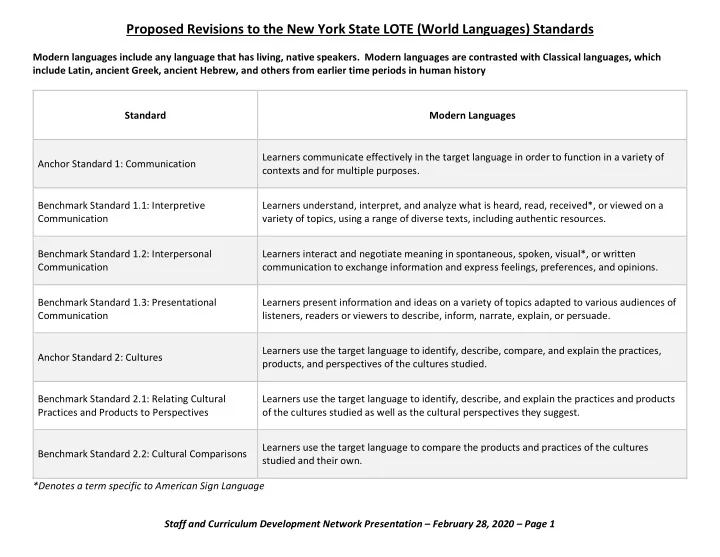
Staff and Curriculum Development Network Presentation – February 28, 2020 – Page 1 Modern languages include any language that has living, native speakers. Modern languages are contrasted with Classical languages, which include Latin, ancient Greek, ancient Hebrew, and others from earlier time periods in human history Standard Modern Languages Anchor Standard 1: Communication Learners communicate effectively in the target language in order to function in a variety of contexts and for multiple purposes. Benchmark Standard 1.1: Interpretive Communication Learners understand, interpret, and analyze what is heard, read, received*, or viewed on a variety of topics, using a range of diverse texts, including authentic resources. Benchmark Standard 1.2: Interpersonal Communication Learners interact and negotiate meaning in spontaneous, spoken, visual*, or written communication to exchange information and express feelings, preferences, and opinions. Benchmark Standard 1.3: Presentational Communication Learners present information and ideas on a variety of topics adapted to various audiences of listeners, readers or viewers to describe, inform, narrate, explain, or persuade. Anchor Standard 2: Cultures Learners use the target language to identify, describe, compare, and explain the practices, products, and perspectives of the cultures studied. Benchmark Standard 2.1: Relating Cultural Practices and Products to Perspectives Learners use the target language to identify, describe, and explain the practices and products
- f the cultures studied as well as the cultural perspectives they suggest.
Benchmark Standard 2.2: Cultural Comparisons Learners use the target language to compare the products and practices of the cultures studied and their own. *Denotes a term specific to American Sign Language
SLIDE 2 Proposed Revisions to the New York State LOTE (World Languages) Standards
Staff and Curriculum Development Network Presentation – February 28, 2020 – Page 2
Modern Languages – Proposed Themes & Topics by Checkpoint
- A. Identity & Social Relationships
A B C Identity X X X Family & Social Relationships X X X Celebrations, Customs, & Traditions X X X
A B C Food & Meal Taking X X X House & Home X X X School Life & Education X X X Travel X X X Leisure X X X Communities & Neighborhood X X X Shopping X X X Earning a Living X X
- C. Science, Technology and the Arts
A B C Health & Wellness X X X Physical Environment, Climate, Weather, & Geography X X X Technology, Media, & Social Media X X X The Arts X X
- D. Global Awareness & Community Engagement
A B C Environmental Issues & Sustainability X X Social Justice & Human Rights X
SLIDE 3
Proposed Revisions to the New York State LOTE (World Languages) Standards
Staff and Curriculum Development Network Presentation – February 28, 2020 – Page 3 Classical languages include Latin, ancient Greek, ancient Hebrew, and others from earlier time periods in human history. Standards Classical Languages Anchor Standard 1: Communication Learners communicate effectively in classical languages by using a variety of texts and resources for multiple purposes, while making interdisciplinary language connections. Benchmark Standard 1.1: Interpretive Communication Learners understand, interpret, and analyze what is heard, read, or viewed on a variety of topics, drawing on a range of diverse texts, including authentic resources. Benchmark Standard 1.2: Presentational Communication Learners present information and ideas on a variety of topics adapted to various audiences of listeners, readers or viewers to describe, inform, narrate, explain, and persuade. Benchmark Standard 1.3: Interpersonal Communication Learners interact and negotiate meaning in spoken or written conversations to exchange information and express feelings, preferences, and opinions. Anchor Standard 2: Cultures Learners use knowledge of classical languages to identify, describe, compare, and explain the practices, products and perspectives of ancient and other cultures. Benchmark Standard 2.1: Relating Cultural Practices and Products to Perspectives Learners use knowledge of classical languages to identify, describe, and explain the practices and products of the cultures studied as well as the cultural perspectives they reveal. Benchmark Standard 2.2: Cultural Comparisons Learners use knowledge of classical languages to reveal and compare the products and practices of the cultures studied and their own.
SLIDE 4 Proposed Revisions to the New York State LOTE (World Languages) Standards
Staff and Curriculum Development Network Presentation – February 28, 2020 – Page 4
Classical Languages – Proposed Themes & Topics by Checkpoint
A B C Identity and Family Life Names, gender, age, nationality,
- ccupations, physical characteristics,
parts of the body, personality traits, health, clothing Family members, childhood, family life, house, apartment, country home, rooms, furnishings, garden Names, gender, age, nationality,
- ccupations, physical characteristics,
parts of the body, personality traits, health, clothing Family members, childhood, family life, birth, coming of age, marriage, death & funerals, house, apartment, country home, rooms, furnishings, garden Names, gender, age, nationality,
- ccupations, physical characteristics,
parts of the body, personality traits, health, clothing Family members, childhood, family life, birth, coming of age, marriage, death & funerals, house, apartment, country home, rooms, furnishings, garden Physical Environment, Geography, and Travel City and town, weather, animals, calendar Relevant geography (e.g., Italy, Greece, and the Mediterranean) Roads City and town, weather, animals, calendar, natural disasters, time Relevant geography (e.g., provinces) Roads, modes of travel, mail and letter writing City and town, weather, animals, calendar, natural disasters, time Relevant geography (e.g., Asia Minor) Roads, modes of travel, mail and letter writing Daily Life and Societal Institutions Pastimes, athletics, circus, arena Everyday family fare Number system, school life Social class structure Pastimes, athletics, circus, arena, baths Everyday family fare, banquets Number system, school life, preparation and training for occupations, structure and curriculum Social class structure Pastimes, athletics, circus, arena, baths, theatre Everyday family fare, banquets Number system, school life, preparation and training for occupations, structure and curriculum Social class structure
SLIDE 5 Proposed Revisions to the New York State LOTE (World Languages) Standards
Staff and Curriculum Development Network Presentation – February 28, 2020 – Page 5 A B C History, Government & Economics Historical periods and forms of government Historical periods, biographies of important historical figures, structure and government organization, political issues, the military, conflict and conquest, economic class structure, shops, commerce and trade, coinage Historical periods, biographies of important historical figures, structure and government organization, political issues, the military, conflict and conquest, law, economic class structure, shops, commerce and trade, coinage Religion, Myths & Legends Deities: functions and attributes Gods, goddesses, heroes, traditional stories and folklore, ethics, mores and values Deities: functions and attributes, traditions and customs, festivals and holidays Gods, goddesses, heroes, traditional stories and folklore, ethics, mores and values Deities: functions and attributes, traditions and customs, festivals and holidays, augury, sacrifice Gods, goddesses, heroes, traditional stories and folklore, ethics, mores and values Literature, Architecture & Art Buildings, structures, and works of art (e.g., mosaics, frescos) Buildings, structures, and works of art (e.g., mosaics, frescos), sites and city planning, painting, sculpture, literature,
Buildings, structures, and works of art (e.g., mosaics, frescos), sites and city planning, painting, sculpture, literature,
- ratory and rhetoric, philosophy
(Topics in bold are new for the Checkpoint.)
SLIDE 6
Proposed Revisions to the New York State LOTE (World Languages) Standards
Staff and Curriculum Development Network Presentation – February 28, 2020 – Page 6
Checkpoint Target Performance Range A Novice Mid-High B Intermediate Low-Mid C Intermediate Mid-High
Candace Black World Language Associate Office of Bilingual Education and World Languages New York State Education Department 89 Washington Avenue, EB505W Albany, NY 12234 (518) 473-7505 Candace.black@nysed.gov
http://www.nysed.gov/world-languages