Propagation by Cuttings Propagation by Cuttings Rooting success - - PowerPoint PPT Presentation

propagation by cuttings propagation by cuttings
SMART_READER_LITE
LIVE PREVIEW

Propagation by Cuttings Propagation by Cuttings Rooting success - - PowerPoint PPT Presentation

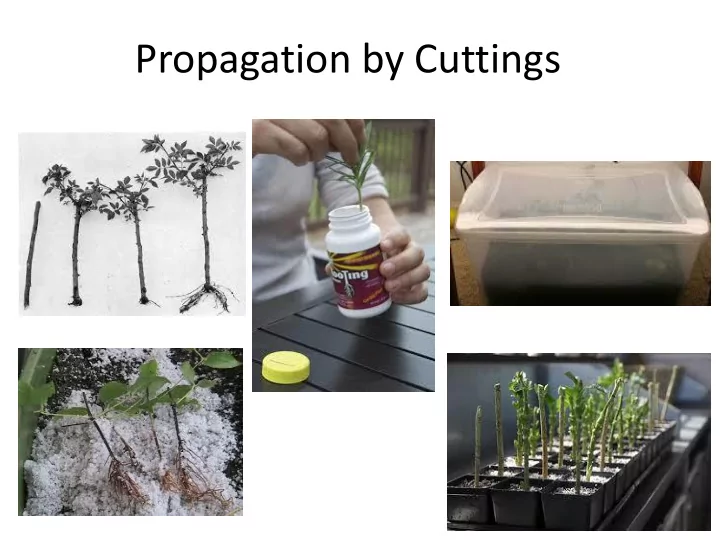
Propagation by Cuttings Propagation by Cuttings Rooting success is almost entirely dependent on controlling moisture, both in the potting media and in the atmosphere around your cuttings. Soil moisture and humidity are crucial. The


slide-1
SLIDE 1

Propagation by Cuttings

slide-2
SLIDE 2

Propagation by Cuttings

  • Rooting success is almost entirely dependent on controlling moisture, both in the

potting media and in the atmosphere around your cuttings. Soil moisture and humidity are crucial.

  • The cuttings will rot if their soil is too wet. If it is too dry, the new roots will desiccate and
  • die. Using a rooting media that maintains proper levels of air and moisture greatly increases

rooting success.

  • When choosing a rooting medium you need to have a mix which allows for moisture to be

retained, but one which does not allow the water to completely saturate the medium so that there is no air (oxygen) in the medium.

  • Texture or coarseness is an important factor in balancing these two requirements. The

smaller particle sizes tend to allow the medium to become saturated, excluding all air and holding too much moisture. Larger particles will hold less moisture and allow air. Most sand is too fine to prevent saturation. Potting soils hold too much moisture.

  • Coarse vermiculite produces very good results. The coarse texture allows for good air

penetration in the media, while the vermiculite holds the moisture.

  • A mix of 60% Perlite and 40% finer vermiculite also works well.
slide-3
SLIDE 3

Propagation by Cuttings

  • If the humidity is too high, mold is

a likely outcome, and if it is too low, the cuttings are at risk of desiccation before rooting occurs.

  • Humidity can be controlled in a

greenhouse, or using something simple like a plastic storage box with the lid substantially closed.

  • Here I used a plastic bag over a

black nursery pot.

slide-4
SLIDE 4

Propagation by Cuttings

Pre-rooting Cuttings

  • Wrap dormant cuttings in lightly

dampened paper towels or newspaper.

  • Then place them in a sealed plastic bag

and put them in a warm place.

  • In a few weeks, you will see root initials

begin to form, and then roots. Be patient; each variety is different and each cutting, even when from the same tree, can differ in its response.

slide-5
SLIDE 5

Propagation by Cuttings

  • Once the cuttings have formed roots they are removed from the bag

for transfer to a clear cup.

  • This "bag" technique can be

used on all sizes of cuttings. I have done some as large as 2" in diameter.

slide-6
SLIDE 6

Propagation by Cuttings

  • Transfer the cuttings from

bags to 26-oz. clear plastic cups containing a rooting medium and with holes drilled in their bottoms.

  • The pre-rooted cuttings are

placed in these clear cups for further root

  • development. Remember

that deeper cups are better than short, squat cups.

slide-7
SLIDE 7

Propagation by Cuttings

  • The pre-rooted cuttings in clear

plastic cups are placed on wire racks, in plastic storage boxes. These boxes hold 20 cuttings and can be used to control humidity.

  • The screen "racks" are used to keep

the cups above the water that collects at the bottom of the storage

  • box. If the cups sit in water, the

rooting media wicks up the water rotting the cuttings. But the water underneath the screen provides humidity to maintain moisture in the cutting.

slide-8
SLIDE 8

Propagation by Cuttings

  • Place the box of cuttings in an area

that receives filtered sunlight. Too much sun can heat up the box and “cook” your cuttings.

  • Open the lid of the box a little bit.

This allows fresh air to enter, which is important in controlling mold. If the lids are wide open, you lose too much humidity.

  • The water at the bottom of the

crate, under the screen, replenishes the humidity lost by having the lids open.

slide-9
SLIDE 9

Propagation by Cuttings

  • Eventually the cuttings will develop roots.

Each cutting may develop at a different rate.

  • An important principle to remember is that

roots and leaves have no relationship to each other.

  • Under identical conditions, some cuttings

will grow roots, some will grow leaves, and some will grow both.

slide-10
SLIDE 10

Propagation by Cuttings

  • You cannot presume root

development from

  • bserving leaf
  • development. This is why

clear cups are beneficial; they allow me to actually see whether roots are developing.

  • Here is a cutting that

looked strong and healthy but there was little root

  • development. This is not a

good candidate for transplanting and should be kept in a very high humidity environment.

slide-11
SLIDE 11

Propagation by Cuttings

  • This cutting has very

vigorous root development seen through the cup as well as good leaf development.

  • It is now removed from the cup

and ready for repotting into a 1 gallon pot.

slide-12
SLIDE 12

Propagation by Cuttings

  • An advantage of vermiculite and perlite as a rooting medium is the

ease of removing the rooted cutting for repotting. Mixes that contain

  • rganic materials tend to stick to the sides of the cups, which leads to

root damage.

  • If the roots stick to the

sides of the cup, squeeze and flex the

  • cup. The sides of the

cup can bend at sharp angles, and the roots will not. The cup may crack, but even cracked cups can be reused because they don't need to hold water.

slide-13
SLIDE 13

Propagation by Cuttings

  • Transfer the cuttings to 1-gallon pots

containing a potting mix of 60% Perlite and 40% potting soil.

  • Acclimate them to the outdoors, usually

putting them in shade with augmented humidity for a few days, and gradually introducing them to more sunlight over a period of weeks.

  • At this stage, potting mix moisture

control is still critical. Too much moisture will still cause root rot and plant failure.

  • When I see roots in the drain holes, I

transfer the trees to 2-gallon pots while reversing the mix to 40% perlite and 60% potting soil.

slide-14
SLIDE 14

Propagation by Cuttings