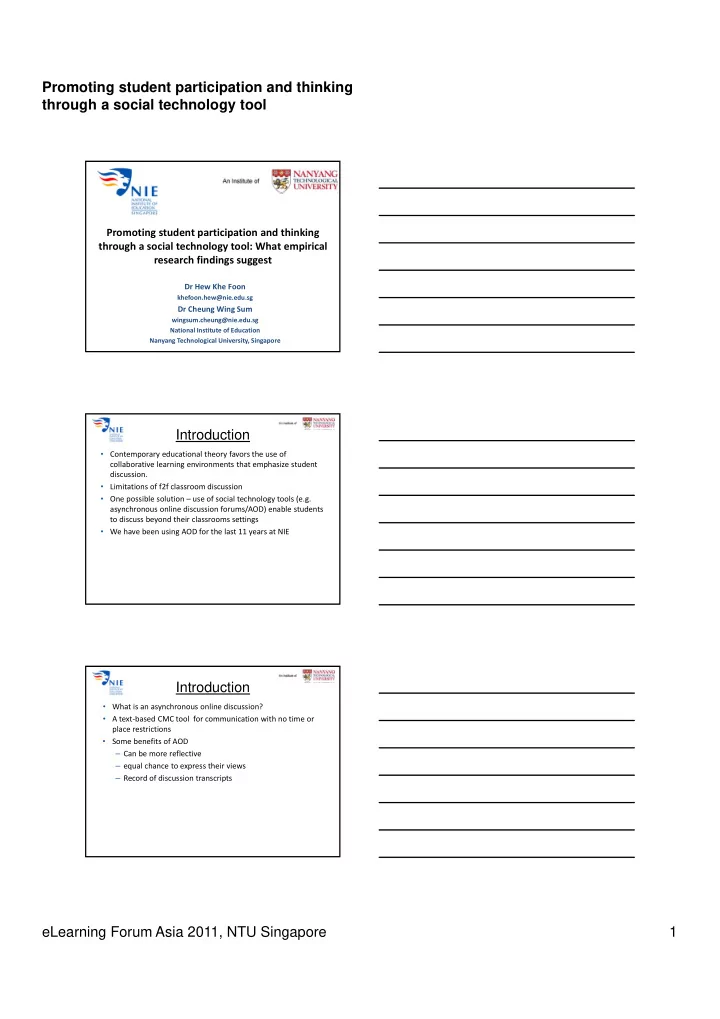
Promoting student participation and thinking through a social - - PDF document

promoting student participation and thinking through a
SMART_READER_LITE
LIVE PREVIEW

Promoting student participation and thinking through a social - - PDF document

Promoting student participation and thinking through a social technology tool Promoting student participation and thinking through a social technology tool: What empirical research findings suggest Dr Hew Khe Foon khefoon.hew@nie.edu.sg Dr Cheung


slide-1
SLIDE 1

Promoting student participation and thinking through a social technology tool eLearning Forum Asia 2011, NTU Singapore 1

Promoting student participation and thinking through a social technology tool: What empirical research findings suggest

Dr Hew Khe Foon

khefoon.hew@nie.edu.sg

Dr Cheung Wing Sum

wingsum.cheung@nie.edu.sg National Institute of Education Nanyang Technological University, Singapore

Introduction

  • Contemporary educational theory favors the use of

collaborative learning environments that emphasize student discussion.

  • Limitations of f2f classroom discussion
  • One possible solution – use of social technology tools (e.g.

asynchronous online discussion forums/AOD) enable students to discuss beyond their classrooms settings

  • We have been using AOD for the last 11 years at NIE

Introduction

  • What is an asynchronous online discussion?
  • A text‐based CMC tool for communication with no time or

place restrictions

  • Some benefits of AOD

– Can be more reflective – equal chance to express their views – Record of discussion transcripts

slide-2
SLIDE 2

Promoting student participation and thinking through a social technology tool eLearning Forum Asia 2011, NTU Singapore 2

  • Students hardly participate in AODs (Hewitt, 2005; Wan &

Johnson, 1994).

  • Students do not necessary exhibit in‐depth critical thinking in
  • nline discussions (Burt, Grady, & McMann, 1994; Bullen, 1998;

Hew & Cheung, 2003; Khine, Yeap, & Tan, 2003; Landsman & Gorski, 2007).

Problem Statement

  • To share the findings of our studies conducted in the last 11

years: A) How to increase student online participation? B) How to foster student in‐depth critical thinking?

Purpose of this presentation

  • Use of peer facilitation instead of instructor facilitation.
  • Why peer facilitation?

– An instructor‐led facilitation could result in instructor‐ centered discussion (Light, Nesbott, Light & White, 2000) – An instructor‐led discussion could also limit students’ active participation and voice (Pearson, 1999)

Context of our research

slide-3
SLIDE 3

Promoting student participation and thinking through a social technology tool eLearning Forum Asia 2011, NTU Singapore 3

  • Research study 1
  • 16 participants
  • Student is the facilitator of own forum to encourage peers to

discuss about their lesson plan

  • Data: students’ reflection logs, questionnaires, interviews,
  • nline discussion postings.
  • Research Qn: Why students participate or not participate in
  • nline discussion?

A) How to increase online participation?

  • Research study 2
  • 27 participants
  • Student is the facilitator of own forum to encourage peers to

discuss about their lesson plan

  • Data: online observations of discussion postings, student

interviews

  • Research Qn: What habits of mind shown by student facilitators

might influence the degree of participation?

A) How to increase online participation?

  • Examined the following habits of mind:

– Awareness of own thinking – Open‐mindedness – Taking a position when the situation warrants it – Sensitive to others

Habits of Mind

slide-4
SLIDE 4

Promoting student participation and thinking through a social technology tool eLearning Forum Asia 2011, NTU Singapore 4

Major Lessons Learned

1) Emphasize efforts to nurture relational capital among students before AOD.

Table 1: Why students choose to participate Factor Reason % Relational capital The forum owner is my friend 93% The forum owner acknowledges my contribution 80% The forum owner offers to contribute in my forum in return for my contribution 40%

A) How to increase online participation?

2) Select topics that directly relate to students’ interests & needs

Factor Reason % Discussion activity

  • r topic

The ongoing online discussion is very interesting 60%

A) How to increase online participation?

3) Use open‐ended discussion topics that allow

participants to give their own unique/personal viewpoints 4) Facilitators should display the following 2 habits of mind more frequently:

– Is aware of own thinking – Open‐mindedness

A) How to increase online participation?

slide-5
SLIDE 5

Promoting student participation and thinking through a social technology tool eLearning Forum Asia 2011, NTU Singapore 5

  • Research Study 1
  • Participants: Graduate students (10 discussion forums)
  • Data: Online postings, interviews
  • Research question:

– What is the quality of thinking, in terms of critical thinking, demonstrated by the participants in the online discussion? – Any differences between higher‐level and lower‐level groups in terms of their group characteristics and the facilitating styles adopted by the student facilitators?

  • Forums ranked according to their score of in‐depth critical

thinking instances. – Top 30% and bottom 30% forums were analyzed

B) How to foster in-depth CT? Possible facilitation techniques

  • Top 30% forums:

– Persistent with the use of questions (e.g., questions posed throughout the discussion, follow‐up questions on some earlier ideas) – Acknowledged participants’ contribution – A variety of questions used

B) How to foster in-depth CT? B) How to foster in-depth CT? Types of questions used in top 30% forums:

  • Essentially Socratic questions

– Questions that require comparison – Questions that require learners to explore other views/options – Questions that require justification – Questions that require reflection – Questions that probe assumptions

slide-6
SLIDE 6

Promoting student participation and thinking through a social technology tool eLearning Forum Asia 2011, NTU Singapore 6

B) How to foster in-depth CT?

  • Question that require comparison.

– E.g., do you think this is better in comparison to my previous version?

  • Questions that require learners to explore other
  • ptions.

– E.g., one way I am thinking of is to let each text grow big for easy reading before shrinking back to smaller size. Any other suggestions that I can explore?

B) How to foster in-depth CT?

  • Questions that require justification.

– E.g. ,is it sufficient to engage your interest and entice you to progress through the course after a heavy day of work? If yes, which are the activities do you find them motivating and make you more interested? If not, what type of activities will motivate you as a learner?

B) How to foster in-depth CT?

  • Questions that require reflection.

– E.g., although I'm doing colors, but I kind of get confused at times to how many colors should be used per slide and that if too many colors are used in a slide will it be too cluttered and distracting. Do you have the same problem also?

slide-7
SLIDE 7

Promoting student participation and thinking through a social technology tool eLearning Forum Asia 2011, NTU Singapore 7

B) How to foster in-depth CT?

  • Questions that probe assumptions.

– E.g., I’m not very certain about using narration to enhance my course delivery and reduce the text

  • used. In my opinion, colors are more visual things,

hence, I thought it will be more appropriate to do away with narration. But then again, am I too narrow minded in making that assumption?

B) How to foster in-depth CT?

  • Bottom 30% forums:

– Orphaned ideas, ideas not followed up – Few questions posed (typically at the start of the discussion) – Seldom acknowledged participants’ contribution

  • Research Study 2
  • Chinese writing project in a primary school
  • N=29 primary four students (8 boys, 21 girls)
  • Students worked in groups of 4s
  • Students played different roles

B) How to foster in-depth CT?

slide-8
SLIDE 8

Promoting student participation and thinking through a social technology tool eLearning Forum Asia 2011, NTU Singapore 8

Sample activity (Chinese writing project) Sample activity (Chinese writing project)

Roles of students

Roles Description Torch start the thread, ask questions, keep discussion going Devil advocate Keep on challenging people’s opinions Pigeon Try to make peace, find common grounds, consensus Vacuum cleaner Summarizing, concluding, suggesting new topics/ideas to explore & discuss

slide-9
SLIDE 9

Promoting student participation and thinking through a social technology tool eLearning Forum Asia 2011, NTU Singapore 9

Some findings (Chinese writing project)

  • Majority of students also preferred this mode of

instruction, compared to group discussion in class (76%) or teachers’ questioning in class (76%).

  • Majority reported that they think harder (in‐depth

critical thinking) using online discussion, compared with group f2f discussions (83%) and classroom questioning by teacher (79%).

THANK YOU