PAEC Technical Advisory Committee Meeting #2 PAEC Master Community - - PowerPoint PPT Presentation

paec technical advisory committee meeting 2
SMART_READER_LITE
LIVE PREVIEW

PAEC Technical Advisory Committee Meeting #2 PAEC Master Community - - PowerPoint PPT Presentation

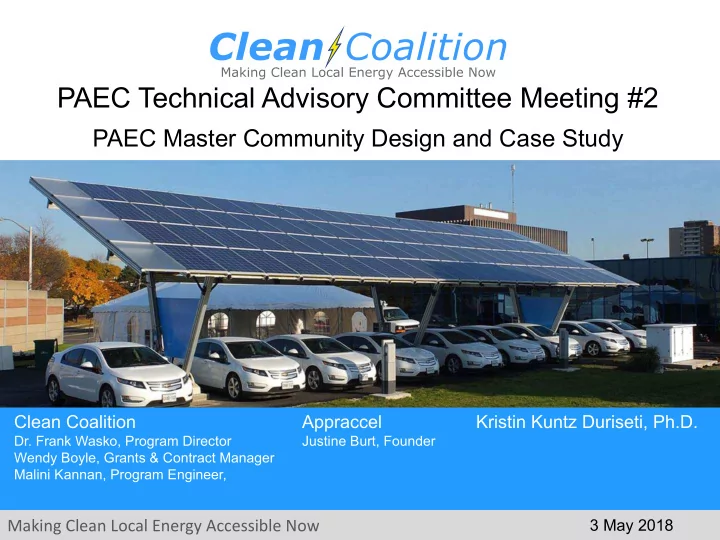
PAEC Technical Advisory Committee Meeting #2 PAEC Master Community Design and Case Study Clean Coalition Appraccel Kristin Kuntz Duriseti, Ph.D. Dr. Frank Wasko, Program Director Justine Burt, Founder Wendy Boyle, Grants & Contract


slide-1
SLIDE 1

Making Clean Local Energy Accessible Now

PAEC Technical Advisory Committee Meeting #2

PAEC Master Community Design and Case Study

3 May 2018

Clean Coalition Appraccel Kristin Kuntz Duriseti, Ph.D.

  • Dr. Frank Wasko, Program Director

Justine Burt, Founder Wendy Boyle, Grants & Contract Manager Malini Kannan, Program Engineer,

slide-2
SLIDE 2

Making Clean Local Energy Accessible Now 2 GoToWebinar FAQ

  • Webinar recording and slides will be

sent to registered attendees within two business days

  • All webinars are archived on

www.clean-coalition.org and the Clean Coalition’s YouTube channel

  • Submit questions in the Questions

window at any time (window view varies by operating system and browser)

  • Questions will be answered during

the Q&A portion of the event

  • Contact Josh Valentine for webinar

questions: josh@clean-coalition.org

slide-3
SLIDE 3

Making Clean Local Energy Accessible Now 3

PAEC collaborators to date

slide-4
SLIDE 4

Making Clean Local Energy Accessible Now 4

PAEC Reports

Task 2.2 - Best Practices report (Menlo Spark) Task 2.4 - Gap Analysis (Menlo Spark) Task 2.6 – Benefit-Cost Analysis Report of Potential Ordinances (DNV GL) Task 2.8 - Interview with Public Agencies, Installers, and Vendors (Sovereign Energy) Task 2.10 - Policy Recommendations & Guidelines for Permitting Energy Storage (Sovereign Energy) Task 2.12 - Model Ordinances for San Mateo County (DNV GL) Task 2.14 - AEC Regulatory and Permitting Recommendations (DNV GL) Task 3.II - Backup Power Valuation Methodology (Sovereign Energy) Task 3.2 – Lending, Customer Compensation, and Government Incentive Report: Strategies and Incentives Available to Advanced Energy Communities In and Around San Mateo County, California (High Noon Advisors) Task 3.4 + 3.10 - Summary of Financial Pro-Forma Delineating the Cost of Capital, Tenor, Risk/Return Profile, and Value Streams for Behind the Meter Energy Storage (Sovereign Energy) Task 3.6 - Dispatch Model for Energy Storage System (Sovereign Energy) Task 3.12 - Successful Energy Storage Financing Program (Sovereign Energy) Task 3.14 – Economic Benefit-Cost Analysis of Energy Efficiency and Fuel Switching Measures: Prototypical Residential Multifamily Building (DNV GL) Task 3.14 – Economic Benefit-Cost Analysis of Energy Efficiency and Fuel Switching Measures: Prototypical Municipal Building (Fire Station) (DNV GL) Task 3.14 – Economic Benefit-Cost Analysis of Energy Efficiency and Fuel Switching Measures: Prototypical Office Building (DNV GL) Task 3.14 – Economic Benefit-Cost Analysis of Energy Efficiency and Fuel Switching Measures: Prototypical Retail Building (DNV GL) Task 3.14 – Economic Benefit-Cost Analysis of Energy Efficiency and Fuel Switching Measures: Prototypical School Building (DNV GL) Task 3.16 - Economic Benefit-Cost Analysis of Electric Vehicle Charging Infrastructure (Sven Thesen & Associates) Task 3.18 - Energy Tracking/Benchmarking Tool Report – Building Energy Management Systems: An Advanced Energy Solution for Commercial Buildings (Office of Sustainability, County of San Mateo) Task 3.i - Report Summarizing Literature Review & ISO/RTO Tariff Analysis (Sovereign Energy) Task 4.2 – Best Practices: Interconnection for Local, Commercial-Scale, Renewable Energy Projects – Streamlining the Interconnection of Advanced Energy Communities to the Grid (Clean Coalition) Task 4.4 – Design of Pilot for Testing Streamlined Interconnection Procedures (Clean Coalition) Task 5.2 – Solar Emergency Microgrid Site Design and Deployment Plan (Clean Coalition) Task 6.1 – Potential Locations for the Electric Vehicle Charging Infrastructure Master Plan (Sven Thesen & Associates) Task 7.1 – Technical and Economic Feasibility of Sustainability Features for the Atherton Civic Center Report (WRNS Studio) Task 7.2 – Scorecard of Sustainability Features (Clean Coalition) Task 8 – Solar Siting Survey (Clean Coalition) Task 10 – PAEC Community Master Plan (Clean Coalition) Task 11 – Evaluation of Project Benefits (Clean Coalition) Task 12.2 – Initial Fact Sheet (Clean Coalition) Task 12.9 – Final Technology/Knowledge Transfer Plan (Clean Coalition)

slide-5
SLIDE 5

Making Clean Local Energy Accessible Now 5

PAEC Media Releases (Blogs and News Article)

Blog Posts: Blog #1 - Peninsula Advanced Energy Community launches, will provide framework for the future of clean energy, posted Blog #2 - Palo Alto is aiming high by going low… carbon Blog #3 - (Task 2) - The reality of implementing 100% clean local energy Blog #4 - Solar Siting Survey of the San Mateo County Region and Core PAEC Region Blog #5 - Palo Alto’s Jewish Community Center: Heating and cooling in newer, cleaner ways Blog #6 - A pathway to zero net energy: Atherton, California Blog #7 - Shaping electric vehicle charging infrastructure in Palo Alto Blog #8 - Best practices encouraging clean local energy deployment in California Blog #9 - Connecting renewables to the grid faster… much faster Blog #10 - Collaborating and innovating to expand clean local energy in San Mateo County Blog #11 - No heat molecule left behind: Stanford’s district-level heat recovery system Blog #12 - What Puerto Rico teaches us about power resilience for all communities Blog #13 - Building owners may be losing money by not investing in energy efficiency Blog #14 - Model ordinances: Showing the way to a clean energy future Blog #15 - Energy storage is about to take off Blog #16 - Keeping the lights on after natural disasters Blog #17 - Splitting up with split incentives: How green leases remove barriers to energy efficiency in commercial buildings News Article: “New solar siting survey identifies 65 megawatts of solar potential in southern San Mateo County, California”, posted May 17, 2017 “Solutions for connecting local renewable energy to the grid more quickly”, posted 9/28/2017 Visit www.clean-coalition.org

slide-6
SLIDE 6

Making Clean Local Energy Accessible Now 6

PAEC Webinars

Webinar Title Date Economics for energy efficiency and fuel switching measures for commercial-scale buildings January 2018 How Solar Siting Surveys identify the potential for local solar generation February 2018 The Green Lease and other innovative approaches for energy efficiency March 2018 Electric vehicle charging infrastructure master plan April 2018 Best practices for streamlining interconnection May 2018 Community Master Design for PAEC Phase 2 June 2018

slide-7
SLIDE 7

Making Clean Local Energy Accessible Now 7

PAEC Workshops

Event Date RICAPS Working Group Meeting 8/23/16 RICAPS Multi-City Working Group 2/28/17 Green Lease Language Round Table 5/22/17 RICAPS Multi-City Working Group 6/20/17 RICAPS Multi-City Working Group 7/25/17 RICAPS Multi-City Working Group 8/22/17 Integration Capacity Analysis presentation 8/22/17

slide-8
SLIDE 8

Making Clean Local Energy Accessible Now 8

Summary of PAEC Technology/Knowledge Transfer Activities (blogs, news articles, webinars, and workshops)

PAEC CEC Reports: approximately 200 Blog Posts: Total of 17 to date; various topics supporting and promoting advanced energy communities activities. News Articles: Total of 3 to date: Solar Siting Survey, Solar Emergency Microgrid, and Solutions for connecting local renewable energy to the grid more quickly. Webinars: Total of 4 completed, with 2 upcoming webinar scheduled for May and June 2018. Workshops: Total of 7 (RICAPS workshops which include project updates, Solar Siting Survey, Interconnection best practices, recommended model ordinances for San Mateo County, energy efficiency and fuel switching measures on 5 prototypical buildings, Green Lease Language, Integration Capacity Analysis).

slide-9
SLIDE 9

Making Clean Local Energy Accessible Now 9 Agenda

9:00 AM Welcome & Introductions – Craig Lewis, Executive Director, Clean Coalition 9:10 AM Agenda and PAEC Project Overview – Dr. Frank Wasko, Program Director, Clean Coalition, and PAEC Project Manager 9:20 AM Task 10, PAEC Master Community Design – Presenter: Clean Coalition – Malini Kannan, Program Engineer and Task Lead:

  • The development of the Clean Coalition’s Master Community Design

showcasing our proposed PAEC2 project 10:20 AM Task 10 Q&A 10:50 AM Task 9, PAEC Case Study - Presenters: Appraccel – Justine Burt, Founder & CEO and Task Lead, Kristin Kuntz Duriseti, Ph.D and Task Lead:

  • Describing and analyzing the actions, challenges, and lessons learned in

planning, designing, and obtaining approval for the PAEC

  • How the development of the PAEC will impact savings on electrical

distribution infrastructure 11:50 AM Task 9 Q&A, Next Steps, and Closing Remarks 1:00 PM Adjourn

slide-10
SLIDE 10

Making Clean Local Energy Accessible Now

PAEC T10: Master Community Design

Redwood City Community Microgrid: Innovation and Resilience

3 May 2018

Malini Kannan

Programs Engineer Clean Coalition 650-533-8039 mobile malini@clean-coalition.org

slide-11
SLIDE 11

Making Clean Local Energy Accessible Now 11

Meeting the T10 Goals and Objectives

Goal: Develop a Master Community Design showcasing the Peninsula Advanced Energy Community.

Scoping and conceptual design have been successfully completed. Design includes the deployment of model Solar Emergency Microgrids, Community Microgrids, and large scale EV charging deployments. Designs span various use-cases and expected ownership models.

Objective: Draft PAEC Design Report which will identify locations of the proposed PAEC elements, describe the synergistic AEC, and describe grid connection locations and methods.

Five sites in Redwood City have have completed scoping and conceptual design. The PAEC elements will be connected behind the meter of each site, with several dedicated distributions lines used to connect sites during a grid outage. Synergies include resilience through emergency backup power from microgrid configurations, lower project cost resulting from deploying DER together, and improving the bankability of certain DER by bundling financing.

This scope of work is on track to be fully completed on time and within budget.

slide-12
SLIDE 12

Making Clean Local Energy Accessible Now 12

Summary of Key Findings

Synergies:

Lower total project cost and improved bankability by bundling DER deployments. Implementing Community Microgrids at critical facilities and for critical loads only ensures that communities can receive resilience, while the cost for this resilience is minimized. Designing Community Microgrids for sites that have already implemented energy efficiency measures can save money. Integrating a battery into a site with EV charging can reduce demand charges and reduce the impact of high-power charging on the grid

Permitting: Redwood City Planning and Permitting Departments do not anticipate any roadblocks with permitting photovoltaics, lithium battery energy storage nor electric vehicle chargers. Interconnection: Proposed generating assets (solar and energy storage) can be interconnected within PG&E service territory under the NEM2 or NEM Multiple tariffs.

slide-13
SLIDE 13

Making Clean Local Energy Accessible Now 13

Core PAEC Region with Solar Siting Survey

slide-14
SLIDE 14

Making Clean Local Energy Accessible Now 14

Redwood City Community Microgrid Conceptual Diagram

slide-15
SLIDE 15

Making Clean Local Energy Accessible Now 15

Redwood City Corporate Yard Sobrato Broadway Plaza San Mateo County Corporate Yard Boys & Girls Club Hoover Elementary School Stanford Redwood City Hoover Park Stanford Medicine Outpatient Clinic

Redwood City Disadvantaged Community and Community Microgrid Sites

USPS USPS

slide-16
SLIDE 16

Making Clean Local Energy Accessible Now 16

Redwood City Corporate Yard Sobrato Broadway Plaza San Mateo County Corporate Yard Boys & Girls Club Hoover Elementary School Stanford Redwood City Hoover Park Stanford Medicine Outpatient Clinic

Redwood City Disadvantaged Community and Community Microgrid Sites

USPS USPS

slide-17
SLIDE 17

Making Clean Local Energy Accessible Now 17

Site Name Meters or Buildings Critical Loads NEM Solar [kW AC] FIT Solar [kW AC] Total Solar [kW AC] Battery [kW] Battery [kWh] EVCI (Level 2)

Stanford Redwood City Phase 1 P1, B1-B4 Campus emergency response 886 886 251 2,100 52 Hoover Cluster Hoover School Shelter & food service 73 203 276 29 150 20 Boys & Girls Club Shelter & food service 11 90 101 10 Hoover Park Equipment staging Redwood City Corporate Yard Redwood City Corporate Yard Road and public facility maintenance and repair 136 352 488 58 360 *4 San Mateo County Corporate Yard (SMC Yard) SMC Yard Meter 1 Road and public facility maintenance and repair 65 65 58 240 SMC Yard Meter 2 33 121 154 *4 SMC Yard Meter 3 79 79 Sobrato Broadway Plaza Sobrato Broadway Plaza (multiple meters) Low income housing 1,197 1,197 TBD TBD TBD Sobrato CVS Pharmacy & grocery 83 83 TBD TBD TBD New Deployments TOTAL 1,204 2,125 3,329 396 2,850 82

Deployment Summary

With net metering, only 1.2 MW can be deployed. With a new FIT program, an additional 2.1 MW of local, renewable generation could be deployed in a disadvantaged community.

slide-18
SLIDE 18

Making Clean Local Energy Accessible Now 18

Technical Approach Step 1: Site walk

Conduct site walk to determine solar siting potential, energy storage and EV charging locations, and details of existing electrical infrastructure (meters, AC bus sizing, etc.) Determine on-site load for each meter using 15 minute interval data where available.

slide-19
SLIDE 19

Making Clean Local Energy Accessible Now 19

Technical Approach Step 2: PV system sizing

Size and model multiple PV systems using PVwatts: 1st system: full-scale PV deployment- use all feasible on-site rooftop and parking lot/ open space as defined in the Solar Siting Survey and site walk. 2nd system: net-metered PV system- determine system size based on utility bills. 3rd system: net-metered PV system with EVCI load- if the site is a candidate for EV charging, combine the existing load profile with the project load profile of additional EV chargers. 4th system: FIT PV system- system size required to take full advantage of the available on-site space, but that exceeds the annual generation allowed by NEM2 interconnection.

slide-20
SLIDE 20

Making Clean Local Energy Accessible Now 20

Technical Approach Step 3: Grid-connected Optimization with Esyst

Used Geli's ESyst tool to determine the optimum energy storage size for a grid-connected system that takes advantage of peak shaving and demand charge management. The figure below shows the projected savings for one of the solutions for RWC Yard- 150 kW of PV, and 58kW 240kWh of energy storage.

slide-21
SLIDE 21

Making Clean Local Energy Accessible Now 21

Technical Approach Step 4: Off-Grid Optimization with HomerPRO

To properly size the system for grid-island mode and use of the Community Microgrid during emergency operations, the critical load profile was input into HomerPRO. Critical load is 10% of normal load. The on-site load was decreased by 10% proportionally. A ground-up energy budget would be more useful and reliable, however, we have not yet developed this type of load profile. Simulation inputs:

Critical load profile Total on-site solar Uptime required- 100%

Simulation outputs:

Optimal energy storage system sizing, based on optimization of net present cost

  • f the system
slide-22
SLIDE 22

Making Clean Local Energy Accessible Now 22

Site Name Meters or Buildings Critical Loads NEM Solar [kW AC] FIT Solar [kW AC] Total Solar [kW AC] Battery [kW] Battery [kWh] EVCI (Level 2)

Stanford Redwood City Phase 1 P1, B1-B4 Campus emergency response 886 886 251 2,100 52 Hoover Cluster Hoover School Shelter & food service 73 203 276 29 150 20 Boys & Girls Club Shelter & food service 11 90 101 10 Hoover Park Equipment staging Redwood City Corporate Yard Redwood City Corporate Yard Road and public facility maintenance and repair 136 352 488 58 360 *4 San Mateo County Corporate Yard (SMC Yard) SMC Yard Meter 1 Road and public facility maintenance and repair 65 65 58 240 SMC Yard Meter 2 33 121 154 *4 SMC Yard Meter 3 79 79 Sobrato Broadway Plaza Sobrato Broadway Plaza (multiple meters) Low income housing 1,197 1,197 TBD TBD TBD Sobrato CVS Pharmacy & grocery 83 83 TBD TBD TBD New Deployments TOTAL 1,204 2,125 3,329 396 2,850 82

Deployment Summary

With net metering, only 1.2 MW can be deployed. With a new FIT program, an additional 2.1 MW of local, renewable generation could be deployed in a disadvantaged community.

slide-23
SLIDE 23

Making Clean Local Energy Accessible Now 23

Stanford RWC Phase 1 and 2

slide-24
SLIDE 24

Making Clean Local Energy Accessible Now 24

Stanford RWC Phase 1 Overview Map

slide-25
SLIDE 25

Making Clean Local Energy Accessible Now 25

Stanford RWC Phase 1 feeders & switching

slide-26
SLIDE 26

Making Clean Local Energy Accessible Now 26

Stanford RWC Solar Layout and Sizing

slide-27
SLIDE 27

Making Clean Local Energy Accessible Now 27

Stanford RWC Trenching Path CAD Drawing

slide-28
SLIDE 28

Making Clean Local Energy Accessible Now 28

Stanford RWC Electrical Single Line Diagram

slide-29
SLIDE 29

Making Clean Local Energy Accessible Now 29

Hoover Cluster Conceptual Diagram

126 kW Solar Carport 77 kW Solar Carport Hoover School Main Transformer 30 kW/ 150 kWh Battery

M M M

83 kW Solar Carport

Not drawn to scale

10 L2 EVCI ports 10 L2 EVCI ports 10 L2 EVCI ports 73 kW Rooftop Solar BGCP Main Transformer BGCP Meter Main Hoover School Meter Main Proposed trenching path Hoover Park Meter Main Proposed overhead conduit path 18 kW Rooftop Solar

slide-30
SLIDE 30

Making Clean Local Energy Accessible Now 30

Hoover Cluster Detailed Map

slide-31
SLIDE 31

Making Clean Local Energy Accessible Now 31

Hoover Cluster Single Line Drawing Block Diagram

Existing Meter Solar PV 11 kW 12 A 10 L2 EV charging ports 300 A To Utility (N) UTILITY XFMR TBD

NOTE: Utility to size all new XFMRs

ATS (N) 150 A Bus To Utility New Meter

NOTE: Solar will be interconnected under PG&E's NEM2.

Solar PV 90 kW 92 A

NOTE: Solar will be interconnected under a FIT.

Legend Transformer Electric utility meter ATS Automatic Transfer Switch Power line Communication line Existing Meter Solar PV 73 kW 80 A 20 L2 EV charging ports 600 A To Utility (N) UTILITY XFMR TBD ATS

NOTE: Solar will be interconnected under PG&E's NEM2.

(N) UTILITY XFMR TBD ATS ATS (N) UTILITY XFMR TBD ATS (N) 250 A Bus To Utility New Meter Solar PV 203 kW 200 A

NOTE: Solar will be interconnected under a FIT.

ATS Li-Ion Battery 30 kW/ 150 kWh 35 A Hoover School (N) 2400 A Bus Redwood City Boys & Girls Club (N) 1400 A Bus
slide-32
SLIDE 32

Making Clean Local Energy Accessible Now 32

Next Steps

The Final Master Community Design Report will contain:

Finalized system sizes for solar and battery deployments Engineering documents including up-to-date functional block diagrams or conceptual single line diagrams that show required site upgrades and new equipment and trenching and conduit path drawings for each site Conceptual drawing and conceptual single line drawing demonstrating the design

  • f the utility infrastructure that will connect each of the sites together for the full

Redwood City Community Microgrid Interconnection details for each new generating asset Total project cost and economics for each site which will demonstrate the commercial viability of the project Availability of funding and financing required to deploy the project at each site

In addition to the above, the Final Master Community Design Report will address specific feedback from the CEC regarding the Draft report.

slide-33
SLIDE 33

Making Clean Local Energy Accessible Now 33

Thank You!

Malini Kannan Programs Engineer Clean Coalition

slide-34
SLIDE 34

Making Clean Local Energy Accessible Now 34

PAEC Task 10: Back up Slides

BACK UP SLIDES

slide-35
SLIDE 35

Making Clean Local Energy Accessible Now 35

Redwood City Corporate Yard Conceptual Drawing

M

360 kWh Battery 75 kW Rooftop Solar 91 kW Rooftop Solar 15 kW Rooftop Solar 132 kW Rooftop Solar 109 kW Rooftop Solar 66 kW Solar Carport 2 L2 EVCI (existing) RWC Yard Meter Main

Not drawn to scale

RWC Yard Main Transformer

slide-36
SLIDE 36

Making Clean Local Energy Accessible Now 36

Redwood City Corporate Yard

  • verview map
slide-37
SLIDE 37

Making Clean Local Energy Accessible Now 37

Redwood City Corporate Yard Single Line Drawing Block Diagram

Existing Meter Solar PV 136 kW 132 A Li-Ion Battery 60 kW/ 360 kWh 70 A 10 L2 EV charging ports 300 A To Utility (N) UTILITY XFMR TBD NOTE: Utility to size new XFMR ATS Redwood City Corporate Yard (N) 1600 A Bus ATS (N) 400 A Bus To Utility New Meter NOTE: Solar will be interconnected under PG&E's NEM2 procedure. Solar PV 352 kW 332 A NOTE: Solar will be interconnected under a FIT pilot with Peninsula Clean Energy as the off-taker. Legend Transformer Electric utility meter ATS Automatic Transfer Switch Power line Communication line

slide-38
SLIDE 38

Making Clean Local Energy Accessible Now 38

San Mateo County Corporate Yard

  • verview map
slide-39
SLIDE 39

Making Clean Local Energy Accessible Now 39

San Mateo County Corporate Yard Single Line Drawing Block Diagram

Existing Meter 1 SAID 51163 Solar PV 65 kW 64 A Li-Ion Battery 60 kW/ 240 kWh 70 A To Utility (N) UTILITY XFMR TBD ATS San Mateo County Corporate Yard (N) 400 A Bus ATS (N) 250 A Bus To Utility New Meter NOTE: Solar will be interconnected under PG&E's NEM2 procedure. Solar PV 200 kW 200 A NOTE: Solar will be interconnected under a FIT pilot with Peninsula Clean Energy as the off-taker. Legend Transformer Electric utility meter ATS Automatic Transfer Switch Power line Communication line (N) UTILITY XFMR TBD NOTE: Utility to size all new XFMRs Existing Meter 2 SAID 82799 Solar PV 33 kW 40 A To Utility ATS San Mateo County Corporate Yard (N) 250/400 A Bus (N) UTILITY XFMR TBD NOTE: Solar will be interconnected under PG&E's NEM2 procedure. ATS ATS ATS

slide-40
SLIDE 40

Making Clean Local Energy Accessible Now 40

Sobrato Broadway Plaza and CVS

  • verview map
slide-41
SLIDE 41

Making Clean Local Energy Accessible Now

3 May, 2018

Justine Burt, Founder & CEO, Appraccel Kristin Kuntz Duriseti, Ph.D.

Task 9 PAEC Case Study

slide-42
SLIDE 42

Making Clean Local Energy Accessible Now 42

PAEC Reports

Task 2.2 - Best Practices report (Menlo Spark) Task 2.4 - Gap Analysis (Menlo Spark) Task 2.6 – Benefit-Cost Analysis Report of Potential Ordinances (DNV GL) Task 2.8 - Interview with Public Agencies, Installers, and Vendors (Sovereign Energy) Task 2.10 - Policy Recommendations & Guidelines for Permitting Energy Storage (Sovereign Energy) Task 2.12 - Model Ordinances for San Mateo County (DNV GL) Task 2.14 - AEC Regulatory and Permitting Recommendations (DNV GL) Task 3.II - Backup Power Valuation Methodology (Sovereign Energy) Task 3.2 – Lending, Customer Compensation, and Government Incentive Report: Strategies and Incentives Available to Advanced Energy Communities In and Around San Mateo County, California (High Noon Advisors) Task 3.4 + 3.10 - Summary of Financial Pro-Forma Delineating the Cost of Capital, Tenor, Risk/Return Profile, and Value Streams for Behind the Meter Energy Storage (Sovereign Energy) Task 3.6 - Dispatch Model for Energy Storage System (Sovereign Energy) Task 3.12 - Successful Energy Storage Financing Program (Sovereign Energy) Task 3.14 – Economic Benefit-Cost Analysis of Energy Efficiency and Fuel Switching Measures: Prototypical Residential Multifamily Building (DNV GL) Task 3.14 – Economic Benefit-Cost Analysis of Energy Efficiency and Fuel Switching Measures: Prototypical Municipal Building (Fire Station) (DNV GL) Task 3.14 – Economic Benefit-Cost Analysis of Energy Efficiency and Fuel Switching Measures: Prototypical Office Building (DNV GL) Task 3.14 – Economic Benefit-Cost Analysis of Energy Efficiency and Fuel Switching Measures: Prototypical Retail Building (DNV GL) Task 3.14 – Economic Benefit-Cost Analysis of Energy Efficiency and Fuel Switching Measures: Prototypical School Building (DNV GL) Task 3.16 - Economic Benefit-Cost Analysis of Electric Vehicle Charging Infrastructure (Sven Thesen & Associates) Task 3.18 - Energy Tracking/Benchmarking Tool Report – Building Energy Management Systems: An Advanced Energy Solution for Commercial Buildings (Office of Sustainability, County of San Mateo) Task 3.i - Report Summarizing Literature Review & ISO/RTO Tariff Analysis (Sovereign Energy) Task 4.2 – Best Practices: Interconnection for Local, Commercial-Scale, Renewable Energy Projects – Streamlining the Interconnection of Advanced Energy Communities to the Grid (Clean Coalition) Task 4.4 – Design of Pilot for Testing Streamlined Interconnection Procedures (Clean Coalition) Task 5.2 – Solar Emergency Microgrid Site Design and Deployment Plan (Clean Coalition) Task 6.1 – Potential Locations for the Electric Vehicle Charging Infrastructure Master Plan (Sven Thesen & Associates) Task 7.1 – Technical and Economic Feasibility of Sustainability Features for the Atherton Civic Center Report (WRNS Studio) Task 7.2 – Scorecard of Sustainability Features (Clean Coalition) Task 8 – Solar Siting Survey (Clean Coalition) Task 10 – PAEC Community Master Plan (Clean Coalition) Task 11 – Evaluation of Project Benefits (Clean Coalition) Task 12.2 – Initial Fact Sheet (Clean Coalition) Task 12.9 – Final Technology/Knowledge Transfer Plan (Clean Coalition)

slide-43
SLIDE 43

Making Clean Local Energy Accessible Now 43

Overview: Chapters

V. Define AEC

  • VI. Policy goals and existing

regulatory structure

  • VII. Key challenges

VIII.Best practices

  • IX. Key findings

X. Case studies

  • XI. Tools to accelerate to

AECs

  • XII. Project benefits

XIII.Areas for future study Appendix

slide-44
SLIDE 44

Making Clean Local Energy Accessible Now 44

Define Advanced Energy Communities

GFO-15-312

  • Minimize need for new

energy infrastructure

  • Energy savings thru ZNE
  • Grid reliability and

resiliency

  • Easier grid integration
  • Replicable and scalable
  • Affordable access

through DER and EE for all electric ratepayers

slide-45
SLIDE 45

Making Clean Local Energy Accessible Now 45

Policy Goals and Existing Regulatory Structure

State goals

  • AB 32 (greenhouse gas emissions)
  • Title 24 and CalGreen (energy efficiency)
  • CPUC Long-Term EE Strategic Plan (ZNE)
  • CPUC Integrated Resource Plan and

Long-Term Procurement Plan

  • AB 117: Community Choice Aggregation
  • AB 2565: EVCI in rental properties
  • AB 2514: Energy Storage

Local jurisdictions

  • San Mateo County
  • Redwood City
  • Atherton
  • Menlo Park
  • East Palo Alto
slide-46
SLIDE 46

Making Clean Local Energy Accessible Now 46

Key Challenges

Economic

  • Life cycle cost

assessments

  • Capital v operating costs
  • Split incentives
  • Falling prices not fallen far

enough

  • Economies of scale
  • Limited financing programs
  • Who should fund AECs?

Policy

  • Inconsistent permitting

requirements

Streamlining interconnection

  • Insufficient staffing

Review increasing number

  • f EE upgrades, DG, EV

charging, microgrids, storage

Budgets, planning, permitting, staffing

slide-47
SLIDE 47

Making Clean Local Energy Accessible Now 47

Best Practices

  • Renewables
  • Energy efficiency
  • Zero net energy
  • EV charging

infrastructure

  • Energy storage
  • Economics (CCA,
  • n-bill financing, fees)
  • Policy (ZNE, retrofits)
  • Technical
slide-48
SLIDE 48

Making Clean Local Energy Accessible Now 48

Key PAEC Findings

Economics

  • Future financial viability of

energy storage

  • Bundling energy efficiency
  • Model ordinances
  • Inconsistent financial tools

(on-bill financing) Policy

  • Focus on deep energy

retrofits - Atherton

  • Streamline interconnection
  • Streamline permitting

Technical

  • Solar siting survey - 65 MW

WDG, minimum project size 100 kW ac

  • EVCI master plan
slide-49
SLIDE 49

Making Clean Local Energy Accessible Now 49

Solar Emergency Micro-grid Case Studies

Solar Emergency Microgrid (SEM)

  • Renewable back-up energy supply
  • Community resilience
  • Economic benefits (DER)

Case 1: Stanford RWC Community Microgrid

slide-50
SLIDE 50

Making Clean Local Energy Accessible Now 50

Solar Emergency Micro-grid Case Studies

Case 2: Hoover Cluster

  • Three scenarios
  • Solar+storage
  • Solar+storage,

plus EV charging

  • 21% of load for emergency

community shelter

  • What benefits larger

community?

slide-51
SLIDE 51

Making Clean Local Energy Accessible Now 51

Solar Emergency Micro-grid Case Studies

Case 3: Atherton Civic Center SEM will provide backup power for:

  • critical emergency response,
  • limited administrative

functioning, and

  • shelter capacity in library.

The SEM system can:

  • perate indefinitely under good

weather conditions, and

  • provide sufficient power to

critical functions for at least four days under the worst weather condition scenarios.

slide-52
SLIDE 52

Making Clean Local Energy Accessible Now 52

Solar Emergency Micro-grid Case Studies

Case 3: Atherton Civic Center

  • First ZNE civic center in the US
  • Minimized EUI reduces size of

PV system

  • Load shifting of energy demand

from combined heat pump and water thermal energy storage

slide-53
SLIDE 53

Making Clean Local Energy Accessible Now 53

Tools to Accelerate AEC Deployment

Economic

  • Standard tools - known benefits,

disincentives, competing priorities

  • Non-monetary benefits (qualitative

metrics) - minimize fossil fuels, accelerate AECs, reduce GHGs

  • Scenario analysis (especially

resilience) Policy

  • Streamlined permitting guidelines
  • Model ordinances
  • Model interconnection process

checklist

  • Green lease language

Technical

  • Solar siting survey
  • Building management systems
slide-54
SLIDE 54

Making Clean Local Energy Accessible Now 54

Project Benefits

General benefits for California

  • Help meet clean energy

policy goals

  • Enhance grid resilience and

security

  • Obviate expense of new

power plants

  • Help modernize the grid
  • Increase % of renewables for

RPS

  • Improve interconnection

policies

  • Create green jobs

Specific benefits

  • Energy consumers

Reduce cost of clean local energy

Bill payers save money

Solar essentially pre- pays electricity bills for next 25 years

slide-55
SLIDE 55

Making Clean Local Energy Accessible Now 55

Project Benefits

  • PAEC community

SEMs provide power for critical facilities

Accelerated development of local solar generation

Economic stimulus

Reduce GHGs

Avoided loss costs from outages – reliability

  • Ratepayers

Energy consumers will save on peak capacity costs, avoided transmission losses,

Energy storage bridges the gap (duck curve)

slide-56
SLIDE 56

Making Clean Local Energy Accessible Now 56

Conclusion: Areas for Future Study

  • Need additional financing tools and

incentives to implement AEC components

  • Train more planning and building

inspection staff to incorporate AEC component requirements into permitting and inspection checklists

  • Accelerate reach codes and deep

energy retrofits

  • Additional revenue streams for

energy storage

  • New rates and tariffs for virtual

microgrids

  • Integrated technology solution

providers

slide-57
SLIDE 57

Making Clean Local Energy Accessible Now 57

Appendix: Mini-Case Studies

  • Stanford University: district energy, retrofits
  • Jewish Community Center: proven technology
  • Kaiser Permanente Hospitals: full-cost accounting,

PPA procurement of PV

  • Palo Alto parking garage PV + EVCI: Feed-In-Tariff
  • Redwood City Corporate Yard: community microgrid

(public benefit) with 3rd party ownership

  • Facebook: LEED, PV, EVCI, water-energy, data centers
slide-58
SLIDE 58

Making Clean Local Energy Accessible Now 58

Infographic (page 1)

slide-59
SLIDE 59

Making Clean Local Energy Accessible Now 59

Infographic (page 2)

slide-60
SLIDE 60

Making Clean Local Energy Accessible Now 60

Thank You!

Justine Burt, Founder & CEO, Appraccel Kristin Kuntz Duriseti, Ph.D.