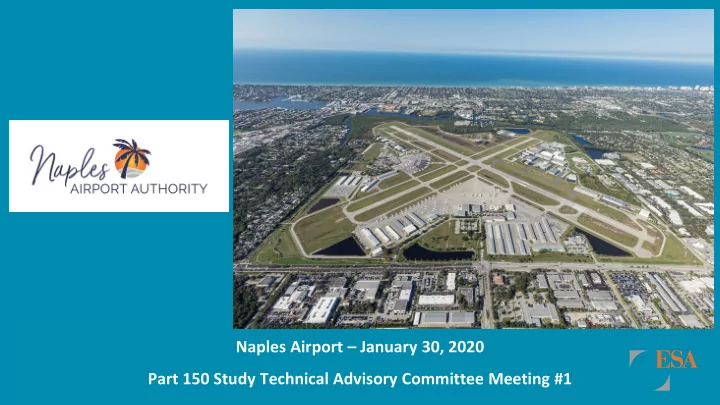
SLIDE 1
Naples Airport – January 30, 2020 Part 150 Study Technical Advisory Committee Meeting #1
SLIDE 2 Agenda
- Welcome and Introductions
- Technical Advisory Committee (TAC)
- Purpose and Objectives of the Technical Committee
- TAC Charter and Participation Agreement
- Role of the TAC Meeting Facilitator
- Florida’s Sunshine Law
- Airport Overview
- Part 150 Study Overview
- Introduction to Aircraft Noise, Modeling, and Compatibility
- Project Schedule
- Questions
SLIDE 3 Welcome and Introductions – Consultant Team
Environmental Science Associates
- 500+ person environmental consulting firm
- Experience at more than 150 airports nationally
- Highly complex projects
- Fort Lauderdale-Hollywood International Part 150
- LaGuardia Part 150
- John F. Kennedy International Part 150
- Los Angeles International Part 150
- San Francisco International Part 150
- Hartsfield-Jackson Atlanta International Part 150
- 100+ airport noise-related studies in Florida
Garth Solutions
- 30+ person communications and management
consulting firm
- Numerous marquis public and private sector
projects including:
- $2.3 billion Fort Lauderdale-Hollywood International
Airport expansion program
- Fort Lauderdale-Hollywood International Part 150
- Broward Schools Capital Improvement SMART
Program
- $4 billion Public-Private Partnership SoLe Mia
Development project in the City of North Miami
- Metlife Stadium
- Tropicana Field
SLIDE 4
Technical Advisory Committee
SLIDE 5 TAC Overview
- Naples Airport Authority (NAA) has formed a Technical Advisory Committee (TAC) for the
Part 150 Study for Naples Airport (APF)
- NAA has invited a cross section of key stakeholders to serve on the TAC
- The TAC is composed of members who are authorized to represent their organization and/or
constituents for the duration of the APF Part 150 Study, which is estimated at two years
- TAC meetings will be conducted in a professional and respectful manner
- TAC meetings will be open to the public, subject to space availability
SLIDE 6 TAC Membership
- Noise Compatibility Committee (NCC)
Liaison
- NAA Liaison
- Community Representatives
− NW, NE, SW and SE Quadrants − At-Large City of Naples − At-Large Collier County
- City Planning Department
- County Growth Management Division
- Greater Naples Chamber
- Naples Area Board of Realtors
(NABOR)
- 5th Avenue Business Improvement
District
- Naples Airport piston operator
- Naples Airport jet operator
- Naples ATCT representative
- FAA RSW TRACON representative
- FAA Airports District Office (ADO)
SLIDE 7 Purpose and Role of the TAC
- TAC members represent the interests of their organization and/or constituents
- The TAC’s role is to support the APF Part 150 Study
― Review study assumptions ― Provide technical feedback within the context of the Part 150 Study (noise exposure maps and noise compatibility program) ― TAC members are encouraged to express their opinions and expected to respect the range of
- pinions expressed by their fellow TAC members
- TAC members are also expected to advise their organization and/or constituents of the TAC’s
discussions
- NAA will respect and consider the TAC’s technical input, but retains responsibility for, and
decision making authority on, the APF Part 150 Study
SLIDE 8 Role of the TAC Facilitator
- To ensure that the TAC meetings are effective they will be facilitated by a professional
meeting facilitator
- The meeting facilitator is responsible for ensuring that the TAC meetings adhere to the
published meeting agenda
- The meeting facilitator may extend or shorten the length of a discussion related to an agenda
item at his or her sole discretion
- The meeting facilitator, or NAA, may cancel or suspend a TAC meeting due to disrespectful
- r disruptive behavior
SLIDE 9 Overview of Florida Sunshine Law
- The activities of the Technical Advisory Committee will be subject to the requirements of
Florida Sunshine Law
- The Technical Advisory Committee will also be subject to public records law
SLIDE 10
Airport Overview
SLIDE 11 APF Overview
- APF began operating in 1943 as a military airfield and celebrated their 50th
anniversary on July 3rd, 2019
- Fiscal Year 2019 the Airport had 112,800 operations
- $8 million invested in noise abatement efforts since 2000
- The Airport is home to:
− Flight Schools − Aircraft Charter and Sales − Air Ambulance − Corporate Aviation − Civil Air Patrol − Mosquito Control
SLIDE 12 APF Overview
− 6,600’ long X 150’ wide − 800’ displaced thresholds at each
runway end
− 5,000’ long X 100’ wide − 128’ displacement at RW 14 end − 450’ displacement at RW 32 end
− 1,850’ long x 100’ wide
- Contract Air Traffic Control Tower
SLIDE 13 Roles of Key Entities
Three core organizations are involved in aircraft operations at APF:
- Federal Aviation Administration (FAA)
― Directs the safe movement of aircraft in the air and on the ground
― Manages the airport(s), improves and maintains airport facilities ― No control over where aircraft fly
― The pilot in command has ultimate responsibility for the safe operation of his/her aircraft
SLIDE 14
Part 150 Study Overview
SLIDE 15
- Interim Rule on Federal Aviation Regulations (FAR) Part 150, Airport Noise Compatibility
Planning issued in 1981 and finalized in 1985, later recodified as Title 14 Code of Federal Regulations (CFR) Part 150
- Issued in response to provisions contained in the Aviation Safety and Noise Abatement Act
- f 1979
- Establishes the methodology to be followed when preparing aircraft noise exposure maps
and developing airport/airport environs land use compatibility programs
- Part 150 studies are voluntary, but…
- Part 150 studies must adhere to 14 CFR Part 150 guidelines to be considered and
accepted and approved by FAA
Part 150 Study Overview
SLIDE 16 Part 150 History at APF
The 14 CFR Part 150 process is the Airport Sponsor’s mechanism to improve the compatibility between the Airport and surrounding communities
1978 First documented publication
abatement procedures 1987 NAA completes first formal noise study 1997 NAA submits Part 150 NEM and NCP updates to FAA 2000 NAA submits 2000 and 2005 NEM update to FAA 2010 NAA Submits 2010 and 2015 NEM update to FAA
SLIDE 17 Goals and Objectives
Key Issues:
- NAA has strong history of industry noise leadership but a desire to examine
whether any additional reasonable noise mitigation strategies can be implemented
- Jet activity has increased and will continue to grow
- Training activity is on rebound
- Seasonal variations are masked by DNL
- Quiet Hours voluntary curfew compliance remains above 98%
- APF noise exposure has generally decreased over time according to federal
guidelines (14 CFR Part 150), but community concerns about aircraft noise continue
SLIDE 18 Goals and Objectives
Opportunities
- Brings stakeholders to the table
- Education
- Provides decision making structure
- Can strengthen community relationships
Challenges
- Seasonal variations in noise exposure
are often not reflected in the DNL contours
- Regulatory process limits what can be
approved
SLIDE 19 Part 150 Study Overview
Regulatory Framework
- Federal law sets aircraft noise standards, prescribes operating rules, establishes the
compatibility planning process, and limits airport proprietor’s ability to restrict aircraft
- perations.
- State law sets forth compatibility planning guidelines and noise standards but aircraft are
exempt.
- Local noise ordinances set noise standards and provide for compatible land use planning
but aircraft are exempt.
SLIDE 20 Part 150 Study Overview
Who Can Regulate Airport Noise?
- Federal Aviation Administration:
(1) Controls aircraft while in flight (2) Responsible for controlling noise at its source (i.e., aircraft engines) (3) Certifies aircraft and pilots
(1) Very limited authority to adopt local restrictions (2) Responsible for capital improvement projects and infrastructure
- Local Governments and States:
(1) Promote compatible land use through zoning (2) Require real estate disclosure (3) Mandate sound-insulating building materials
SLIDE 21 Part 150 Study Overview
Analyze, Evaluate, Educate
- Determine existing and future noise conditions in the vicinity of an airport
- Identify incompatible uses
- Identify measures to improve compatibility
― Evaluate the feasibility of possible flight procedure/land use changes ― Submit locally-endorsed recommendations to the FAA regarding noise reduction measures ― Approved measures may be eligible for Federal grant funding
- Educate communities on the Federal process and what can and cannot be done to address
aircraft noise concerns
SLIDE 22 Part 150 Study Overview
Noise Exposure Map Report (NEM)
- Develop a comprehensive database of current conditions
- Noise contour development and impact analysis
- Prepare and submit Noise Exposure Map (NEM) Report
Noise Compatibility Program (NCP)
- Identify and evaluate noise abatement alternatives
- Identify and evaluate compatible land use alternatives
- Identify and evaluate administrative measures
- Prepare and submit Noise Compatibility Program (NCP) Report
Stakeholder Outreach Program
- Local Jurisdictions/Agencies
- FAA
- Public
SLIDE 23 Part 150 Study Overview
(NEMs) (NCP)
SLIDE 24
Noise Modeling and Compatibility
SLIDE 25 Introduction to Aircraft Noise - DNL
Day-Night Average Sound Level (DNL)
- 24-hour time weighted energy average noise level based on A-weighted decibels (dBA)
- Noise occurring between 10 p.m. to 7 a.m. is penalized by 10 dB to account for the higher
sensitivity to noise during nighttime hours and for the expected further decrease in background levels that typically occur in the nighttime
- FAA requires the use of DNL for airport noise assessments
- Average Annual Day aircraft noise exposure is calculated over a broad area and then
depicted using contour lines of equal noise levels
SLIDE 26
Introduction to Aircraft Noise - DNL
SLIDE 27 Introduction to Aircraft Noise - DNL
Noise Modeling
- Aircraft noise modeling allows:
― Calculation of noise exposure at any point ― Depicting annual average aircraft noise exposure ― Predicting future aircraft noise exposure ― Assessing changes in noise impacts resulting from runway configuration changes or new runways ― Assessing changes in fleet mix and/or number of operations ― Evaluating operational procedures
- Aviation Environmental Design Tool (AEDT) replaced the Integrated Noise Model (INM) when it
was released in 2015. The current version, AEDT 2C, will be used for the APF Part 150 Study.
SLIDE 28 Part 150 Study Overview – Years of Analysis
Noise Exposure Maps – Baseline Conditions
- Base year and a future year which is at least 5 years into the future
- Basis of comparison for effectiveness of potential noise abatement measures
- Year of submittal must be consistent with base year
− Existing Condition: 2020/2021 − Future Condition: 2025/2026
- Existing Condition based on recent 12 months of operational data applied to 2020
projected activity level
SLIDE 29 Part 150 Study Overview – Modeling
Model Inputs
- The Amount of Noise Exposure is determined by:
− Aircraft types − Stage length − Number of average annual day operations − Nighttime weighting (1 nighttime operation = 10 daytime operations)
- The Noise Exposure Distribution is determined by:
− Runway configuration and use − Flight track locations − Flight track use
− Meteorological Conditions Aviation Environmental Design Tool (AEDT) Version 3B
SLIDE 30 Part 150 Study Overview – Land Use Compatibility
Land Uses
- Existing and Future Land Use
- Land parcel data
- Zoning
- Jurisdictional boundaries and neighborhoods
Noise Sensitives Uses
- Residential
- Places of worship
- Schools, colleges and universities
- Libraries/cultural institutions
- Hospitals and residential healthcare facilities
- Daycare and assisted living facilities
- Historic properties
SLIDE 31 Part 150 Study Overview – Land Use Compatibility
Land Use Compatibility
- Table 1 in Appendix A of 14 CFR Part 150
provides noise and land use compatibility guidelines
- Deems levels below 65 dB DNL to be compatible
with all land uses
- Allows for the adoption of appropriate local land
use standards for land use compatibility planning purposes The City of Naples and Collier County have adopted the 60 DNL contour as the threshold of significance
SLIDE 32
Part 150 Study Overview – Sample Noise Exposure Map (NEM)
RSW
SLIDE 33 Part 150 Overview - FAQs
Frequently Asked Questions
- Will the study “fix” all the noise issues around the airport?
− No, overflights of residential areas are unavoidable and sensitivity to noise varies by
person
- What type of noise monitoring will be conducted?
− None, all analysis is modeling based which allows consistency and evaluation of future
conditions
- Will the Study address concerns about safety, soot, or other concerns related to aircraft
- peration?
− The Part 150 process focusses exclusively on noise and land use compatibility
SLIDE 34
Project Schedule
SLIDE 35
SLIDE 36
Kickoff Public Workshops
Baker Park Sugden-Gomez Center 100 Riverside Circle Naples FL 34102 5:00 – 7:00 pm Moorings Presbyterian Church 791 Harbour Drive Naples, FL 34103 9:30 – 11:30 am Lorenzo Walker Technical School 3702 Estey Avenue Naples, FL 34104 6:00 - 8:00 pm
February 11, 2020 February 12, 2020 February 12, 2020 1 2 3 1 2 3
SLIDE 37 Future Meetings
Technical Advisory Committee
- TAC Meeting #2 (Tentative)
- TAC Meeting #3 (Tentative)
- Reminder notices will be sent out in advance of each meeting
- All TAC Materials will be posted on the Project Website following the meeting
April 23, 2020 November 5, 2020
SLIDE 38 Public Website
Project Website (flynaples.com):
- Project Information
- Process
- Study Elements
- FAQ’s
- Noise History PowerPoint
- Public Draft and Final reports
- Schedule
- Newsletters (4)
Communication and Feedback:
- Upcoming meetings including location/dates/times
- Receipt of comments specific to Part 150 Study
- Links to other websites/resources
SLIDE 39
Questions?