PROMOTING PLACE-BASED DEVELOPMENT IN DECLINING AREAS THE STRUCTURED - - PowerPoint PPT Presentation

promoting place based development in declining areas the
SMART_READER_LITE
LIVE PREVIEW

PROMOTING PLACE-BASED DEVELOPMENT IN DECLINING AREAS THE STRUCTURED - - PowerPoint PPT Presentation

PROMOTING PLACE-BASED DEVELOPMENT IN DECLINING AREAS THE STRUCTURED DEMOCRATIC DIALOGUE PROCESS AS A TOOL OF PARTICIPATORY PLANNING CASE STUDY/ THE LIMASSOL WINE VILLAGES LOCAL DEVELOPMENT PILOT PROJECT: THE CONTRIBUTION OF HERITAGE TO LOCAL AND


slide-1
SLIDE 1

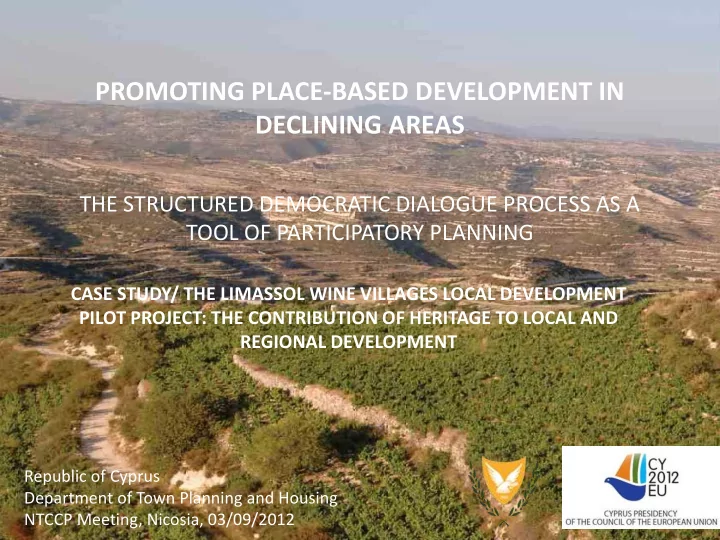
PROMOTING PLACE-BASED DEVELOPMENT IN DECLINING AREAS

THE STRUCTURED DEMOCRATIC DIALOGUE PROCESS AS A TOOL OF PARTICIPATORY PLANNING

CASE STUDY/ THE LIMASSOL WINE VILLAGES LOCAL DEVELOPMENT PILOT PROJECT: THE CONTRIBUTION OF HERITAGE TO LOCAL AND REGIONAL DEVELOPMENT

Republic of Cyprus Department of Town Planning and Housing NTCCP Meeting, Nicosia, 03/09/2012

slide-2
SLIDE 2

CONTENTS

  • INTRODUCTION
  • CYPRUS PLANNING SYSTEM AND PUBLIC PARTICIPATION
  • LIMASSOL LOCAL DEVELOPMENT PILOT PROJECT (LDPP)
  • STRUCTURED DEMOCRATIC DIALOGUE PROCESS (SDDP)

PROMOTING PLACE-BASED DEVELOPMENT IN DECLINING AREAS Department of Town Planning and Housing

slide-3
SLIDE 3

INTRODUCTION

  • Statement:

Bottom-up participatory processes with consensus building are the foundation of a place-based strategy in the field of spatial planning.

  • Purpose of the paper:

i. To demonstrate an effective way of public participation (Structured Democratic Dialogue Process – SDDP) that allows the expression of citizens’ knowledge and preferences and articulates their vision along with the steps to be taken to achieve it (wider/ European scope);

  • ii. To assess the planning procedures and participatory practices in

Cyprus (national objective);

  • iii. To show in general the positive impact of these participatory

processes on heritage.

  • The opportunity to do so:

The ‘Limassol Wine Villages Local Development Pilot Project: the contribution of heritage to local and regional development’, which falls into the Council of Europe’s Local Development Pilot Projects Programme (LDPP).

PROMOTING PLACE-BASED DEVELOPMENT IN DECLINING AREAS Department of Town Planning and Housing

slide-4
SLIDE 4

Introduction

General Regulation of the European Union Structural and Rural Development Funds proposals make community-led local development a key feature of the next programs (2014-2020)

COHESION POLICY

Public participation Territorial Cohesion Place-based strategy

Community-led local development

PROMOTING PLACE-BASED DEVELOPMENT IN DECLINING AREAS Department of Town Planning and Housing

Cyprus Presidency of the Council of the EU

slide-5
SLIDE 5

Introduction

PROMOTING PLACE-BASED DEVELOPMENT IN DECLINING AREAS Department of Town Planning and Housing

  • Place-based strategy in its general level of application:
  • Long term development perspective
  • Capitalises on location advantages
  • Involves a broad collaborative partnership (local elites)
  • Supported by multilevel governance and integrated

approach.

  • The component of heritage (cultural and natural) acquires

greater significance with:

  • the introduction of the territorial dimension of the Cohesion

Policy

  • the spread of the international economic crisis
  • increasing global competition.

Cyprus Presidency of the Council of the EU

slide-6
SLIDE 6

Introduction

All the above show that:

  • The European Union has an increasing focus on

development actions with integrated delivery on the ground, based on the active involvement of people.

  • Heritage is a motive power especially in declining rural

areas which require new development models and

  • pportunities arising internally, collectively and from the

grassroots.

PROMOTING PLACE-BASED DEVELOPMENT IN DECLINING AREAS Department of Town Planning and Housing

Cyprus Presidency of the Council of the EU

slide-7
SLIDE 7

Department of Town Planning and Housing

Cyprus Planning System and Public Participation

PROMOTING PLACE-BASED DEVELOPMENT IN DECLINING AREAS

slide-8
SLIDE 8

Cyprus planning system and public participation

Three-tier hierarchy of Development Plans:

Policy Statement for the Countryside:

  • Introduced due to the absence of a legally bound Island Plan;
  • Its general provisions are applicable in rural areas where neither a

Local Plan nor an Area Scheme is in force.

National territory and regional distribution of resources and development opportunities. Major urban areas, areas of exceptional importance or areas undergoing intensive development pressures. Detailed and specifically project

  • riented for areas of a smaller scale.

Department of Town Planning and Housing PROMOTING PLACE-BASED DEVELOPMENT IN DECLINING AREAS

ISLAND PLAN LOCAL PLANS AREA SCHEMES

Cyprus Presidency of the Council of the EU

slide-9
SLIDE 9

Development Plans and public participation

Public involvement is introduced through:

  • Open community meetings, aimed at gathering the views and
  • pinions of the public.
  • Written consultations by the public at large (individuals,

bodies or authorities). A number of them are put forward at public hearings.

  • Joint Boards, which advise the Minister of Interior regarding

the preparation or revision of Local Plans/ Area Schemes; its members are elected from the local authorities and also include individuals with specialist knowledge or a valid

  • pinion in respect of the Plan.
  • Objections submitted by the public (Local authorities, NGOs,

and any interested body or individual) against any of the Plan’s provisions.

Department of Town Planning and Housing PROMOTING PLACE-BASED DEVELOPMENT IN DECLINING AREAS

Cyprus planning system and public participation

Cyprus Presidency of the Council of the EU

slide-10
SLIDE 10
slide-11
SLIDE 11

Local Plan Preparation - Objections

Department of Town Planning and Housing PROMOTING PLACE-BASED DEVELOPMENT IN DECLINING AREAS

Cyprus planning system and public participation

Cyprus Presidency of the Council of the EU

slide-12
SLIDE 12

Evaluation of public participation

  • Institutional limitations do not really promote public

participation and new effective levels of governance (delay in the process of decentralisation and restructuring of local authorities).

  • Weaknesses of Joint Boards, which restrain a bottom-up

approach based on citizen participation (participants are few, their involvement is temporary and their role is consultative).

  • Inability of local authorities to draw up a real development

programme beyond the usual re-zoning requests.

  • Problems of citizen behaviour, awareness and know-how

make difficult the dialogue on matters of strategy and public interest.

Department of Town Planning and Housing PROMOTING PLACE-BASED DEVELOPMENT IN DECLINING AREAS

Cyprus planning system and public participation

Cyprus Presidency of the Council of the EU

slide-13
SLIDE 13

The Limassol LDPP could supplement existing planning procedures by:

  • improving existing participatory practices and

mechanisms,

  • widening the scope of planning in socio-economic issues

and implementation methods,

  • formulating a more appropriate and shared project

vision and strategy.

Department of Town Planning and Housing PROMOTING PLACE-BASED DEVELOPMENT IN DECLINING AREAS

Cyprus planning system and public participation

Cyprus Presidency of the Council of the EU

slide-14
SLIDE 14

A new opportunity for participatory planning: the Local Development Pilot Project (LDPP) for the Wine Villages in Limassol

Department of Town Planning and Housing PROMOTING PLACE-BASED DEVELOPMENT IN DECLINING AREAS

Limassol LDPP

Cyprus Presidency of the Council of the EU

slide-15
SLIDE 15

The Limassol Local Development Pilot Project (LDPP) as an instrument for territorial cohesion

The LDPP programme:

  • Provides an opportunity for innovative/ fruitful discussion of issues, with

possible implementation of the outcomes in the existing institutional framework.

  • Helps protect, conserve and enhance the territory’s heritage as a factor of

socio-economic development, identity and cohesion.

  • Promotes a model of holistic, multi-sectoral and sustainable development,

underpinned by the active involvement of citizens.

  • Aims to improve the standard of living, minimise the differences between

urban and rural life and create opportunities for employment and economic development.

  • Promotes transparency, democracy and dialogue.

Department of Town Planning and Housing PROMOTING PLACE-BASED DEVELOPMENT IN DECLINING AREAS

Limassol LDPP

The Limassol LDPP, like other similar projects, will be developed in 3 phases:

DIAGNOSIS STRATEGY IMPLEMENTATION PROGRAMME

Cyprus Presidency of the Council of the EU

slide-16
SLIDE 16

The Wine Villages in the Region of Limassol

  • A mountainous and semi-mountainous area

with 15 traditional settlements (total population 3369 - 2011 Census)

  • A functional region based on physical,

historical, environmental and socio-economic similarities.

Department of Town Planning and Housing PROMOTING PLACE-BASED DEVELOPMENT IN DECLINING AREAS

Limassol LDPP

Cyprus Presidency of the Council of the EU

slide-17
SLIDE 17

The Wine Villages in the Region of Limassol

  • The area is known for its:
  • i. wine producing tradition, which has its footprints on the

landscape dominated by a system of dry-laid stone terraces (cultivated or abandoned);

  • ii. rich fauna and flora, which led to the inclusion of some

significant parts of the area in the Natura 2000 network;

  • iii. religious buildings and vernacular architecture strongly

influenced by the wine production economy.

Department of Town Planning and Housing PROMOTING PLACE-BASED DEVELOPMENT IN DECLINING AREAS

Limassol LDPP

Cyprus Presidency of the Council of the EU

slide-18
SLIDE 18

The Wine Villages in the Region of Limassol

  • Some of the issues faced in the area are:
  • i. the process of dereliction, abandonment and depopulation of

the most remote and mountainous settlements;

  • ii. the abandonment, neglect and deterioration of many dry-laid

stonewall terraced vineyards because of the decay of agriculture and its mechanisation;

  • iii. the change of the authentic cultural landscape;
  • iv. the gradual transformation of the traditional character of

settlements.

Department of Town Planning and Housing PROMOTING PLACE-BASED DEVELOPMENT IN DECLINING AREAS

Limassol LDPP

Cyprus Presidency of the Council of the EU

slide-19
SLIDE 19

The LDPP programme experiments a real place-based approach and a community-led local development method, under the wider agenda of Territorial Cohesion. The characteristics and problems of the region of the Wine Villages make of the area a unity of space, which asks for a territorially sensitive approach. This will also help in the preservation of the villages’ rich cultural and natural heritage.

Department of Town Planning and Housing PROMOTING PLACE-BASED DEVELOPMENT IN DECLINING AREAS

Limassol LDPP

Cyprus Presidency of the Council of the EU

slide-20
SLIDE 20

The Structured Democratic Dialogue Process (SDDP)

Department of Town Planning and Housing PROMOTING PLACE-BASED DEVELOPMENT IN DECLINING AREAS

slide-21
SLIDE 21

The SDDP instrument

  • The Structured Democratic Dialogue Process – SDDP

(developed by Dr. Alexander Christakis and John Warfield) is a deeply reasoned, scientific methodology for large-scale, collaborative design, which is effective in:

  • resolving multiple conflicts and problems that are more and

more complex in a reasonably limited amount of time;

  • gathering the collective wisdom (‘Demosophia’) of a wide

range of different stakeholders who experience the problem;

  • assisting heterogeneous groups in collectively developing a

common framework of thinking based on consensus building and thus achieving results.

Department of Town Planning and Housing PROMOTING PLACE-BASED DEVELOPMENT IN DECLINING AREAS

SDDP

Cyprus Presidency of the Council of the EU
slide-22
SLIDE 22

The SDDP instrument

  • The Structured Democratic Dialogue Process (SDDP) was used as

the main instrument in the 1st phase of the Limassol LDPP (‘Diagnosis’) completed up to now.

  • Specifically, it was used to:
  • describe and analyze the current situation in the Wine Villages

area and extrapolate it to the future on the basis of the existing situation (base scenario);

  • identify the possible obstacles for reaching a specific topic/ the

desired situation (‘Wall of Obstacles’) ;

  • develop a shared vision for the sustainable development of the

territory (‘Vision Tree of Descriptors’).

  • It then converges on a collaboratively developed ‘Action Agenda’

that will tear down the ‘Wall of Obstacles’ and nourish the ‘Vision Tree’. It focuses on the distinctions among the ‘can be’ (problems), ‘ought to be’ (vision) and ‘will be’ (strategy).

Department of Town Planning and Housing PROMOTING PLACE-BASED DEVELOPMENT IN DECLINING AREAS

SDDP

Cyprus Presidency of the Council of the EU

slide-23
SLIDE 23

Cluster Tree

Retroductive Design & Development Frame

CURRENT SITUATION

Vision Descriptors

EXTRAPOLATED FUTURE

Wall of Obstacles

GAP

Co-laboratory I: “Can” Co-laboratory II: What “ought to be”

Co-lab III: “Will be done”

Department of Town Planning and Housing PROMOTING PLACE-BASED DEVELOPMENT IN DECLINING AREAS

SDDP

(Diagramme by Dr A. Christakis)

Cyprus Presidency of the Council of the EU

slide-24
SLIDE 24

Structure and process of the SDDP

A core group of people, the ‘Knowledge Management Team’ (KMT) composed by the owners of the problem, representatives

  • f the main government agencies and the SDDP experts, plays a

crucial role in coordinating the process (identification of stakeholders, drafting the triggering questions, preparation of the reports, invitation of participants, etc). The identification of stakeholders is of paramount importance. They have to accurately represent elements of the subject and cover all of its facets (local stakeholders, relevant public and semi-public organisation, NGOs etc).

Department of Town Planning and Housing PROMOTING PLACE-BASED DEVELOPMENT IN DECLINING AREAS

SDDP

Cyprus Presidency of the Council of the EU

slide-25
SLIDE 25

Structure and process of the SDDP

  • 1. The participants are invited to answer the Triggering Question,

formulated by the KMT, at a round-table session.

Department of Town Planning and Housing PROMOTING PLACE-BASED DEVELOPMENT IN DECLINING AREAS

SDDP

Cyprus Presidency of the Council of the EU

slide-26
SLIDE 26

Structure and process of the SDDP

  • 2. All responses to the triggering question (one idea in one

sentence) are recorded in Cogniscope™ software, printed and posted on the wall.

Department of Town Planning and Housing PROMOTING PLACE-BASED DEVELOPMENT IN DECLINING AREAS

SDDP

Cyprus Presidency of the Council of the EU

slide-27
SLIDE 27

Structure and process of the SDDP

  • 3. The authors of the proposals clarify and describe their ideas for

better understanding and to avoid overlapping.

Department of Town Planning and Housing PROMOTING PLACE-BASED DEVELOPMENT IN DECLINING AREAS

SDDP

Cyprus Presidency of the Council of the EU

slide-28
SLIDE 28

Structure and process of the SDDP

  • 4. The ideas are clustered into categories based on similar

attributes.

Department of Town Planning and Housing PROMOTING PLACE-BASED DEVELOPMENT IN DECLINING AREAS

SDDP

Cyprus Presidency of the Council of the EU

slide-29
SLIDE 29

Structure and process of the SDDP

  • 5. All participants get five votes and are asked to choose their five

favourite (most important to them) ideas. Only the ideas that received votes go to the next and most important phase.

Department of Town Planning and Housing PROMOTING PLACE-BASED DEVELOPMENT IN DECLINING AREAS

SDDP

Cyprus Presidency of the Council of the EU

slide-30
SLIDE 30

Structure and process of the SDDP

  • 6. Participants are asked to explore influences of one idea on
  • another. If the answer is ‘yes’ (great majority) an influence is

recorded in the special software, which minimises the number

  • f queries by using mathematical algorithms.

Department of Town Planning and Housing PROMOTING PLACE-BASED DEVELOPMENT IN DECLINING AREAS

SDDP

Cyprus Presidency of the Council of the EU

slide-31
SLIDE 31

Structure and process of the SDDP

  • 7. The relations recorded result in the production of an ‘influence

tree’ (‘Wall of Obstacles’ or ‘Vision Descriptors’) by the

  • software. The ‘influence tree’ is presented to the participants,

subject to discussion.

Department of Town Planning and Housing PROMOTING PLACE-BASED DEVELOPMENT IN DECLINING AREAS

SDDP

Cyprus Presidency of the Council of the EU

slide-32
SLIDE 32

The Limassol LDPP: experience of participation

  • Road Map of the Diagnosis Phase of the LDPP: made out of

consecutive and participatory approaches that allow the overall and focused analysis of the area.

  • This process, based on the SDDP ‘Wall of Obstacles’, is summarised in

the following diagramme, where: 1st step: The ‘Wall of Obstacles’ (root cause map) was designated by Co-laboratory I. 2nd step: Seven thematic working groups elaborated a SWOT analysis and/ or a sectoral common vision for each theme, representing a group of obstacles. 3rd step: The ‘Vision Tree of Descriptors’ of the area was drawn out

  • f a synthesis of the previous thematic work, by

Co-laboratory II.

  • The KMT meetings take place at several instances to coordinate the

process.

Department of Town Planning and Housing PROMOTING PLACE-BASED DEVELOPMENT IN DECLINING AREAS

SDDP

Cyprus Presidency of the Council of the EU

slide-33
SLIDE 33

Department of Town Planning and Housing PROMOTING PLACE-BASED DEVELOPMENT IN DECLINING AREAS

SDDP

Cyprus Presidency of the Council of the EU

slide-34
SLIDE 34

The Limassol LDPP: experience of participation

1st step: ‘Wall of Obstacles’ – Co-laboratory I

  • The KMT selected as a Triggering Question: ‘Which are the obstacles

for the development of the Wine-villages of Limassol?’

  • The 27 participants, representing 26 stakeholders, gave 71 answers.
  • The answers were then clustered into 7 categories.
  • Participants voted 5 barriers they considered as the relatively most

important (16 barriers were collectively considered as the most important).

  • Participants explored possible interactions and independencies

between the 16 most important barriers by answering the question: ‘If we manage to deal with barrier A, would this significantly assist us in dealing with barrier B?’

  • The ‘Wall of Obstacles’ depicted that the fundamental (root-cause)

barriers were the incomplete process of institutional agglomeration of the local authorities, their low level of management capacities and the lack of effective cooperation between government departments.

Department of Town Planning and Housing PROMOTING PLACE-BASED DEVELOPMENT IN DECLINING AREAS

LDDP

Cyprus Presidency of the Council of the EU

slide-35
SLIDE 35

Root causes

Influence tree Or ‘Wall of Obstacles’

Department of Town Planning and Housing PROMOTING PLACE-BASED DEVELOPMENT IN DECLINING AREAS

LDDP

Cyprus Presidency of the Council of the EU

slide-36
SLIDE 36

The Limassol LDPP: experience of participation

2nd step: Theme Working Groups

  • Following the Co-laboratory I, 7 Themes of sectoral or strategic nature

were identified for further investigation:

  • 1. Society and Culture
  • 2. Architecture and Settlements
  • 3. Economy and Entrepreneurship
  • 4. Infrastructure and Services
  • 5. Agriculture, Environment and Landscape
  • 6. Education and Information
  • 7. Governance and Administration
  • For the development of each Theme, a Working Group with

members and leader was designated by the KMT. This enabled the stakeholders’ base to drastically enlarge.

Sectoral Strategic

Department of Town Planning and Housing PROMOTING PLACE-BASED DEVELOPMENT IN DECLINING AREAS

LDDP

Cyprus Presidency of the Council of the EU

slide-37
SLIDE 37

The Limassol LDPP: experience of participation

2nd step: Theme Working Groups

  • The Working Groups proceeded with a SWOT analysis for the 5

sectoral themes, in order to obtain a better understanding of the area’s real limitations and potentials at local and macro regional level.

  • A sectoral common vision through the Structured Democratic

Dialogue Process (SDDP) was established for each of the 7 Theme

  • Groups. The TQ was: ‘What are the descriptors of the desired situation

for the sustainable development of the wine villages in the field of … (relevant thematic)?’

  • The Theme Working Groups identified an average of 60 descriptors

for each Thematic, selected and average of 15 more influential descriptors and produced 7 separate sectoral ‘Vision Trees of Descriptors’.

Department of Town Planning and Housing PROMOTING PLACE-BASED DEVELOPMENT IN DECLINING AREAS

SDDP

Cyprus Presidency of the Council of the EU

slide-38
SLIDE 38

The Limassol LDPP: experience of participation

3rd step: Holistic ‘Vision Tree of Descriptors’

  • The KMT, with the collaboration of the Working Groups’ leaders,

analysed the sectoral ‘Vision Trees of Descriptors’ and identified the most influential factors.

  • An inter-sectoral co-laboratory with representatives of each thematic

working group was organized with the aim of establishing a common, integrated, holistic vision for the area.

  • The 44 most influential descriptors of the different Thematic clusters

were discussed, and 18 were selected as the most important. Their interrelationships were then explored.

  • The ‘Vision Tree of Descriptors’ depicted that the most fundamental

action towards the sustainable development of the area is again the institutional agglomeration of the local authorities, which will facilitate a number of local initiatives (one-stop shop for facilitating development and investments and a local agency for the promotion and preservation

  • f architectural heritage).

Department of Town Planning and Housing PROMOTING PLACE-BASED DEVELOPMENT IN DECLINING AREAS

SDDP

Cyprus Presidency of the Council of the EU

slide-39
SLIDE 39

Fundamental actions

‘Vision Tree of

Descriptors’

Department of Town Planning and Housing PROMOTING PLACE-BASED DEVELOPMENT IN DECLINING AREAS

SDDP

Cyprus Presidency of the Council of the EU

slide-40
SLIDE 40

Department of Town Planning and Housing PROMOTING PLACE-BASED DEVELOPMENT IN DECLINING AREAS

SDDP

Cyprus Presidency of the Council of the EU

slide-41
SLIDE 41

The added value of SDDP

  • Strategic character of the dialogue;
  • Promotion of decentralisation and inter-communal

cooperation;

  • Promotion of a place-based and bottom-up approach;
  • Consideration of not only territorial, but also social and

economic aspects, in an integrated development approach;

  • Fostering identity and heritage;
  • Long-term outcomes rather than immediate and temporary
  • utputs;
  • Networking and capacity building, especially among

neighbouring communities;

Department of Town Planning and Housing PROMOTING PLACE-BASED DEVELOPMENT IN DECLINING AREAS

SDDP

Cyprus Presidency of the Council of the EU

slide-42
SLIDE 42

The added value of SDDP

  • Legitimacy of the actors and their work;
  • Stakeholders engagement and the sense of collective
  • wnership;
  • Empowerment of community members;
  • Creation of a core team (KMT) to sustain the continuity of the

process;

  • Development of mutual trust between participants;
  • Redefinition of the role of the civil servants;
  • Participation on equal basis and respecting the autonomy of

all participants;

  • Facilitation of mutual understanding and consensus building.

Department of Town Planning and Housing PROMOTING PLACE-BASED DEVELOPMENT IN DECLINING AREAS

SDDP

Cyprus Presidency of the Council of the EU

slide-43
SLIDE 43

Limitations of the SDDP

  • Time consuming process, since there is a need of

systematization or standardization;

  • Training requirement of facilitators, since the tools employed

and the software used have to be learned;

  • Need for involvement of a substantial number of participants,

for the wider possible representation and interaction among institutions;

  • Need to achieve a state of mutual trust which is a prerequisite
  • f collective action;
  • Need for coordination between various government agencies

which are relevant to the project;

  • Need for long-term commitment of institutions and local

people, due to the long meetings of working groups.

Department of Town Planning and Housing PROMOTING PLACE-BASED DEVELOPMENT IN DECLINING AREAS

SDDP

Cyprus Presidency of the Council of the EU

slide-44
SLIDE 44

The Structured Democratic Dialogue Process (SDDP):

  • Effective instrument of community-led local development,

since it actively involves stakeholders in a consensus building process.

  • Comprehensive mechanism of dialogue amongst stakeholders

from the outset, based on a real bottom-up approach.

  • Designed in such a way as to encounter complex issues and to

harness the collective wisdom of participants, regardless of their educational and cultural background. The priority now is to customise this instrument in spatial planning, aiming to improve existing participatory practices.

Department of Town Planning and Housing PROMOTING PLACE-BASED DEVELOPMENT IN DECLINING AREAS

SDDP

Cyprus Presidency of the Council of the EU

slide-45
SLIDE 45

Conclusion

  • The Limassol LDPP has proved to be a unique opportunity to experience

a place-based approach:

  • approach with long-term outcomes and perspective;
  • invests on heritage and other locational advantages;
  • vision, strategy and policies really adapted to the context and needs;
  • involvement of numerous stakeholders in a collaborative way;
  • vertical and horizontal integration achieved by the choice of

participants and the cross-sectoral dialogue.

  • It drove deep into the question of methodology and participation and its

findings could be disseminated.

  • It could be an aspiration for future models of development, especially

during this period of economic crisis (more clear understanding of the place, recall of quality values, return to the roots of heritage).

  • This exercise could thus become an opportunity to reassess EU’s

development paradigm and a source for clarifying and enriching the notion of territorial cohesion.

Department of Town Planning and Housing PROMOTING PLACE-BASED DEVELOPMENT IN DECLINING AREAS

slide-46
SLIDE 46

Thank you for your attention!

Republic of Cyprus Department of Town Planning and Housing Nicosia, 03/09/2012