Promoting Economic Mobility Through Transitioning the Atlanta - - PowerPoint PPT Presentation

promoting economic mobility through transitioning the
SMART_READER_LITE
LIVE PREVIEW

Promoting Economic Mobility Through Transitioning the Atlanta - - PowerPoint PPT Presentation

Promoting Economic Mobility Through Transitioning the Atlanta Community Food Bank Partner Network Mirit Friedman, Mirit Friedman, Masters in City and Regional Planning Candidate 19 Masters in City and Regional Planning Candidate 19


slide-1
SLIDE 1

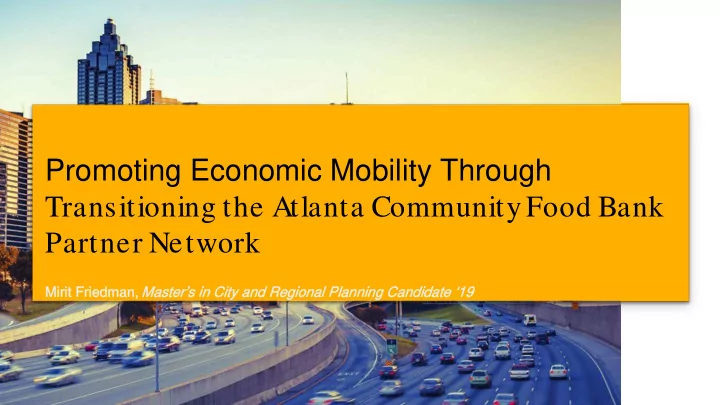
Promoting Economic Mobility Through Transitioning the Atlanta Community Food Bank Partner Network

Mirit Friedman, Mirit Friedman, Master’s in City and Regional Planning Candidate ‘19 Master’s in City and Regional Planning Candidate ‘19

slide-2
SLIDE 2

2

ECONOMIC MOBILITY ECONOMIC MOBILITY

Source: Brookings Institute, 2015
slide-3
SLIDE 3

3

POVERTY CYCLE + INCOME VOLATILITY POVERTY CYCLE + INCOME VOLATILITY

Source: The Alternative: Most of What You Believe About Poverty Is Wrong
slide-4
SLIDE 4

THE ATLANTA COMMUNITY FOOD BANK THE ATLANTA COMMUNITY FOOD BANK

Founded in 1979

  • Response to emergency food need

Works to serve the annual meal gap of 140M meals The ACFB mission is “ to fight hunger by engaging, educating, and empowering our community ”

4

slide-5
SLIDE 5

819,000 Georgians 819,000 Georgians

Out of 5.9M in the ACFB service area rely on the emergency food supply in a single year

$3 billion $3 billion

in adverse economic costs are estimated in our region

5

Source: Atlanta Community Food Bank 2016 Strategic Plan

SERVICE AREA OVERVIEW SERVICE AREA OVERVIEW

slide-6
SLIDE 6

Food Food Pantry Pantry Wraparound Wraparound Service Service Center Center Food Food Cooperative Cooperative

6

slide-7
SLIDE 7

7

ACFB Organizational Assessment ACFB Organizational Assessment

Food Pantry Wraparound Service Center Food Cooperative

ATLANTA COMMUNITY FOOD BANK ATLANTA COMMUNITY FOOD BANK

DISTRIBUTES FOOD TO: DISTRIBUTES FOOD TO: Clients Clients Clients DISTRIBUTES FOOD TO: DISTRIBUTES FOOD TO:

slide-8
SLIDE 8

8

RESEARCH QUESTION RESEARCH QUESTION

What characteristics are needed in the Food Bank network to transform food pantries from a distribution

  • riented model to a

comprehensive service model for stabilizing working families?

slide-9
SLIDE 9

METHODS METHODS

9

ACFB Organizational Assessment ACFB Organizational Assessment ACFB ORGANIZATION + STRATEGIC VISION + DATA OVERVIEW → FUTURE ACFB DIRECTION Case Study Case Study 27 ARTICLES + 7 INFORM AL INTERVIEWS + ONLINE RESEARCH → ORGANIZATIONAL TY POLOGY

slide-10
SLIDE 10

FINDINGS FINDINGS

Key typological features of organizations that contribute to their economic stability approach

10 10

slide-11
SLIDE 11

11 11

Family Independence Initiative

ACFB Organizational Assessment ACFB Organizational Assessment

Potential Potential Future Future Models Models Food Pantry Wraparound Service Center Food Cooperative

ATLANTA COMMUNITY FOOD BANK ATLANTA COMMUNITY FOOD BANK

DISTRIBUTES FOOD TO: DISTRIBUTES FOOD TO:

453 24 30

DISTRIBUTES FOOD TO: DISTRIBUTES FOOD TO: Alternative Service Providers

slide-12
SLIDE 12

TYPOLOGY OF APPROACH TYPOLOGY OF APPROACH

Democratic Participant Democratic Participant Control Control - Does the participant have a say in how the money is spent? Participant Food Choice Participant Food Choice Option Option - Does the participant have a choice over the food they receive? Additional Services Additional Services - Are there services beyond food distribution available at this site? How well connected are services? Approach to Participant Approach to Participant Success Success - How do the staff approach overseeing participation? Economic Stability Focus Economic Stability Focus - Is a participant’s economic stability a defined desired

  • utcome?

Institutional Logics Institutional Logics - Does an

  • rganization advocate on

behalf of the organization or the people it serves? 12 12

Case Study Case Study

slide-13
SLIDE 13

13 13 FAMILY FAMILY INDEPENDENCE INDEPENDENCE INITIATIVE INITIATIVE FOOD FOOD COOPERATIVE COOPERATIVE WRAPAROUND WRAPAROUND SERVICE CENTER SERVICE CENTER FOOD PANTRY FOOD PANTRY Participant Food Choice Option - Does the participant have a choice over the food they receive? N/A N/A YES YES

  • Member

Member Driven Food Driven Food Purchasing Purchasing YES, Under Client YES, Under Client Choice Model Choice Model NO NO

slide-14
SLIDE 14

14 14 FAMILY FAMILY INDEPENDENCE INDEPENDENCE INITIATIVE INITIATIVE FOOD FOOD COOPERATIVE COOPERATIVE WRAPAROUND WRAPAROUND SERVICE CENTER SERVICE CENTER FOOD PANTRY FOOD PANTRY

Democratic Democratic Participant Control Participant Control - Does the participant have a say in how the money is spent?

YES YES YES YES NO NO NO NO

slide-15
SLIDE 15

15 15 FAMILY FAMILY INDEPENDENCE INDEPENDENCE INITIATIVE INITIATIVE FOOD FOOD COOPERATIVE COOPERATIVE WRAPAROUND WRAPAROUND SERVICE CENTER SERVICE CENTER FOOD PANTRY FOOD PANTRY Approach to Participant Success - How do the staff approach overseeing participation? Navigating With Navigating With Family Cohort Family Cohort Navigating With Navigating With Community Community Case Management Case Management Case Management Case Management

slide-16
SLIDE 16

16 16 FAMILY FAMILY INDEPENDENCE INDEPENDENCE INITIATIVE INITIATIVE FOOD FOOD COOPERATIVE COOPERATIVE WRAPAROUND WRAPAROUND SERVICE CENTER SERVICE CENTER FOOD PANTRY FOOD PANTRY Economic Stability Focus - Is a participant’s economic stability a defined desired outcome with resources to support it? YES YES

  • Data

Data Collection and Collection and Asset Asset Development Development SOMEWHAT SOMEWHAT

  • Rely

Rely On Community On Community Support Support YES YES

  • Through

Through Education Education Programs Programs NO NO

slide-17
SLIDE 17

17 17 FAMILY FAMILY INDEPENDENCE INDEPENDENCE INITIATIVE INITIATIVE FOOD FOOD COOPERATIVE COOPERATIVE WRAPAROUND WRAPAROUND SERVICE CENTER SERVICE CENTER FOOD PANTRY FOOD PANTRY Additional Services - Are there services beyond food distribution available at this site? How well connected are participants to services? YES YES

  • Through

Through Technology Based Technology Based Resource Hub Resource Hub SOMEWHAT SOMEWHAT

  • Relies on

Relies on Community to Community to Identify Identify YES YES

  • Must

Must Connect Through Connect Through Case Worker Case Worker NO NO

slide-18
SLIDE 18

18 18 FAMILY FAMILY INDEPENDENCE INDEPENDENCE INITIATIVE INITIATIVE FOOD FOOD COOPERATIVE COOPERATIVE WRAPAROUND WRAPAROUND SERVICE CENTER SERVICE CENTER FOOD PANTRY FOOD PANTRY Institutional Logics - Does an organization advocate on behalf of the organization or the people it serves? Develops Policy Develops Policy Recommendations Recommendations To Address To Address Poverty Poverty NEITHER NEITHER Develops Develops Community Based Community Based Advocates Advocates NEITHER NEITHER

slide-19
SLIDE 19

5

ORGANIZATIONAL BOARD MEMBER AFFILIATION ORGANIZATIONAL BOARD MEMBER AFFILIATION

Community Community Member Member - Resident Resident Community Community Organization Organization Large Large Corporation Corporation Local Local Company Company Law Group Law Group Financial Financial Services Services

19 19

Family Family Independence Independence Inititative Inititative Food Food Cooperative Cooperative Wraparound Wraparound Service Center Service Center Food Pantry Food Pantry

4 3 5 6 2 3 2 1 1 2 1 7

Community Community Member Member - Client Client

slide-20
SLIDE 20

20 20

POVERTY CYCLE + INCOME VOLATILITY POVERTY CYCLE + INCOME VOLATILITY

Source: The Alternative: Most of What You Believe About Poverty Is Wrong
slide-21
SLIDE 21

RECOMMENDATIONS RECOMMENDATIONS

DIRECTIONAL ALIGNMENT DIRECTIONAL ALIGNMENT

  • Ensure board members and staff of

partners are aligned with and have the skills to further economic mobility work DATA DRIVEN DATA DRIVEN

  • Track client financial and social progress to make

future adaptations to programs based on data CONNECTED + TARGETED SERVICES CONNECTED + TARGETED SERVICES

  • Assess the ways in which

services align with economic mobility indicators and address target population of working families COACHING, NOT MANAGING COACHING, NOT MANAGING

  • Further practices that promote clients

being in control of desired outcomes

21 21

slide-22
SLIDE 22

22 22

THANKS! THANKS!

Any questions? Any questions? You can find me at: ▪ miritfriedman@gatech.edu

slide-23
SLIDE 23

KEY SOURCES KEY SOURCES

▪ Alexis Weaver, ACFB ▪ J eremy Lewis, Urban Recipe Co

  • op

▪ Doris Pereira, Community Assistance Center ▪ Stephanie Suggs, NetWorks Co

  • op

▪ Nancy Harnell, Food Security For America ▪ M ichael Davis, Sheltering Arms ▪ Tanisha Corporalat, Emmaus House 23 23

INTERVIEWS:

▪ ACFB Stabilizing Lives White Paper ▪ M eeting the Need: Creating Stability - 2025 Strategic Plan ▪ The Alternative: M

  • st of What you Believe About

Poverty Is Wrong ▪ A Novel Food Pantry Program: Food Security, Self- Sufficiency, and Diet-Quality Outcomes ▪ Social Capital Dimensions in Household Food Security Interventions ▪ Institutional Logics, M

  • ral Frames, and Advocacy

▪ Achieving the four dimensions of food security for refugees ▪ Please ask for a complete list of readings if Please ask for a complete list of readings if interested interested

READINGS:
slide-24
SLIDE 24

CREDITS CREDITS Special thanks to all the people who helped in this research process: ▪ Georgia Tech, Enterprise Innovation Institute ▪ Atlanta Community Food Bank Staff ▪ Georgia Tech, School of City and Regional Planning

24 24

slide-25
SLIDE 25

25 25

THANKS! THANKS!

Any questions? Any questions? You can find me at: ▪ miritfriedman@gatech.edu