Prolapse Following Carotid Artery Stenting by OCT Bernhard Reimers, - - PowerPoint PPT Presentation

prolapse following carotid
SMART_READER_LITE
LIVE PREVIEW

Prolapse Following Carotid Artery Stenting by OCT Bernhard Reimers, - - PowerPoint PPT Presentation

Characterization of Plaque Prolapse Following Carotid Artery Stenting by OCT Bernhard Reimers, MD Mirano, Italy Disclosure Statement of Financial Interest I, Bernhard Reimers DO NOT have a financial interest/arrangement or affiliation with

slide-1
SLIDE 1

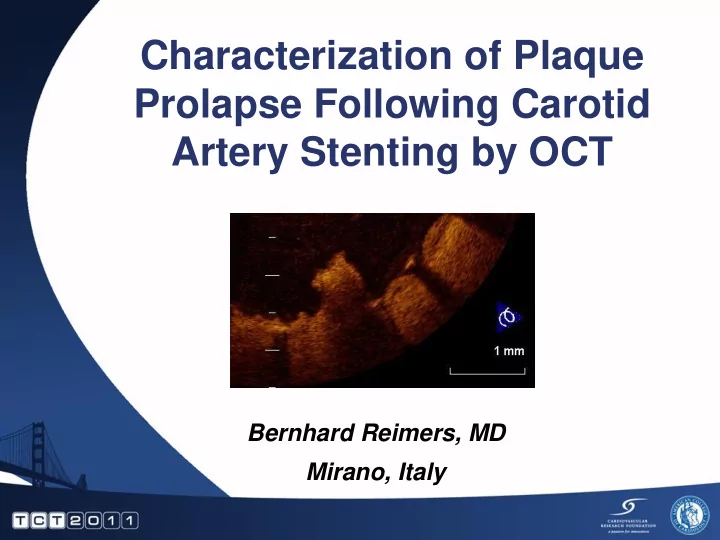
Characterization of Plaque Prolapse Following Carotid Artery Stenting by OCT

Bernhard Reimers, MD Mirano, Italy

slide-2
SLIDE 2

Disclosure Statement of Financial Interest I, Bernhard Reimers DO NOT have a financial interest/arrangement or affiliation with one or more organizations that could be perceived as a real or apparent conflict of interest in the context of the subject of this presentation.

slide-3
SLIDE 3

Definition

Plaque prolapse is defined as tissue extrusion through the stent struts post- procedure. Brack MJ, et al. Int J Cardiol. 1994;44(1):93- 95

slide-4
SLIDE 4

Heart: From enzyme rise to heart attack Brain: From ischemic lesions to stroke Possible distal embolization

Consequences of plaque prolapse

slide-5
SLIDE 5

Relation between plaque components and plaque prolapse after DES implantation: virtual histology –intravascular ultrasound Hong YJ et al. Circ J 2010;74:1142

Necrotic core and fibrotic components were associated with development of PP; and both components in prolapsed plaque were associated with cardiac enzyme elevation after DES implantation.

BMJ Case Reports 2009; Tsui, Lau

slide-6
SLIDE 6

SPACE

CEA & CAS have additional complications within 30 days

Lancet 2006

slide-7
SLIDE 7

DW MRI before and 5 days after CAS DESERVE Study

slide-8
SLIDE 8

Cause of plaque prolapse

Cheese grater effect of stents:

  • during deployment,
  • during postdilatation (most TCD hits),
  • during 30-days post procedure
slide-9
SLIDE 9

Cheese grating is not always good

Increased plaque prolapse from coronary experience:

  • thrombotic lesion
  • lipid core
  • thin cap over necrotic core

Hung et al; Circ 2010 Differences between soft and hard cheeses plaques

slide-10
SLIDE 10

Detection of plaque prolapse

Angiography IVUS OCT AHA Journals; BMJ; J Intevent Cardiol In coronary arteries

slide-11
SLIDE 11

Precise NexStent Xact Acculink Ø = 0.107 mm Ø = 0.118 mm

Ø = 0.128 mm Ø = 0.173 mm

Closed-cell stents Open-cell stents

The concept of plaque scaffolding of stents

slide-12
SLIDE 12

Emboli Protection Strategies and OCT acquisition

Non Occlusive Technique

slide-13
SLIDE 13

Emboli Protection Strategies and OCT acquisition

Occlusive Technique

slide-14
SLIDE 14

1 Positioning of OCT catheter distal to stent

slide-15
SLIDE 15

2 Careful hand injection of 20cc dye (Ultravist 320) 3 When images ok: pull-back of OCT system

slide-16
SLIDE 16

4 Hand re-aspiration of dye

slide-17
SLIDE 17
slide-18
SLIDE 18

Carotid OCT

After stent in stent with Acculink 6-8 x 40 mm and postdilatation with 5.5 x 20 a 12 atm balloon

Post stent OCT

slide-19
SLIDE 19

Small ulcers (no clinical determinant of complictions)

Carotid OCT

slide-20
SLIDE 20

Open cell struts Closed cell struts

Carotid OCT

Open cell stent Closed cell stent

slide-21
SLIDE 21

Plaque rupture

Carotid OCT

slide-22
SLIDE 22

Flow artefact

Carotid OCT

slide-23
SLIDE 23

Carotid OCT

Plaque prolapse: Possible determinants of late complications

slide-24
SLIDE 24

Carotid OCT before CAS

slide-25
SLIDE 25

Lesion after stenting

slide-26
SLIDE 26

Final result after post-dilatation

slide-27
SLIDE 27

Conclusions (1)

OCT after carotid stenting appears feasible and safe. Using the occlusive technique, better quality images were

  • btained with the advantage not to increase the contrast load

Carotid OCT allows collection of important information regarding the stent and plaque behaviour not seen with standard angiography Compared to IVUS less penetration (for plaque characterization), better surface images (for stent evaluation)

Reimers et al.; EuroIntervention 2011

Conclusions

slide-28
SLIDE 28
slide-29
SLIDE 29
slide-30
SLIDE 30
slide-31
SLIDE 31
slide-32
SLIDE 32
slide-33
SLIDE 33
  • Interv. Cardiol 2010;2:535

Prolapse Malapposition Prolapse Prolapse Dissection Coronary OCT