
SLIDE 1
Linking Environment And Farming
engaging activities to make them memorable
www.leafuk.org
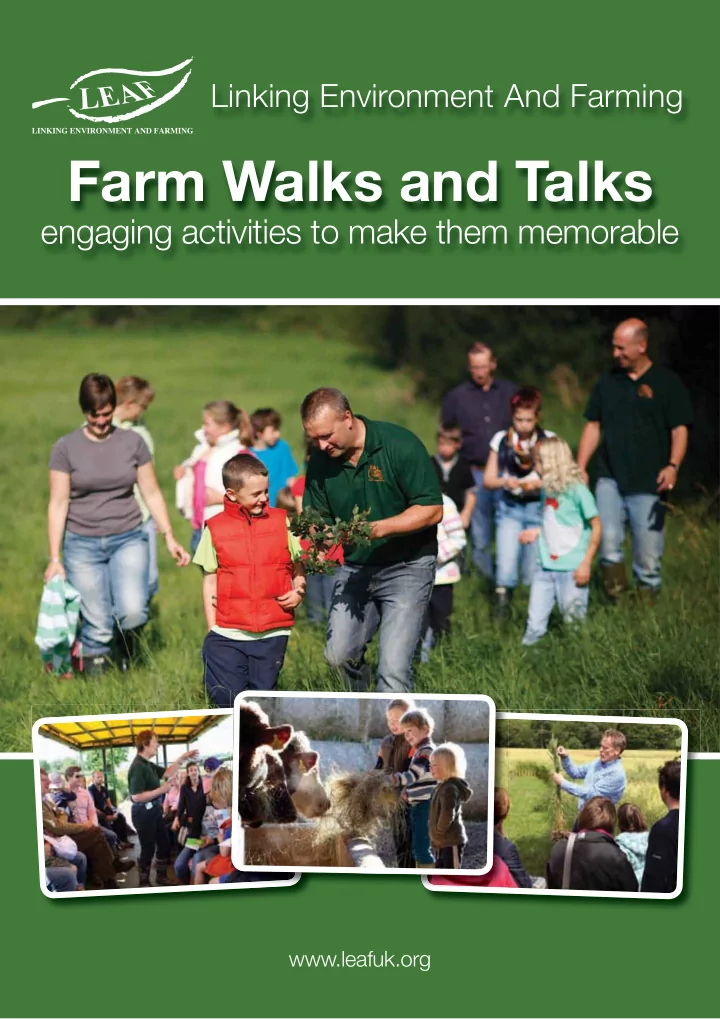
Farm Walks and Talks engaging activities to make them memorable - - PDF document
Linking Environment And Farming Farm Walks and Talks engaging activities to make them memorable www.leafuk.org About LEAF range of audiences, through organised visits. They LEAF (Linking Environment communicate an understanding of IFM in
www.leafuk.org
LEAF (Linking Environment And Farming) is a leading global organisation delivering more sustainable food and
scientists and consumers, to inspire and enable sustainable farming that is prosperous, enriches the environment and engages local communities. LEAF promotes Integrated Farm Management (IFM), a whole farm business approach that delivers sustainable farming.
Integrated Farm Management (IFM)
Integrated Farm Management (IFM) is a whole farm business approach that delivers sustainable
and traditional methods to deliver prosperous farming that enriches the environment and engages local
principles will demonstrate site-spercifjc and contiuous improvement across the whole farm.
The LEAF Sustainable Farming Review
The LEAF Sustainable Farming Review is a self- assessment, online management tool for LEAF members to help them farm more sustainably. It enables them to monitor their performance, identify strengths and weaknesses and set targets for improvement across the whole farm, covering the 9 sections of Integrated Farm Management. It is a very easy to use, practical resource to help farmers make more informed management decisions to drive their businesses forward - economically, environmentally and socially.
The LEAF Marque
The LEAF Marque is an assurance system recognising sustainably farmed products, based on LEAF’s Integrated Farm Management (IFM)
farms are independently inspected to ensure they meet stringent criteria to demonstrate that food is being produced to high environmental standards, across the whole farm.
LEAF’s Demonstration Farms and Innovation Centres
LEAF Demonstration Farms are commercial farms which show the benefjcial practices of Intergrated Farm Management (IFM) to a broad range of audiences, through organised visits. They communicate an understanding of IFM in order to encourage uptake by farmers, support from the industry and political awareness of sustainable food and farming. LEAF Innovation Centres are research
development and promotion of Integrated Farm Management.
Public engagement
LEAF manages Open Farm Sunday, the single, most efgective and supported day in the farming calendar for the industry to ‘open their gates’ and welcome consumers onto farms to discover the story behind their food and the vital role farmers have in caring for the countryside. We also manage Open Farm School Days which encourage school children out onto farms to learn more about where their food comes from and how it is produced. Visit www.farmsunday.org for more information. Let Nature Feed Your Senses delivers sensory rich farm visits to people with disabilities of all ages,
who live in some of the most disadvantaged areas of
Speak Out – the LEAF communications initiative
LEAF’s ‘Speak Out’ initiative encourages farmers to improve their communication skills and provides them with the know how to explain ‘what they do and why they do it.’ Speak Out is a self-help CD-Rom that has already helped thousands
communications training events for farmers.
Membership
LEAF is a charity and membership organisation. We help our members’ to farm more sustainably through our membership tools and services. These include, the LEAF Sustainable Farming Review, the Integrated Farm Management Guide, the IFM Bulletin, handbooks on sustainable soil and water management, access to our online Information Centre as well as technical case studies, events and training videos.
Some of the activities require very little preparation and few resources, others are more complicated and you will need time (and help) to prepare, not a job for the night before! There are many ways to tell your farming story. The activities in this booklet are designed to engage the visitor and enhance your farming messages – they are not an end in themselves or a substitute for a well told story. LEAF has produced a collection of farm information boards covering a range of topics. They can be positioned individually or grouped together beside a footpath, farm entrance or even on the wall of a visitor centre or farm shop. For more information and to order your boards, go to www.leafuk.org. LEAF’s Farm Trail is another way of engaging your
around how farmers produce food sustainably. LEAF’s Farm Trail, developed with funding from The Ernest Cook Trust, is designed to relate to all farm enterprises and is suitable for families and school
‘Open my farm’ at www.farmsunday.org
These activities have been chosen and adapted so that you can host a farm visit that will engage your visitors and give them a fun experience to remember. Taking part in a hands on activity will help them remember the messages that you give them.
One or two activities should be enough for any event depending on numbers expected and how many helpers you have. Every one of the activities can be linked to the curriculum and visiting teachers can do this easily themselves. Liaison with the class teacher before a visit is essential and if you let them know what you are planning to do, they will be able to tell you where the activity fjts into their scheme of work or how they intend to use it in their creative curriculum. Remember that practice makes perfect, you will soon work out what is best for you and your farm. Do what you do best, tell your own unique farming story, this is what the visitor wants to hear and what they will remember most. Good luck and enjoy showing visitors around your
about any other activities that you have tried and would like to share with others.
The LEAF team
Yo Y u could include hand tools and equipment from a bygone age to challenge your audience (e.g. reaping hook, plum picking basket) as well as ‘in season’ crops and vegetables. Yo Y u may need to do a bit of acting as well – rather like the game charades!
When and where to do this
This is a fun activity which can be done at various stops on a tractor and trailer ride or at the end
and engage in a bit of audience participation. It demonstrates the complexity of faming today and the variety of equipment needed. Yo Y u could do an ear tagging demonstration on a cardboard calves ear (which you have prepared earlier) r , encourage your visitors to have a go.
Suggestions for the prop box
Find implements used regularly but which look strange to the general public such as :
castration (no demonstrations!)
mask)
Before any farm walk or talk you should fill your pockets with a selection of tools and small items of equipment that are used in your everyday a farming activities that will be unfamiliar to your visitors. These ‘props’ can then be handed around to engage your visitors by asking them what they are and how they are used.
Suggested messages
to do their job effectively and effjciently
to produce high quality food
produce high quality raw materials
When and where to do this
This can be done throughout a farm tour or at one of the ‘stops’ chosen for a rich selection of wildflowers and grasses (fjeld margins, beetle banks). This simple, but effective activity requires little preparation time and should be done to encourage people to look closely at the world around them; to notice the variety of plants, leaves and flowers. Whilst they are doing this they will see insects and bugs flying, creeping and crawling in different habitats. Ask your visitors to fjnd many different colours from plants and other natural things - on the ground, in the hedgerow and in the fjelds (obviously the winter months are less colourful but the example in the photo was done in December!). They need to pull off the top tape to reveal the sticky surface underneath and then pick very small pieces of the colours about the size of your thumb nail to stick on the tape. Encourage them to leave the insects where they fjnd them, they will not recover once they are stuck onto the tape! Yo Y u will be amazed at the care and attention people give to this simple activity and it will generate some interesting comments, giving you the ideal
wildlife in mind. Yo Y ur visitors will look at these when they get home and remember the wonderful day they have had on the farm.
An activity using pieces of cardboard which hav a e a strip of double sided tape on it
which they can take home as a memory. Suitable for all ages, younger children (under 5) will need help, especially getting the top tape off the sticky bit!
You will need
strips wide enough to accommodate the tape with a bit extra on each side
Y u should provide enough strips for at least 2 per family or one for each child
Suggested messages
natural treasures
the countryside and encouraging biodiversity
part of a food chain and are all important
When and where to do this
This activity demonstrates the diversity of plant and animal life found on the farm and like many of the
and complex messages about biodiversity and different farm practices, for example LEAF’s Integrated Farm Management (IFM), organic farming, food chains. But remember - do what you do best - send them home with a message about what you do on your farm. Yo Y u can do this activity on a walk or on one of the stops on a farm tour. Suggest to your visitors that they think of a wild creature that can be found on the farm such as a rabbit, bird, deer. Then ask them to fjnd things that the creatures like to eat and get them to press them into the clay which they have flattened to form the pizza base.
birds
Yo Y ur visitors will ask loads of questions and the younger children will start to add other things to the pizza. This does not matter, it is yet another springboard to talk about the way farmers care for their land and provide food for wildlife as well as people. Yo Y u can link this activity to feeding livestock on the
touch and smell. Explain that you grow the feed for your livestock and feed them it during the winter whereas wildlife has to fjnd its own food.
An activity using clay a as a pizza base for your visitors to collect ‘ingredients’ from around the farm. A good ‘messy’ family activity for visitors to look more closely at the diversity around them and make a pizza to remind them of their day a and why farms matter. r
You will need
from your own ground is best as you can then talk about soils, but clay bought from a craft supplier is very easy to use and will self harden)
adventurous, ask your local pizza supplier for some boxes to put them in (good advertising for them!)
beetles, mice etc
hands including running water, liquid soap and paper towels
Suggested messages
wildlife, livestock and people
produce excellent quality food for animals and people
You will need
cm long) with interesting shapes
40 cm lengths (it is a good idea to prepare this in advance)
to attach their fjnds to the stick using rubber bands rather than string
pocket to help them out
example
to use as a contrast and examples of how we use maps today, you could include soil maps and cropping rotations The idea for this activity is based on a Native American method of recording and remembering
down through generations with great respect and care as treasured possessions as there was no written language. Different coloured twine or wool was used to tie on artefacts that would inform the ‘reader’ of the journey, where to fjnd water, where to hunt for food, the best place to make shelter and dangerous areas.
An activity for all ages using a stick on which visitors tie things they collect as they walk around the farm. This will help them remember their journey and why farms matter. r
Suggested messages
and wildlife
the countryside and encouraging biodiversity
management
When and where to do this
This is an ideal activity to do whilst on your farm
visitors choose their own stick and wool. If you let them pick them up from your own woodland floor it takes far too long and you will never start the walk! At A each stop, and after you have told them a bit about what they can see at this particular place, ask the visitors to look around and fjnd something that will remind them of this stop and the place they are in – a small bunch of grass to indicate a fjeld for hay, berries from a hedgerow that has been planted with native species and provides food for wildlife. They could wrap blue wool around the stick to indicate a pond or river, ears of corn will remind them that your farm produces wheat for bread flour. Feathers from different birds remind them of the variety of wildlife
My map stick journey
Fa F r a m r er e Jo J hn has a lots t
idlif i e f
f r a m r
the sheds wher e e r the re r ke k pt eir i fleece c is s i
s a fe f at a her e , r id a i fox
pheas a an a t. h
ar a e r g n a pat a h an a d mossy s
e the to t p
a d do you we found? A b y ar a n o r You Y ca c n s a ee e smal a l bo the cr c e r at a u t re r s e the o
What to do and when to do it
Yo Y u could plan to do this as part of a farm tour, particularly if the focus at one stop was about birds, you may be growing crops for bird cover, or attracting wild birds. Yo Y u may even be part of, or near, a release site for owls or Red Kites in which case you could build a huge nest with all the things Red Kites scavenge to build their nests. Birds only use their beak and feet to build nests, so encourage your visitors to use only one hand as the beak to gather the materials and to make the nest. They will soon realise how diffjcult it is and just what marvellous feats of construction nests are. This is a super activity to do if your walk is just before Easter. Yo Y ur visitors can make small hand sized nests and then go on an ‘egg hunt’ to fjnd eggs to put in their nests.
A fun activity for all ages using natural materials, sticks, straw and hay a to create a nest, either for a bird or for the visitor!
You will need
thicknesses, shapes and sizes
together
Suggested messages
places for wild birds
family
biodiversity
to be controlled
When and where to do this
This activity can be done in the fjeld at the start or end of a tour. Adults and children will enjoy the challenge of guessing how many loaves of bread, boxes of cornflakes, 37g bags of Maltesers, bottles
metre mini fjeld. For more facts and fjgures of what can be produced out of a square metre mini fjeld, visit the activity section in ‘Open my farm’ at www.farmsunday.org and in the activity section in Things to do at www.letnaturefeedyoursenses.org This activity was developed as part of the Let Nature Feed Your Senses project run by LEAF and The Sensory Trust with funding from The Big Lottery Fund www.letnaturefeedyoursenses.org. Grateful thanks to David Jones for supplying the mini fjelds facts.
This is a great group activity to help you tell your ‘farm to fork’ story by focusing on
and use them to talk about the seeds and other inputs, the farming process, timelines, what is produced and what it is used for – whether 11 pints of beer, 265 (37g) bags
always amazes visitors. You can create your own mini fjeld stories about what you produce or tell mini fjeld stories about whatever crop or livestock you like.
You will need
For each mini fjeld you will need:
wood, sticks, bamboo or plastic plumbing conduit and corner joints
story, for example, seed, fertiliser, spray, harvested crops, through to boxes of corn flakes, 37g bags of Maltesers, rapeseed oil, crisps and loaves of bread
crop/s - either prepare your own facts or refer to the pre-prepared mini fjelds facts available in the activity section in ‘Open my farm’ at www.farmsunday.org
Suggested messages
produced on UK farms
environment following LEAF’s sustainable farming principles
certifjed – this means they are growing food with environmental care
has a direct efgect on the countryside
Example mini field facts for: Winter Wheat Inputs:
Seed 300 seeds Pesticide/spray 1.5ml PK Fertiliser (0.24.24) 30g Nitrogen fertiliser (AN) 58g
Outputs:
Wheat 1kg Gives 800g flour 1 large loaf of bread
There is a wonderful selection of scarecrows if you do a ‘google’ search! In different parts of the country scarecrows have different names and it is a good idea to do a little research to fjnd out what they are called in your area.
A fun activity for the whole family using props to make a scarecrow, which they can take home or leave in your fields. This activity could be used as an alternative activity if people do not want to walk around the farm. It is possible to base your whole farm visit around what props and clothing you make available to make the scarecrow.
You will need
For a full size scarecrow:
hedgerow
waistcoats For a mini version try making a ‘puppet’
less time consuming but does not have the same dramatic effect. Yo Y u will need:
faces
handle of the spoon
cut from old shirts and jumpers
Having an example scarecrow on view will help people understand how to make their own. Make sure that the cross pieces, which will form the arms, are well secured.
Suggested messages
from the young children forced to run through the fjelds scaring off birds, the scarecrow, rope bangers, raptor kites and windmills
predators
Management principles, encourages biological (beetle banks), cultural (rotations, varieties) and mechanical (tillage) methods,
An activity using prepared sheets for your visitors to record things they see as they go around the farm.
You will need
and photocopied. Examples on reverse
boards)
can use them again
Suggested messages
Y u need to use all your senses to discover the wonders of the countryside
contributes to the amazing countryside we have around us
When and where to do this
This activity does not require collecting but relies on keen observation. If the activity sheets are prepared with imagination they will be a real hit with both parents and children. As you walk around the farm you can stop, or slow down at points that have interesting things to see which can be recorded onto the sheet. At A each stop you can tell a ‘chapter’ of your story. Be prepared for some identifjcation questions, have some simple ID books with you. Hopefully you will have a good idea about the wildlife on your farm! The variety of things
and help them to see the broader picture of what is around them. Depending on the ‘hunt’ and on how quickly your visitors fjll in the sheet, you may need to have another one ready for the families who romp ahead.
The Plant Olympics
Use the circles to draw in...
A p l a n t t h e f a r m e r d Variation
If you have older school groups visiting you could send them out with a shopping list to buy a certain number of items. They will be astounded at the amount of money they need! They could use the information gained to take back to school to do a real accounts exercise - income and expenditure. It has been known for farmers to open up their accounts for A level students who are doing Business Studies. Brave people! If you allow children to sit in or on the machinery make sure it is safe, secure one door open, lock the
Y u may need handrails, but all the health and safety issues must be dealt with as you think appropriate.
A display a of machinery that visitors can look around to see the variety, size and technology of modern farm machinery. Each piece of machinery should have a description on a board next to it. This activity takes a good deal of time and effort to set up. It could be a good starting point for your farm tour or you could make it part of your ‘grand finale’.
Suggested messages
farmers have to have in order to do the work
machinery over the last two decades has led to a reduction in farm labour force
methods of farming
T ade link – international companies producing the equipment rather than local and UK Global market Yo Y u could indicate
manufactured
You will need
T organise as much farm machinery on view as you can
the hay making equipment together
beside it with a brief description of what it is and what it is used for. Perhaps with a picture
Y u could include the price, or perhaps make this into a quiz. If you have farming magazines, the children will love looking through them to fjnd the prices For example:
FO F R SALE
S e c
c n d h a n d a a P Z H a y a a B
( M a d a a e i n G e r m r r a n a a y n ) H a y a a t u t t r n r r e r G
c
c n d i t i i i
i n £ ? ? ?
VALUAT A ION
N e w H
l a n a a d T L 8 T r T T a r r c a a t
( M a d a a e i n I t a l a a y ) l 5 y e a r a a s r r
d G
c
c n d i t i
i n w e l e e l m a i n a a t a i a a n e d
£ ? ? , ? ?
When and where to do this
Yo Y u can use this booklet for all kinds of activities as they are real winners with children, especially if they have the sticky bits on them! Using the book focuses attention and encourages
Y u can make the writing in the book as simple or as complex as you want. These booklets can be used for a variety of topics for example: My favourite farm book - hings I can see, hear, smell, feel on the farm My favourite sheep book - things I like about sheep Farm alphabet book - things beginning with A, B. C etc (a simple look and record activity) “I spy book” - can you see a green tractor? Where are the nest boxes in the yard?
You will need
T mplate overleaf - remember to take a photocopy as a master to use again!
not too dark otherwise the writing will not show up
– it is more work but more fun!
Little eight paged booklets which are simple to make from a single sheet of A4 paper so families with young children can record different things about their visit and take them home as a souvenir. r
Suggested messages
When you have clarifjed your take home message(s) you can decide what to write on the pages to reinforce your message – for example, LEAF farms are for food, wildlife and people.
Step 1
Photocopy the template
centre line
Step 2
Open the sheet back out to A4 size and fold 2 and 3 to the centre
Step 3
Open the sheet back
horizontally
Step 4
Open the sheet back out to A4 size and fold back on centre line. Cut from fold 1
along fold 4
Step 5
When cut, open sheet of paper to A4 size and push in 2 ends to form an x shape and you have your booklet
Step 6
Now write on the pages
is’ or ‘sheep eat hay’ and underneath put a piece
various ‘treasures’
How to do this
LEAF farmers carry out Integrated Farm Management (IFM) - a whole farm business approach that delivers sustainable farming.
Fold 4 Fold 4 Fold 4 Top Bottom CUT CUT
Fold 2 to centre Fold 1 centre line Fold 3 to centre
When and where to do this
Do this activity as part of any farm tour based on food production. It will be very rewarding as there is always something interesting turning up and your audience will be amazed by what you will fjnd. Ideally you will have enough sets of equipment for everybody to have a go, or if you do this as a demonstration, make sure you involve different people as helpers, and there needs to be plenty of
If you have been able to get hold of a set of soil sieves, do a demonstration which separates the soil particles by size. Yo Y u must have dry soil for this so it is a good idea to dry some out the night before! Each group could then dig out some soil and try to sieve it by shaking it into a tray or onto a plate. Yo Y u will notice the different sized soil particles. Yo Y u will fjnd earthworms, so encourage your visitors to look at them with the magnifying glass. Yo Y u may fjnd
Yo Y u can tell your visitors about soil cultivation and how it is done on a large scale on the farm – ask them how they do it in their own gardens. Yo Y u could also have some cultivation equipment on show.
Soil sieving is a great activity for all ages to explain and demonstrate the importance
Y u can talk about the role of earthworms in maintaining the health of the soil. Explain practices you undertake to reduce compaction or poaching and that without the elements there would be no soil! Yo Y u could also dig a soil profile pit to help demonstrate soil structure and root growth.
You will need
different size holes, secondary schools may have these
T owels
hands including running water, liquid soap and paper towels
Suggested messages
for people and for animals
to soil erosion – flooding, wind blow
Look at The Adventures of Herman the Worm
When and where to do this
Children and adults enjoy the challenge of fjnding
teasing it out and twisting it between their fjngers. Do this out in the fjeld if the weather is fjne but in a shed or out building if it is wet. When they have a length of wool they can weave it onto the loom. Get your visitors to weave other things onto the loom, pieces of hay, straw and string. Combine this activity with the ‘Favourite Sheep Book’ or a sheep related scavenger hunt. Remind them to wash their hands afterwards.
You will need
a hazel stick about 25cm
sheepskins and shorn fleece (The British Wool Marketing Board could help with these)
a theme, you could have a spinner who will demonstrate using a wheel (someone in your audience might know how)
An activity using small cardboard weaving looms which spun wool and other materials found on the farm can be woven onto. This is a great way wa wa of encouraging your visitors to look more closely at the diversity around them.
Suggested messages
production is not profjtable in this country unless for a specialist market - synthetic fjbres have taken over
churches were built on the wealth of the sheep industry and these contribute to our amazing heritage
support of the British public
LEAF Marque
When and where to do this activity
This activity can be done at the start of a walk, tractor ride or as part of a f a farm event. It could be the end of walk activity that reinforces the take home messages. This activity can be as easy or as complicated as you want it to be but it is a real success as many people will have no idea about the ingredients in the food they buy such as vinegar, HP sauce, whisky, beer, biscuits, even muesli. Pick out an item and ask your visitors if they can guess the ingredients, but don’t keep asking questions that you know they cannot answer as this can be very demoralising! Pass the food items around so that everyone has a chance to look at the labels - give them time to have a chat with each
T ll them what you grow on the farm and how it is marketed. If you are growing cereals for animal feed explain how that links into the food chain. On your walk or tour give your visitors a chance to pick ears of corn, examine the pods of oil seed rape, pick peas and get as close as possible to your livestock.
An activity using a range of food to help people make the link between their shopping baskets and your fields and the choices people make when they buy food have a direct effect on the social and environmental future of the countryside.
You will need
that are either grown on your farm or are produced by other farmers. Yo Y u will need to take some time searching the shelves to fjnd out just how many food items contain ingredients grown in this country – try to get a wide range of shapes and sizes to make your basket interesting
T y and select produce that carry logos or marques that recognise farming practices that benefjt the countryside such as LEAF Marque
place it where it can easily be seen, or even ask your visitors to carry it on the farm tour
corn, oilseed rape or vegetables these can go alongside
stuff them full of scrunched up paper - if a packet of flour or cereals gets broken it does make an awful mess!
miles, you could include similar foods grown
Suggested messages
produced by the British countryside
produced with environmental care
better for the environment – low food miles
food have a direct effect on the social and environmental future of the countryside
Dancing Diggers
Have a seating area and demonstrate some machinery working, for example, a telehandler putting a grab of silage into a feeder wagon. Then you can talk about machinery and perhaps even give people a chance to sit in a tractor. Care will need to be taken to fence off this area.
Master Chef
If you have livestock, why not have different types of feed out on display next to them. For example, with diary cows, have a barrow fjlled with a cow's ration for one day, a 45 gal drum illustrating how much water a cow needs to drink a day, and buckets showing how much milk one cow could produce in one day.
Farm Collage
A simple activity for children that can be done as a planned 'one off' activity or to fill in time whilst people are waiting. The collage could be a general farming one or of animals or machinery. Best done
Y u will need a variety of farming magazines, scissors, glue
as a base. To T give people a focus put a heading e.g. ‘My favourite animals’ or ‘Machines I like’ on top
that they want to cut out and stick on the board. If you have several large sheetsof stiff paper some children could stick pictures on it and take them home, a real winner!
Weights and measures
eighing children in an animal weigh crate is a very simple thing to do. It will demonstrate the importance of keeping a check on the animals’ weight to make sure they are growing properly and are healthy. The weights could be written on a board for comparison. Provide details of animal weights at different ages so your visitors can compare them to their weights. Great care needs to be taken to avoid trapping fjngers and the weigh crate must be absolutely
large numbers of children.
Clean Hands
A short fun activity with a serious message to encourage visitors to wash their hands after touching animals. It should be done at the start of a farm walk or before your visitors enter any building with animals. Mix up the cardboard ‘hands’ and then hand them
the ‘hands’ to spell out two words. When they have successfully arranged them to form CLEAN HANDS explain that it is important to make sure they wash their hands (in running water with liquid soap and paper towels) after they have been in contact with animals or picking things up from around the farm. Remind parents that children (and adults) should not put their fjngers in their mouths or eat when near animals.
Points of view
In the reception area have a large board headed ‘What does farming mean to you?’ for people to write on. This is a great way to help your visitors get a better understanding of what you do and why.
When and where to do this
This is a group discussion activity most suitable for young adults or families with older children. The idea is that you have a discussion with your visitors about all the skills involved in being a farmer. People will be fascinated to learn about the huge variety of skills needed and the diversity of career
ask to get discussions going could include, ‘Who can name some of the skills involved in being a farmer?’, ‘Anyone thought about farming as a career?’, ‘If so what appeals to you about it?’ Get people to shout out all the skills they think a farmer
how you got started. People love to hear personal stories, so tell yours! EDGE is an industry leading project which helps new entrants take their fjrst steps towards careers in food and farming. To fjnd out more and for current vacancies visit www.edgeapprenticeships.org
Showing visitors around your farm will hopefully inspire some of them to consider a career in agriculture or a related industry. There are a whole range of job opportunities and skills required to work in this high tech, forward thinking, professional industry. There are a huge number of skills required to be a farmer – mathematician, accountant, soil scientist, engineer, technician, scientist, conservationist, marketer, grain trader and lots
group discussion activity will help to highlight to your visitors the many skills needed to be a farmer and the range of jobs you and the people you work with undertake. Hopefully it will inspire budding young farmers to explore the career opportunities in farming.
You will need
a farmer
the varied aspects of your job
you do. These could include an ear tagger, mobile phone, account records, soil testing kit etc If you get any careers enquiries whether from young people wanting to start a career in the sector or career changers, please forward them to EDGE www.edgeapprenticeships.org
Suggested messages
difgerent – it’s not all wellies and mud!
an d development
agriculture, the number of roles in supporting industries is growing signifjcantly
in agriculture not only in farming but also horticulture, marketing, management
C h e c k l i s t f
m a k i n g f f y
r f a r m w a l k a s u c c e s s
G e t e x p e r i e n c e b y h e l p i n g
t a t
h e r f a f f r m e r ’ s e v e n t s P r
e y
r f a f f r m a s a l
a t i
t
h e r i g h t p e
l e i n p e r s
, v i a n e t w
k s , p
t e r s , p r e s s
t
r i s t i n f
f r m a t i
N
i f y i n s u r e r s
t h e v i s i t O b s e r v O b s e r O b s e r e h e a l t h a n d s a f e t y p r
e d u r e s – r i s k a s s e s s m e n t , f f h a n d w a s h i n g f a c i l i t i e s f f I n v I n I n
v l l e
h e r s a s h e l p e r s
s p e a k e r s . B r i e f t h e m w e l l P l a n r
t e t a k i n g a c c
n t
i n t e r e s t s / n e e d s
g r
p , t i m e a v a i l a b l e , a a d i s t a n c e , w e a t h e r P r e p a r e p r
s
m a l l
l a r g e
e a f f c h s t
a l
g t h e w a y a a S e t u p d i s p l a y w i t h p
t e r s a n d p r
s
i n t e r e s t a a f
e a r f f l y a l l r r i v r i r i e r s W a l k t h e r
t e . C h e W W c k a l l i s w e l l . T i m e i t S
t t h e m e s s a g e s f
e a f f c h s t
a l
g t h e r
t e a n d t h e t h
g h t y
w a n t a l l y
r v i s i t
s t
e a v a a e w i t h O r g a n i s e r e f r e s h m e n t s / t
l e t a n d h a n d
a s h i n g f a c i l i t i e s f f H a v a a e ‘ g i v e ‘ g i e ‘ g i e
w a a a y s ’ r e a d y – a a f a f f r m f a c t s , l e a fl e t s , s t i f f c k e r s , p r
u c t s t
f
a n d w h e r e t
u y e t c f f S i g n s u p a t e n t r a n c e , f
p a r k i n g , t
l e t s e t c f f T
e t f e e d b a f f c k – k n
w h a t y
w i l l a s k
p r e p a r e s h e e t s f
f f v i s i t
s t
i v v i s i t
s t
i v i s i t
s t
i e c
m e n t s
And afterwards
M a k e a n
e
w h a t w e n t r i g h t a n d w r
g – a n d d
v e n b e t t e r n e x t t i m e !
Our grateful thanks to EDGE for supporting the printing of this booklet www.edgeapprenticeships.org
LEAF (Linking Environment And Farming) Stoneleigh Park Warwickshire CV8 2LG UK T: 02476 413911
Registered charity no: 1045781 LEAF is a company limited by guarantee, registered in England number: 3035047
LEAF (Linking Environment And Farming) is the leading organisation delivering more sustainable food and farming. We work with
LEAF is a charity and membership organisation. We help our members to farm more sustainably through our membership tools and services. Go to www.leafuk.org to join online.
www.leafuk.org enquiries@leafuk.org
@LEAF_Farming facebook.com/LinkingEnvironmentAndFarming