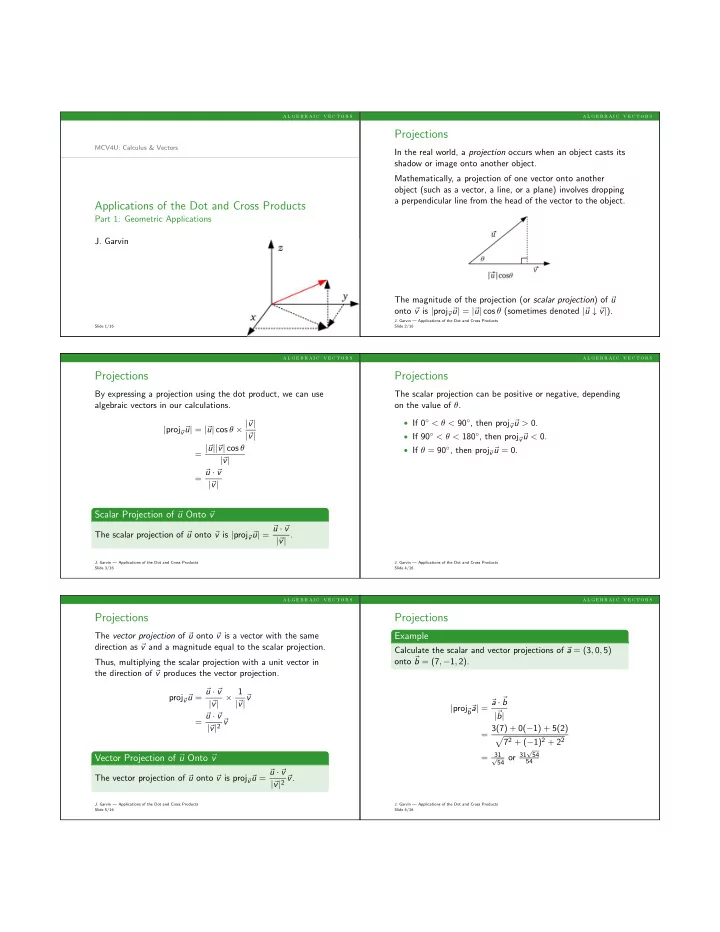
Projections MCV4U: Calculus & Vectors In the real world, a - - PDF document

projections
SMART_READER_LITE
LIVE PREVIEW

Projections MCV4U: Calculus & Vectors In the real world, a - - PDF document

a l g e b r a i c v e c t o r s a l g e b r a i c v e c t o r s Projections MCV4U: Calculus & Vectors In the real world, a projection occurs when an object casts its shadow or image onto another object. Mathematically, a projection of one


slide-1
SLIDE 1

a l g e b r a i c v e c t o r s

MCV4U: Calculus & Vectors

Applications of the Dot and Cross Products

Part 1: Geometric Applications

  • J. Garvin

Slide 1/16

a l g e b r a i c v e c t o r s

Projections

In the real world, a projection occurs when an object casts its shadow or image onto another object. Mathematically, a projection of one vector onto another

  • bject (such as a vector, a line, or a plane) involves dropping

a perpendicular line from the head of the vector to the object. The magnitude of the projection (or scalar projection) of u

  • nto

v is |proj

v

u| = | u| cos θ (sometimes denoted | u ↓ v|).

  • J. Garvin — Applications of the Dot and Cross Products

Slide 2/16

a l g e b r a i c v e c t o r s

Projections

By expressing a projection using the dot product, we can use algebraic vectors in our calculations. |proj

v

u| = | u| cos θ × | v| | v| = | u|| v| cos θ | v| = u · v | v|

Scalar Projection of u Onto v

The scalar projection of u onto v is |proj

v

u| = u · v | v| .

  • J. Garvin — Applications of the Dot and Cross Products

Slide 3/16

a l g e b r a i c v e c t o r s

Projections

The scalar projection can be positive or negative, depending

  • n the value of θ.
  • If 0◦ < θ < 90◦, then proj

v

u > 0.

  • If 90◦ < θ < 180◦, then proj

v

u < 0.

  • If θ = 90◦, then proj

v

u = 0.

  • J. Garvin — Applications of the Dot and Cross Products

Slide 4/16

a l g e b r a i c v e c t o r s

Projections

The vector projection of u onto v is a vector with the same direction as v and a magnitude equal to the scalar projection. Thus, multiplying the scalar projection with a unit vector in the direction of v produces the vector projection. proj

v

u = u · v | v| × 1 | v| v = u · v | v|2 v

Vector Projection of u Onto v

The vector projection of u onto v is proj

v

u = u · v | v|2 v.

  • J. Garvin — Applications of the Dot and Cross Products

Slide 5/16

a l g e b r a i c v e c t o r s

Projections

Example

Calculate the scalar and vector projections of a = (3, 0, 5)

  • nto

b = (7, −1, 2). |proj

b

a| = a · b | b| = 3(7) + 0(−1) + 5(2)

  • 72 + (−1)2 + 22

=

31 √ 54 or 31 √ 54 54

  • J. Garvin — Applications of the Dot and Cross Products

Slide 6/16

slide-2
SLIDE 2

a l g e b r a i c v e c t o r s

Projections

proj

b

a = a · b | b|2

  • b

= |proj

b

a| ×

  • b

| b| = 31(7, −1, 2) 54 = 217

54 , − 31 54, 31 27

  • J. Garvin — Applications of the Dot and Cross Products

Slide 7/16

a l g e b r a i c v e c t o r s

Area of a Parallelogram

Recall that the magnitude of the cross product is given by | u × v| = | u|| v| sin θ. Consider the following diagram of a parallelogram. Since the area of a parallelogram is given by A = bh, the area

  • f the parallelogram is the magnitude of the cross product.
  • J. Garvin — Applications of the Dot and Cross Products

Slide 8/16

a l g e b r a i c v e c t o r s

Area of a Parallelogram

Example

Determine the area of a parallelogram with one vertex at the

  • rigin and two others at (3, 5, 1) and (2, 0, −1).
  • u ×

v = (5(−1) − 1(0), 1(2) − 3(−1), 3(0) − 5(2)) = (−5, 5, −10)

  • J. Garvin — Applications of the Dot and Cross Products

Slide 9/16

a l g e b r a i c v e c t o r s

Area of a Parallelogram

| u × v| = |(−5, 5, −10)| =

  • (−5)2 + 52 + (−10)2

= 5 √ 6 units2

  • J. Garvin — Applications of the Dot and Cross Products

Slide 10/16

a l g e b r a i c v e c t o r s

Triple Scalar Product

A calculation involving both the dot and cross products is the triple scalar product.

Triple Scalar Product

For vectors u, v and w, the triple scalar product (TSP) is

  • u ·

v × w. As its name suggests, the TSP produces a scalar value. Since the dot and cross products both operate on vectors, the cross product must be performed first.

  • J. Garvin — Applications of the Dot and Cross Products

Slide 11/16

a l g e b r a i c v e c t o r s

Triple Scalar Product

Example

Determine the TSP of p = (1, 2, 0), q = (4, 0, −3) and

  • r = (3, −1, −2).
  • p ·

q × r = (1, 2, 0) · (4, 0, −3) × (3, −1, −2) = (1, 2, 0) · (−3, −1, −4) = −5 Note that the TSP can be positive or negative.

  • J. Garvin — Applications of the Dot and Cross Products

Slide 12/16

slide-3
SLIDE 3

a l g e b r a i c v e c t o r s

Volume of a Parallelepiped

A parallelepiped is a six-faced, three-dimensional solid where

  • pposite faces are parallel.Let

b and c form the base of a parallelepiped, and a a non-coplanar edge, as shown.

  • J. Garvin — Applications of the Dot and Cross Products

Slide 13/16

a l g e b r a i c v e c t o r s

Volume of a Parallelepiped

Like all prisms, the volume of a parallelepiped can be calculated as the product of the area of its base and its height. Since the base is a parallelogram, the area of its base is | b × c|. The height of the parallelepiped is the magnitude of a projected onto the vector produced by b × c. The volume, v, of the parallelepiped is V = | b × c|| a · b × c| | b × c| = | a · b × c| The volume of a parallelepiped is the magnitude of the TSP.

  • J. Garvin — Applications of the Dot and Cross Products

Slide 14/16

a l g e b r a i c v e c t o r s

Volume of a Parallelepiped

Example

Determine the volume of the parallelepiped defined by

  • u = (1, 0, 3),

v = (4, 1, 0) and w = (2, −1, 1). | u · v × w| = |(1, 0, 3) · (4, 1, 0) × (2, −1, 1)| = |(1, 0, 3) · (1, −4, −6)| = 17 units3

  • J. Garvin — Applications of the Dot and Cross Products

Slide 15/16

a l g e b r a i c v e c t o r s

Questions?

  • J. Garvin — Applications of the Dot and Cross Products

Slide 16/16