Project Technology can be burned in boilers, used as cultivation - - PDF document

project technology
SMART_READER_LITE
LIVE PREVIEW

Project Technology can be burned in boilers, used as cultivation - - PDF document

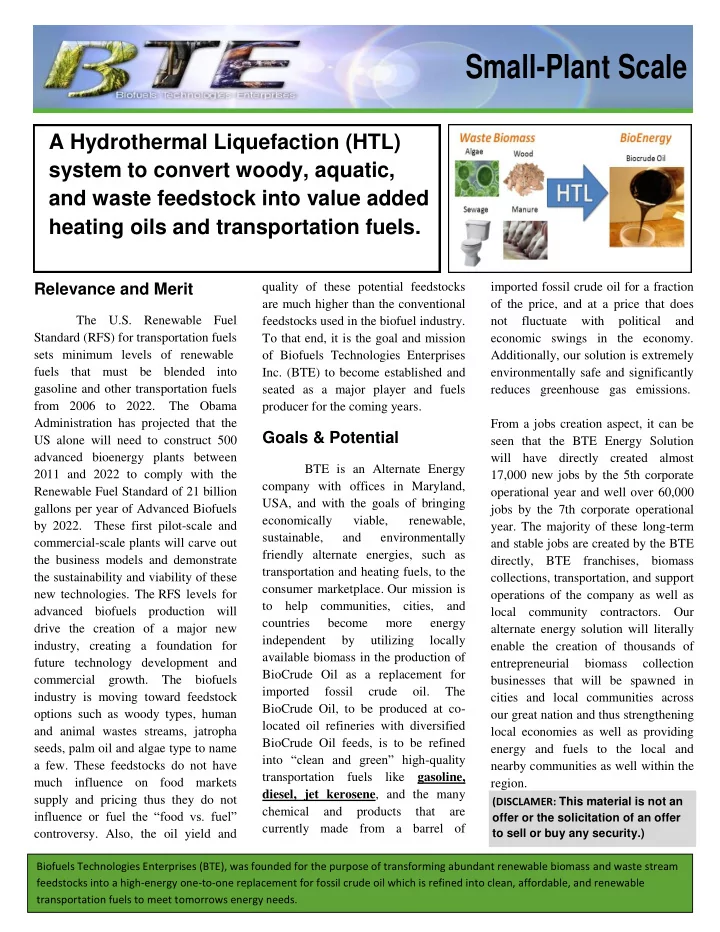
Small-Plant Scale A Hydrothermal Liquefaction (HTL) system to convert woody, aquatic, and waste feedstock into value added heating oils and transportation fuels. Relevance and Merit quality of these potential feedstocks imported fossil crude


slide-1
SLIDE 1

Biofuels Technologies Enterprises (BTE), was founded for the purpose of transforming abundant renewable biomass and waste stream feedstocks into a high-energy one-to-one replacement for fossil crude oil which is refined into clean, affordable, and renewable transportation fuels to meet tomorrows energy needs.

Relevance and Merit

The U.S. Renewable Fuel Standard (RFS) for transportation fuels sets minimum levels of renewable fuels that must be blended into gasoline and other transportation fuels from 2006 to 2022. The Obama Administration has projected that the US alone will need to construct 500 advanced bioenergy plants between 2011 and 2022 to comply with the Renewable Fuel Standard of 21 billion gallons per year of Advanced Biofuels by 2022. These first pilot-scale and commercial-scale plants will carve out the business models and demonstrate the sustainability and viability of these new technologies. The RFS levels for advanced biofuels production will drive the creation of a major new industry, creating a foundation for future technology development and commercial growth. The biofuels industry is moving toward feedstock

  • ptions such as woody types, human

and animal wastes streams, jatropha seeds, palm oil and algae type to name a few. These feedstocks do not have much influence on food markets supply and pricing thus they do not influence or fuel the “food vs. fuel”

  • controversy. Also, the oil yield and

quality of these potential feedstocks are much higher than the conventional feedstocks used in the biofuel industry. To that end, it is the goal and mission

  • f Biofuels Technologies Enterprises
  • Inc. (BTE) to become established and

seated as a major player and fuels producer for the coming years.

Goals & Potential

BTE is an Alternate Energy company with offices in Maryland, USA, and with the goals of bringing economically viable, renewable, sustainable, and environmentally friendly alternate energies, such as transportation and heating fuels, to the consumer marketplace. Our mission is to help communities, cities, and countries become more energy independent by utilizing locally available biomass in the production of BioCrude Oil as a replacement for imported fossil crude

  • il.

The BioCrude Oil, to be produced at co- located oil refineries with diversified BioCrude Oil feeds, is to be refined into “clean and green” high-quality transportation fuels like gasoline, diesel, jet kerosene, and the many chemical and products that are currently made from a barrel of imported fossil crude oil for a fraction

  • f the price, and at a price that does

not fluctuate with political and economic swings in the economy. Additionally, our solution is extremely environmentally safe and significantly reduces greenhouse gas emissions. From a jobs creation aspect, it can be seen that the BTE Energy Solution will have directly created almost 17,000 new jobs by the 5th corporate

  • perational year and well over 60,000

jobs by the 7th corporate operational

  • year. The majority of these long-term

and stable jobs are created by the BTE directly, BTE franchises, biomass collections, transportation, and support

  • perations of the company as well as

local community contractors. Our alternate energy solution will literally enable the creation of thousands of entrepreneurial biomass collection businesses that will be spawned in cities and local communities across

  • ur great nation and thus strengthening

local economies as well as providing energy and fuels to the local and nearby communities as well within the region.

Small-Plant Scale

A Hydrothermal Liquefaction (HTL) system to convert woody, aquatic, and waste feedstock into value added heating oils and transportation fuels.

(DISCLAMER: This material is not an

  • ffer or the solicitation of an offer

to sell or buy any security.)

slide-2
SLIDE 2

Biofuels Technologies Enterprises (BTE), was founded for the purpose of transforming abundant renewable biomass and waste stream feedstocks into a high-energy one-to-one replacement for fossil crude oil which is refined into clean, affordable, and renewable transportation fuels to meet tomorrows energy needs.

Project Technology

We propose a Hydrothermal Liquefaction (HTL) system for producing crude oil from various woody, algae aquatic type, and other feedstock to be used for replacing petroleum based crude oil which is further refined into transportation fuels like gasoline, diesel, and jet kerosene, as well as for the production of the many chemicals stemming from a standard barrel of fossil crude oil. During the hydrothermal liquefaction process, high moisture biomass is subjected to elevated temperatures (250-350 deg C) and pressures (10-20 MPa) in order to break down and reform the chemical building blocks into bio-crude oil. At these temperatures and pressures, water becomes a highly reactive medium promoting the breakdown and cleavage of chemical bonds, allowing for the reformation of biological

  • molecules. The conversion mimics the

natural geological processes which produced our current fossil fuel reserves and allows for the conversion

  • f a wide range of feedstocks.

Water is also beneficial as a reaction medium since the newly formed bio-crude oil self-separates after conversion. The aqueous medium also eliminates the need dry the incoming feedstock, bypassing resource and energy intensive preprocessing steps. Depending on the feedstock, the resulting bio-crude oil can have a heating value comparable to bunker crude oil (30-40 MJ/kg) and can be burned in boilers, used as home/business heating

  • ils,
  • r

upgraded, via catalytic cracking and hydro-treating, and refined into higher value transportation fuels or chemical

  • compounds. The ability to convert

such a wide range of feedstocks under hydrothermal conditions is due to the fundamental biological building blocks that are broken down and reformed during the process. Depending on the feedstock, waste biomass is composed of varying ratios

  • f

macromolecules including carbohydrates (cellulose and starch), lignin, lipids, and proteins. Initially, these macromolecules are broken down into their monomer units. Moving forward, as the hydrothermal liquefaction process continues, the monomer units are further cleaved and broken into smaller fragment molecules. During fragmentation, the goal is to remove

  • xygen and other heteroatoms (e.g.

nitrogen, sulphur, phosphorous), leaving behind the initial carbon and hydrogen atoms in the form of low molecular weight compounds. This process maximizes the energy content

  • f the Biocrude oil and increases the

value and ability to refine the final product. The robust reaction conditions and aqueous environment make hydrothermal liquefaction well suited for the conversion of low-lipid, fast- growing algae that proliferate in wastewater treatment facilities. Additionally, integrating algae cultivation into a wastewater treatment plant offers the synergetic benefit of providing nutrient remediation. Algae capture and utilize dissolved nitrogen and phosphorous present in wastewater to support growth. These plentiful nutrients would otherwise be released into the environment, creating harmful eutrophic zones as a result of prolific algal growth. By converting nutrient waste into a resource, we can reduce environmental pollution, produce bioenergy, and preserve our water resources.

Process Implementation

The small-plant design is for a minimum, but profitable, non-co- located commercial production facility which will produce transportation fuels and heating via the BTE HTL direct "Biomass-to-Gasoline (Diesel, Kerosene, home/business heating oil and others )" process. All of the fuels can be blended into existing fuels

  • r could be used directly in existing

automobiles, trucks, airplanes, power engines, and heating furnaces without

  • modifications. This implementation is

for a 1000 - 2000 barrel/day small- plant in Maryland, USA, and be able to utilize ALL types of biomass which include leaves, switch grass, crop wastes, algae, seaweeds, human and animal wastes streams, just to name a few. The base process even has potential to utilize other types of waste streams like old tires, plastics, coal, oil shale and even tar sands to recover

slide-3
SLIDE 3

Biofuels Technologies Enterprises (BTE), was founded for the purpose of transforming abundant renewable biomass and waste stream feedstocks into a high-energy one-to-one replacement for fossil crude oil which is refined into clean, affordable, and renewable transportation fuels to meet tomorrows energy needs.

fossil crude oil although not the direct focus at this time as we are currently mainly interested in non-food competitive biomass and waste stream types.

Projections and Partnerships

Our projected production growth is for co-located facility(s) going from 5,000 barrels/day (year 1) at $1.74/gal, 25,000/barrels/day (year 3) at $1.31/gal, and 100,000 barrels/day (year 5) at $1.00/gal facilities will enable BTE to have a production capacity of well over 100,000 barrels/day after 5 years

  • peration with a targeted wholesale

fuel price of about $2.50 gallon. These transportation fuels can be made available to the general public at very economical prices while still realizing substantial profits per gallon of product sold. The co-location distributed bio-refinery model that is utilized in

  • ur business model will allow BTE to

augment and enhance existing oil refineries by

  • ffering

a smooth transition from fossil crude oil to BioCrude Oil which can make economical, cleaner, and renewable fuels while still creating thousands of local area jobs for each production facility that goes into operation. To do this, we have assembled a collaborative team of world-class scientist from across 7 universities and 2 national laboratories, whom are all leaders in the biomass and biofuels industry to work closely with BTE towards the realization of this national

  • effort. In addition, BTE has also

started forming industry partnerships with various business & industry companies as well as being a membership in the federally supported Commercial Aviation Alternate Fuels Initiative (CAAFI). At present, the use of biomass resources to produce infrastructure- compatible fuels is very appealing. Hydrocarbon biofuels can potentially be used without significant changes to the current fuel distribution and utilization infrastructure, including pipelines, pumping stations, and

  • vehicles. Given the relatively short

time between now and 2017, the goal

  • f 35 billion gallons per year of

renewable fuels will be more readily met if hydrocarbon biofuels are part of the fuel mix.

Energy Efficiency and Environmental Benefits

The proposed technique has several merits to US and Canada in general including: (a) Environmentally friendly, economical profitable and efficient conversion of wood feedstock to crude oil, (b) Less dependence on foreign energy sources, (c) Reduction

  • f the electricity price by consuming a

low or negative value feedstock for electricity generation, (d) Production

  • f high calorific value crude oil that

can be refined and has potential to produce transportation fuel and (e) Reduction of carbon dioxide emission.

Project Specifications

Production: 400 – 800 t/d (1000 – 2000 barrel/day) Industry Partners:

Titan Worldwide, Inc., Thunder Bay, Ontario, Canada Unlimited Green Fuels, LLC

Associations:

Commercial Aviation Fuel Initiative (CAAFI)

Academic Collaborators:

University of Arkansas University of Alaska University of Georgia University of Hawaii University of Iowa University of Kentucky Mississippi State University

United States National Laboratory Collaborators:

National Renewable Energy Laboratory (NREL) Pacific Northwest National Laboratory (PNNL)

Contact Information:

Lonnie Cumberland Biofuels Technologies Enterprises, Inc. Direct: 313-333-2935 Lonnie@biofuelstechnologyinc.com

Website: http://www.bteinc.net

OFFTAKE STATUS UPDATE: BTE currently has fuels offtake commitment contract in place for more than 30-million gallons of fuels annually with more offtake agreements in process.