Progress and Status of gated IPM collaboration: FY2018 KEK/J-PARC - - PowerPoint PPT Presentation

progress and status of gated ipm collaboration fy2018
SMART_READER_LITE
LIVE PREVIEW

Progress and Status of gated IPM collaboration: FY2018 KEK/J-PARC - - PowerPoint PPT Presentation

US-Japan Meeting on Accelerators and Beam Equipment for High-Intensity Neutrino Beams: 19, 21/03/2019 Progress and Status of gated IPM collaboration: FY2018 KEK/J-PARC Kenichirou Satou / Introduction Issue on gain degradation of MCP


slide-1
SLIDE 1

Progress and Status of gated IPM collaboration: FY2018

KEK/J-PARC Kenichirou Satou

/ Introduction ・Issue on gain degradation of MCP detector ・Merit of the gated IPM / Project plan and progress ・New plan: extended by 2 years ・HV gating system Discharge problem -> Delayed schedule ・How to improve a withstand voltage How to connect cables? ・Performance check ・3rd IPM workshop at J-PARC / Summary

US-Japan Meeting on Accelerators and Beam Equipment for High-Intensity Neutrino Beams: 19, 21/03/2019

slide-2
SLIDE 2

Issue on a charged particle detector, Micro Channel Plate (MCP)

Local gain degradation after the long-term operation of 9 years

Photo of IPM Profile measurement principle

  • 25%

MCP gain Beam profiles controlled by the local bump orbits

Effective area of MCP Photo of the detector, MCP

Effective area

Beam center ・MCP is used as a charged particle detection and signal amplification devise and its gain uniformity is essential for the profile measurement ・The local gain decrease with increase the integrated

  • utput charge, and thus it is severe at the center area

・MCP devise is expensive and cannot be replaced easily

slide-3
SLIDE 3

Solution: HV DC -> Pulse mode operation

Gated system Local gain decrease can be expressed as

Integrated output charge Averaged profile measured Beam center fluctuation Averaged intensity Integrated time of measurement

∆𝐇 𝒚 ∝ 𝑅 𝑦 ∝ 𝐻0 𝑊

𝑐𝑗𝑏𝑡 ∙ ෤

𝜍 𝑦 − 𝑔

𝑦0 𝑦

∙ ෩ 𝐽0 ∙ 𝑈 ∙ 𝐸𝑐𝑓𝑏𝑛 ∙ 𝑬𝑱𝑸𝑵

MCP gain set Local gain change Beam on ratio Duty of IPM operation

Gated IPM system can

  • ptimize this parameter

𝑭 × 𝑪 (𝒘𝒜= 𝑭𝒚𝑪𝒛) drift sweeps the charged particle away from the area of MCP detector On mode Off mode Courtesy of Randy Thurman-Keup, profile measured by the IPM @ FNAL with pulsed HV: From the presentation file of US/Japan monitor meeting at FNAL, 2015.

When 100Hz 1% duty switching operation is used (𝑬𝑱𝑸𝑵: 𝟐 → 𝟏. 𝟏𝟐) , only 20 turn profiles will be selected for each pulse. MCP life will be extended to 100 times longer than that in the case of non-gated system.

slide-4
SLIDE 4

Project plan and progress

  • FY2016

– Design of the HV switching module – Performance check with test circuit – Particle tracking simulation of gated IPM system

  • FY2017

– Construction

  • HV switching module -> Delayed due to

corona and flush over discharge problem

  • New faraday cage

– Performance check of the HV switching module – Particle tracking simulation of gated IPM system

  • FY2018

– Install

  • New faraday cage -> for both H, V IPMs
  • HV switching module -> Delayed: PS and

control unit will be delivered soon (3/19)

– Performance check of the new gated IPM system -> Delayed

Some items are delayed And the schedule is extended New item is added

  • FY2019

– Install

  • HV gating system: New PS and

control unit

– Performance check of the gated IPM system

  • Beam study
  • Simulation using a code IPMsim3D

– Feasibility study of an e-scanner for J-PARC MR

  • Future plan
  • To check profile data consistency

between gated IPM and e-scanner

  • Simulation using the code IPMsim3D
  • FY2020

– Performance check of the gated IPM system – Some modifications will be made for the gated IPM system if needed – Feasibility study of an e-scanner for J-PARC MR

Almost finished

slide-5
SLIDE 5

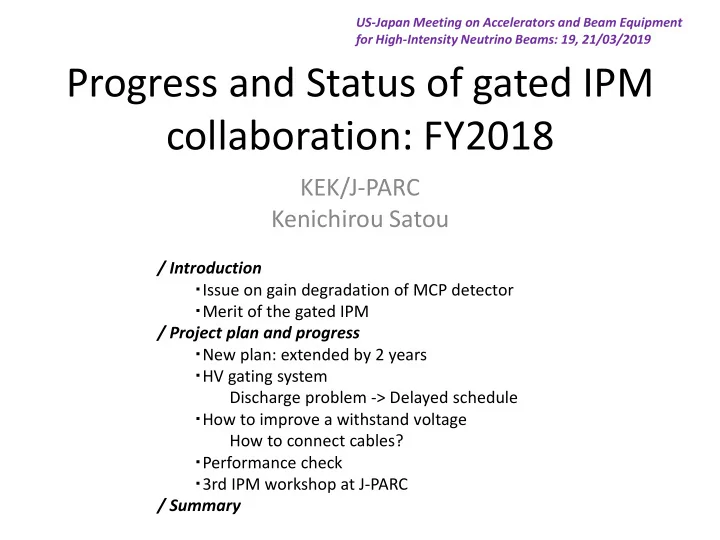
HV gating system

28 27 26 25 19 20 21 22 23 24 18 17 16 15 14 29 6

N

7

N

8

N

9

N

10

N

12

N

12

N

13

N

12

P

11

P

10

P

9

P

8

P

7

P

6

P

4 3 2 1 TTL +5V 0.4A 1A fuse HTS301-03-GSM Lemo Fault TTL 5VDC 0.4ADC GND

  • Cnt. Inp 3-10V

1μ F 1kΩ 1kΩ 1MΩ 1MΩ GND HVout HMBR-20R0.6 PLC V

setmon

Display Display Display Imon Vmon 2A fuse +24V 1.3A typ Vin:+24V 1.7A typ. GND=CASE GND=CASE Vcont:0-5V Vref 5V Remote HV on/off Imon:5V/定 格 Zout=1kΩ Vmon:5V/定 格 Zout=1kΩ HVout GND HFR30-30N HFR30-30P GND HVout Vmon:5V/定 格 Zout=1kΩ Imon:5V/定 格 Zout=1kΩ Remote HV on/off Vref 5V Vcont:0-5V GND=CASE GND=CASE Vin:+24V 1.7A typ. 2A fuse +24V 1.7A typ 0~ 10V PLCout PLC GND Vmon Imon Polarity setting NC COM Polarity setting NC NC NC NC Vcont:0-10V Voltage matching by Resistors To PLC To PLC Vmon:10V/定 格 Imon:10V/定 格 Vin:+24V 1.3A typ. Remote HV on/off (Short=ON, Open=FF) Vin:+24V 1.3A typ. Vin return Vin return TTL Hi:Posi, Lo:Neg TTL Hi:Posi, Lo:Neg G61C841P +HV

  • HV
  • ut

Lemo 4pin Lemo FG:Gate generator 1MΩ G61C841P G61C841P Normal Close Normal Close Hi:On, Low:Off Door switch Door switch Hi:On, Low:Off Hi:On, Low:Off Door switch Normal Close PLC Hi,Open:HVout Low,Short:GND Oil Capacitor HV out Switched 30kV LED: HV on, Gate on, Polarity(Pos, Neg), Power on(for each PS), Fault(HTS301-03-GSM) HV out DC 15kV Oil Capacitor 1μ F Lemo?? Lemo?? 5 13

P

+30kV DC PS

High voltage power supply Compact:19 inch rack mount size

Operational max. HV: 25kV Withstand HV: ≥30kV

  • 30kV DC PS

±20kV DC PS MOS switch Capacitor 1μF Pulsed HV DC HV Relay switch Polarity change Relay switch Discharging Pulsed HV PS Capacitor 1μF Controller
slide-6
SLIDE 6

HV PS controller

FG GND pin HV on/off 9

N

10

N

11

N

12

N

13

N

13

P

12

P

Analog out Display Display Analog out GND=CASE 11

P

10

P

LED Analog out Door switch HV on/off 8

P

GND=CASE 9

P

GND=CASE 0-5V Display Analog out V set 7

P,7 N,21,23

6

P,6 N,22,28

LEMO Analog out PLC 0-10V out PLC TTL on/off filter PLC TTL on/off LED Analog out Trigger Gate out HV gate on/off BNC 1 Note:50Ω matching Analog out LED 1A Fuse +5V 0.4A 2 3 LED 4 PLC TTL on/off Polarity set LED Analog out 5,19 +24V 3A typ 4A Fuse 2 2 Vcont HV on/off Vcont GND=CASE Dial set Analog out Display 14 15 17 16 Display Analog out 18 19 GND=CASE 20 21 23 22 24 25 HV on/off Analog out LED Local/remote Dial set Remote/Local Switch Local/remote Timing module Dial set Local/remote Analog out Display 26 27 28 29 GND=CASE 1kΩ ? 1kΩ ? 1kΩ ? 1kΩ ?

Output control: Gate On/Off: Gate Local/Remote switch Polarity set Timing Trigger HV value set On/Off: HV output

Control by the PLC Gate signal from a function generator : Monitor signals (Current, Voltage)

slide-7
SLIDE 7

How to connect HV cables

Improved withstand voltage: 20kV ⇒ >30kV

Polyvinyl-based resin Silicone oil compound Heat shrinkage tube 1) Connect a resistor and cables with sleeve Sleeve Resister 2) Round the corner with a sandpaper 3) Paint the surface with polyvinyl-based resin 4) Put silicone oil compound and inserted into a heat shrinkage tube 5) Cover again the junction with the tube as well as the cut-edge of the cable shield

slide-8
SLIDE 8

Performance check: Dummy load

10Hz

A SPICE model can reproduce the performances

Dummy load HV cable capacitor CMOS switch 30kV DC PS 20kV DC PS Capacitor

SPICE model for this test setup

Charging time

slide-9
SLIDE 9

SPICE model of Gated IPM

Gated IPM chamber

Rise/Fall time: 15.7μs Pulse width : 200 μs Cycle : 10 Hz Duty : 0.2%

  • Max. HV : 0.9×30kV

200μs

slide-10
SLIDE 10

Simulation work

Gated IPM design, Feasibility study on e-scanner

Electron and ion motion simulation are now on going using a home-made 3D particle tracking simulator, IPMsim3D.

Gaussian profile

Successive Over Relaxation (SOR) to estimate Poisson eq. ・Assumed to be 2D: Relativistic ・Rectangular grid Grid data from POISSON/Superfish (2D) CST STUDIO SUITE (3D) ・Rectangular or Cubic grid Ionization cross section Single differential cross section for H, He, H2, CH4, NH3, and H2O Double differential cross section for H, and He

Flow chart of IPMsim3D

3D particle tracking 4th order Runge- Kutta method Beam intensity of bunch train

slide-11
SLIDE 11

IPM workshop at J-PARC: 18-20/9/2019

International workshop on non-invasive beam profile monitors for hadron machines and its related techniques: 3rd IPM workshop

https://conference-indico.kek.jp/indico/event/55/

In total, 14 talks and 1 special seminar

2 talks on Gated IPM “IPM system for J-PARC MR: Magnet issues and Gated System”, K. Satou “Present Status of Non-Invasive Profile Monitors at FNAL”, Dr. Randy J-PARC seminar “MCPs and MCP based detectors”, Dr. Raquel Ortega Comino (Photonis)

slide-12
SLIDE 12

Summary

  • The construction of the pulsed HV PS was delayed due to ,,,

– Corona, and flush over discharge problems in the PS – New connection methods was developed and applied for the cable and resistor connection – Withstand voltage was improved to be > 30 kV – Will be delivered in J-PARC MR on 20/03/2019

  • Basic performances of the HV gating system was checked using dummy load

– Switching speed: Rise/fall time – Intensity – Our SPICE model can reproduce the performances obtained

  • Performances of the HV gating system used of the real IPM system were estimated by

the SPICE model

– 10 Hz, 200 μs pulse width, duty 0.2 % operation is possible with the maximum output voltage of 90%

  • f the maximum voltage of DC PS and switching speed of about 16 μs
  • To recover the delayed schedule, the projects was extended by 2 years: a new item was

added in the new plans

– The HV gating system will be implemented in the present IPM system during summer long shutdown this year – We are searching for another profile monitor to compare the profile measured by the gated IPM -> Cross check – The feasibility study of a e-scanner for the J-PARC MR using the simulation code, IPMsim3D

  • Possibilities of another profile monitor would also be discussed; beam gas fluorescence monitor, gas sheet

monitor, and flying-wire monitor

  • The 3rd IPM workshop was organized at J-PARC in Sep. 2018

– We already have a good community on the IPM system, and it would be nice to keep discussions in this community – Next or next-next IPM workshop? At FNAL?

slide-13
SLIDE 13

Back-up slides

slide-14
SLIDE 14

HV switching module: Prototype

Prototype module and dummy load

CMOS switch 1 HV PS Dummy load Cable C: 1nF The basic performance was checked by using a prototype- module(6kV) and a dummy-load, and a 10m long HV cable. The obtained rise time is consistent with the circuit simulations. The cable capacitance determines the time response, not the series resistor in total 60 MΩ in the Dummy load. Impedance matching is important. Cable C: 1nF

Cable reflection

5μs

Rise time< 5μs

10MΩ 1nF

slide-15
SLIDE 15

HV switching module

Following discussions with FNAL team, we modified again the switching circuit and changed HV switching point. Taking the capacitance of long HV cable which is 6.6nF into account, switching speed would be about 25μs. The production is now on going and it will be delivered in this March.

Final design:30kV switching module circuit Estimated Switching performance Rise/fall time: 25μs Turn on time: 100μs Turn off time: 399.9ms Duration: 400ms

  • Max. fre.: 2.5Hz

2 P.S. Max HV: ±30kV

IPM chamber Cable C: 6.6nF CMOS switch

P.S. P.S.

Cable C: 6.6nF Max output current of PS and CMOS switch determine the max operation frequency 100MΩ Impedance matching capacitor: 1nF

slide-16
SLIDE 16

New Faraday cage

Ion-catcher structure Matching capacitors

New faraday cage was installed in 2017 summer

・Ion-catcher structure to reduce electron contaminant ・Matching capacitors to improve HV switching speed 1)HV aging up to 30kV 2)Out-gas rate measurement by vacuum-group 3)Degas conditioning for 3 months-> under BG at present

It is now in operation on 30kV DC Ready for gated operation!!

Trend of degree of vacuum after install Out gas test of capacitor

1E-5Pa 1E-6Pa 1E-7Pa

slide-17
SLIDE 17

10kV 20kV 20170127 0.2T w.o. Ion catcher structure 20180114 0.2T w. Ion catcher structure

The ion catcher structure improve signal purity

slide-18
SLIDE 18

Electron motion / Gate-off-state

Ec Es B X(m) y(m) X(m) Z(m) y(m) Z(m) ΔZ(m) Ec×B Beam Beam Es B Ec Ec×B Es B Ec Ec×B

slide-19
SLIDE 19

Ion motion / gate-off-state

X(m) z(m) Beam Es B Ec Ec×B Ec Es B X(m) y(m) Ec×B Beam y(m) Z(m) Es B Ec Ec×B Beam ΔZ(m)

slide-20
SLIDE 20

Off state

slide-21
SLIDE 21

Simulation: IPMsim3D

Beam parameters of J-PARC MR ・Injection (3 GeV) 𝜏𝑢=40ns(600ns interval), 𝜏𝑦=7.6mm, 𝜏𝑧=12.3mm ・Extraction (30 GeV) 𝜏𝑢= 10ns(588ns interval), 𝜏𝑦= 2.7mm, 𝜏𝑧= 4.4mm Interval 正しくは 5380/9ns for inj. 5229/9ns for ext.