1 Early Computers Were Made of Thousands of Identical Electronic - - PDF document

1
SMART_READER_LITE
LIVE PREVIEW

1 Early Computers Were Made of Thousands of Identical Electronic - - PDF document

Voltage-Gated Ion Channels in Voltage-Gated Ion Channels in Health and Disease Health and Disease jdk3 I. Multiple functions of voltage- gated ion channels Principles of Neural Science, chapter 9 II. Neurological diseases involving


slide-1
SLIDE 1

1

Voltage-Gated Ion Channels in Health and Disease

jdk3 Principles of Neural Science, chapter 9

Voltage-Gated Ion Channels in Health and Disease

I. Multiple functions of voltage- gated ion channels

  • II. Neurological diseases involving

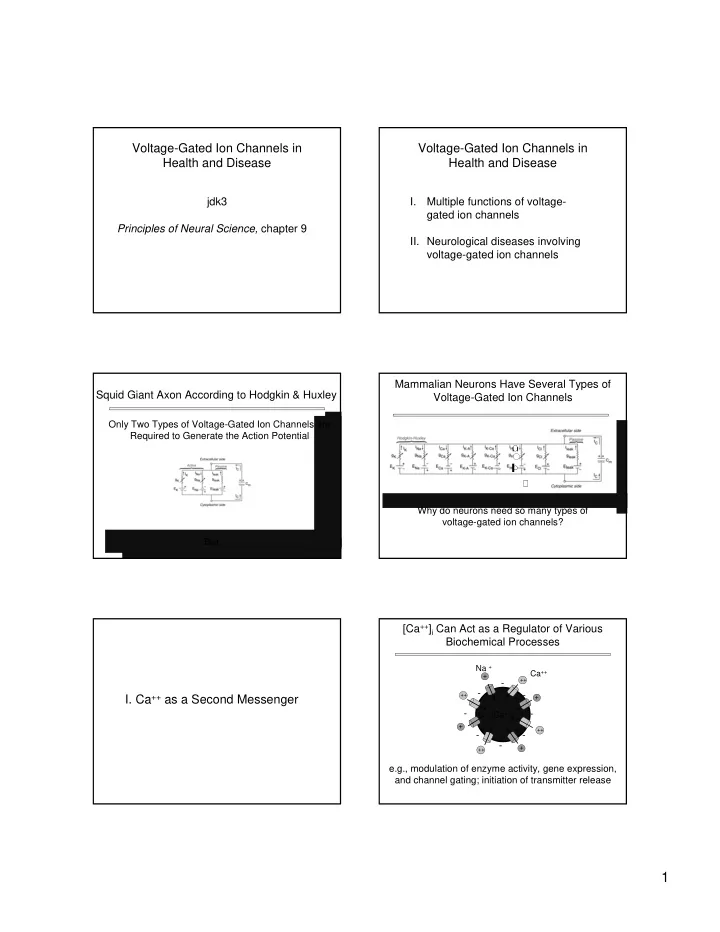
voltage-gated ion channels Squid Giant Axon According to Hodgkin & Huxley

But.... Only Two Types of Voltage-Gated Ion Channels are Required to Generate the Action Potential

Mammalian Neurons Have Several Types of Voltage-Gated Ion Channels

Why do neurons need so many types of voltage-gated ion channels?

  • I. Ca++ as a Second Messenger

[Ca++]i Can Act as a Regulator of Various Biochemical Processes

+

  • +

+ + + + + + + + + + +

++ ++ ++ ++

Ca++ Na +

e.g., modulation of enzyme activity, gene expression, and channel gating; initiation of transmitter release

[Ca++]i

slide-2
SLIDE 2

2

  • II. Fine Control of Membrane Excitability

Early Computers Were Made of Thousands of Identical Electronic Components

ENIAC’s Computational Power Relied on the Specificity of Connections Between Different Identical Elements

Electronic Devices Are Made of a Variety of Specialized Elements With Specialized Functional Properties

Each Class of Neuron Expresses a Subset

  • f the Many Different Types of

Voltage-Gated Ion Channels, Resulting in a Unique Set of Excitability Properties

  • +

+ + + + + + +

  • +

+ + + + + + +

  • +

+ + + + + + +

Each Class of Voltage-Gated Ion Channel Has a Unique Distribution Within the Nervous System

e.g., consider a single gene that encodes voltage-gated K+ channels

slide-3
SLIDE 3

3

Alternative Splicing of Pre-mRNA

Variation of Alternative Splicing of pre-mRNA From One Gene Results in Regional Variation in Expression of Four Different Isoforms of a Voltage-Gated K+ Channel

PNS Fig 6-14

HVA Channels Affect Spike Shape LVA Channels Affect Spike Encoding

Time

Neurons Differ in Their Responsiveness to Excitatory Input Some Neurons Respond with a Burst, Rather than a Train

PNS, Fig 9-11

Thalamocortical Relay Neurons Burst Spontaneously

HCN current T-type Ca++ current

PNS, Fig 9-11

slide-4
SLIDE 4

4

Synaptic Input Can Modulate a Neuron’s Excitability Properties by Modulating Voltage-Gated Ion Channels

Resting Following Synaptic Stimulation

PNS, Fig 13-11C

Neurons Vary as Much in Their Excitability Properties as in Their Shapes Some Nerve Terminals Exhibit Activity-Dependent Spike Broadening

Firing Rate (Hz) Spike Broadening (% of max)

First Spike Last Spike

Dendrites Are NOT Just Passive Cables Many Have Voltage-Gated Channels That Can Modulate the Spread of Synaptic Potentials

PNS, Fig 8-5

Distribution of Four Types of Dendritic Currents in Three Different Types of CNS Neurons

(S = soma location)

Functional Consequences of Regional Variation

  • f Ion Channel Types Within a Neuron
slide-5
SLIDE 5

5

Voltage-Gated Ion Channels in Health and Disease

I. Multiple functions of voltage- gated ion channels

  • II. Neurological diseases involving

voltage-gated ion channels Various Neurological Diseases Are Caused by Malfunctioning Voltage-Gated Ion Channels

Acquired neuromyotonia Andersen’s syndrome Becker’s myotonia Episodic ataxia with

myokymia

Familial hemiplegic

migraine

Generalized epilepsy

with febrile seizures

Hyperkalemic periodic

paralysis

Malignant hyperthermia Myasthenic syndrome Paramyotonia congenita Spinocerebellar ataxia Thompson’s myotonia

Na+, K+, Ca++, Cl- How Voltage-Gated Ion Channels Go Bad

Mutations Autoimmune diseases Defects in transcription of

normal genes

Mislocation within the cell

  • I. Mutations in Different Genes Can

Lead to Similar Symptoms

Myotonic Muscle is Hyperexcitable

Vm Vm

Build-up of K+ Ions in the T-Tubules Following an Action Potential Can Depolarize the Muscle Cell

Action Potential Ca++ Release Surface Membrane Sarcoplasmic Reticulum T-tubule Cytoplasm

EK = RT ln Ko F Ki

slide-6
SLIDE 6

6

Mutations in Voltage-Gated Cl- Channels in Skeletal Muscle Can Result in Myotonia Mutations in Voltage-Gated Na+ Channels in Skeletal Muscle Can Also Result in Myotonia Many of These Point Mutations Affect Kinetics or Voltage-Range of Inactivation

Mutations in Either α or β-Subunits Can Lead to Similar Symptoms

  • II. Different Mutations in the Same Gene

Can Lead to Different Symptoms

“Happy families are all alike. Every unhappy family is unhappy in its own way.”

Tolstoy, p.1, Anna Karenina

slide-7
SLIDE 7

7

Different Point Mutations in the Same α-Subunit Lead to Three Different Classes of Symptoms

Voltage-Gated Na+ Channels in Skeletal Muscle Can Have Point Mutations That Lead to:

Potassium Aggravated Myotonia, Paramyotonia Congenita, or Hyperkalemic Periodic Paralysis

Degree of Na+ Inactivation Deficit Determines Whether Paralysis or Hyperexcitability Occurs Na+ channels open, but do not inactivate normally Firing Depolarization

e.g., endplate potential

Activation of normal Na+ channels Hyperexcitability = Myotonia [K+]o More positive EK Persistent inactivation of normal Na+ channels Paralysis

+ + +

Increasing Degree of Persistent Activation Can Switch the Muscle Fiber from Hyperexcitable to Inexcitable

e.g., Voltage-Gated Na+ Channels Found in the CNS And Those Found in Skeletal Muscle Are Encoded by Different Genes

III.Regional Differences in Gene Expression Account for Much of the Specificity of Ion Channel Diseases

Mutations in Na+ Channels in the CNS Give Rise to Epilepsy - Not to Myotonia

slide-8
SLIDE 8

8

  • IV. Subunit Structure of Ion Channels

Can Influence Inheritance Patterns of Hereditary Ion Channel Diseases

  • Pharmacological block of 50% of Cl- channels

produces no symptoms.

  • Heterozygotes with 50% normal Cl- channel

gene product are symptomatic (autosomal dominant myotonia congenita).

Paradox

Because Cl- Channels are Dimers, Only 25 % of Heterozygotic Channels are Normal

Mutant Wild Type

Genes Channels