Inverse Functions Inverse Functions If f is a one-to-one function - - PowerPoint PPT Presentation

inverse functions
SMART_READER_LITE
LIVE PREVIEW

Inverse Functions Inverse Functions If f is a one-to-one function - - PowerPoint PPT Presentation

Inverse Functions Inverse Functions If f is a one-to-one function with domain A and range B , we can define an inverse function f 1 (with domain B and range A ) by the rule f 1 ( y ) = x if and only if f ( x ) = y . This satisfies the


slide-1
SLIDE 1

Inverse Functions

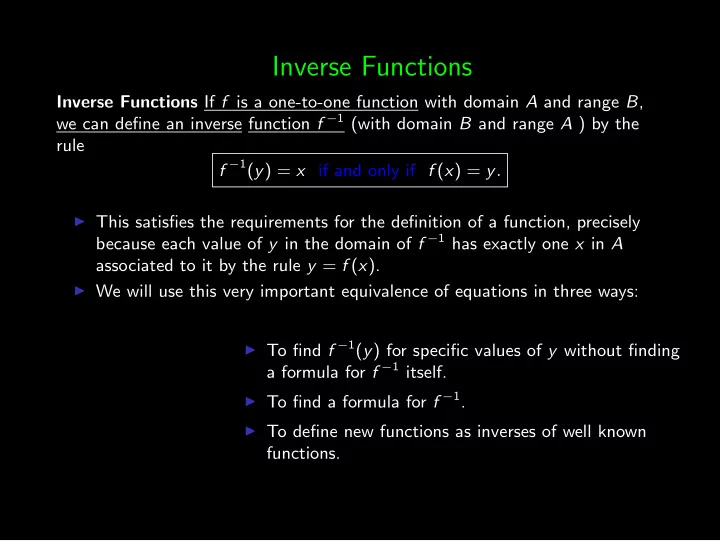
Inverse Functions If f is a one-to-one function with domain A and range B, we can define an inverse function f −1 (with domain B and range A ) by the rule f −1(y) = x if and only if f (x) = y.

◮ This satisfies the requirements for the definition of a function, precisely

because each value of y in the domain of f −1 has exactly one x in A associated to it by the rule y = f (x).

◮ We will use this very important equivalence of equations in three ways: ◮ To find f −1(y) for specific values of y without finding

a formula for f −1 itself.

◮ To find a formula for f −1. ◮ To define new functions as inverses of well known

functions.

slide-2
SLIDE 2

Finding f −1(y) for specific values of y.

Example: If f (x) = x3 + 1, use the equivalence of equations given above find f −1(9).

◮ We first write out our equivalence of equations:

f −1(y) = x if and only if f (x) = y.

◮ Replacing y by 9 tells us that

f −1(9) = x is the same as saying that f (x) = 9.

◮ Substituting the formula for f tells us that

f −1(9) = x is the same as saying that x3 + 1 = 9.

◮ Thus solving for x in

f −1(9) = x is the same as solving for x in x3 = 8. which gives x = 2.

◮ Thus f −1(9) = 2. ◮ Try to repeat this process to find f −1(28)

before you see the solution. (Do not solve this by finding a formula for the inverse function, the purpose of this exercise to is learn the above method.)

slide-3
SLIDE 3

Finding f −1(y) for specific values of y.

Example: If f (x) = x3 + 1, find f −1(28).

◮ f −1(y) = x if and only if

f (x) = y.

◮ This tells us that f −1(28) = x if and only if f (x) = 28. ◮ Therefore f −1(28) = x if and only if x3 + 1 = 28. ◮ Thus f −1(28) = x if and only if x3 = 27. which is the same as

saying that x = 3.

◮ Thus f −1(28) = 3. ◮ Note: the statement of equivalence “if and only if” is often

abbreviated to iff or ⇐ ⇒ in mathematics.

slide-4
SLIDE 4

A bit of guesswork

Example: If g(x) = cos(x) + 2x, find g −1(1).

◮ In this case, we know that g is a one-to-one function (why?) ◮ Because g ′(x) = 2 − sin(x) > 0. ◮ We know g −1(1) = x ⇐

⇒ 1 = cos(x) + 2x (using g −1(1) = x is the same as g(x) = 1).

◮ It is difficult to solve for x in the equation 1 = cos(x) + 2x but in this

case we can guess:

◮ We know that cos(0) = 1, therefore cos(0) + 2(0) = 1 and x = 0 must

the unique value of x which fits the equation 1 = cos(x) + 2x.

◮ Thus g −1(1) = 0.

slide-5
SLIDE 5

Domains and Ranges

Note that the domain of f −1 equals the range of f and the range of f −1 equals the domain of f .

◮ Example Let g(x) = √4x + 4. ◮ What is Domain g? The domain of g is all values of x for which

4x + 4 ≥ 0 i.e. {x|x ≥ −1}.

◮ What is Range g? The range of g is {y|y ≥ 0}. ◮ Does g −1 exist? ◮ Yes because g is a 1-1 function. ◮ What is the domain and range of g −1? ◮ The domain of g −1 is the range of g which is {x|x ≥ 0}. ◮ The range of g −1 is the domain of g which is {x|x ≥ −1}. ◮ What is g −1(4)? ◮ g −1(4) = x ⇐

⇒ g(x) = 4 ⇐ ⇒ √4x + 4 = 4 ⇐ ⇒ 4x + 4 = 16 ⇐ ⇒ 4x = 12 ⇐ ⇒ x = 3. i.e. g −1(4) = 3.