
SLIDE 1
Transactions of the Korean Nuclear Society Virtual Spring Meeting July 9-10, 2020
Program for Heat-map Entropy Evaluation of Eye-tracking Data
Seung-Bin Son a, Yejin Lee a, Hyun-Chul Lee a*
aSevere Accident Monitoring and Mitigation Research Team,
Korea Atomic Energy Research Institute, 989-111 Daedeok-daero, Yuseong-gu, Daejeon, Korea 34057
*Corresponding author: leehc @kaeri.re.kr
- 1. Introduction
An eye-tracker is useful equipment to record what human looks at in real time. Since the eye tracker collects x,y-coordinated data in a very short time interval, experimenters have abundant eye-tracking data from an experiment which require much time to reach an analysis
- result. The heat-map entropy is a measure of gaze point
dispersion and requires much time to evaluate. To reduce time-consuming data processing and get faster heat-map entropy analysis, a computer software program was developed and this paper shows the development process and an used case.
- 2. Methods and Results
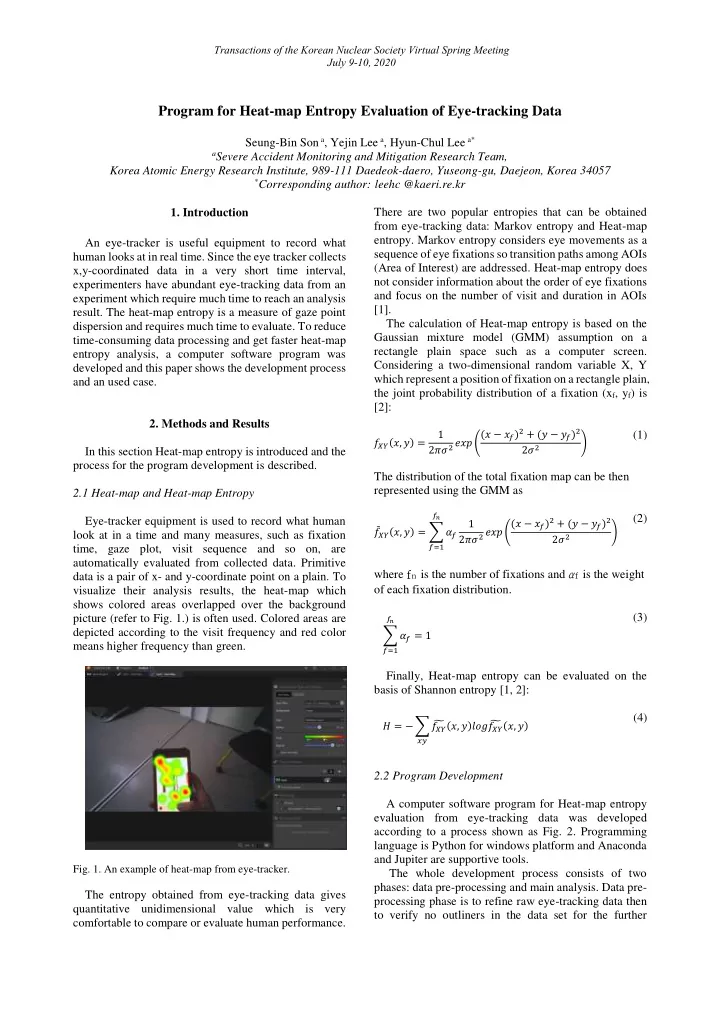
In this section Heat-map entropy is introduced and the process for the program development is described. 2.1 Heat-map and Heat-map Entropy Eye-tracker equipment is used to record what human look at in a time and many measures, such as fixation time, gaze plot, visit sequence and so on, are automatically evaluated from collected data. Primitive data is a pair of x- and y-coordinate point on a plain. To visualize their analysis results, the heat-map which shows colored areas overlapped over the background picture (refer to Fig. 1.) is often used. Colored areas are depicted according to the visit frequency and red color means higher frequency than green.
- Fig. 1. An example of heat-map from eye-tracker.
The entropy obtained from eye-tracking data gives quantitative unidimensional value which is very comfortable to compare or evaluate human performance. There are two popular entropies that can be obtained from eye-tracking data: Markov entropy and Heat-map
- entropy. Markov entropy considers eye movements as a
sequence of eye fixations so transition paths among AOIs (Area of Interest) are addressed. Heat-map entropy does not consider information about the order of eye fixations and focus on the number of visit and duration in AOIs [1]. The calculation of Heat-map entropy is based on the Gaussian mixture model (GMM) assumption on a rectangle plain space such as a computer screen. Considering a two-dimensional random variable X, Y which represent a position of fixation on a rectangle plain, the joint probability distribution of a fixation (xf, yf) is [2]: (1) The distribution of the total fixation map can be then represented using the GMM as (2) where fn is the number of fixations and αf is the weight
- f each fixation distribution.
(3) Finally, Heat-map entropy can be evaluated on the basis of Shannon entropy [1, 2]: (4) 2.2 Program Development A computer software program for Heat-map entropy evaluation from eye-tracking data was developed according to a process shown as Fig. 2. Programming language is Python for windows platform and Anaconda and Jupiter are supportive tools. The whole development process consists of two phases: data pre-processing and main analysis. Data pre- processing phase is to refine raw eye-tracking data then to verify no outliners in the data set for the further
𝑔
𝑌𝑍(𝑦, 𝑧) =
1 2𝜌𝜏2 𝑓𝑦𝑞 ( (𝑦 − 𝑦𝑔)2 + (𝑧 − 𝑧𝑔)2 2𝜏2 ) 𝑔 ̃
𝑌𝑍(𝑦, 𝑧) = ∑ 𝛽𝑔 𝑔
𝑜
𝑔=1
1 2𝜌𝜏2 𝑓𝑦𝑞 ( (𝑦 − 𝑦𝑔)2 + (𝑧 − 𝑧𝑔)2 2𝜏2 ) ∑ 𝛽𝑔 = 1
𝑔
𝑜