Producing Transgenic Plants Efficient tissue culture system for - - PowerPoint PPT Presentation

producing transgenic plants
SMART_READER_LITE
LIVE PREVIEW

Producing Transgenic Plants Efficient tissue culture system for - - PowerPoint PPT Presentation

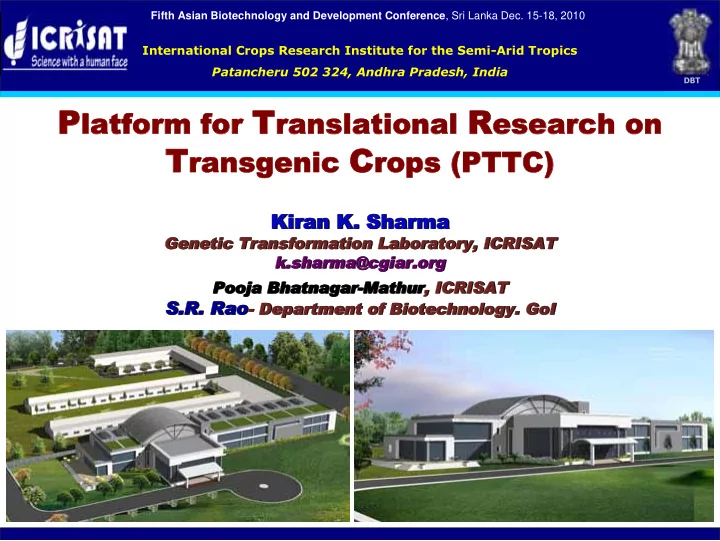
Fifth Asian Biotechnology and Development Conference , Sri Lanka Dec. 15-18, 2010 International Crops Research Institute for the Semi-Arid Tropics Patancheru 502 324, Andhra Pradesh, India DBT P latform for T ranslational R esearch on T ransgenic


slide-1
SLIDE 1

DBT

Platform for Translational Research on Transgenic Crops (PTTC)

Fifth Asian Biotechnology and Development Conference, Sri Lanka Dec. 15-18, 2010

International Crops Research Institute for the Semi-Arid Tropics Patancheru 502 324, Andhra Pradesh, India

Kiran K. Sharma

Genetic Transformation Laboratory, ICRISAT k.sharma@cgiar.org Pooja Bhatnagar-Mathur, ICRISAT

S.R. Rao- Department of Biotechnology. GoI

Kiran K. Sharma

Genetic Transformation Laboratory, ICRISAT k.sharma@cgiar.org Pooja Bhatnagar-Mathur, ICRISAT

S.R. Rao- Department of Biotechnology. GoI

slide-2
SLIDE 2

Producing Transgenic Plants

  • Efficient tissue culture system for regenerating shoots
  • I ntroduction of gene into plant cells
  • Selection of transform ed cells or tissues
  • Regeneration of putatively transform ed w hole plants
  • Transfer to greenhouse and advancem ent of generations
  • Molecular and genetic characterization
  • Selection of events under greenhouse conditions
  • Contained field testing under natural conditions
  • Open field testing for agronom ic perform ance
  • Food and Environm ental safety
  • Release, introgression into new varieties, & Com m ercialization
slide-3
SLIDE 3

DBT

slide-4
SLIDE 4

DBT

slide-5
SLIDE 5

DBT

Indian Research Scenario

The figures include basic research

Crops Pub. Pvt. Total

FIELD CROPS Wheat 1 1 Rice 30 5 35 Ragi 2 2 Sorghum 10 2 12 Mustard 5 1 6 Maize 2 2 Subtotal 50 8 58 VEGETABLES Brinjal 4 5 9 Black Pepper 3 3 Bell Pepper 1 1 Okra 6 6 Cabbage 2 2 4 Carrot 1 1 Cauliflower 2 3 5 Chillies 4 4 Tomato 20 7 27 Potato 8 8 Subtotal 45 23 68 Crops Pub. Pvt. Total FRUITS Banana 3 3 Citrus 1 1 Muskmelon 1 1 Pomegranate 1 1 Watermelon 2 2 Subtotal 8 8 OTHER CROPS Chickpea 5 2 7 Pigeonpea 13 1 14 Groundnut 9 9 Cassava 2 2 Soybean 2 1 3 Sunflower 1 1 2 Mulberry Cotton 11 50 61 Coffee 1 1 Cardamom 1 1 Sutotal 45 55 99 Total 148 86 234

Source: IGMORIS and public domain

slide-6
SLIDE 6

DBT

Transgenic Crops Research in India

The figures include basic research Source: IGMORIS and public domain

  • 6 technologies (cotton) already approved (5 private & 1 public)
  • 4 technologies waiting for commercial approval (all private)
  • 29 technologies approved for field testing in 2010 (4 in BRL

stages and all belong to private)

slide-7
SLIDE 7

DBT

AgBiotech driven by lengthy Product Development Cycle and Large Investment Process*

Year 0 1 2 4 6 8 9 3 5 7 10

Discovery Discovery Phase I Phase I Phase II Phase II Phase III Phase III Phase IV Phase IV

Gene/Trait Identification Gene/Trait Identification Proof of Concept Proof of Concept Early Development Early Development Advanced Development Advanced Development Regulatory Submission Regulatory Submission

  • High throughput

screening

  • Model crop testing
  • High throughput

screening

  • Model crop testing
  • Gene optimization
  • Crop

transformation

  • Gene optimization
  • Crop

transformation

  • Trait

development

  • Pre-regulatory

data

  • Large scale

transformation

  • Trait

development

  • Pre-regulatory

data

  • Large scale

transformation

  • Trait integration
  • Field testing
  • Regulatory data

generation

  • Trait integration
  • Field testing
  • Regulatory data

generation

  • Regulatory

submission

  • Seed bulk-up
  • Pre-marketing
  • Regulatory

submission

  • Seed bulk-up
  • Pre-marketing
  • Regulatory

submission

  • Seed bulk-up
  • Pre-marketing

$2-5M

(5%)

$5-10M

(25%)

$10-15M

(50%)

$15-30M

(75%)

$20-40M

(90%)

On Average:

Time to market: 8-10 years Total expense: ~$100M

On Average: On Average:

Time to market: 8-10 years Total expense: ~$100M

On Average:

Time to market: 8-10 years Total expense: ~$100M

Spending

(Probability of Success in %)

* Numbers (time duration, spending, and probability of success) are all estimates. The actual for individual projects vary. Source: S.R. Rao-DBT

slide-8
SLIDE 8

DBT

Distribution of Total R&D Expenditure in Science and Technology

Percentage Public Private

India 95 05 Mexico 88 12 Indonesia 96 04 Zimbabwe 86 14 USA 30 70 Switzerland 26 74

Source: S.R. Rao-DBT

Developing new Biotechnology is not cheap!

Most current research is being done by private sector companies in the developed world

  • In most of the developing countries, public sector invests in

research and development.

  • Private sector investment is beginning to increase due to

globalization and reforms in some of them.

slide-9
SLIDE 9

DBT

  • Failure to test the concepts on a large scale
  • Failure to translate concepts into commercial

products

  • Barriers of IP/Trade/interest of private sector
  • Biosafety regulations/Food safety
  • Risk assessment and risk management
  • Training & Capacity building
  • Partnerships for product development &

deployment

  • Commercialization limitations, a serious barrier

Bottlenecks

slide-10
SLIDE 10

DBT

Problems in commercialization

Lack of proper understanding of issues related to: Intellectual property rights Regulatory aspects Roadmap for lab to farmers’ field Market demands Public-private partnerships in R&D

Priority setting for Transgenic Plants

slide-11
SLIDE 11

DBT

  • 1. Overcome delays in moving GM crops to farmers.
  • 2. Food safety & Research issues linked to risk

assessment and risk management.

  • 3. Training on the development and deployment aspects.
  • 4. Public awareness (media workshops; training of policy

makers, trainers, NGOs etc…. ).

  • 5. Socioeconomics & potential impact.
  • 6. Partnerships for product development & deployment

[Commercialization]

i. Public sector partners (groundnut and chickpea) ii. Transgenic Research Consortia (hybrid pigeonpea; other crops) iii. Facilitate technology development & commercialization (ASP@ICRISAT)) iv. Facilities for translation of transgenic products (PTTC)

Solutions Solutions

Deployment of transgenics Deployment of transgenics

slide-12
SLIDE 12

DBT

Technology Transfer Technology Transfer

Develop strong relationships between:

Basic Research Technology Development Technology Transfer Technology Diffusion

Focus on human resource development. Create congenial environment for encouraging

R & D through the development of infrastructure and incentives.

Interface public and private sectors for

enhanced synergies in technology development and deployment.

slide-13
SLIDE 13

DBT

Principles

  • 1. Create and charter an entity with express purpose of

“translating” genetic engineering research into a practical, value adding technology 2.The entity would embody the requisite scientific and business skills that are appropriately balanced

Mission

To “translate transgenic technology and harness its products to meet the needs

  • f agricultural growth”

An ICRISAT-DBT Initiative PTTC

slide-14
SLIDE 14

DBT

To promote an existing transgenic technology into a value added product

  • f commercial use

Translational Research?

slide-15
SLIDE 15

DBT

The main drivers of innovation are priority and potential new technology

PTTC intervention point

Implementation R & D of a new technology Assessment of the technology Proof of concept Assess market potential Design strategy Innovation= Invention + Commercialization

Roadmap

slide-16
SLIDE 16

DBT

Concept

slide-17
SLIDE 17

DBT

Partnership

(Public-Private /Public-Public)

Partnership

(Public-Private /Public-Public)

PTTC

  • Research & Development
  • Field Evaluation
  • Safety Assessments
  • IP Evaluation
  • Regulatory Approvals
  • Research & Development

Resea Resea Resea pment ch & Development

  • Field Evaluation

ld Field Field aluation

  • Safety Ass

fety fety fet afety fety Ass

  • IP Evaluat

Eva Ev P Eva uat

  • Regulatory

Regulatory Regulatory Regulatory Regulatory

PTTC

  • Research & Development
  • Field Evaluation
  • Safety Assessments
  • IP Evaluation
  • Regulatory Approvals

Selected Technology from Public Sector Research Institute Selected Technology from Public Sector Research Institute Selected Technology from Public Sector Research Institute Funding Agencies Funding Agencies Funding Agencies

Product Product Product

Partners

(ICAR, ICMR, CSIR, SAUs, etc.)

Partners

(ICAR, ICMR, CSIR, SAUs, etc.)

Partners

(ICAR, ICMR, CSIR, SAUs, etc.)

Regulatory Bodies Regulatory Bodies Regulatory Bodies

International Experts International Experts International Experts

Services Services Services

Operational Model

PTTC Sustenance

Fund

PTTC Sustenance

Fund

PTTC Sustenance

Fund

slide-18
SLIDE 18

DBT

To develop and deploy state-of-the-art infrastructure for conduct of transgenic research. To act as a clearinghouse for technology inputs, transgenic research leads/ prototypes with proof of concept derived from Indian research institutes, universities, and other likely sources. To evaluate specific concepts, ideas and technologies, and advance the promising transgenic events through a development cycle with adequate safety assessments. To “evolve” the technology to a point where a practical application can be demonstrated, and transfer this “evolved” technology for product development and distribution to appropriate agencies

Objectives

slide-19
SLIDE 19

DBT

PTTC Executive Committee Technology Advancement Advisory Committee (TAAC) - Representatives from ICRISAT, DBT, ICAR, SAUs, Private Sector, Investors, NGOs, etc. International Advisory Board – Eminent Scientists, Policy makers, Venture capitalists, Technology Managers, IP Experts, etc.

Organization

  • Dr. William Dar

Director General ICRI SAT

  • Dr. Kiran K.Sharma

Director, PTTC & Principal

  • Scientist. I CRI SAT
slide-20
SLIDE 20

DBT

Infrastructure & Facilities

  • State-of-the-art infrastructure for transgenic

crop development on an area of 50,000 Sq. Ft

  • High-throughput transformation facility
  • Well equipped molecular biology laboratory
  • Analytical laboratory & Instrumentation facility
  • Plant pathology & virology laboratory
  • Insect rearing facility
  • P2 level contained and regular greenhouses
  • Contained Fields
slide-21
SLIDE 21

DBT

  • Genetic transformation
  • Genotyping: PCR, Southern analysis, qPCR with liquid

handling systems, proteomics, etc.

  • Phenotyping: Screening for resistance to aflatoxin, virus, foliar

diseases; tolerance to drought & salinity; etc.

  • Food & Feed Safety Assessment: heat stability, pepsin

digestibility, homology search, etc.

  • Environmental Safety Assessment: Gene flow studies,

aggressiveness & weediness Potential, effect on non target

  • rganisms (tier 2), etc
  • Field Trials: Confined Field Trials (BRL I & BRL II)
  • IP Management: FTO Analysis,
  • Product Dossier Preparation: Crop biology document,

Technology dossier, Biosafety dossier

Research Capacities

slide-22
SLIDE 22

DBT

Independent evaluation of trait-specific transgenic events Examine IPR issues in transgenic product development Develop product dossiers for commercialization Create specific projects with defined milestones and end-points Coordinate and conduct the evaluation of transgenic events for biosafety studies Introgression of the desirable transgenic events Identify partnerships for sharing mechanisms for marketing of the final “product”

Activities

slide-23
SLIDE 23

DBT

Roadmap

Need & benefits identified by SAC/TAC at PTTC Potential technology identified by PTTC EOI/Application received Complete review and due diligence carried out Resource needs and sources to be identified and sought Establishment of the process (Event selection/risk assessment etc.) Adoption and implementation of the process towards commercialization

slide-24
SLIDE 24

DBT

FTO Analysis

slide-25
SLIDE 25

DBT

Product Development Pipeline

A A B

Homology to Known allergens, toxins, anti-nutrients Blast Searches

Heat Stability

Acute Oral Toxicity in Rats/ Mice (14 Days)

Pepsin Digestibility

Inheritance Over Multiple Generations RT-PCR, Southern, qPCR data available as above Western & ELISA to be performed with Ab (A) produced from the protein

Pedigree Map Documentation from the data recorded from T1 to T5 Sequence data of inserted genetic material & of the flanking regions Identification

  • f ORFs

Genome Walking

Organisation of inserted genetic material PCR & Sequencing

Net House Evaluation Field trials Season 1 Field trials Season 2

  • Exp. Level of

Protein ELISA

Reproductive & Survival Biology Phenotyping

Site 1 Site 2 Site 3 Site 1 Site 2 Site 3 Composition al Analysis Impact on Non-Target Org.– Tier 1 Impact on Non-Target Org – Tier 2 Livestock Feeding Studies

Number of Insertion Sites qPCR data available as above Antibody Production Protein Equivalence Study Functional, Structural and Biochemical Equivalence Plant Protein purification Purification & scale up of protein from Bacterial / other systems

PCR, Southern, qPCR, RT-PCR PCR, Southern, qPCR, RT-PCR PCR, Southern, qPCR, RT-PCR PCR, Southern, qPCR, RT-PCR PCR, Southern, qPCR, RT-PCR

Transformation

T0 T1 T2 T3 T5 T4 B

Construct preparation

R&D Event Selection BRL-I

BRL- II

Sub-Chronic Feeding Study in Rodents (90 Days)

Molecular Studies Field Studies Protein Studies Field trials Gene Flow Aggressiveness & Weediness LOD 0.01%
slide-26
SLIDE 26

DBT

  • Project Partners –

ICRISAT & DBT

  • Activity Partners -

MoA with NARS like NIN, ITRI, SAUs, etc. and private sector

  • rganisations on need

basis

  • Preliminary discussion

with some org. already completed

  • MoU with Associates

/ Consultants are being executed

PTTC Network

slide-27
SLIDE 27

DBT

Product commercialization in a competitive mode Public Funding for Public Private Partnership (SBIRI,BIPP) Proposal to be developed jointly with Applicant in a project mode Public Funding (DBT, ICAR) Private Industry (Consortia etc.) Potential technology identified for product development Contract Research Services Client’s own Funding Proposal to be developed jointly with Applicant in a project mode

Funding Mechanism

slide-28
SLIDE 28

DBT

PTTC Services

slide-29
SLIDE 29

DBT

Research Service Packages

Genomics

  • Stable

integration

  • ver

multiple generations

  • copy Number and number of insertion

sites

  • Organization of Inserts
  • Flanking regions study
  • Bioinformatics analysis of novel ORFs

putative chimeric proteins

  • T-DNA sequencing
  • Absence of plasmid backbone

Proteomics

  • Protein Characterization & Scale-up
  • Homology Studies
  • Heat Stability
  • Pepsin Digestibility

Environmental Assessment Studies

  • Plant pest potential
  • Out crossing
  • Gene Flow Studies
  • Aggressiveness and weediness
  • Impact on NTOs (Tier-1 & Tier 2)
  • LOD 0.01%

Toxicity and Allergenicity

  • Acute oral toxicity test in rodents
  • Sub chronic feeding test in rodents
  • Primary skin irritation test in rabbits
  • Mucous membrane irritation study in

female rabbits

Compositional Analysis

Ash, Total fat, moisture, Protein, Crude fibre, Acid detergent fibre, amino acid profile, Total lipids, Fatty acid profile, Vitamin profile, Mineral profile

Livestock Feeding Studies

Representative Animals – Goat, Chicken, Cow / Buffalo, Fish, etc.

slide-30
SLIDE 30

DBT

Referral Documents

Forms

  • Expression of Interest – Public & Private Sector
  • Evaluation of Technology Roadmapping

Agreements

  • Memorandum of Understanding
  • Memorandum of Agreement

Service Agreement Partnership Agreement

  • Non-Disclosure Agreement
  • Material Transfer Agreement
slide-31
SLIDE 31

DBT

  • Flyers, FAQs, Posters, Website, etc.
  • Stakeholder meetings, Media Workshops,

Biosafety workshops etc.

  • Crop biology documents

Outreach

slide-32
SLIDE 32

DBT

Outcomes

slide-33
SLIDE 33

DBT

Looking ahead Looking ahead Looking ahead

PTTC has the potential to evolve into a “leading edge” technology translational facility It could serve as a global model for the utilization of transgenic technologies and their products (North-

South & South-South)

slide-34
SLIDE 34

DBT

Thank you